
Life, 1885-06-18 · page 3 of 16
Life — June 18, 1885 — page 3: what you’re looking at
What you’re looking at
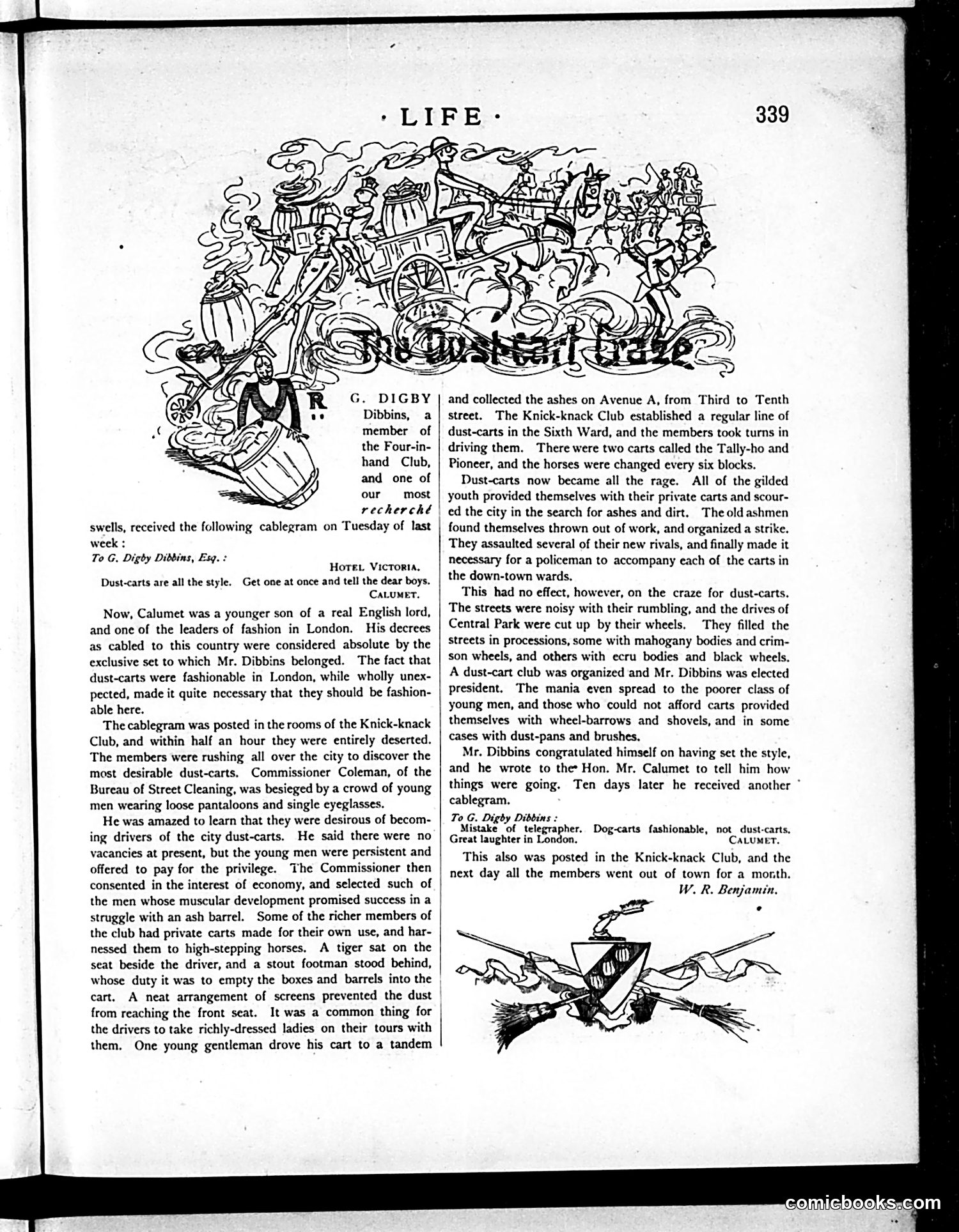
This page satirizes the "dust-cart" craze among wealthy young men in London. The elaborate illustration at top depicts chaotic street scenes with dust carts and fashionably dressed participants. The article mocks how G. Digby Dibbins, a member of an exclusive club called the "Four-in-hand Club," received a cablegram announcing that dust-carts had become fashionable. Young aristocrats competed to drive these refuse vehicles through city streets, hiring them for social outings and even taking wealthy ladies along. The satire targets upper-class frivolity—how idle wealthy youth adopted working-class activities as trendy entertainment, treating street cleaning like sport. The absurdity lies in fashionable people abandoning their dignity to pursue whatever novelty strikes their fancy, regardless of how ridiculous.
📄 Transcribed text from this page (OCR, searchable)
Machine-transcribed from the original scan — historical spelling and the odd misread are preserved.
the Four-in- hand Club, and one of our most recherché | swells, received the following cablegram on Tuesday of last week : To G. Digby Diddins, Esq. : a a Horet Victoria, Get one at once and tell the dear boys. CALUMET. Dust-carts are all the style. Now, Calumet was a younger son of a real English lord, and one of the leaders of fashion in London. His decrees as cabled to this country were considered absolute by the exclusive set to which Mr. Dibbins belonged. The fact that dust-carts were fashionable in London, while wholly unex- pected, made it quite necessary that they should be fashion- | able here. The cablegram was posted in the rooms of the Knick-knack Club, and within half an hour they were entirely deserted. The members were rushing all over the city to discover the most desirable dust-carts. Commissioner Coleman, of the Bureau of Street Cleaning, was besieged by a crowd of young men wearing loose pantaloons and single eyeglasses. He was amazed to learn that they were desirous of becom- ing drivers of the city dust-carts. He said there were no vacancies at present, but the young men were persistent and | offered to pay for the privilege. The Commissioner then | consented in the interest of economy, and selected such of | the men whose muscular development promised success in a struggle with an ash barrel. Some of the richer members of the club had private carts made for their own use, and har- nessed them to high-stepping horses. A tiger sat on the seat beside the driver, and a stout footman stood behind, whose duty it was to empty the boxes and barrels into the cart. A neat arrangement of screens prevented the dust from reaching the front seat. It was a common thing for the drivers to take richly-dressed ladies on their tours with them. One young gentleman drove his cart to a tandem 339 VAS ri) ye Zk and collected the ashes on Avenue A, from Third to Tenth street. The Knick-knack Club established a regular line of dust-carts in the Sixth Ward, and the members took turns in driving them. There were two carts called the Tally-ho and Pioneer, and the horses were changed every six blocks. Dust-carts now became all the rage. All of the gilded | youth provided themselves with their private carts and scour- ed the city in the search for ashes and dirt. The old ashmen found themselves thrown out of work, and organized a strike. They assaulted several of their new rivals, and finally made it necessary for a policeman to accompany each of the carts in the down-town wards. This had no effect, however, on the craze for dust-carts. The streets were noisy with their rumbling, and the drives of Central Park were cut up by their wheels. They filled the streets in processions, some with mahogany bodies and crim- son wheels, and others with ecru bodies and black wheels. A dust-cart club was organized and Mr. Dibbins was elected president. The mania even spread to the poorer class of young men, and those who could not afford carts provided themselves with wheel-barrows and shovels, and in some cases with dust-pans and brushes, Mr. Dibbins congratulated himself on having set the style, and he wrote to thes Hon. Mr. Calumet to tell him how things were going. Ten days later he received another * cablegram. To G. Digby Dibbins : Mistake of telegrapher. Dog-carts fashionable, not_ dust-carts, Great laughter in London. CaLumer. This also was posted in the Knick-knack Club, and the next day all the members went out of town for a month, W. R. Benjamin.