
Life, 1885-06-18 · page 10 of 16
Life — June 18, 1885 — page 10: what you’re looking at
What you’re looking at
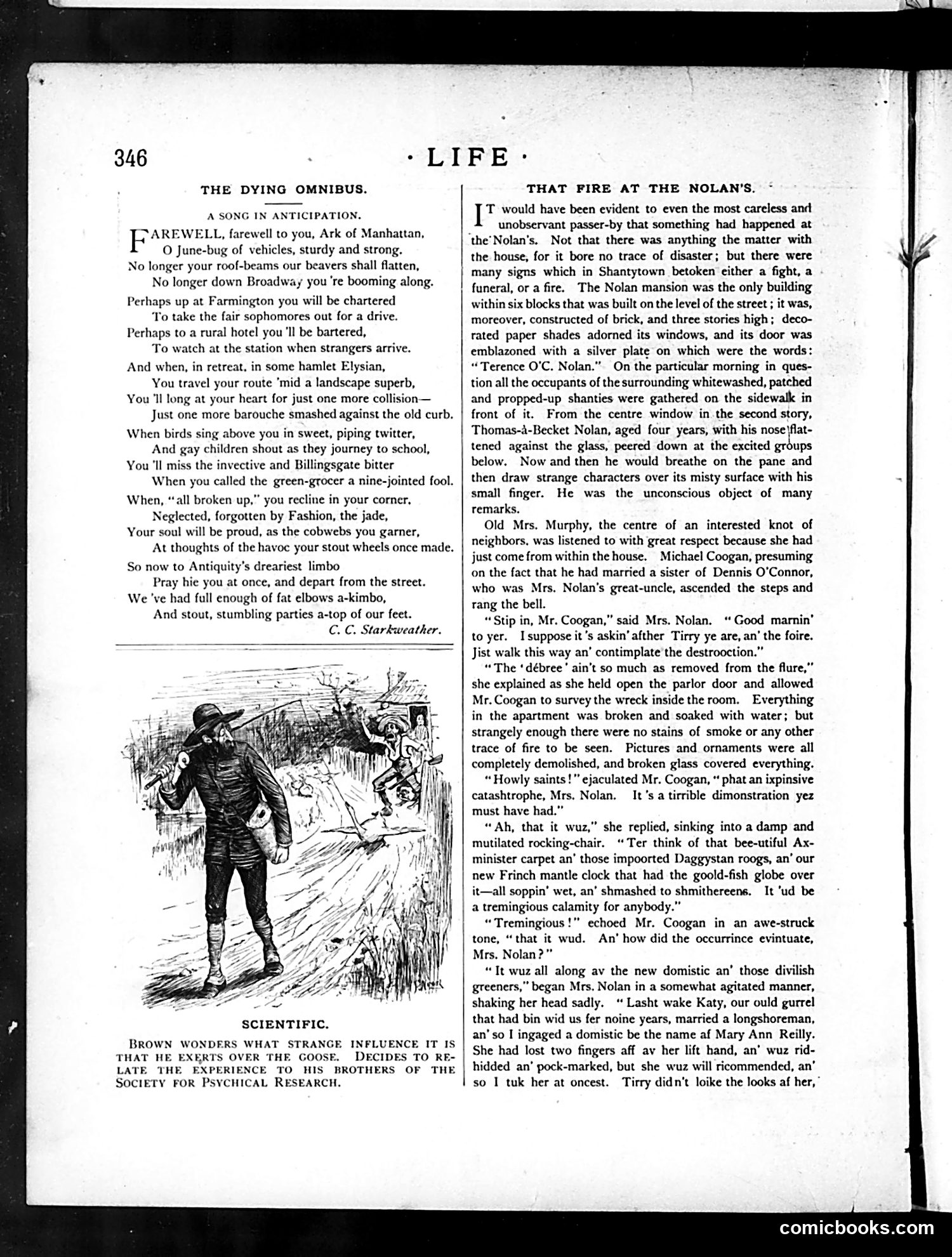
This page contains two distinct pieces of satirical content: **"The Dying Omnibus"** is a humorous farewell poem to horse-drawn streetcars, which were being displaced by newer transportation (likely electric trolleys or automobiles). The satire mocks the omnibus—personifying it as a worn-out vehicle that created chaos in Manhattan streets through collisions and crowded conditions. The poem ironically celebrates its retirement while nostalgically imagining it yearning for "just one more collision." **"That Fire at the Nolan's"** is a prose story (excerpt visible) set in "Shantytown," depicting working-class Irish immigrants. It describes a mysterious incident at the Nolan house where everything is destroyed and water-soaked, yet bears no traces of fire or smoke—the setup for apparent comedic mystery. The heavy Irish dialect and references to social hierarchy ("Mrs. Murphy...was listened to with great respect") provide gentle ethnic humor typical of early-1900s Life magazine. Both pieces satirize urban American life and social change.
📄 Transcribed text from this page (OCR, searchable)
Machine-transcribed from the original scan — historical spelling and the odd misread are preserved.
346 THE DYING OMNIBUS. A SONG IN ANTICIPATION. | aA a farewell to you, Ark of Manhattan, O June-bug of vehicles, sturdy and strong. No longer your roof-beams our beavers shall flatten, No longer down Broadway you ‘re booming along. Perhaps up at Farmington you will be chartered To take the fair sophomores out for a drive. Perhaps to a rural hotel you'll be bartered, To watch at the station when strangers arrive. And when, in retreat, in some hamlet Elysian, You travel your route ‘mid a landscape superb, You ‘Il long at your heart for just one more collision— Just one more barouche smashed against the old curb. When birds sing above you in sweet, piping twitter, And gay children shout as they journey to school, You ‘ll miss the invective and Billingsgate bitter When you called the green-grocer a nine-jointed fool. When, “all broken up,” you recline in your corner, Neglected, forgotten by Fashion, the jade, Your soul will be proud, as the cobwebs you garner, At thoughts of the havoc your stout wheels once made. So now to Antiquity’s dreariest limbo Pray hie you at once, and depart from the street. We ‘ve had full enough of fat elbows a-kimbo, And stout, stumbling parties a-top of our feet. C. C. Starkweather. SCIENTIFIC. DERS WHAT STRANGE $ OVER THE GOOSE. DECIDES TO RE- THE PERIENCE TO HIS BROTHERS OF THE Y FOR PSYCHICAL RESEARCH. INFLUENCE IT IS ‘the’ Nolan's. - LIFE: THAT FIRE AT THE NOLAN’S. T would have been evident to even the most careless and unobservant passer-by that something had happened at Not that there was anything the matter with the house, for it bore no trace of disaster; but there were many signs which in Shantytown betoken either a fight, a funeral, or a fire. The Nolan mansion was the only building within six blocks that was built on the level of the street ; it was, moreover, constructed of brick, and three stories high; deco- rated paper shades adorned its windows, and its door was emblazoned with a silver plate on which were the words: “Terence O'C. Nolan.” On the particular morning in ques- tion all the occupants of the surrounding whitewashed, patched and propped-up shanties were gathered on the sidewalk in front of it. From the centre window in.the second story, Thomas-a-Becket Nolan, aged four years, with his nose\flat- tened against the glass, peered down at the excited groups below. Now and then he would breathe on the pane and then draw strange characters over its misty surface with his small finger. He was the unconscious object of many remarks. Old Mrs. Murphy, the centre of an interested knot of neighbors, was listened to with great respect because she had just come from within the house. Michael Coogan, presuming on the fact that he had married a sister of Dennis O’Connor, who was Mrs. Nolan's great-uncle, ascended the steps and rang the bell. “Stip in, Mr. Coogan,” said Mrs. Nolan. “Good marnin’ to yer. I suppose it’s askin’ afther Tirry ye are, an’ the foire. Jist walk this way an’ contimplate’the destrooction.” “The ‘débree' ain’t so much as removed from the flure,”’ she explained as she held open the parlor door and allowed Mr. Coogan to survey the wreck inside the room. Everything in the apartment was broken and soaked with water; but strangely enough there were no stains of smoke or any other trace of fire to be seen. Pictures and ornaments were all completely demolished, and broken glass covered everything. “Howly saints!" ejaculated Mr. Coogan, “ phat an ixpinsive catashtrophe, Mrs. Nolan. It's a tirrible dimonstration yez must have had.” “Ah, that it wuz,” she replied, sinking into a damp and mutilated rocking-chair. “Ter think of that bee-utiful Ax- minister carpet an’ those impoorted Daggystan roogs, an’ our new Frinch mantle clock that had the goold-fish globe over it—all soppin’ wet, an’ shmashed to shmithereens. It ‘ud be | a tremingious calamity for anybody.” “Tremingious!" echoed Mr. Coogan in an awe-struck tone, “that it wud. An’ how did the occurrince evintuate, Mrs. Nolan?” “Tt wuz all along av the new domistic an’ those divilish greeners,” began Mrs, Nolan in a somewhat agitated manner, shaking her head sadly. “ Lasht wake Katy, our ould gurrel that had bin wid us fer noine years, married a longshoreman, an’ so I ingaged a domistic be the name af Mary Ann Reilly. She had lost two fingers aff av her lift hand, an’ wuz rid- hidded an’ pock-marked, but she wuz will ricommended, an’ so I tuk her at oncest. Tirry didn’t loike the looks af her,” comicbooks.com