
A complete issue · 16 pages · 1885
Life — April 2, 1885
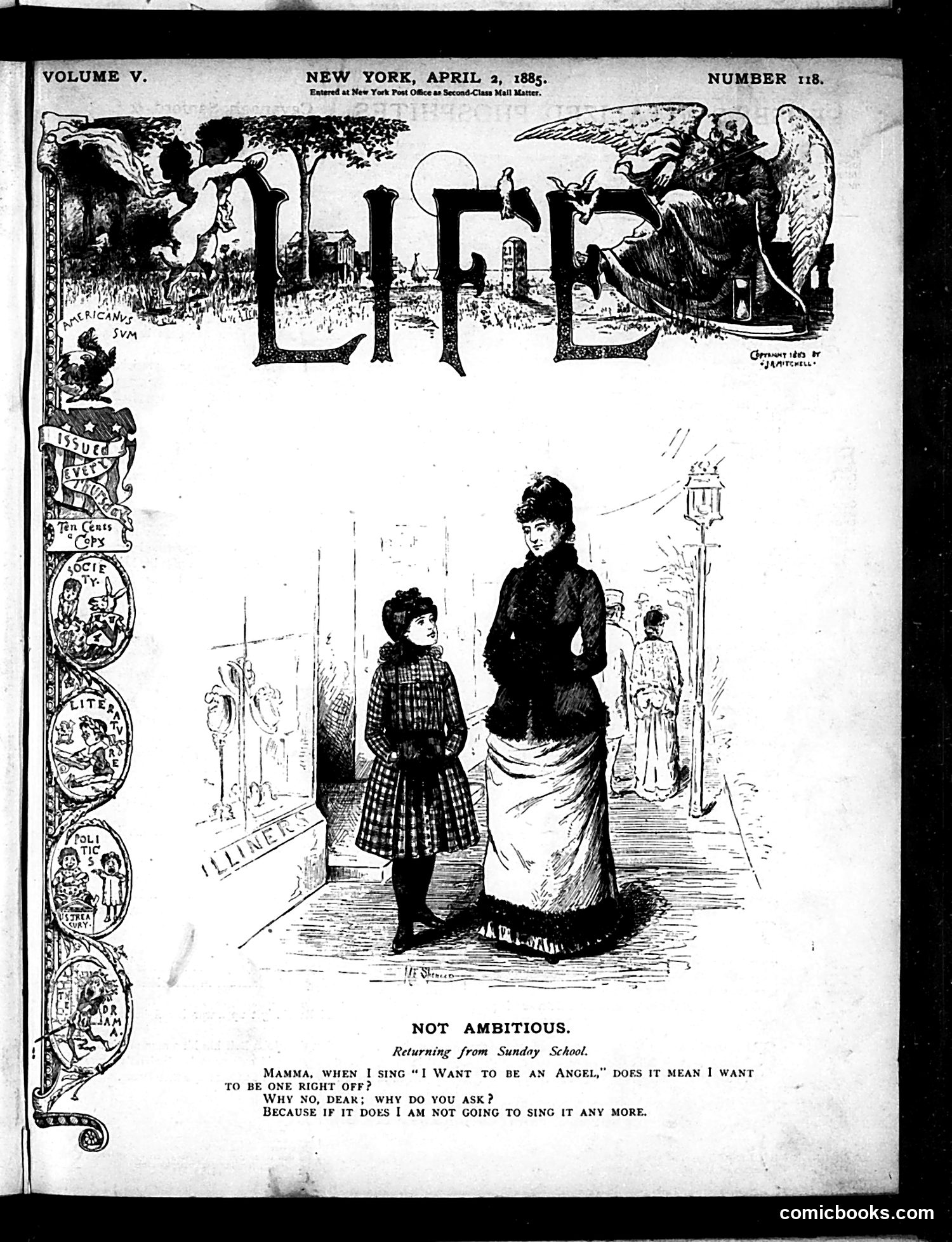
This page features a single-panel cartoon titled "Not Ambitious," showing a woman and child returning from Sunday School. The joke is a child's literal misinterpretation of the hymn "I Want to Be an Angel." The child asks her mother whether singing "I Want to Be an Angel" means she wants to die and go to heaven. The mother replies she doesn't want that—she's just singing the song and won't sing it anymore. The satire mocks childish logic and religious education. The child's innocent, literal reading of religious sentiment as expressing a death wish creates dark humor. It also gently satirizes how children mechanically learn religious songs without understanding deeper meaning, revealing the gap between pious sentiment and actual human desire for life.
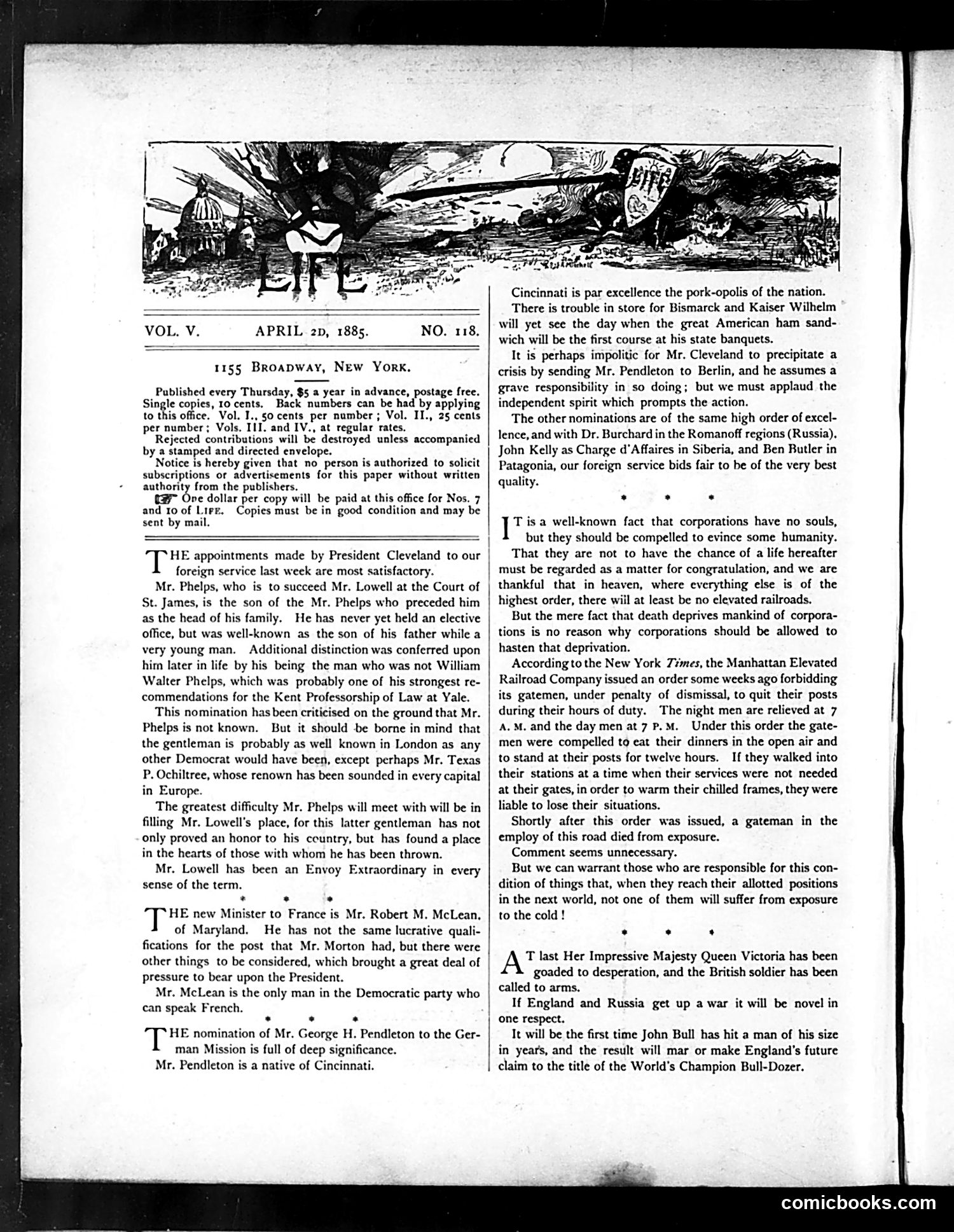
This page contains editorial commentary rather than cartoons. The masthead illustration depicts a surreal landscape with classical and industrial elements—likely symbolic of America's political and economic state. The text discusses President Cleveland's recent diplomatic appointments, praising his choices (including Cincinnati native George H. Pendleton as German envoy). It critiques corporations' inhumane labor practices, referencing the Manhattan Elevated Railroad's order forcing gatemen to work twelve-hour shifts in dangerous cold, resulting in one worker's death from exposure. The final section predicts an England-Russia war and jokes that John Bull (Britain's personification) will finally face an opponent matching his size—a reference to British imperial dominance and Victorian-era geopolitical tensions.
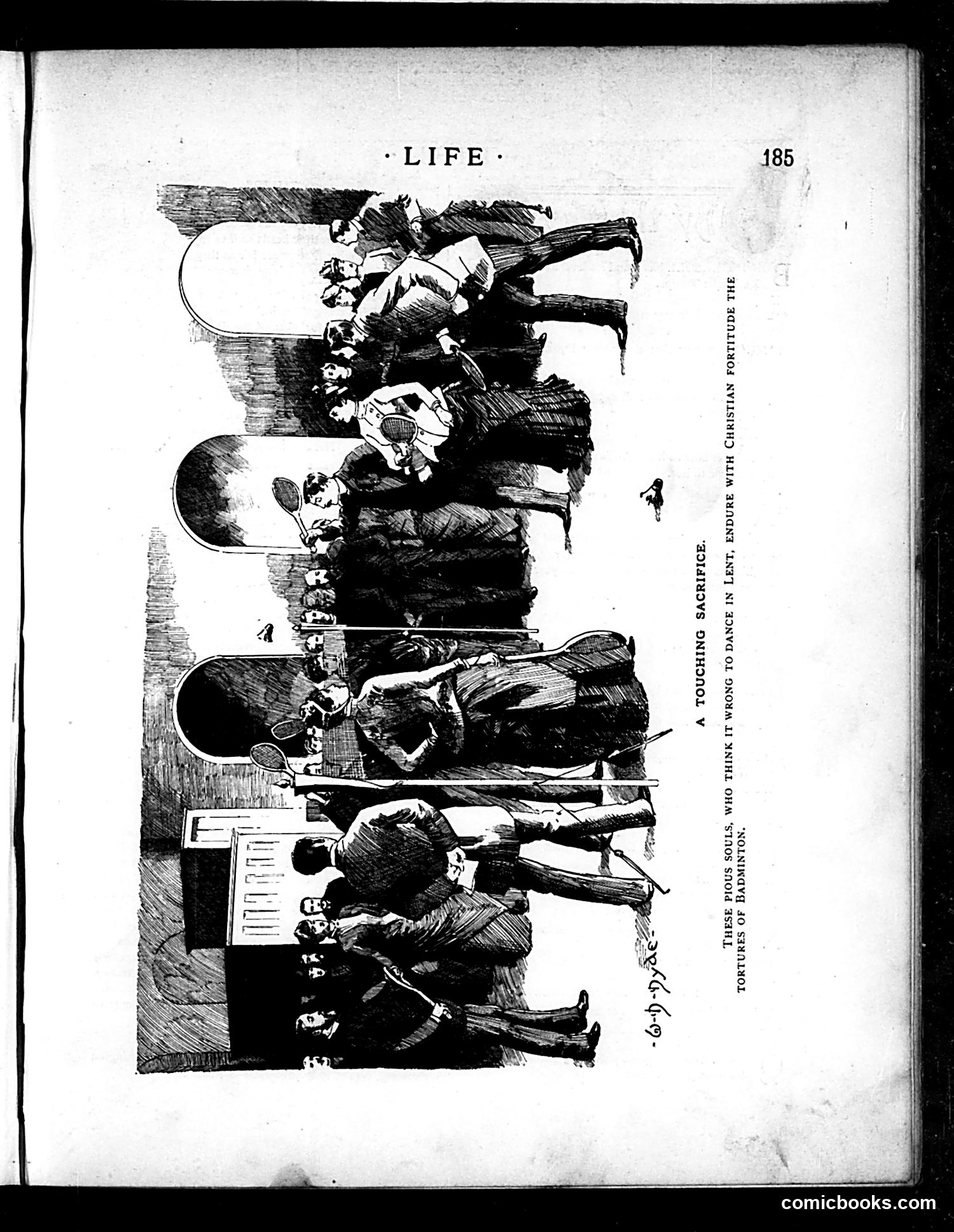
This political cartoon satirizes the wealthy and powerful who claim to make sacrifices for the nation while actually protecting their interests. The caption states: "Their pious souls end their it prong a dance is lent, ensure with Christian fortitude the bombardons." The image depicts elegantly dressed figures (likely wealthy industrialists or politicians) performing what appears to be a theatrical or ritualistic dance, while common people labor below them. The satire suggests these elites publicly perform patriotic duty and self-sacrifice—framed in religious language ("pious souls," "Christian fortitude")—while actually engaging in self-serving behavior disconnected from ordinary citizens' struggles. The "touching sacrifice" is ironic: their actual contributions are minimal compared to their claims of patriotic devotion, exposing the gap between elite rhetoric and reality.
This page contains several brief satirical commentaries rather than a cartoon. The items mock contemporary topics: 1. **"By the Way"** section includes jabs at a "Dynamite Scare" (likely referencing anarchist violence concerns of the era) and comments on fish trials and a book titled "At the Sign of the Lyre." 2. A joke about **metals more valuable than gold** appears to reference brass, possibly a dig at military or bureaucratic waste. 3. The **"Woman's Age" comment** satirizes uncertainty about women's ages and aging anxieties. 4. A notice warns contributors that **"allusions to Turkey Cox are at sender's risk"** — apparently an inside editorial joke about a sensitive or problematic reference. 5. A final query mocks whether **Spring Elections could be used for "bouncing purposes"** — likely political satire about election manipulation. The page also features a poem about tulips and a book review list.
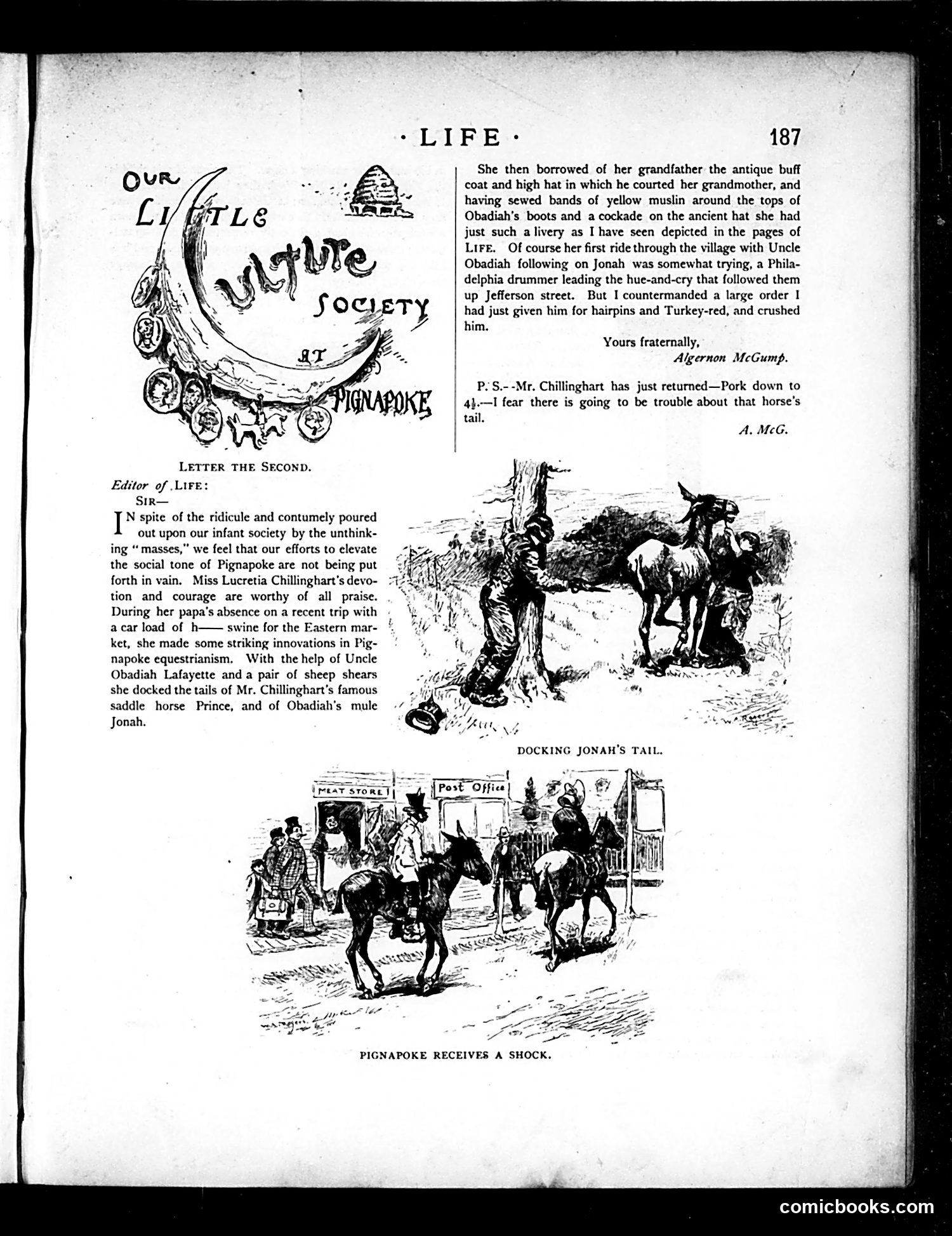
This page features "Our Little Culture Society at Pignapoke," a humorous column mocking a provincial town's pretensions to sophistication. The letter describes Miss Lucretia Chillinghart's "striking innovations" in equestrian fashion—specifically, she decorated the saddle horse Prince and a mule with borrowed finery (her grandfather's antique buff coat and high hat) while leading a procession resembling a Philadelphia parade. The accompanying illustrations humorously depict the chaos that ensued: "Docking Jonah's Tail" shows the mule's tail being cut, and "Pignapoke Receives a Shock" depicts the commotion when the ornately-dressed animals startled townspeople at the post office. The satire targets rural vanity and the absurd results when unsophisticated people attempt urban culture. The postscript hints at further equine trouble brewing.
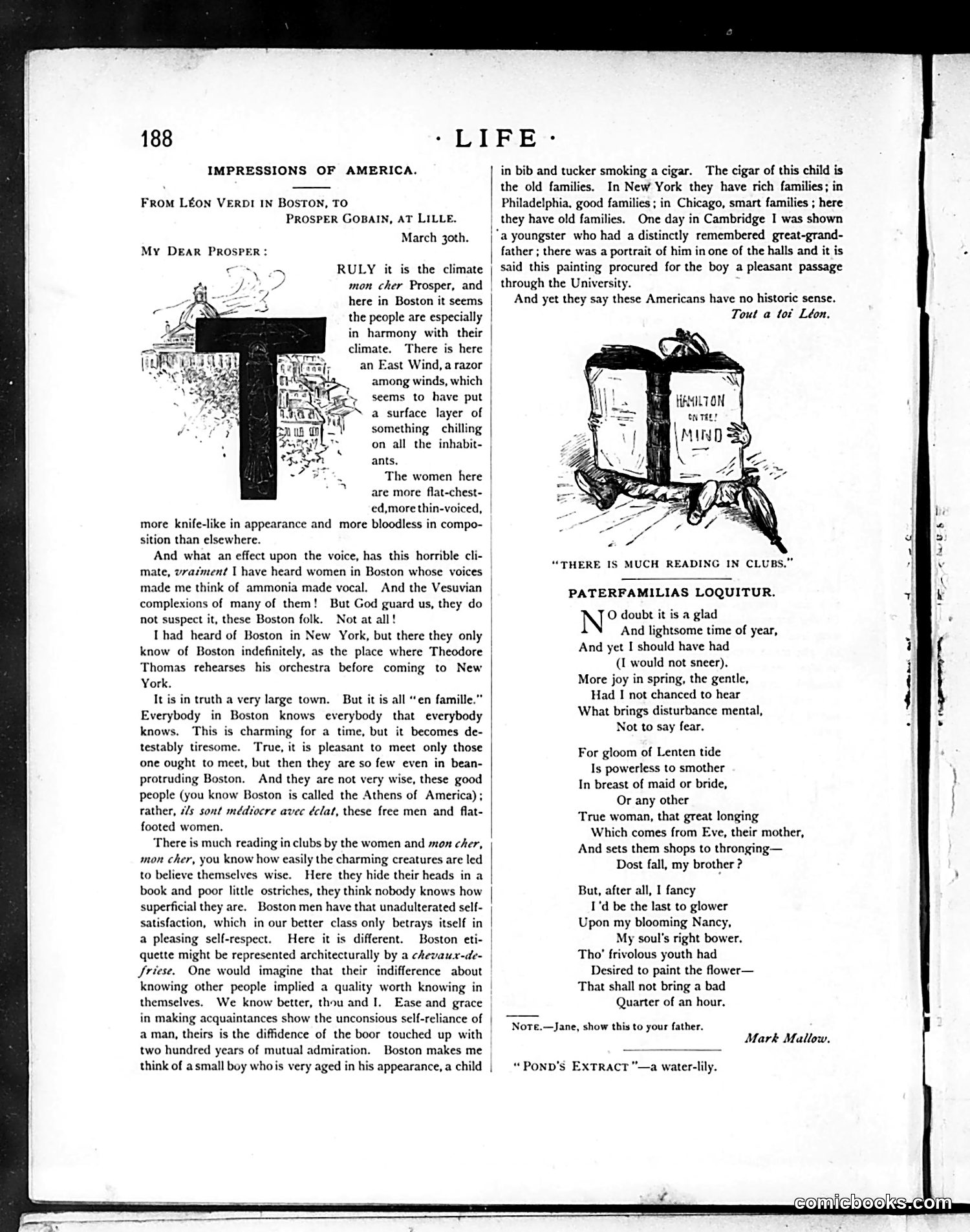
This page contains a letter from Léon Verdi in Boston critiquing American society, paired with a cartoon and poem. **The Cartoon:** Shows two large books labeled "HAMILTON" and "MIND" on wheels—likely a satirical comment on American intellectualism or the commercialization of thought. The caption "THERE IS MUCH READING IN CLUBS" suggests women's reading clubs were fashionable but perhaps superficial. **The Satire:** Verdi's letter mocks Boston society, particularly women's voices ("thin-voiced," "bloodless"), self-satisfaction, and lack of historic awareness. He contrasts Boston's pretensions to cultural refinement with its actual superficiality. **The Poem** "Paterfamilias Loquitur" humorously presents a father's conflicted feelings about his daughter's suitor—a common Victorian satirical subject. The overall tone criticizes American pretension and social hypocrisy.
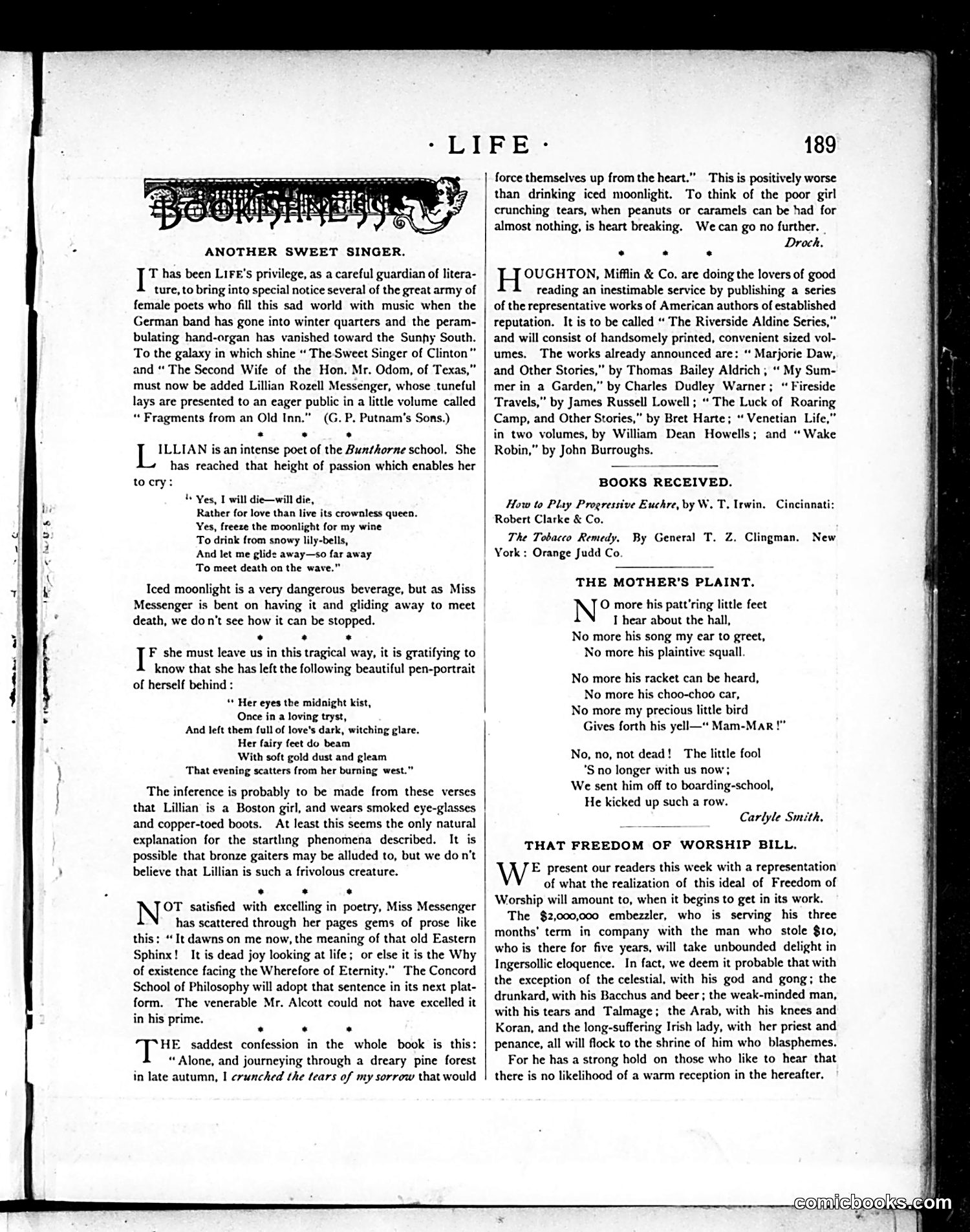
The page contains literary criticism and book reviews rather than political cartoons. At the top is a decorative header labeled "ANOTHER SWEET SINGER" discussing Lillian Rozell Messenger, a female poet of the "Danthorpe school." The critic humorously mocks Messenger's intense poetry, particularly her reference to drinking "iced moonlight" to meet death. The satire suggests her work is overly dramatic and affected—the critic expresses skepticism that she's "such a frivolous creature." The right column includes "Books Received" listings and a poem titled "The Mother's Plaint" by Carlyle Smith. Below is commentary on "That Freedom of Worship Bill," discussing religious tolerance. This page is primarily literary criticism and book notices rather than visual satire.
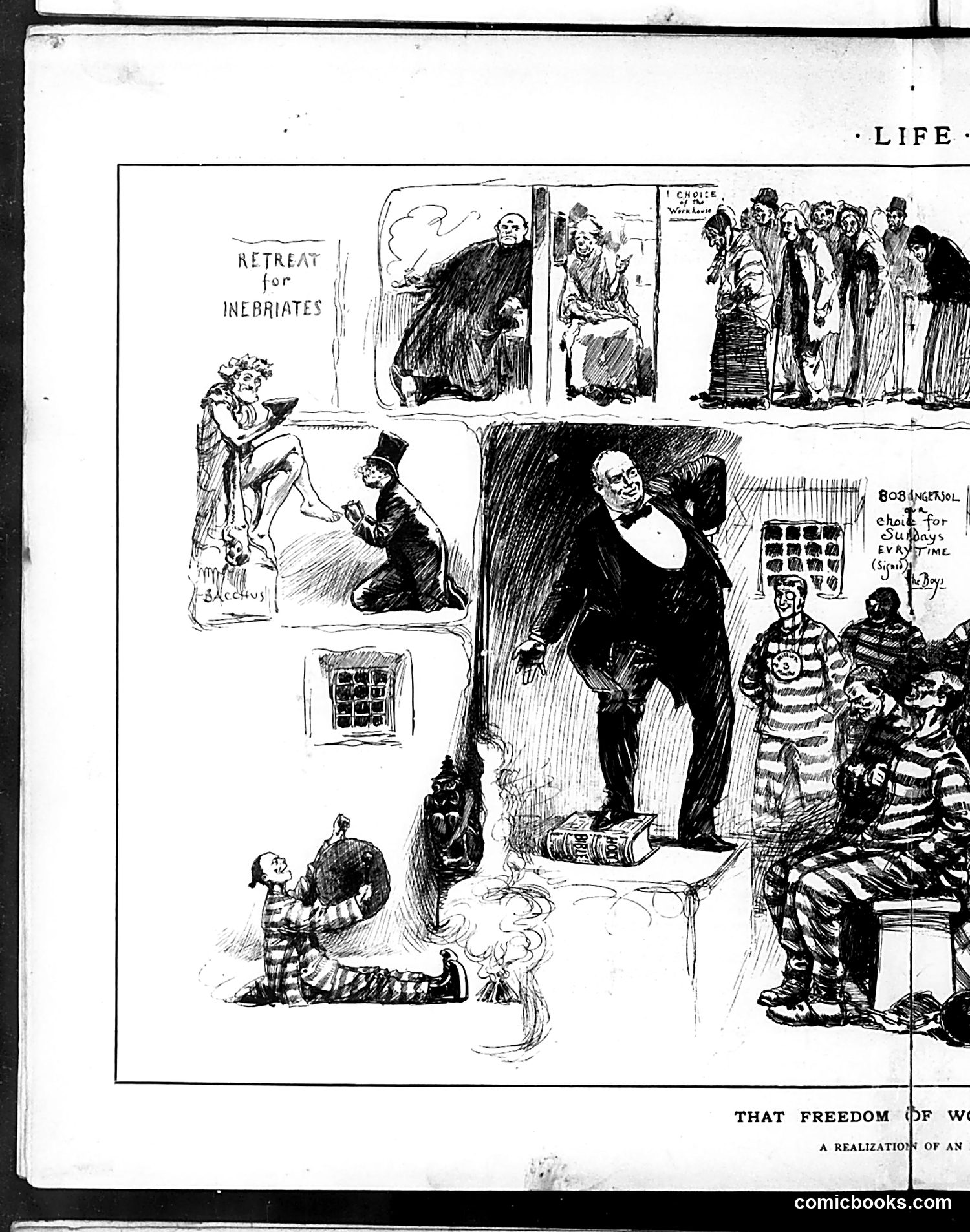
This satirical comic strip from *Life* magazine critiques what appears to be a temperance or alcohol rehabilitation facility. The title "Retreat for Inebriates" labels the establishment ironically. The narrative shows intoxicated men entering a supposed recovery program, but the final panels reveal the satire: the "choir" singing hymns consists of people in striped prison uniforms, and the facility's supposed reformative purpose is undermined by its prison-like conditions. The cartoon mocks the era's faith in institutional "cures" for alcoholism—suggesting such retreats functioned more as punitive detention than genuine rehabilitation. The striped uniforms are particularly significant, equating the treatment of alcoholics with criminal punishment, a common satirical target of *Life* magazine's social commentary.
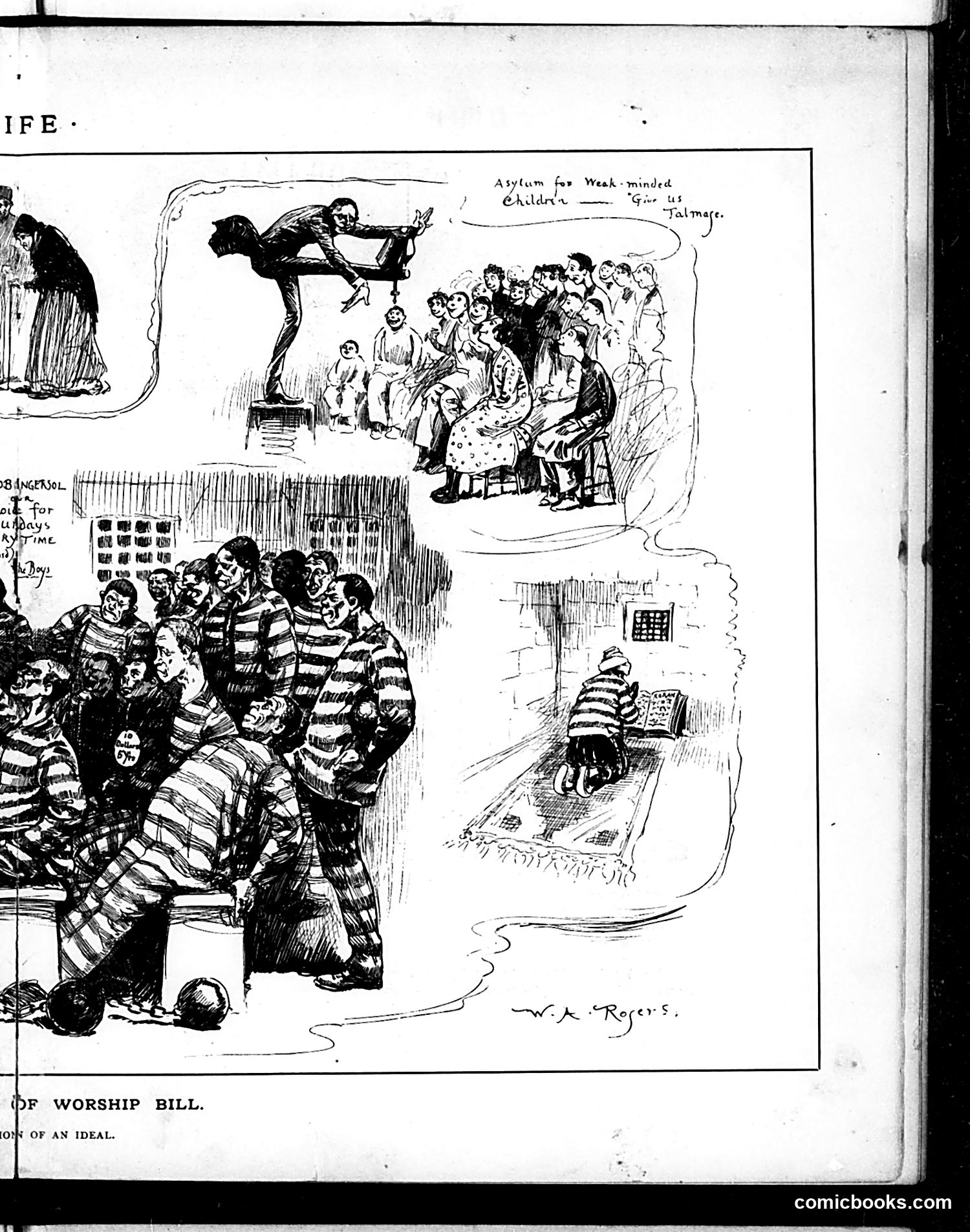
This page contains satirical sketches by W.A. Rogers critiquing institutional treatment of children. The top panel labeled "Asylum for Weak-minded Children—'Gur lit' Talmage" depicts an acrobatic instructor contorting himself before seated children, mocking religious or educational instruction. The lower section shows children in striped prison-like uniforms crowded together, likely critiquing overcrowded or harsh institutional conditions. The "Worship Bill" reference at the bottom appears related to legislation governing religious or institutional practices. The satire targets what Rogers views as inadequate or exploitative conditions in facilities for vulnerable children, using exaggerated imagery to expose institutional failings. The cartoonist advocates for improved standards through public ridicule of current practices.
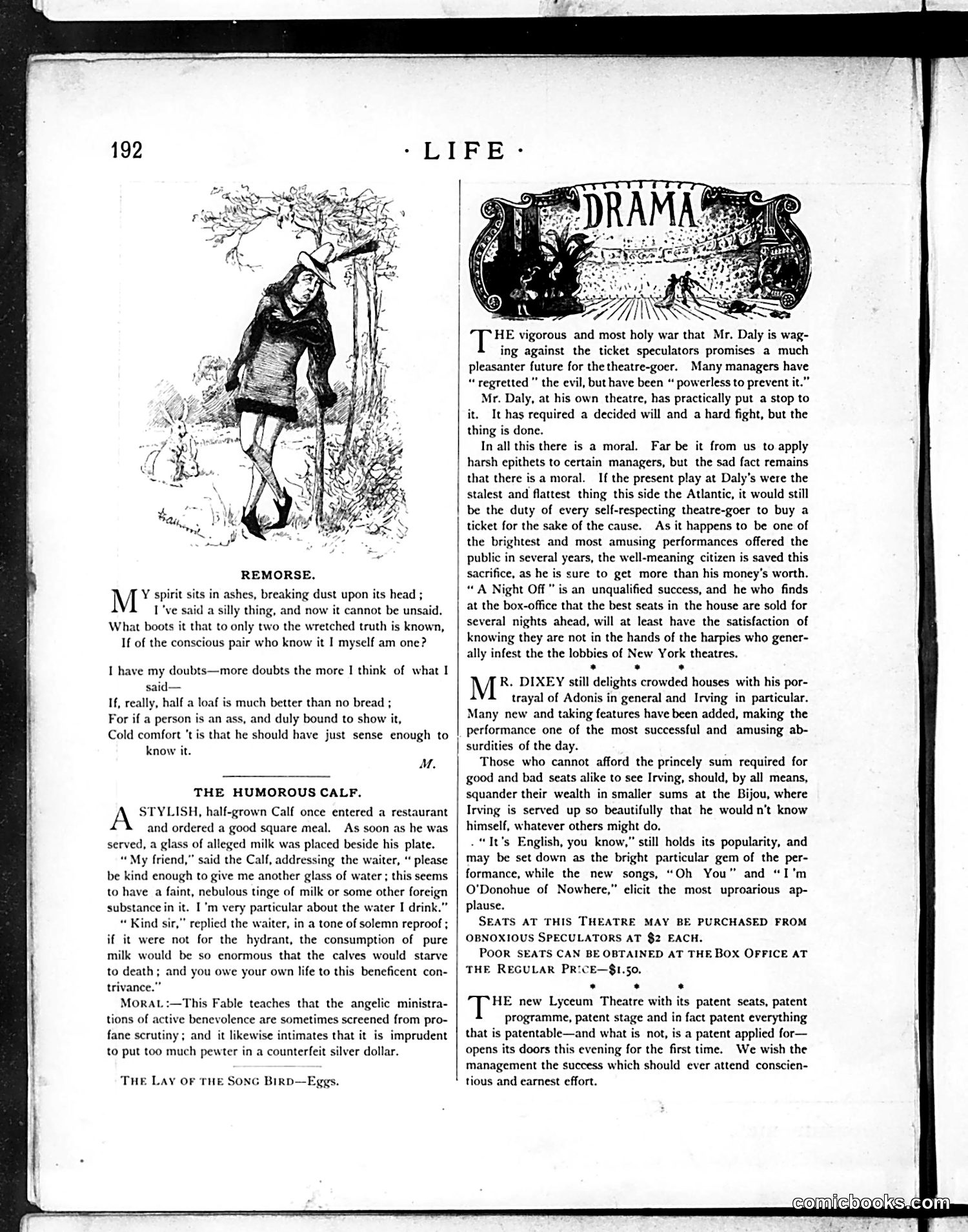
This page contains theatrical criticism and humor from Life magazine (appears to be late 19th century based on style). **Main Content:** The "Drama" section praises theater manager Mr. Daly's fight against ticket scalpers, calling it a moral crusade benefiting theater-goers. It celebrates the success of "A Night Off" and notes that good seats are legitimately sold out rather than monopolized by speculators. The page also reviews R. Dixey's popular performance as "Adonis" and praises the musical "It's English, You Know," with particular mention of songs "Oh You" and "I'm O'Donohue of Nowhere." **Humor:** "The Humorous Calf" is a satirical fable where a fastidious calf objects to "impure" water at a restaurant. The waiter explains the water sustains the calf's life—a moral about ungraciously rejecting hidden benefits. The moral's second point appears to critique adulteration (adding cheap metal to silver). **Left Column:** A brief melancholic poem titled "Remorse" about regretted words.
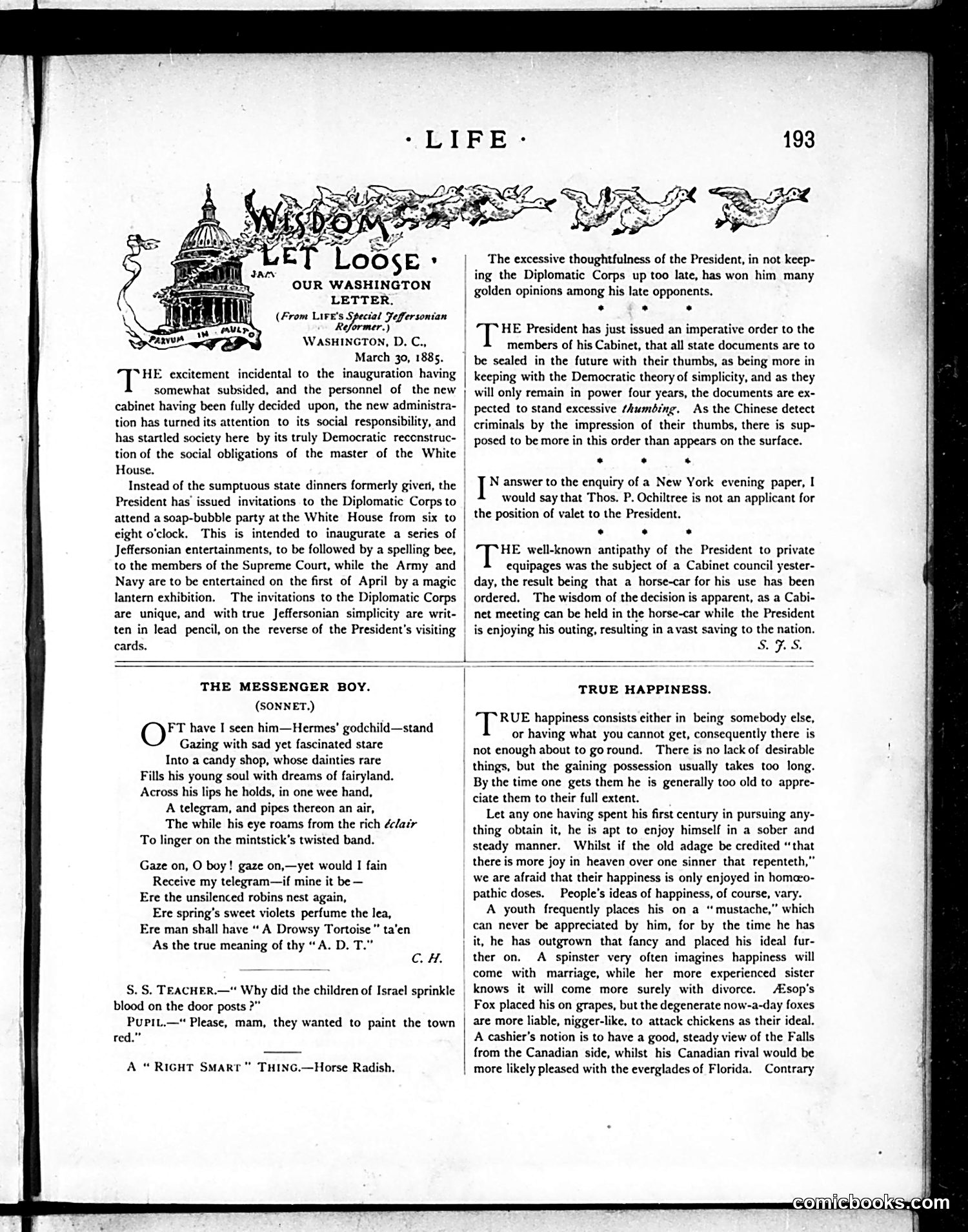
This March 1885 Washington Letter satirizes President Grover Cleveland's attempt to implement "Democratic simplicity" in White House social customs, contrasting sharply with previous Republican administrations' formality. **The satire targets:** - **Soap-bubble parties** for the Diplomatic Corps instead of formal state dinners—mocking Cleveland's populist ideology as absurdly undignified - **Thumbprint sealing** of documents instead of official wax seals—equating democratic "simplicity" with primitive procedures - **Horse-car transportation** for Cabinet meetings instead of private carriages—ridiculing the pretense that economy justifies conducting government business in public transit The author sarcastically praises these measures as winning "golden opinions," while the tone makes clear they're ridiculous affectations. The accompanying poems mock various social subjects unrelated to politics. **Context:** Cleveland, the first Democratic president after Reconstruction, genuinely advocated fiscal conservatism and democratic ideals. Life's conservative editors found his reformist posturing laughable, especially when applied to diplomatic protocol.
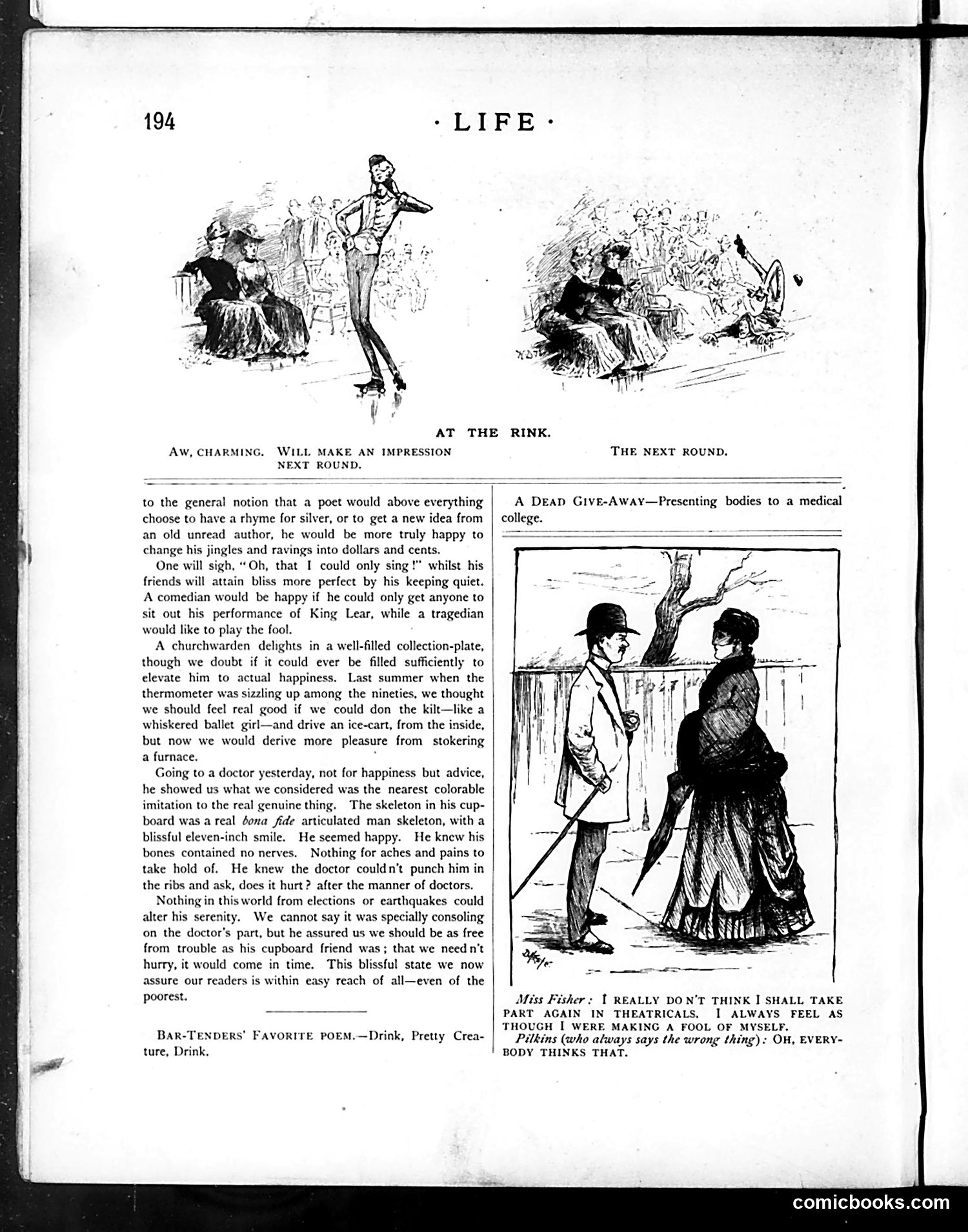
**Top cartoons ("At the Rink"):** Two skating scenes showing social interaction—a man impressing onlookers with his skating ability, with captions suggesting he'll "make an impression next round," depicting the vanity of public performance and social posturing at fashionable ice rinks. **Main illustration ("A Dead Give-Away"):** A doctor presenting a skeleton to a woman (Miss Fisher), who expresses reluctance about theatrical performances. The man beside her (Pilkins) tactlessly agrees, saying "everybody thinks that"—a joke about social awkwardness and insensitive comments. **Text essay:** A satirical reflection on human desires and happiness. The author argues that various professions (poets, comedians, clergymen) would be happier doing opposite work. The skeleton anecdote suggests that freedom from physical pain equals ultimate happiness—available to everyone eventually through death—a dark, morbid humor typical of late 19th/early 20th-century American satire. The humor relies on Victorian-era social conventions and morbid wit now largely unfamiliar to modern readers.
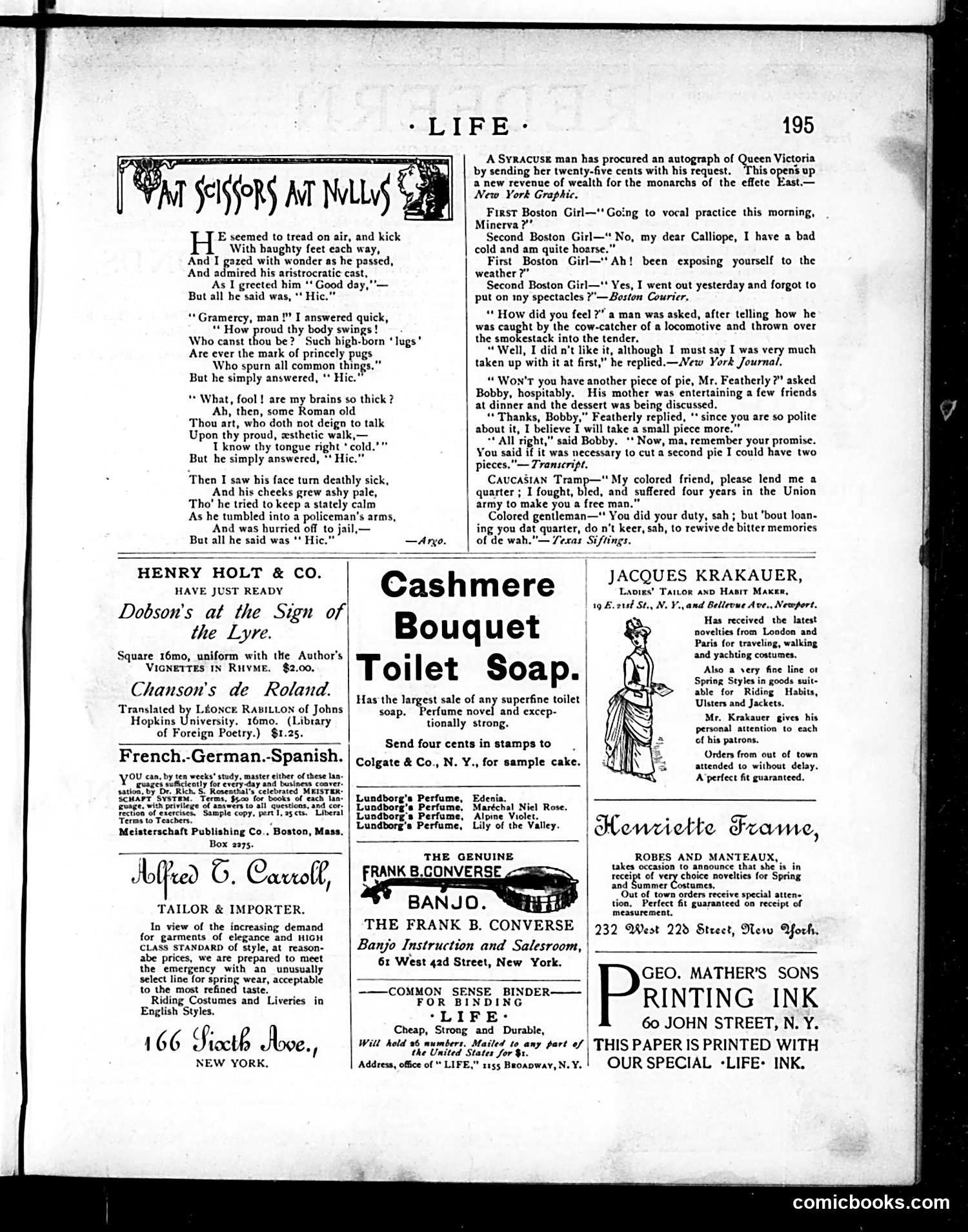
This page combines satirical poetry, humor snippets, and advertisements typical of Life magazine's format. **The Main Cartoon/Poem** ("At Seisers At Nullys"): A humorous narrative poem about a man who repeatedly says "Hic" (Latin for "this") in increasingly absurd situations. He's portrayed as a pretentious character affecting Latin mannerisms. The satire targets affectation and snobbery—the joke being that this supposedly refined, classical gentleman is ultimately just another ordinary person hauled off to jail for drunkenness (implied by "Hic"). **Humor Snippets Below** include period jokes about Boston girls, a locomotive accident, and notably, a **Reconstruction-era joke** featuring a Caucasian tramp asking a Black man for money, claiming he "fought...to make you a free man." The Black man refuses, rejecting the tramp's claim of moral entitlement—social commentary on post-Civil War racial tensions and false paternalism. The remaining content is primarily **advertisements** for books, clothing, soap, and printing services.
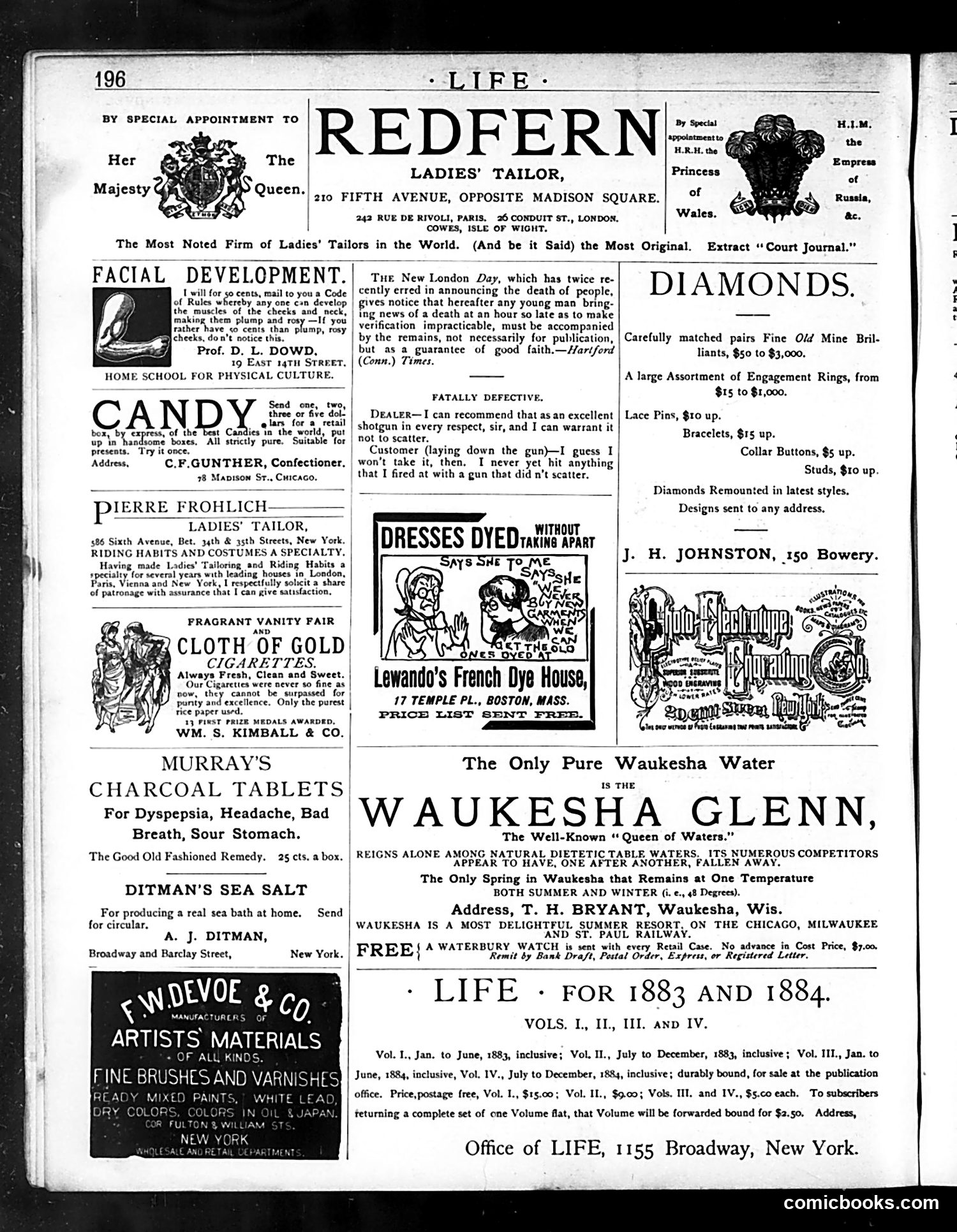
This is primarily an **advertising page** with minimal editorial content. The notable satirical element is a small two-panel cartoon titled "DRESSES DYED WITHOUT TAKING APART," depicting a woman asking a tailor about dyeing her dress. The joke appears to be a play on words or mistaken expectation—likely the woman hopes the dress can be dyed while she's wearing it, or without disassembly, but the punchline (partially unclear in the OCR) suggests an absurd or impossible outcome. The page is otherwise dominated by **commercial advertisements** typical of 1880s American magazines: ladies' tailors (Redfern, Pierre Frohlich), confections, patent medicines (charcoal tablets for dyspepsia), cigarettes, jewelry, and beauty products. The ads reflect upper-middle-class consumer culture and women's fashion concerns of the era. The only substantial editorial content is a brief **satirical news item** mocking a London newspaper for repeatedly announcing deaths prematurely—suggesting they should require young men bringing death announcements to provide the actual corpse as "proof."
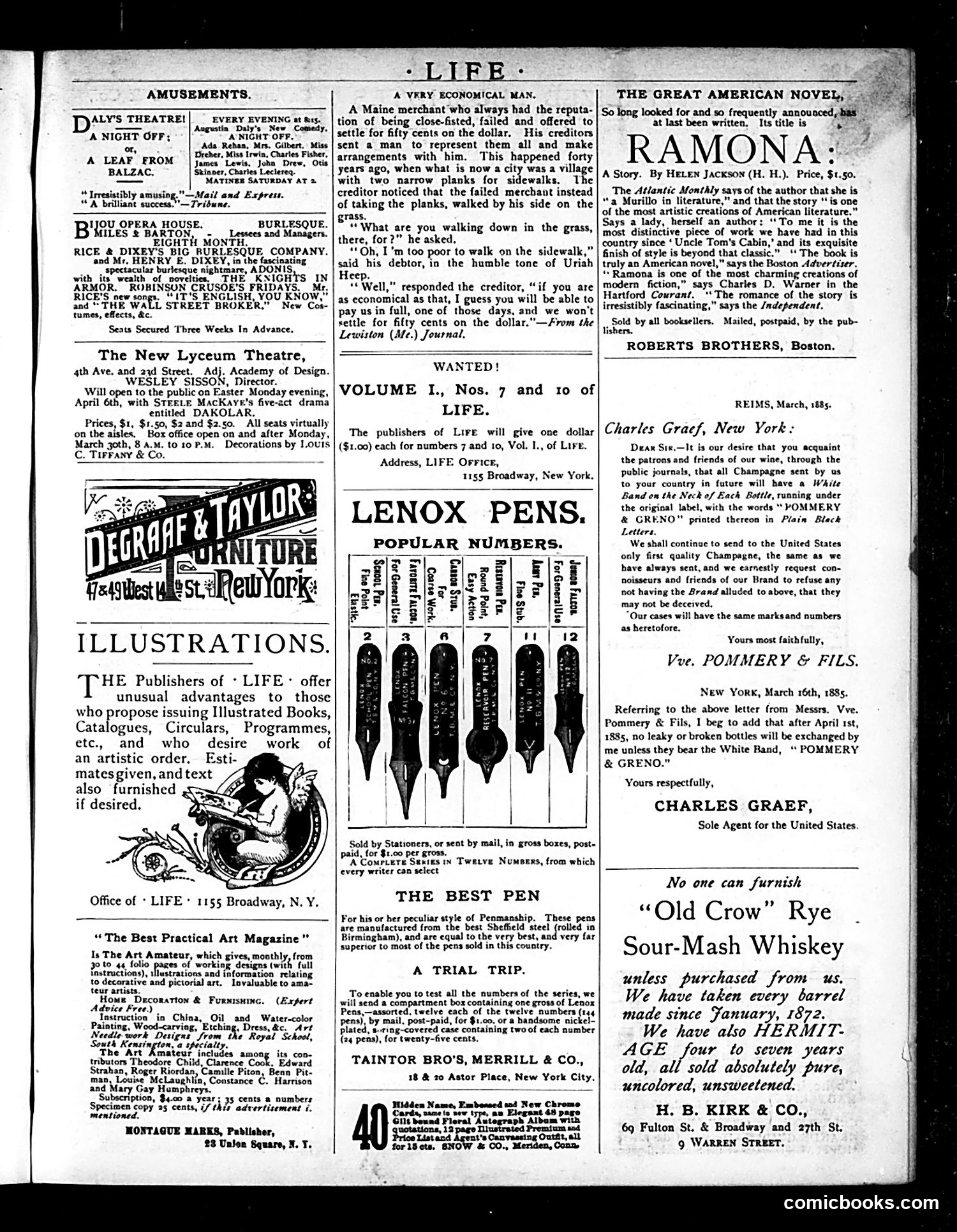
This page is primarily **advertisements and theatrical notices** from March 1885, with minimal political content. The main satirical piece is a brief anecdote titled "A Very Economical Man" about a failed Maine merchant who offers creditors fifty cents on the dollar. When a debt collector notices the merchant walking on grass instead of sidewalks to save money, the creditor becomes convinced the man will eventually pay in full due to his extreme frugality. The joke satirizes **penny-pinching miserliness**—the merchant's obsessive cost-cutting (refusing to walk on paid sidewalks) ironically persuades the creditor that he's actually trustworthy and will recover financially. The reference to "Uriah Heep" (Dickens' obsequious character) adds to the satire of false humility masking financial desperation. The rest of the page consists of theater advertisements, pen and champagne product ads, and notices about the magazine *Life* itself—typical of 1880s periodical content.
This is primarily an **advertising page** from *Life* magazine, not a satirical cartoon. The page contains no political commentary or caricatures requiring historical context. The content consists entirely of commercial advertisements for late 19th-century products: patent medicines (Crosby's Phosphites nerve tonic, Cuticura skin treatments), imported soaps and toiletries, tailoring services, bicycles, carriages, window shades, and a "Voltaic Belt" device marketed to young men (likely a quack electrical cure). The only notable satirical element is the small "What's Trumps?" advertisement for Hyatt's game indicator—a trivial pun on card games rather than political satire. The page reflects the era's unregulated patent medicine industry and dubious health claims now recognized as fraudulent. No specific historical figures or events are referenced.