
Life, 1885-04-02 · page 7 of 16
Life — April 2, 1885 — page 7: what you’re looking at
What you’re looking at
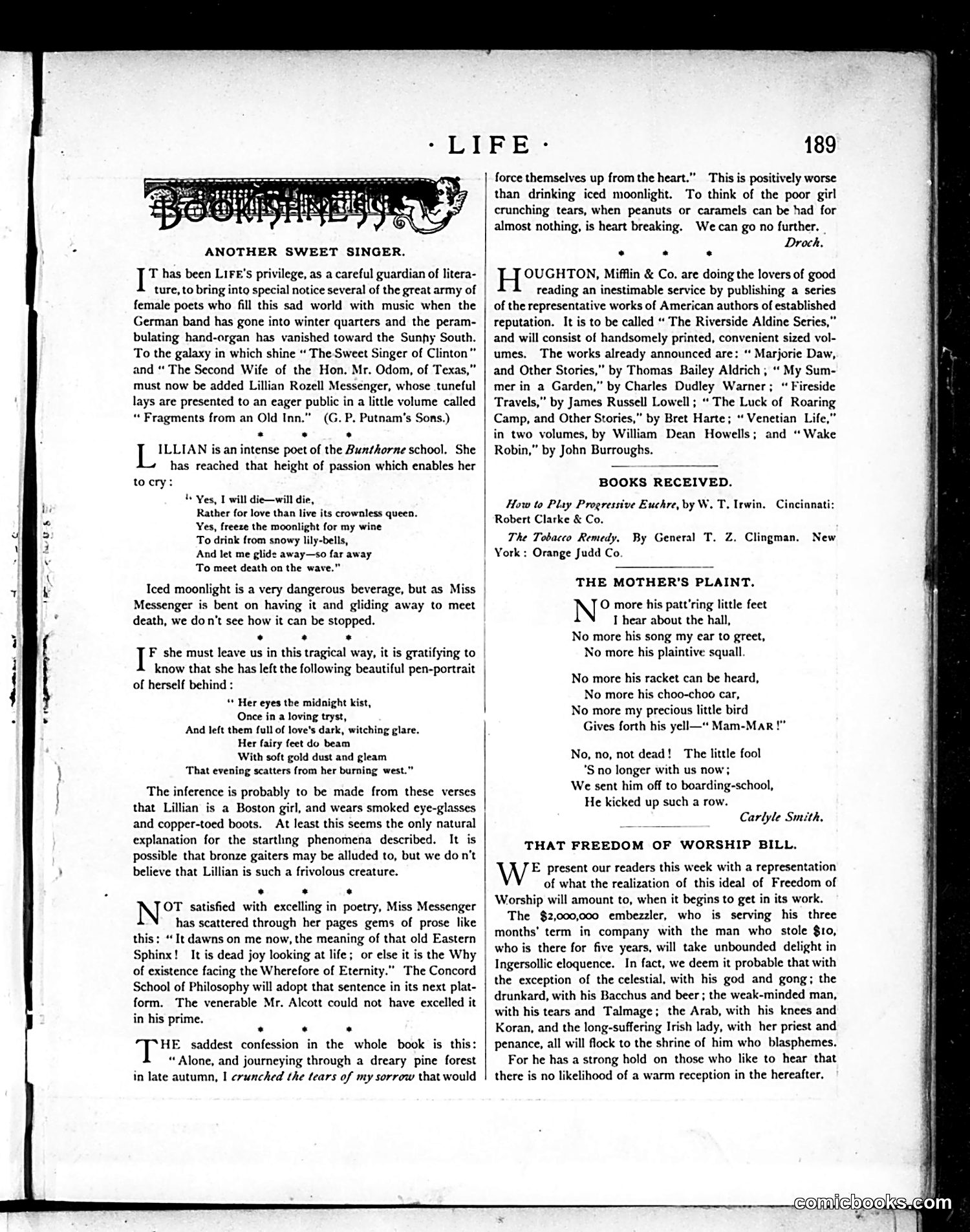
The page contains literary criticism and book reviews rather than political cartoons. At the top is a decorative header labeled "ANOTHER SWEET SINGER" discussing Lillian Rozell Messenger, a female poet of the "Danthorpe school." The critic humorously mocks Messenger's intense poetry, particularly her reference to drinking "iced moonlight" to meet death. The satire suggests her work is overly dramatic and affected—the critic expresses skepticism that she's "such a frivolous creature." The right column includes "Books Received" listings and a poem titled "The Mother's Plaint" by Carlyle Smith. Below is commentary on "That Freedom of Worship Bill," discussing religious tolerance. This page is primarily literary criticism and book notices rather than visual satire.
📄 Transcribed text from this page (OCR, searchable)
Machine-transcribed from the original scan — historical spelling and the odd misread are preserved.
Dh ReE: ANOTHER SWEET SINGER. T has been Lire's privilege, as a careful guardian of litera- ture, to bring into special notice several of the great army of | female poets who fill this sad world with music when the German band has gone into winter quarters and the peram- bulating hand-organ has vanished toward the Sunfy South. To the galaxy in which shine ‘ The Sweet Singer of Clinton” and “ The Second Wife of the Hon. Mr. Odom, of Texas,” must now be added Lillian Rozell Messenger, whose tuneful lays are presented to an eager public in a little volume called “ Fragments from an Old Inn.” (G. P. Putnam's Sons.) . . . ILLIAN is an intense poet of the Bunthorne school. She has reached that height of passion which enables her to cry: ‘Yes, I will die—will die, Rather for love than live its crownless queen. Yes, freeze the moonlight for my wine To drink from snowy lily-bells, And let me glide away—so far away To meet death on the wave.” Iced moonlight is a very dangerous beverage, but as Miss Messenger is bent on having it and gliding away to meet death, we don’t see how it can be stopped. . . . F she must leave us in this tragical way, it is gratifying to know that she has left the following beautiful pen-portrait of herself behind : “ Her eyes the midnight kist, Once in a loving tryst, And left them full of love's dark, witching glare. Her fairy feet do beam With soft gold dust and gleam ‘That evening scatters from her burning west.” The inference is probably to be made from these verses that Lillian is a Boston girl, and wears smoked eye-glasses and copper-toed boots. At least this seems the only natural explanation for the startling phenomena described. It is possible that bronze gaiters may be alluded to, but we don’t believe that Lillian is such a frivolous creature. . * . OT satisfied with excelling in poetry, Miss Messenger | has scattered through her pages gems of prose like this: “It dawns on me now, the meaning of that old Eastern Sphinx! It is dead joy looking at life; or else it is the Why of existence facing the Wherefore of Eternity.” The Concord School of Philosophy will adopt that sentence in its next plat- form. The venerable Mr. Alcott could not have excelled it in his prime. . . . HE saddest confession in the whole book is this: “Alone, and journeying through a dreary pine forest in late autumn, I crunched the tears of my sorrow that would 189 force themselves up from the heart.” This is positively worse than drinking iced moonlight. To think of the poor girl crunching tears, when peanuts or caramels can be had for almost nothing, is heart breaking. We can go no further. Droch. . . . OUGHTON, Mifflin & Co. are doing the lovers of good reading an inestimable service by publishing a series of the representative works of American authors of established reputation. It is to be called “ The Riverside Aldine Series,” and will consist of handsomely printed, convenient sized vol- umes. The works already announced are: “ Marjorie Daw, and Other Stories,” by Thomas Bailey Aldrich , “ My Sum- mer in a Garden,” by Charles Dudley Warner; “ Fireside Travels,” by James Russell Lowell ; “ The Luck of Roaring Camp, and Other Stories,” by Bret Harte; “ Venetian Life,” in two volumes, by William Dean Howells; and “ Wake Robin,” by John Burroughs. BOOKS RECEIVED. How to Play Progressive Euchre, by W. T. Irwin. Cincinnati: Robert Clarke & Co. The Tobacco Remedy, By General T. Z, Clingman, New York : Orange Judd Co. THE MOTHER'S PLAINT. O more his patt'ring little feet I hear about the hall, No more his song my ear to greet, No more his plaintive squall. No more his racket can be heard, No more his choo-choo car, No more my precious little bird Gives forth his yell—* Mam-Mar !” No, no, not dead! The little fool "Sno longer with us now; We sent him off to boarding-school, He kicked up such a row. Carlyle Smith, THAT FREEDOM OF WORSHIP BILL. E present our readers this week with a representation of what the realization of this ideal of Freedom of Worship will amount to, when it begins to get in its work. The $2,000,000 embezzler, who is serving his three months’ term in company with the man who stole $10, who is there for five years, will take unbounded delight in Ingersollic eloquence. In fact, we deem it probable that with the exception of the celestial, with his god and gong; the drunkard, with his Bacchus and beer ; the weak-minded man, with his tears and Talmage; the Arab, with his knees and Koran, and the long-suffering Irish lady, with her priest and penance, all will flock to the shrine of him who blasphemes. For he has a strong hold on those who like to hear that there is no likelihood of a warm reception in the hereafter.