
Life, 1885-04-02 · page 6 of 16
Life — April 2, 1885 — page 6: what you’re looking at
What you’re looking at
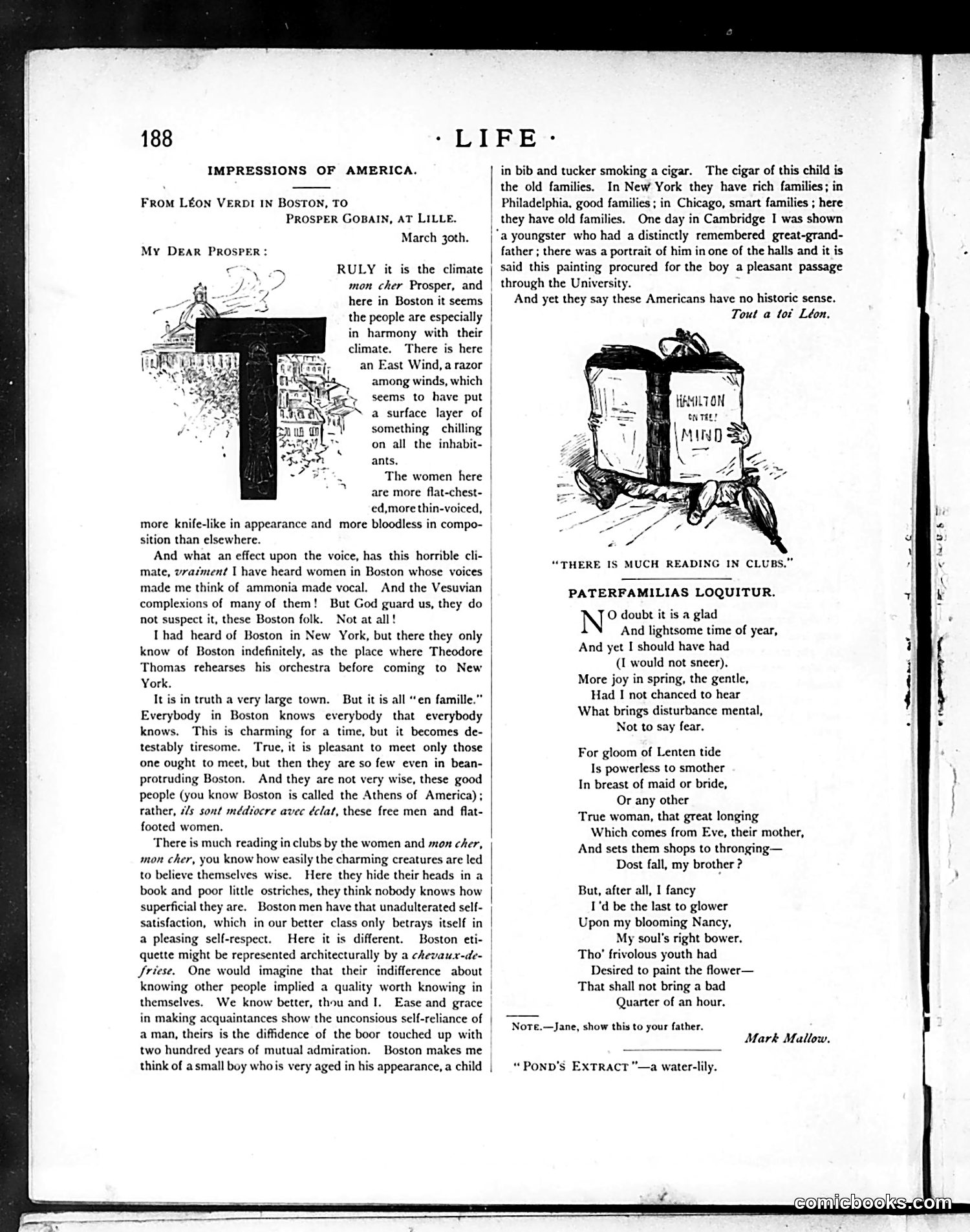
This page contains a letter from Léon Verdi in Boston critiquing American society, paired with a cartoon and poem. **The Cartoon:** Shows two large books labeled "HAMILTON" and "MIND" on wheels—likely a satirical comment on American intellectualism or the commercialization of thought. The caption "THERE IS MUCH READING IN CLUBS" suggests women's reading clubs were fashionable but perhaps superficial. **The Satire:** Verdi's letter mocks Boston society, particularly women's voices ("thin-voiced," "bloodless"), self-satisfaction, and lack of historic awareness. He contrasts Boston's pretensions to cultural refinement with its actual superficiality. **The Poem** "Paterfamilias Loquitur" humorously presents a father's conflicted feelings about his daughter's suitor—a common Victorian satirical subject. The overall tone criticizes American pretension and social hypocrisy.
📄 Transcribed text from this page (OCR, searchable)
Machine-transcribed from the original scan — historical spelling and the odd misread are preserved.
188 IMPRESSIONS OF AMERICA. From Lton VERDI IN Boston, TO PROSPER GOBAIN, AT LILLE. March 30th. My DEAR PROSPER: RULY it is the climate mon cher Prosper, and here in Boston it seems the people are especially in harmony with their climate. There is here an East Wind, a razor *LIFE- in bib and tucker smoking a cigar. The cigar of this child is the old families. In New York they have rich families; in | Philadelphia. good families ; in Chicago, smart families ; here they have old families. One day in Cambridge I was shown |"a youngster who had a distinctly remembered great-grand- father ; there was a portrait of him in one of the halls and it is said this painting procured for the boy a pleasant passage through the University. | And yet they say these Americans have no historic sense. | Tout a toi Léon, among winds, which | seems to have put a surface layer of | something chilling on all the inhabit- ants. The women here are more flat-chest- ed,more thin-voiced, more knife-like in appearance and more bloodless in compo- sition than elsewhere. And what an effect upon the voice, has this horrible cli- mate, vraiment | have heard women in Boston whose voices made me think of ammonia made vocal. And the Vesuvian complexions of many of them! But God guard us, they do not suspect it, these Boston folk. Not at all! Thad heard of Boston in New York, but there they only know of Boston indefinitely, as the place where Theodore Thomas rehearses his orchestra before coming to New York. It is in truth a very large town. But it is all “en famille.” Everybody in Boston knows everybody that everybody knows. This is charming for a time, but it becomes de- testably tiresome. True, it is pleasant to meet only those one ought to meet, but then they are so few even in bean- protruding Boston. people (you know Boston is called the Athens of America); rather, #/s sont médrocre avec éclat, these free men and flat- footed women. There is much reading in clubs by the women and mon cher, mon cher, you know how easily the charming creatures are led to believe themselves wise. Here they hide their heads in a book and poor little ostriches, they think nobody knows how superficial they are. Boston men have that unadulterated self- satisfaction, which in our better class only betrays itself in a pleasing self-respect. Here it is different. Boston eti- quette might be represented architecturally by a chevaux-de- Sriese. One would imagine that their indifference about knowing other people implied a quality worth knowing in themselves. We know better, thou and I. Ease and grace in making acquaintances show the unconsious self-reliance of aman, theirs is the diffidence of the boor touched up with two hundred years of mutual admiration. Boston makes me think of a small boy whois very aged in his appearance, a child | And they are not very wise, these good | “THERE IS MUCH READING IN CLUBS, PATERFAMILIAS LOQUITUR. O doubt it is a glad And lightsome time of year, | And yet I should have had (I would not sneer). More joy in spring, the gentle, Had I not chanced to hear What brings disturbance mental, Not to say fear. For gloom of Lenten tide Is powerless to smother In breast of maid or bride, Or any other True woman, that great longing Which comes from Eve, their mother, And sets them shops to thronging— Dost fall, my brother ? But, after all, I fancy I'd be the last to glower Upon my blooming Nancy, My soul's right bower. Tho’ frivolous youth had Desired to paint the fower— That shall not bring a bad Quarter of an hour. Note.—Jane, show this to your father. Mark Mallow. “Ponp's EXTRACT "—a water-lily.