
Life, 1885-04-02 · page 10 of 16
Life — April 2, 1885 — page 10: what you’re looking at
What you’re looking at
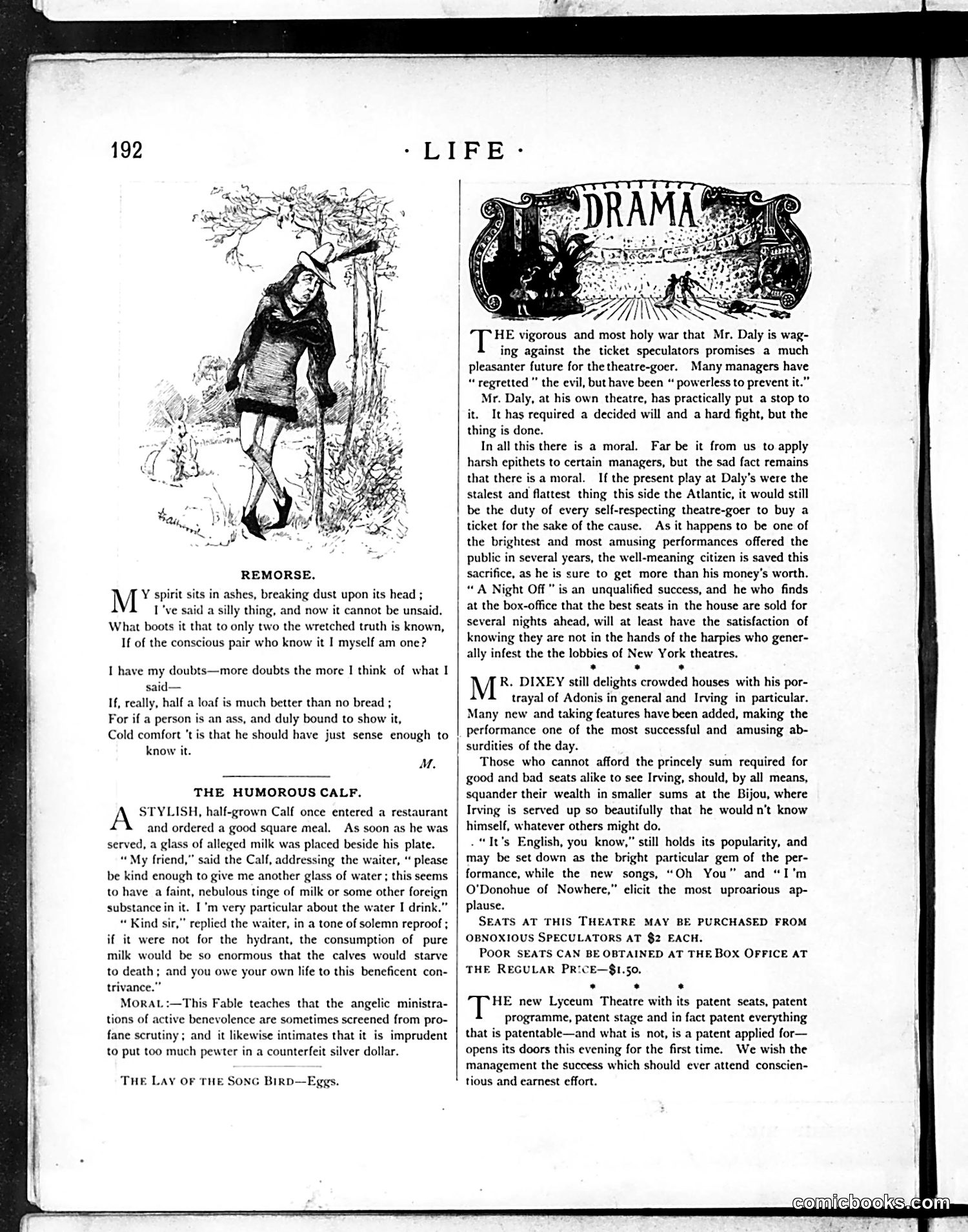
This page contains theatrical criticism and humor from Life magazine (appears to be late 19th century based on style). **Main Content:** The "Drama" section praises theater manager Mr. Daly's fight against ticket scalpers, calling it a moral crusade benefiting theater-goers. It celebrates the success of "A Night Off" and notes that good seats are legitimately sold out rather than monopolized by speculators. The page also reviews R. Dixey's popular performance as "Adonis" and praises the musical "It's English, You Know," with particular mention of songs "Oh You" and "I'm O'Donohue of Nowhere." **Humor:** "The Humorous Calf" is a satirical fable where a fastidious calf objects to "impure" water at a restaurant. The waiter explains the water sustains the calf's life—a moral about ungraciously rejecting hidden benefits. The moral's second point appears to critique adulteration (adding cheap metal to silver). **Left Column:** A brief melancholic poem titled "Remorse" about regretted words.
📄 Transcribed text from this page (OCR, searchable)
Machine-transcribed from the original scan — historical spelling and the odd misread are preserved.
Y spirit sits in ashes, breaking dust upon its head ; I've a silly thing, and now it cannot be unsaid. What boots it that to only two the wretched truth is known, If of the conscious pair who know it I myself am one? I have my doubts—more doubts the more I think of what I said— If, really, half a loaf is much better than no bread ; For if a person is an ass, and duly bound to show it, Cold comfort ‘t is that he should have just sense enough to know it. M. THE HUMOROUS CALF. STYLISH, half-grown Calf once entered a restaurant and ordered a good square meal. As soon as he was served, a glass of alleged milk was placed beside his plate. “My friend,” said the Calf, addressing the waiter, “ please be kind enough to give me another glass of water ; this seems to have a faint, nebulous tinge of milk or some other foreign substance in it. I'm very particular about the water I drink.” “ Kind sir,” replied the waiter, in a tone of solemn reproof ; if it were not for the hydrant, the consumption of pure milk would be so enormous that the calves would starve | to death; and you owe your own life to this beneficent con- trivance.” MoRAL :—This Fable teaches that the angelic ministra- tions of benevolence are sometimes screened from pro- fane scrutiny; and it likewise intimates that it is imprudent to put too much pewter in a counterfeit silver dollar. THE Lay OF THE SONG BiIRD—Eggs. | that there is a moral. a 5 ZZ RSS HE vigorous and most holy war that Mr. Daly is wag- ing against the ticket speculators promises a much pleasanter future for the theatre-goer. Many managers have “ regretted the evil, but have been “ powerless to prevent it.” Mr. Daly, at his own theatre, has practically put a stop to it. It has required a decided will and a hard fight, but the thing is done. In all this there is a moral. Far be it from us to apply harsh epithets to certain managers, but the sad fact remains If the present play at Daly's were the stalest and flattest thing this side the Atlantic, it would still be the duty of every self-respecting theatre-goer to buy a ticket for the sake of the cause. As it happens to be one of the brightest and most amusing performances offered the public in several years, the well-meaning citizen is saved this sacrifice, as he is sure to get more than his money's worth. “A Night Off” is an unqualified success, and he who finds at the box-office that the best seats in the house are sold for several nights ahead, will at least have the satisfaction of knowing they are not in the hands of the harpies who gener- ally infest the the lobbies of New York theatres. . . . R. DIXEY still delights crowded houses with his por- trayal of Adonis in general and Irving in particular. Many new and taking features have been added, making the performance one of the most successful and amusing ab- surdities of the day. Those who cannot afford the princely sum required for good and bad seats alike to see Irving, should, by all means, squander their wealth in smaller sums at the Bijou, where Irving is served up so beautifully that he would n't know himself, whatever others might do. . “It's English, you know,” still holds its popularity, and may be set down as the bright particular gem of the per- formance, while the new songs, “Oh You” and “I'm O'Donohue of Nowhere,” elicit the most uproarious ap- plause. SEATS AT THIS THEATRE MAY BE PURCHASED FROM OBNOXIOUS SPECULATORS AT $2 EACH. POOR SEATS CAN BE OBTAINED AT THE BOX OFFICE AT THE REGULAR PR:CE—$1.50. . . . HE new Lyceum Theatre with its patent seats, patent programme, patent stage and in fact patent everything that is patentable—and what is not, is a patent applied for— opens its doors this evening for the first time. We wish the management the success which should ever attend conscien- tious and earnest effort.