
A complete issue · 16 pages · 1885
Life — March 26, 1885
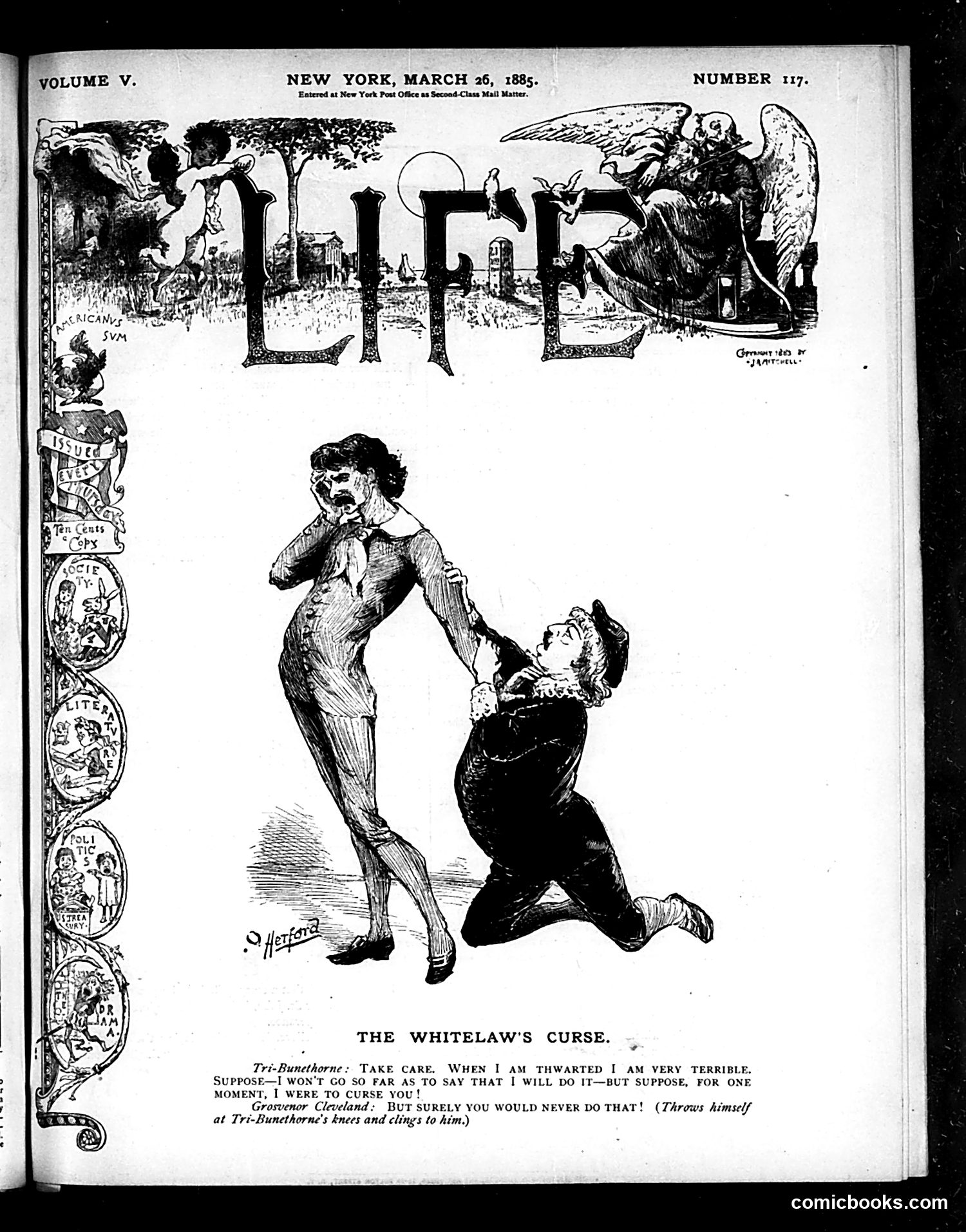
This cartoon satirizes a conflict between two figures identified in the dialogue as **Tri-Buncthorne** and **Governor Cleveland**. The image shows a man on his knees before a standing woman in a dramatic pose. The caption references Tri-Buncthorne threatening to curse Cleveland if he's "thwarted," to which Cleveland responds he'd never do what Tri-Buncthorne demands. The setup appears to parody theatrical melodrama—specifically referencing Gilbert and Sullivan's "Patience" (which featured a character named Bunthorne), treating a political dispute as overwrought theatrical performance. Without additional historical context, the specific political disagreement remains **unclear**, though it likely involved Governor **Grover Cleveland** of New York and some contemporary political controversy of 1882.
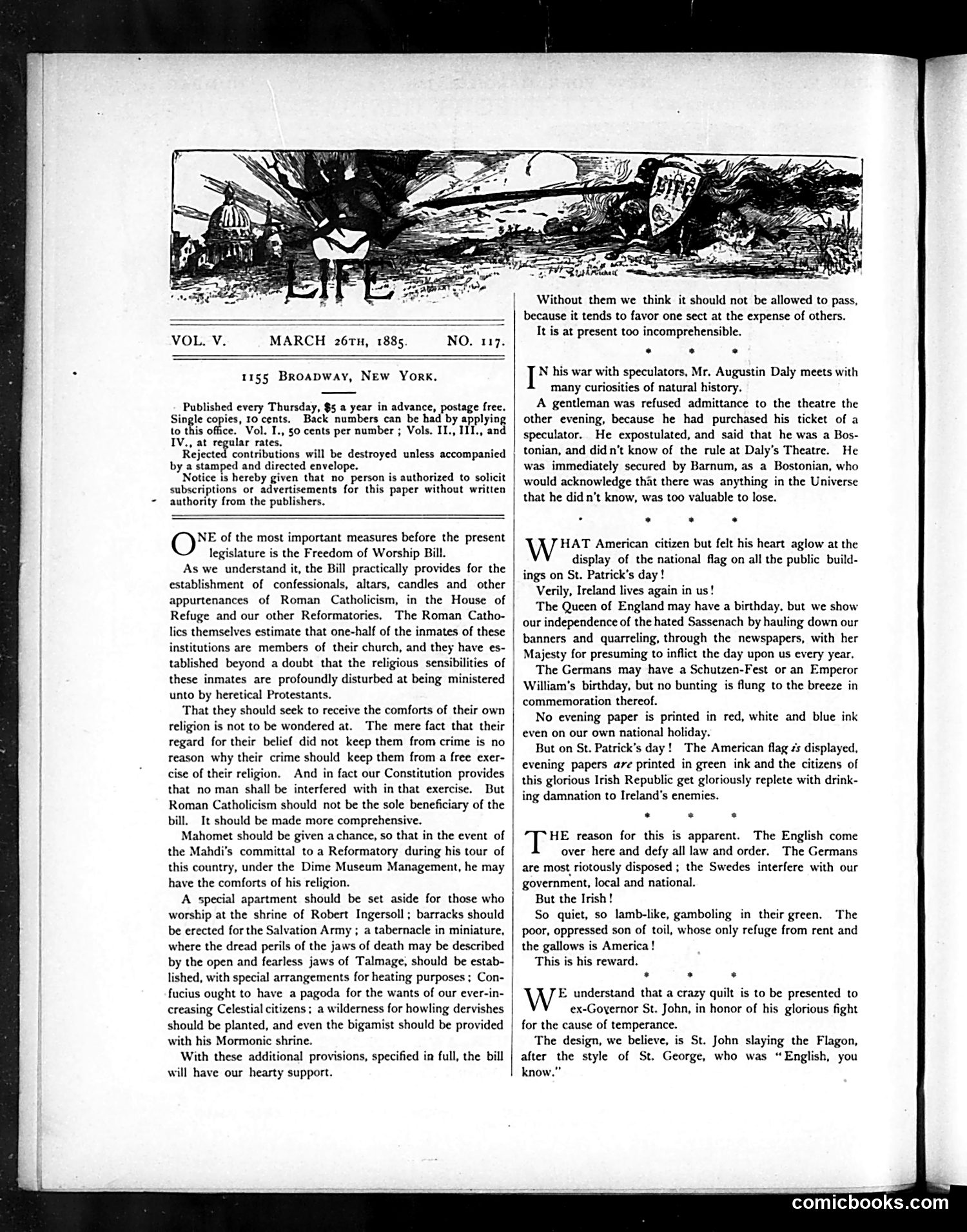
The masthead cartoon depicts a nighttime urban scene with a large tree and buildings, likely illustrating one of the articles below. The text discusses the **Freedom of Worship Bill** before the legislature, advocating for provisions protecting Roman Catholics and other religious groups in institutional settings (refuges, reformatories). The author argues these facilities should allow inmates religious comfort and practice. A separate piece criticizes the display of American flags on public buildings for **St. Patrick's Day**, sarcastically suggesting this represents Irish-American rebellion against English rule. The author mocks Irish citizens as "quiet, lamb-like" yet somehow dangerous, using inflammatory stereotypes common to anti-Irish sentiment of the 1880s. The final note mentions a temperance quilt honoring ex-Governor St. John's prohibition efforts.
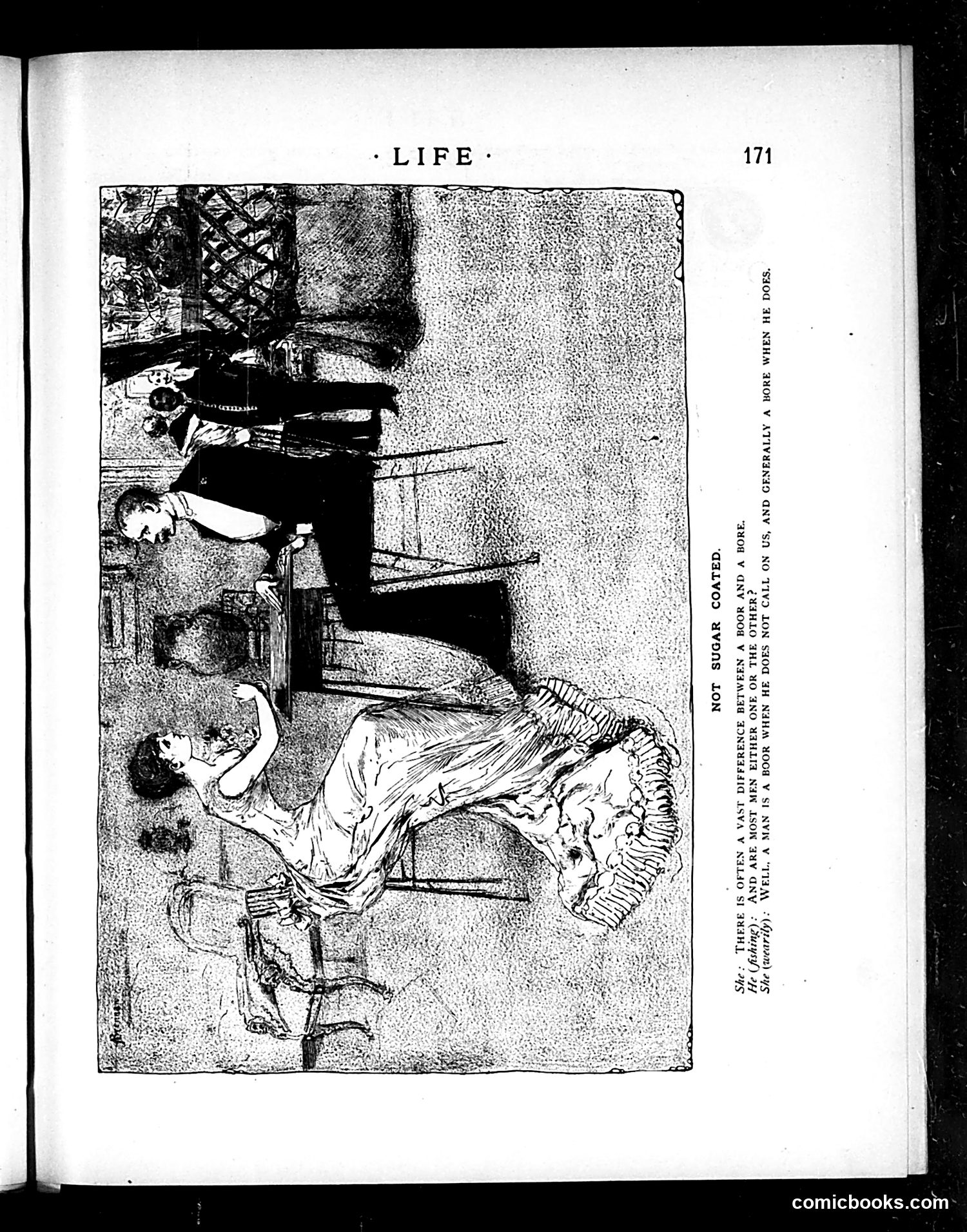
This cartoon satirizes the tension between appearance and reality in social conduct. The image shows a well-dressed man in formal attire standing above a reclining woman in an elaborate dress. The caption indicates there is "an utter van difference between a bride and certainly a wife" — the joke being that marriage transforms romantic courtship into domestic reality. The satire targets the gap between the idealized, "sugar-coated" presentation of romance (the formal, elegant setting) and the actual, unglamorous realities of married life. The woman's sprawled, undignified pose contrasts sharply with her formal dress, embodying this disconnect. This reflects early 20th-century Life magazine's frequent commentary on marriage, gender relations, and the disillusionment that follows romantic idealization.
This page from *Life* magazine (page 172) contains two distinct sections: **Left side ("By the Way")**: A humor column with brief satirical observations about contemporary society—Oscar Wilde's fashion views, regional American speech patterns, Prince Bismarck's political career, and various anecdotes about animals and public figures. These are disconnected quips rather than a unified cartoon. **Right side ("The Music of the Future")**: A poem by Penny Whistler mocking Wagner and modern classical music. The speaker complains that contemporary "Music of the Future" (Wagner's avant-garde compositions) is incomprehensible and headache-inducing, preferring traditional composers like Brahms and Liszt. The content satirizes both social trends and artistic pretension of the era. No political cartoons appear on this page—it's primarily satirical text and verse commentary on contemporary culture.
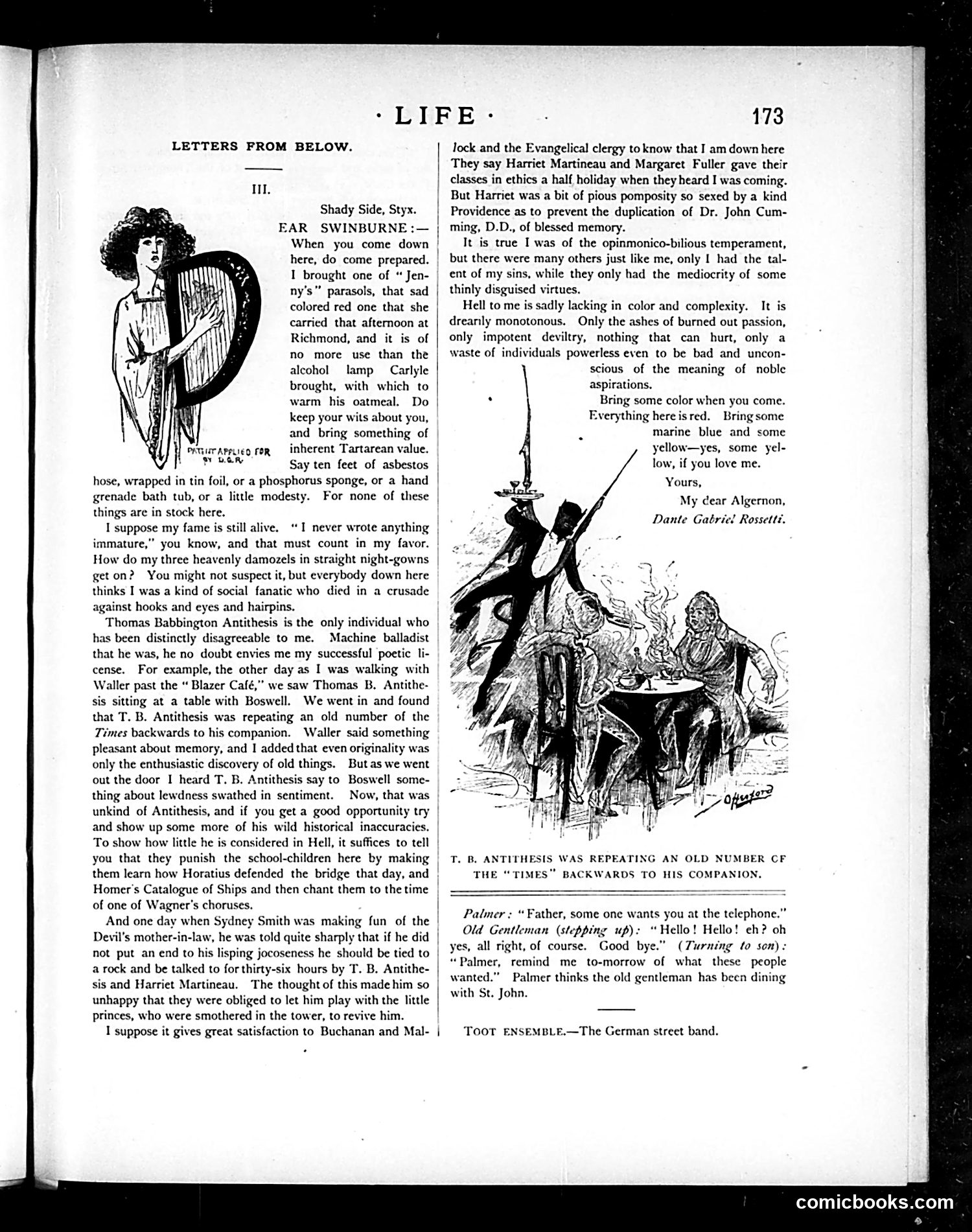
This page contains a satirical letter section titled "Letters From Below." The main cartoon depicts a figure suspended upside-down on what appears to be a rope or cable, drawn in a dramatic, darkly comedic style. The accompanying letter from "Dear Algernon" (signed "Dante Gabriel Rossetti") is a mock epistle complaining about dreary conditions and requesting the correspondent bring color and vibrancy—"marine blue and some yellow"—when visiting. The satire appears to target Victorian literary and artistic pretension, specifically mocking the aesthetic movement and its figures. The upside-down figure likely represents the inverted values or ridiculous affectations of such circles. The reference to Dante Gabriel Rossetti (the actual Pre-Raphaelite painter) adds another layer of literary in-joking for contemporary readers familiar with that artistic movement.
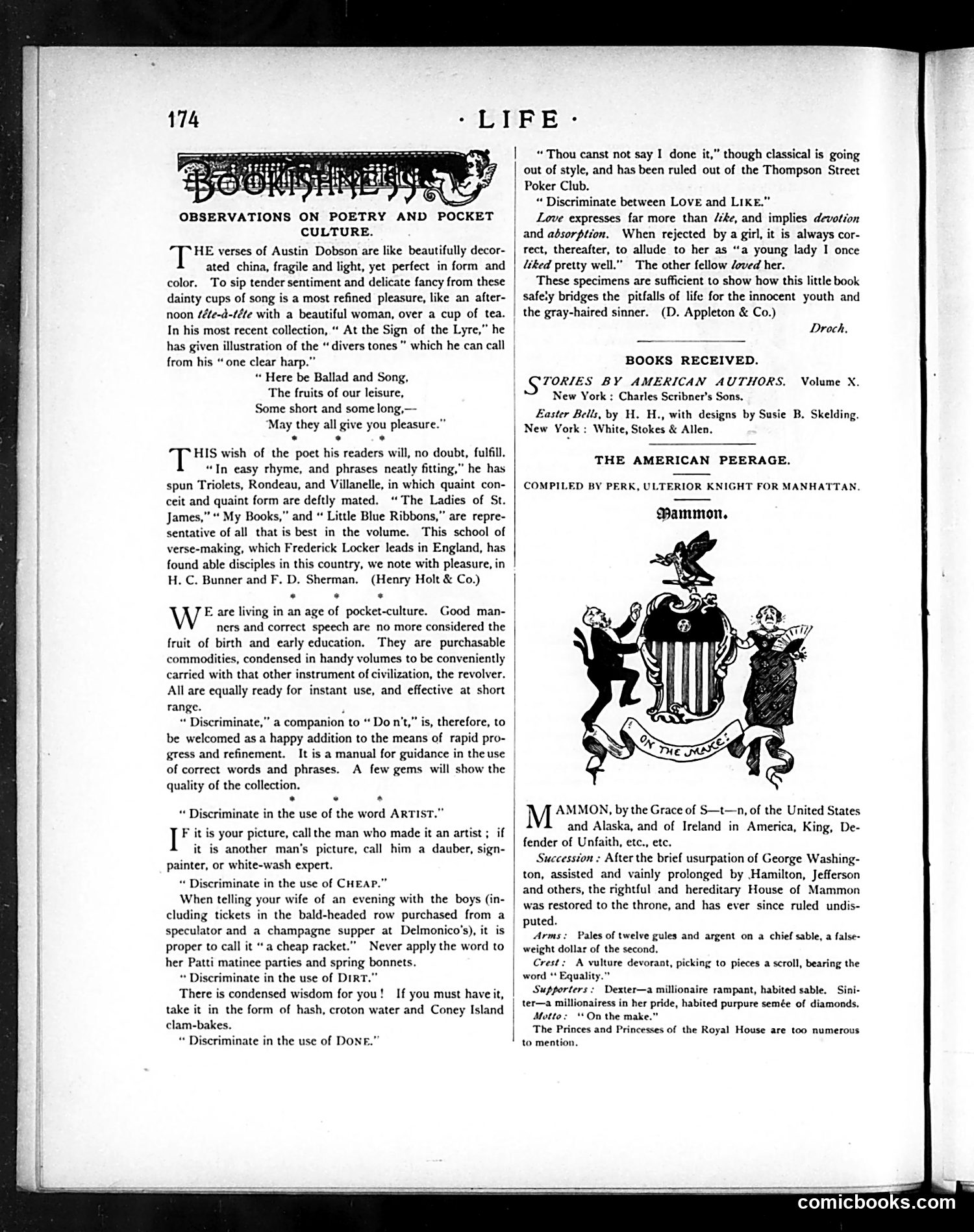
This page contains literary criticism and book reviews rather than political cartoons. The left column discusses poetry and "pocket culture"—etiquette guides for proper speech and manners. The text satirizes the commercialization of refinement, suggesting that good manners are now "purchasable commodities" sold in handy volumes alongside revolvers, indicating a critique of rapid American materialism and superficial self-improvement. The right side features "The American Peerage," a heraldic design mocking American aristocratic pretensions. The coat of arms parodies how newly wealthy Americans ape European nobility. The text humorously describes "Mammon" (wealth personified) as a ruler after George Washington, suggesting that money—not democratic ideals—truly governs America. This satire targets Gilded Age inequality and class aspiration.
This page contains two heraldic coats of arms with biographical entries for aristocratic families (De Bilt and Blujay), followed by satirical commentary on roller skating's social impact. "The Latest Rinkle" mockingly critiques the skating rink craze. It describes how young women now spend hours daily skating instead of intellectual pursuits, while men "suck the top of [their] canes" watching them. The satire targets the fashionable obsession with skating rinks as frivolous leisure activity. The bottom section, "Two Sides to the Question," presents a theatrical dialogue about a woman attending the theater—apparently notable enough to be a social talking point, suggesting commentary on changing women's public visibility and propriety in social spaces. The overall tone satirizes late-nineteenth-century upper-class social trends and gender dynamics.
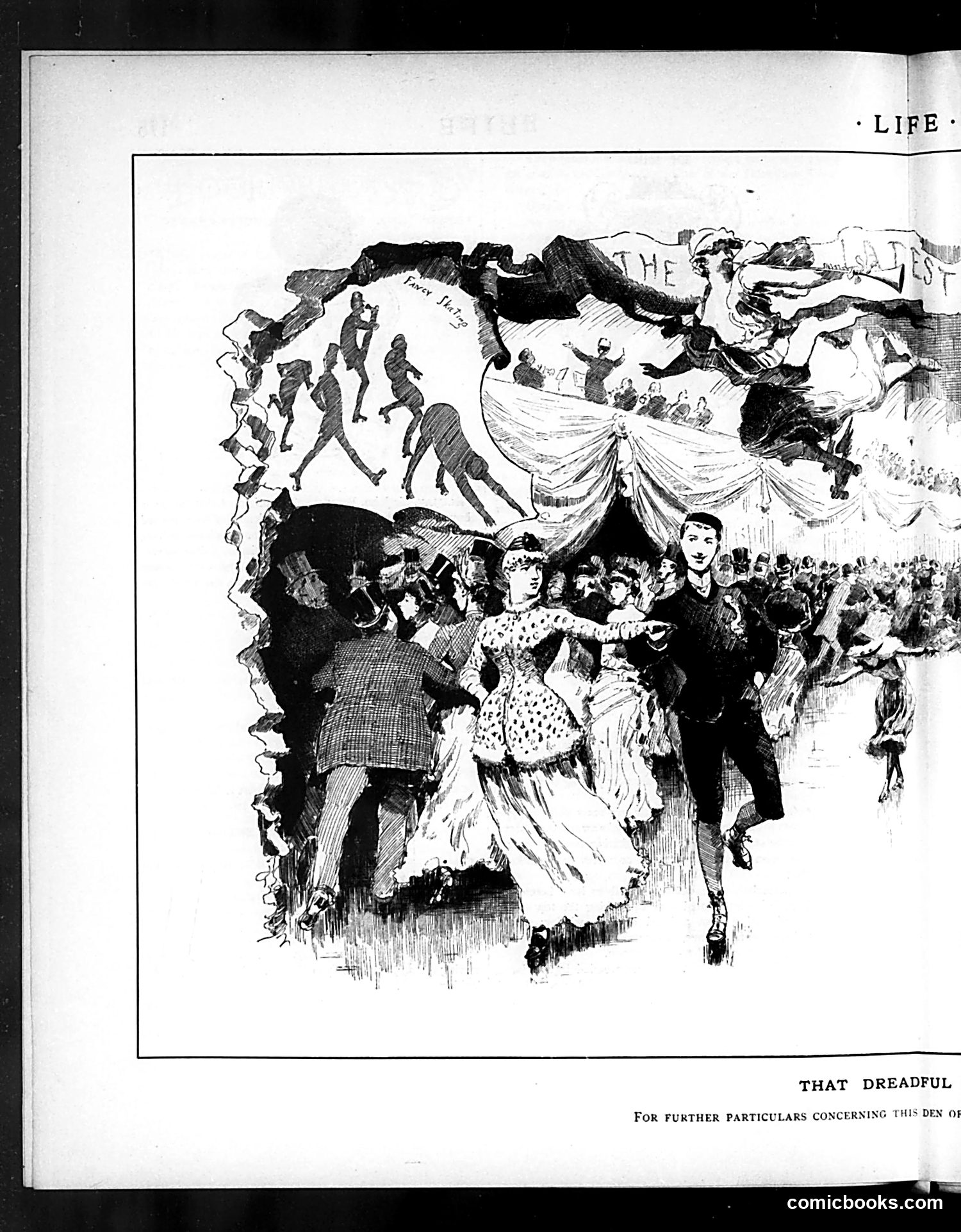
This Life magazine page depicts a surreal, nightmarish scene titled "THAT DREADFUL" (text cut off). The illustration shows a woman in a polka-dot dress at the center of a grotesque skull-shaped composition made of human figures. Couples dance and embrace within the skull's outline, while mountainous, dark forms loom above like wings or horns. The satire appears to comment on **the dangers or corruption of social excess**—likely critiquing Jazz Age revelry, moral decay, or frivolous indulgence during the 1920s-30s. The skull imagery suggests death lurking within seemingly glamorous social gatherings. The specific reference in the title remains unclear due to text truncation, but the visual metaphor warns that pleasurable pursuits conceal darker consequences.
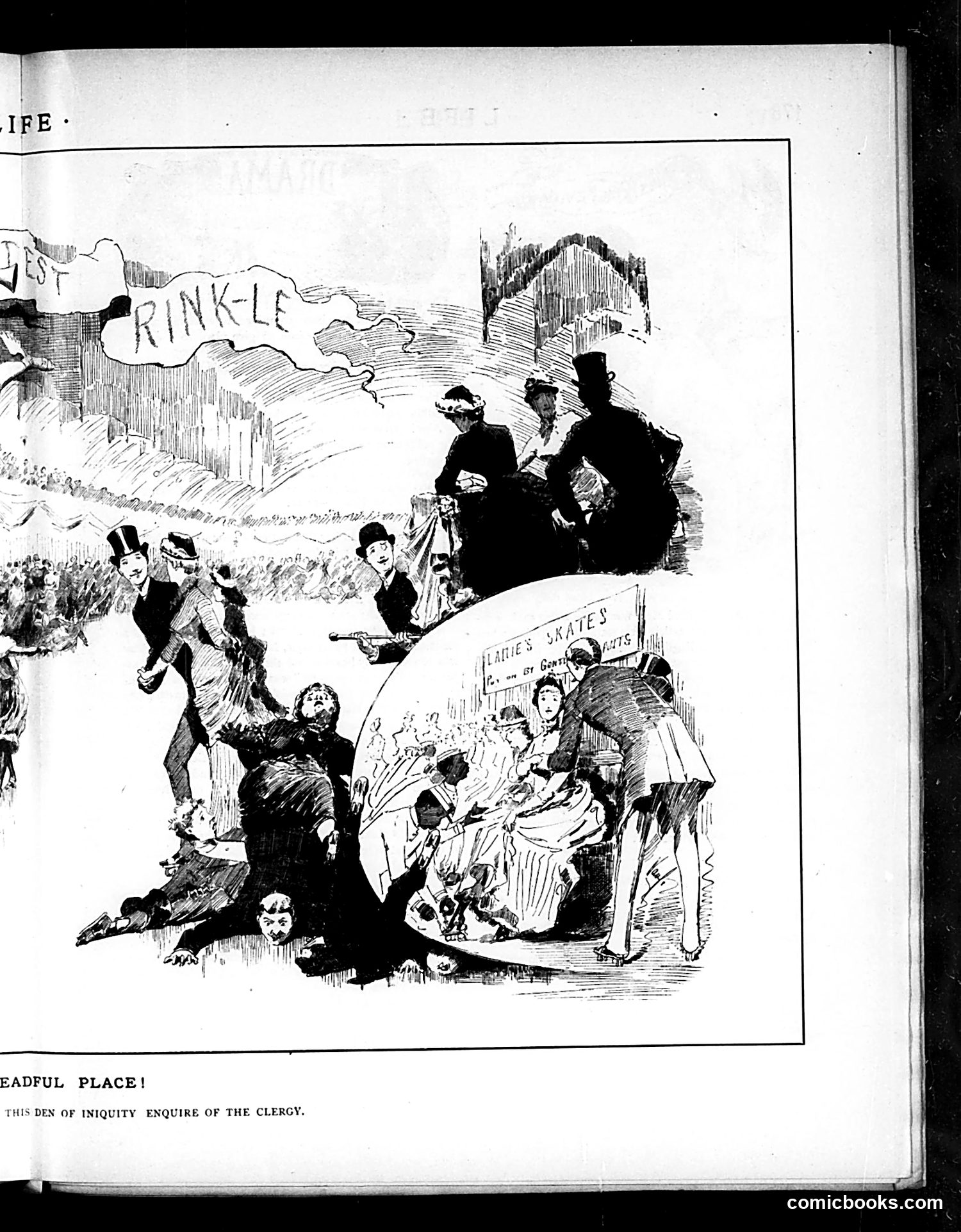
This is a satirical cartoon critiquing clergy involvement in secular matters. The caption "A DREADFUL PLACE!" with subtitle "THIS DEN OF INIQUITY ENQUIRE OF THE CLERGY" suggests the clergy are being mocked for their moral pronouncements on worldly venues. The scene depicts what appears to be an ice skating rink labeled "SKATES" with well-dressed people enjoying recreational activity. Three clergymen in top hats observe from above, seemingly scandalized. The satire appears to target Victorian-era religious figures who condemned popular entertainment and social gathering places as morally corrupt "dens of iniquity." The cartoon mocks the disconnect between clergy moral outrage and ordinary citizens' innocent pleasures, suggesting their disapproval of modern recreation was excessive or hypocritical. This reflects broader 19th-century tensions between religious conservatism and emerging leisure culture.
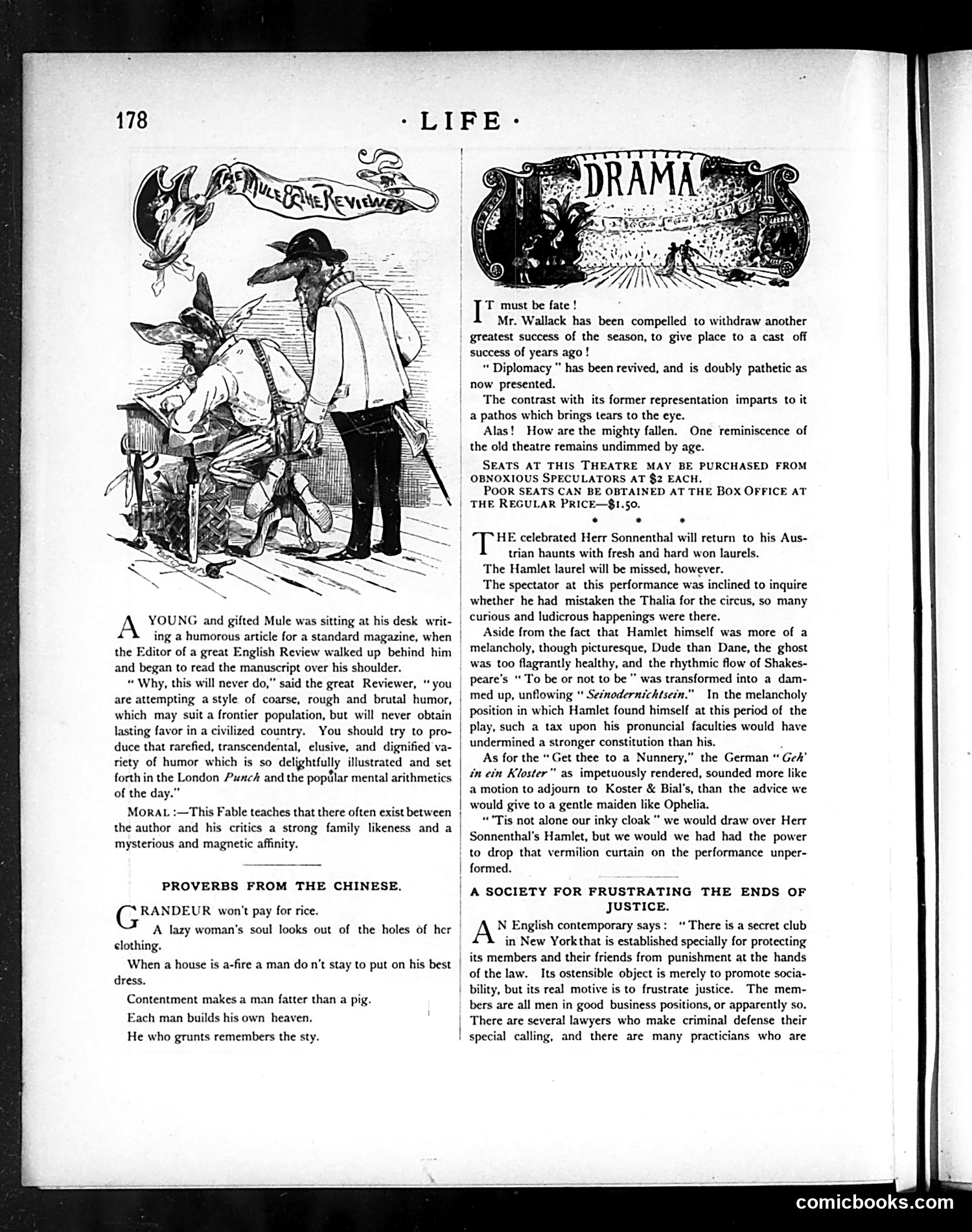
**The Mule Cartoon (Top Left):** A young American writer ("Mule") is criticized by a pompous English Review editor for writing "coarse, rough and brutal humor" suited only to "frontier population." The editor insists he should imitate London's *Punch* magazine's "rarefied, transcendental" style. The moral: critics often resemble those they criticize—suggesting the editor's pretentiousness mirrors his own limitations. This satirizes the American anxiety about European cultural superiority and mocks affected literary elitism. **Drama Section (Right):** Theater criticism attacking actor Herr Sonnenthal's performance of *Hamlet*. The review ridicules his interpretation—portraying Hamlet as a vain "Dude," the Ghost as "too flagrantly healthy," and his German pronunciation of "Geh' in ein Kloster" sounding like an adjournment to a dance hall (Koster & Bial's). The satire targets both pretentious foreign actors and absurd theatrical excess. **Lower Section:** Reports on a secretive New York club allegedly protecting wealthy members and friends from legal consequences—ostensibly social, actually enabling injustice through lawyer members.
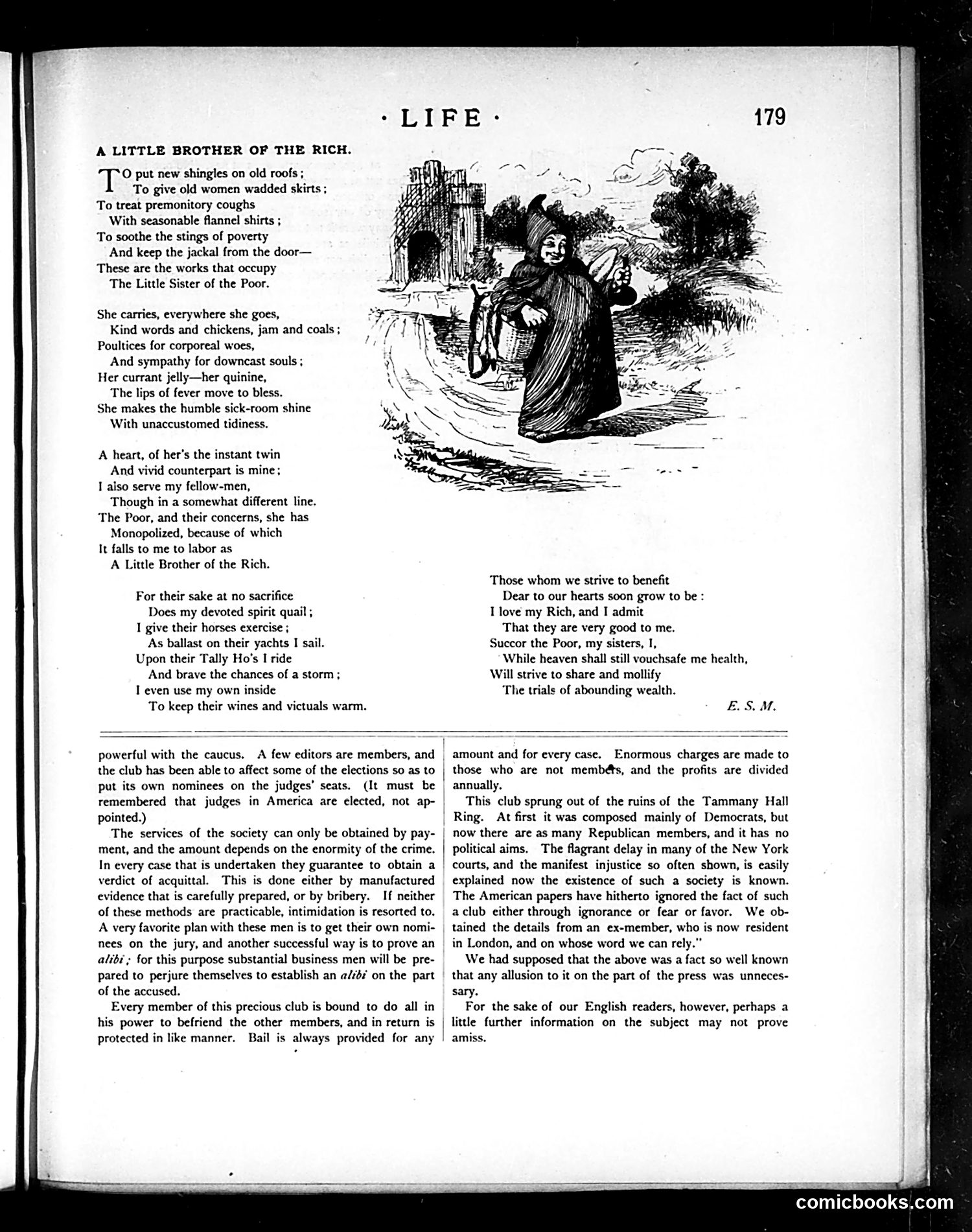
This poem satirizes wealthy philanthropists by contrasting them with the "Little Sister of the Poor" (a reference to an actual Catholic charitable organization). The speaker ironically claims to be a "Little Brother of the Rich," serving the wealthy by exercising their horses, sailing on their yachts, and keeping their wine warm—trivial tasks masquerading as noble service. The satire's bite: while religious sisters genuinely help the poor (providing food, medicine, comfort), the wealthy's "little brother" performs useless services for people already drowning in luxury, yet claims equal moral standing. The closing couplet delivers the joke—he'll "strive to share and mollify / The trials of abounding wealth," mocking the notion that the rich face genuine hardship requiring compassionate intervention. The accompanying prose discusses a corrupt New York club guaranteeing acquittals through bribery and perjured alibis, suggesting that wealth-serving corruption extended far beyond charity into actual justice.
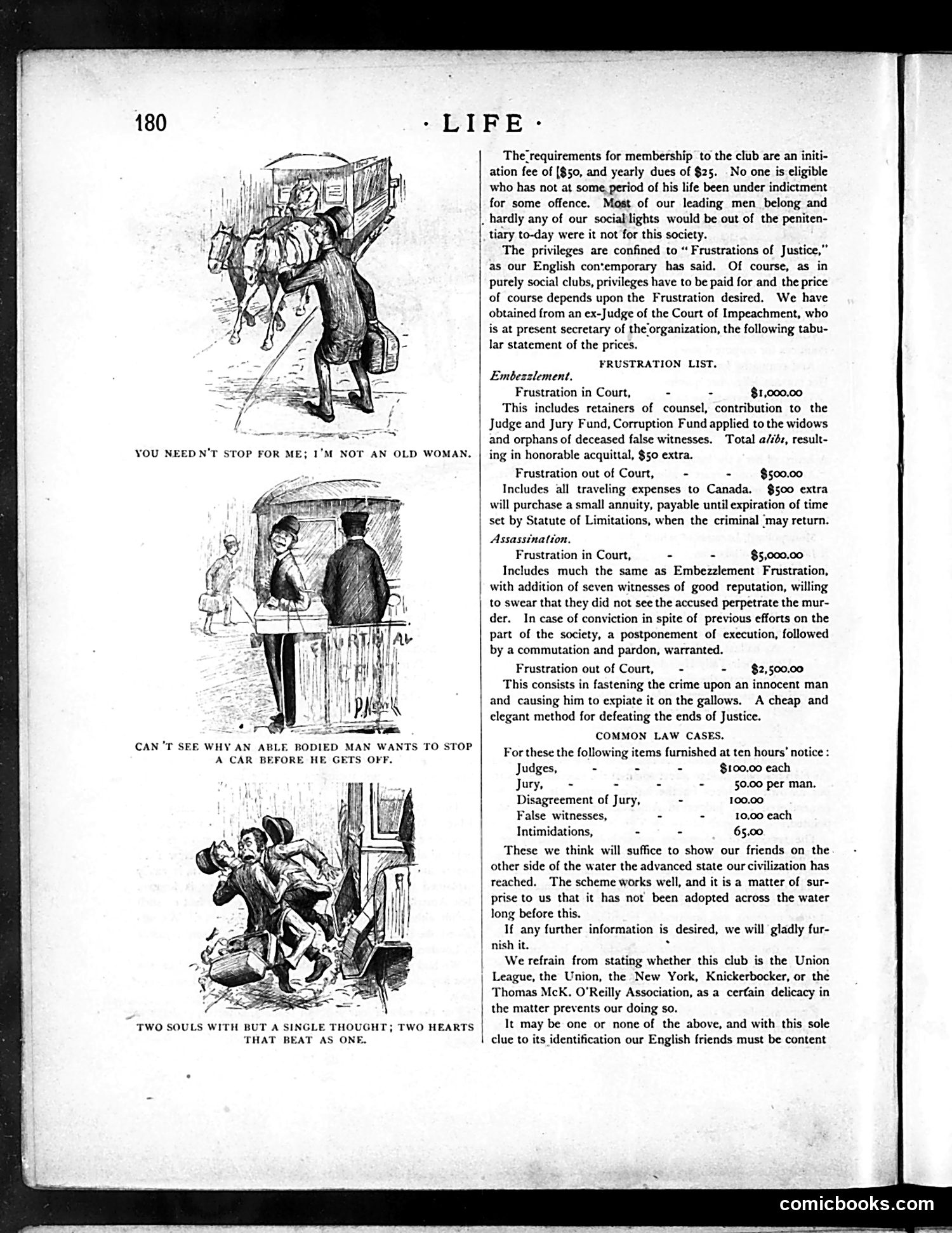
This page satirizes American judicial corruption through a fake "Frustration of Justice" club that openly sells legal favors. The satire lists prices for various crimes' acquittals: embezzlement ($1,000), assassination ($5,000), and common services like bribing judges ($100 each) or producing false witnesses ($10). The three cartoons mock related social hypocrisies: a man stopping a streetcar to let off a woman (questioning able-bodied behavior), and romantic couples—contrasting petty social etiquette with the magazine's larger point about systemic corruption. The author knowingly refuses to name which exclusive club this parodies (Union League? Knickerbocker?), suggesting real American institutions enabled wealthy criminals to escape justice through bribery. The bitter conclusion—sarcastically praising this "advanced civilization"—mocks how normalized corruption had become among America's elite in the Gilded Age.
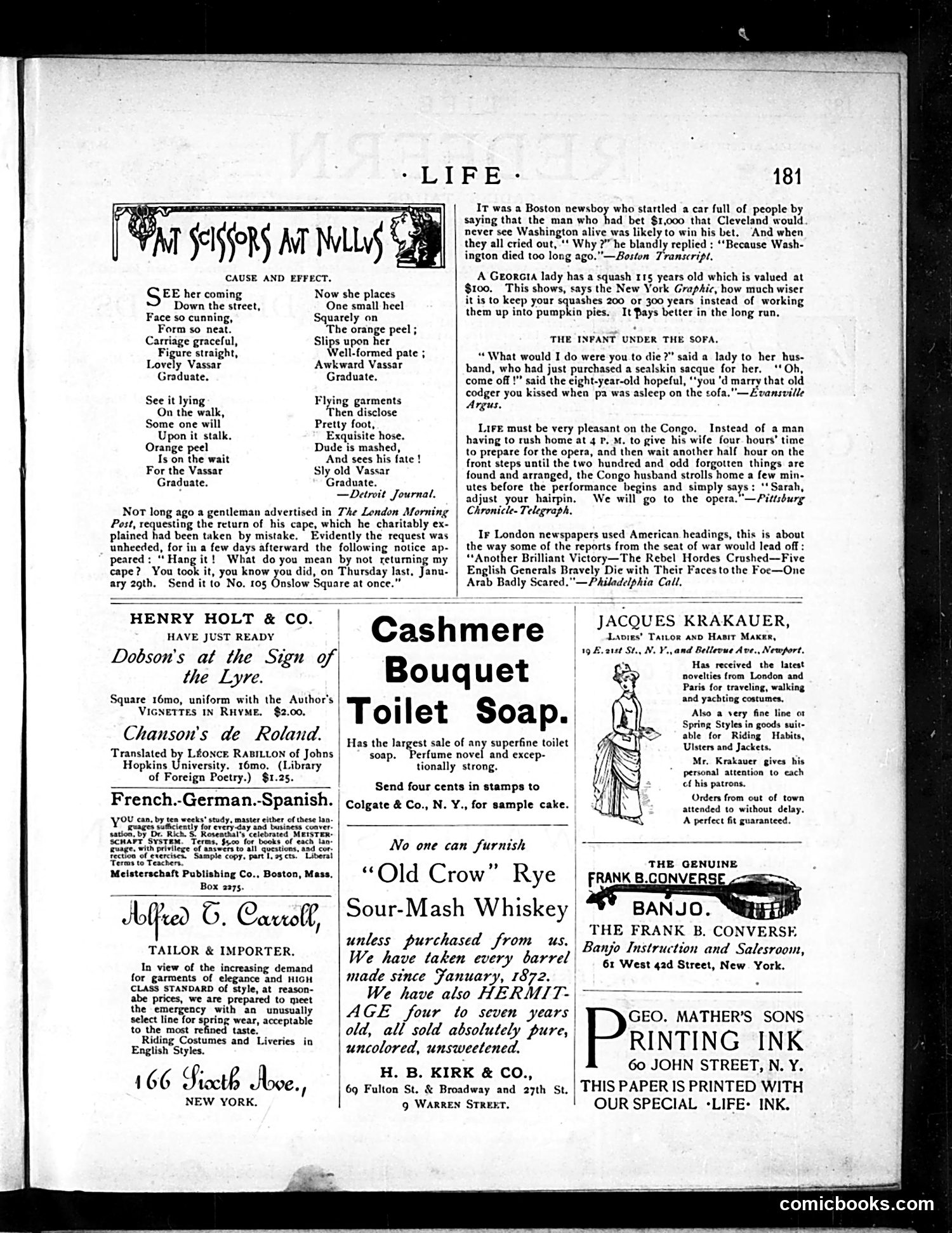
This page is primarily **advertisements and humorous anecdotes** rather than political cartoons. The visual centerpiece is a poem titled "At Scissors at Nulls" contrasting a Vassar graduate's graceful appearance with an "Awkward Vassar Graduate"—satire on women's education and deportment. The anecdotes mock various subjects: a Boston newsboy's joke about Cleveland (likely President Grover Cleveland, playing on the name), a Georgia woman preserving a squash for 115 years, and a woman's cheeky response when her husband asks what she'd do if he died (implying she'd remarry quickly). There's also satire about London war reporting using American-style sensational headlines. The advertisements occupy substantial space, promoting books, tailoring services, whiskey, soap, and banjo instruction—typical of 1880s-90s Life magazine's mixed content format. **No major political cartoons appear on this page**, though the Cleveland reference suggests late-19th-century American publication.
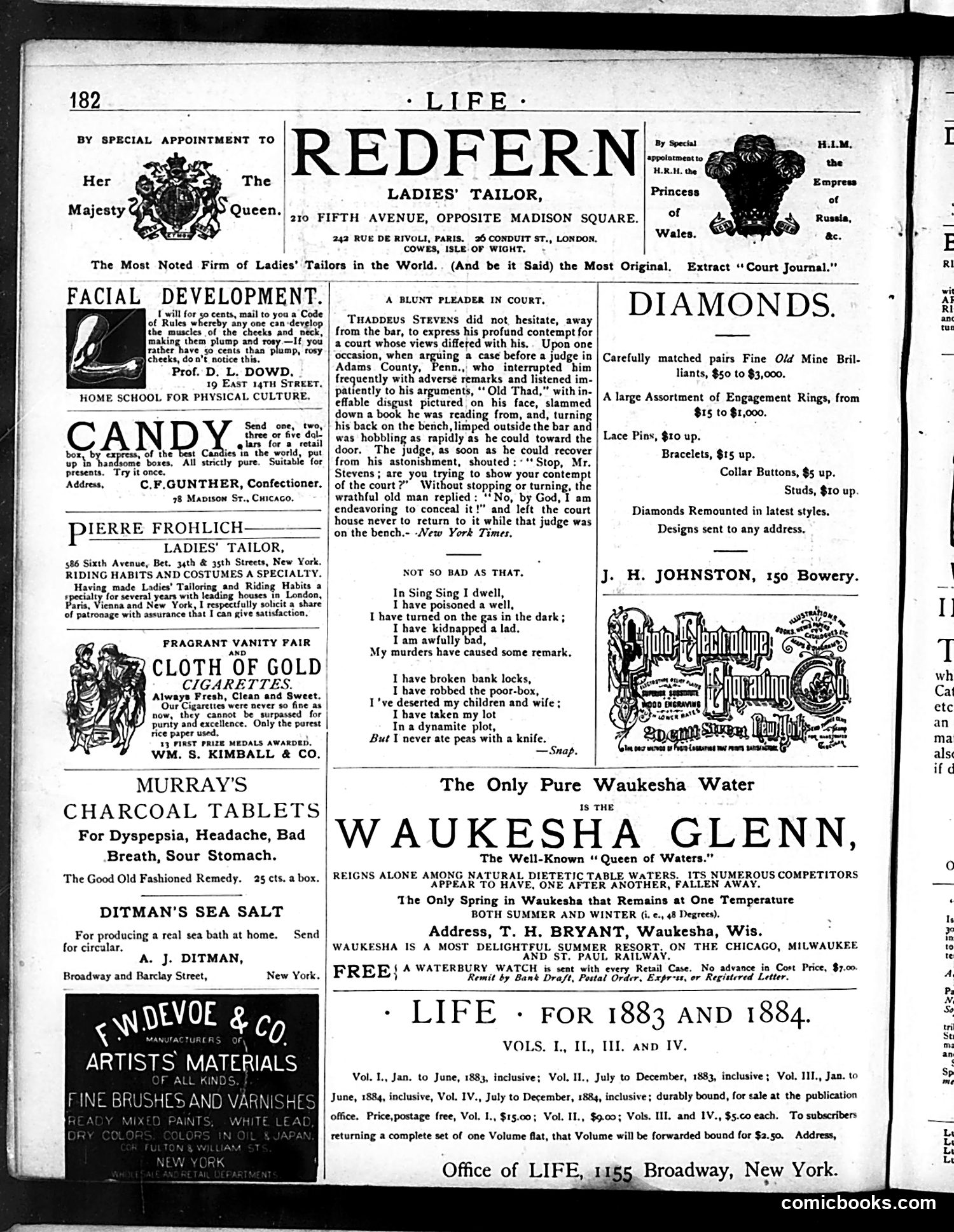
This page is primarily **advertisements** with one notable anecdote. The main text, "A Blunt Pleader in Court," recounts a story about Thaddeus Stevens (a historical congressman known for his abrasive manner) confronting a judge in Adams County, Pennsylvania who repeatedly interrupted his arguments. Stevens's response—slamming his book, limping out of court, and refusing to return—illustrates his legendary contempt for judicial disrespect. The humor lies in Stevens's dramatic protest: rather than verbally argue, he physically withdraws, making his disdain unmistakable. This reflects 19th-century attitudes about honor and courtroom decorum. The page also includes a comedic poem ("Not So Bad As That") about a criminal who confesses to poisoning, kidnapping, and murder—but draws the line at eating peas with a knife, satirizing rigid social etiquette as absurdly prioritized over actual morality. The remaining content consists of period advertisements for tailoring, diamonds, candy, and patent medicines.
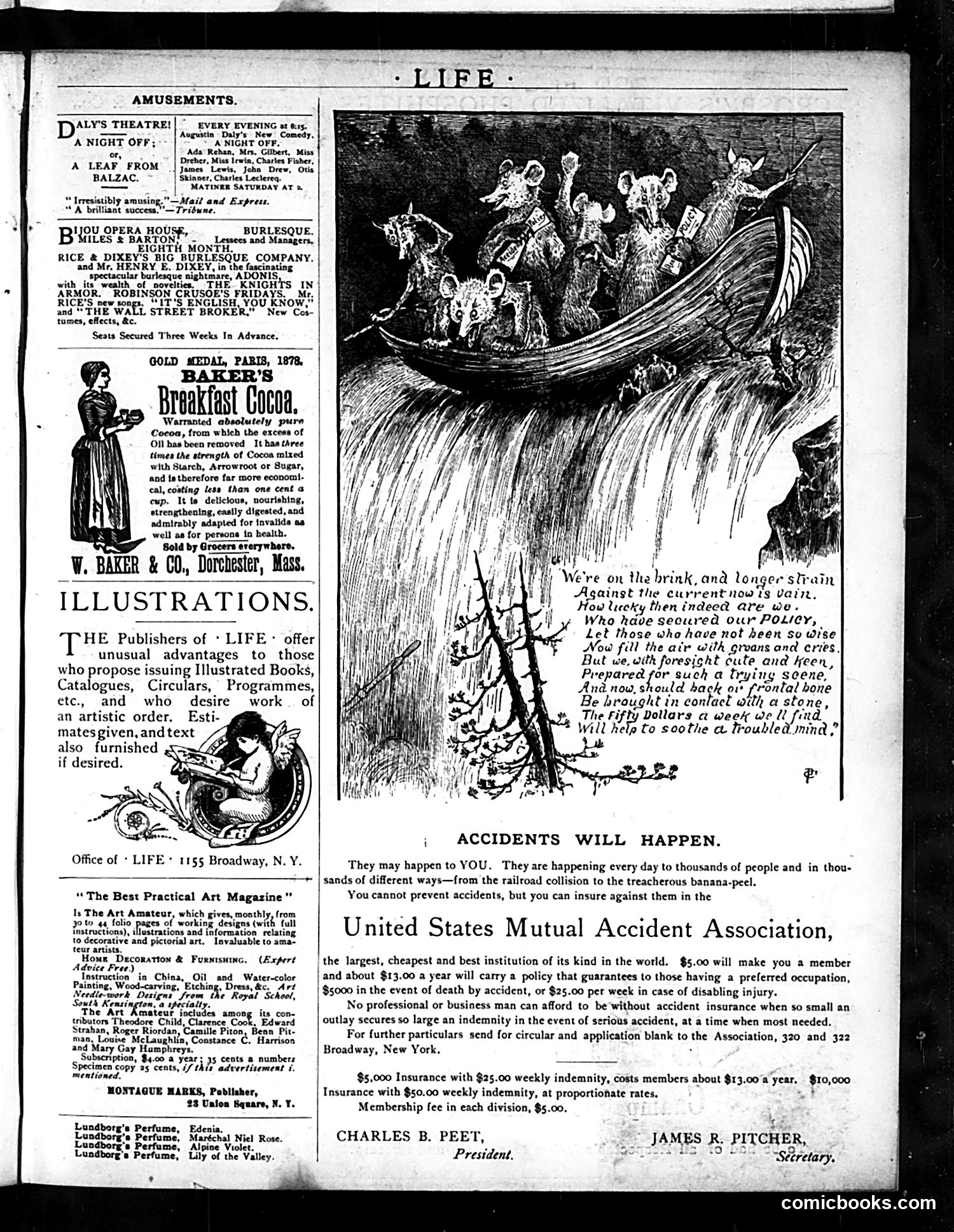
This page features a satirical illustration accompanying an advertisement for accident insurance. The cartoon depicts figures in a boat teetering on a waterfall's edge, with the poetic caption warning of impending disaster: "We're on the brink, and longer strain / Against the current now is vain." The satire targets the *anxiety* of modern life. The verse contrasts two groups: the foolish who face calamity unprepared (filling "the air with groans and cries"), versus the prudent who purchased accident insurance policies—who can calmly accept misfortune knowing they'll receive "$50 a week" in compensation. The joke is deliberately heavy-handed: Life magazine uses melodramatic imagery of imminent catastrophe to mock both the genuine hazards of industrial-era America (railroad collisions, accidents) and the *fear-based marketing* that insurance companies deployed. The cartoon satirizes how insurers exploited public anxiety about unpredictable dangers to sell peace of mind—a recognizable advertising strategy even today.
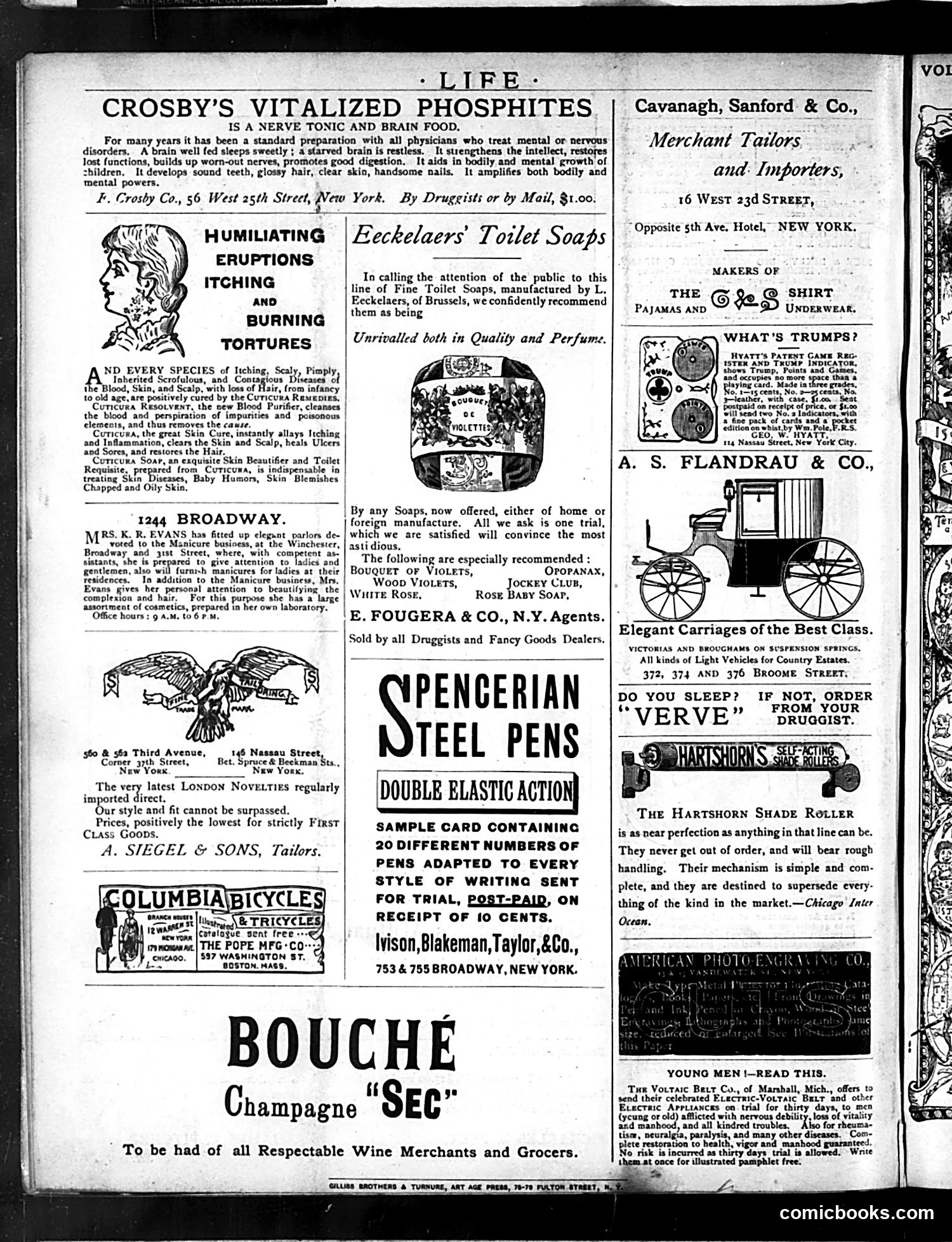
This is primarily an **advertising page** with no political cartoons or satire. The content consists entirely of commercial advertisements typical of late 19th-century American magazines. The advertisements promote various patent medicines and consumer goods reflecting period health concerns: Crosby's Phosphites (a "nerve tonic"), Cuticura remedies (for skin conditions), and Eeckelaers' toilet soaps. These reveal that readers were marketed solutions for ailments like nervous disorders, skin eruptions, and poor complexion—common anxieties of the era. Other ads showcase contemporary consumer products: steel pens, champagne, bicycles, tailoring services, carriages, and a "Hartshorn Shade Roller" (window shade). The page also advertises an "Electric-Voltaic Belt" for treating male ailments—a popular but dubious patent medicine of the period. The only illustration is a simple line drawing of a woman's face with skin problems, accompanying the Cuticura advertisement. There is **no political content or satire** on this particular page.