
Life, 1885-03-26 · page 2 of 16
Life — March 26, 1885 — page 2: what you’re looking at
What you’re looking at
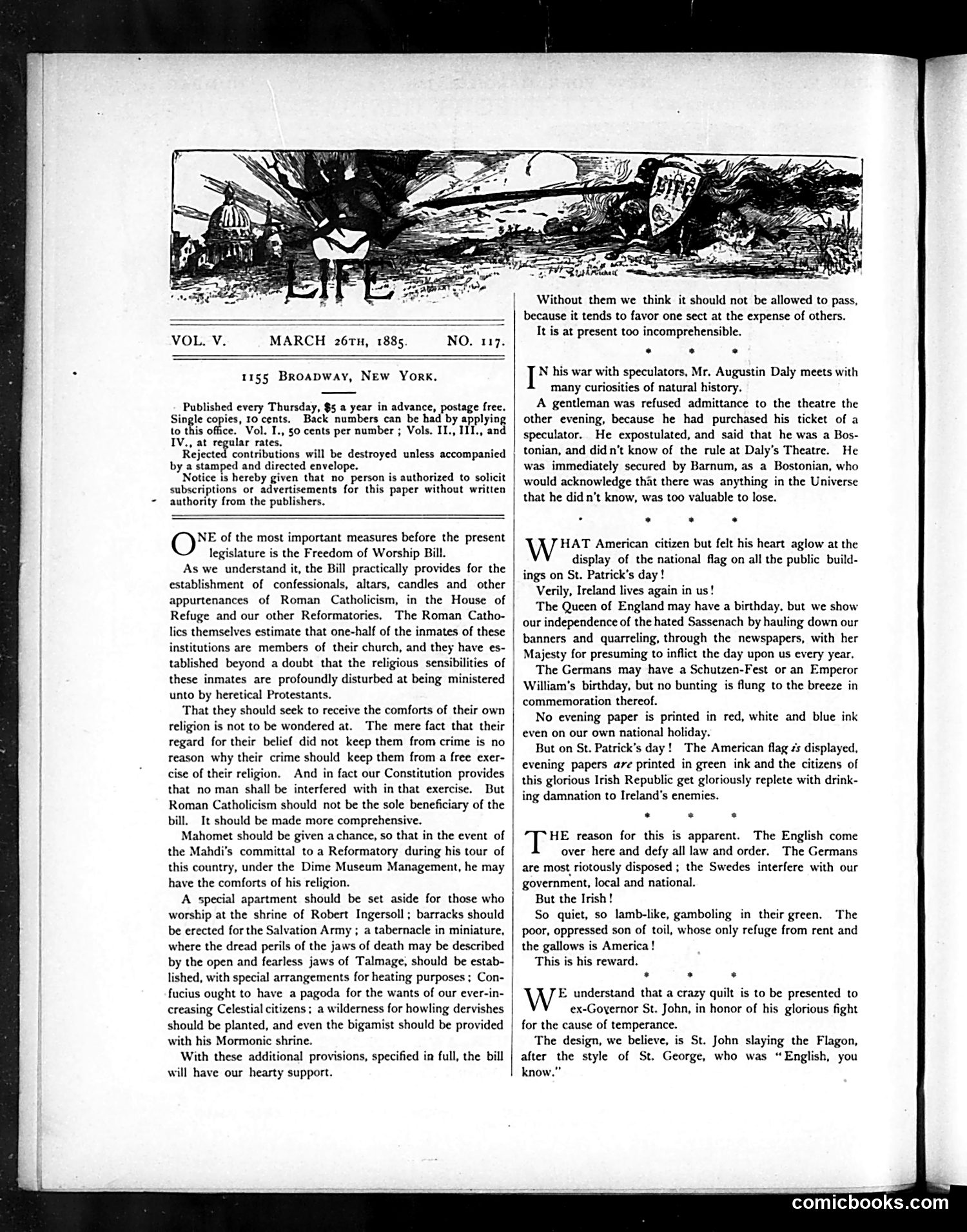
The masthead cartoon depicts a nighttime urban scene with a large tree and buildings, likely illustrating one of the articles below. The text discusses the **Freedom of Worship Bill** before the legislature, advocating for provisions protecting Roman Catholics and other religious groups in institutional settings (refuges, reformatories). The author argues these facilities should allow inmates religious comfort and practice. A separate piece criticizes the display of American flags on public buildings for **St. Patrick's Day**, sarcastically suggesting this represents Irish-American rebellion against English rule. The author mocks Irish citizens as "quiet, lamb-like" yet somehow dangerous, using inflammatory stereotypes common to anti-Irish sentiment of the 1880s. The final note mentions a temperance quilt honoring ex-Governor St. John's prohibition efforts.
📄 Transcribed text from this page (OCR, searchable)
Machine-transcribed from the original scan — historical spelling and the odd misread are preserved.
VOL. V. MARCH 26tu, 1885. 1155 Broapway, New York. Published every Thursday, $5 a year in advance, postage free. Single copies, 10 cents. Back numbers can be had by applying to this office. Vol. I., 50 cents per number ; Vols. II., III., and IV., at regular rates. Rejected contributions will be destroyed unless accompanied by a stamped and directed envelope. Notice is hereby given that no person is authorized to solicit | subscriptions or advertisements for this paper without written | authority from the publishers. NE of the most important measures before the present legislature is the Freedom of Worship Bill. As we understand it, the Bill practically provides for the establishment of confessionals, altars, candles and other appurtenances of Roman Catholicism, in the House of Refuge and our other Reformatories. The Roman Catho- lics themselves estimate that one-half of the inmates of these institutions are members of their church, and they have es- tablished beyond a doubt that the religious sensibilities of these inmates are profoundly disturbed at being ministered unto by heretical Protestants. That they should seek to receive the comforts of their own religion is not to be wondered at. The mere fact that their regard for their belief did not keep them from crime is no reason why their crime should keep them from a free exer- cise of their religion. And in fact our Constitution provides that no man shall be interfered with in that exercise. But Roman Catholicism should not be the sole beneficiary of the | bill. It should be made more comprehensive. Mahomet should be given achance, so that in the event of | the Mahdi’s committal to a Reformatory during his tour of this country, under the Dime Museum Management, he may have the comforts of his religion. A special apartment should be set aside for those who | worship at the shrine of Robert Ingersoll ; barracks should be erected forthe Salvation Army ; a tabernacle in miniature, where the dread perils of the jaws of death may be described by the open and fearless jaws of Talmage, should be estab- lished, with special arrangements for heating purpo: Con- fucius ought to have a pagoda for the wants of our ever-in- creasing Celestial citizens; a wilderness for howling dervishes should be planted, and even the bigamist should be provided with his Mormonic shrine. With these additional provisions, specified in full, the bill will have our hearty support. Without them we think it should not be allowed to pass, because it tends to favor one sect at the expense of others. It is at present too incomprehensible. . * ° I N his war with speculators, Mr. Augustin Daly meets with many curiosities of natural history. A gentleman was refused admittance to the theatre the other evening, because he had purchased his ticket of a speculator. He expostulated, and said that he was a Bos- tonian, and didn’t know of the rule at Daly’s Theatre. He was immediately secured by Barnum, as a Bostonian, who would acknowledge that there was anything in the Universe that he didn’t know, was too valuable to lose. HAT American citizen but felt his heart aglow at the display of the national flag on all the public build ings on St. Patrick’s day ! Verily, Ireland lives again in us! The Queen of England may have a birthday. but we show our independence of the hated Sassenach by hauling down our banners and quarreling, through the newspapers, with her Majesty for presuming to inflict the day upon us every year. The Germans may have a Schutzen-Fest or an Emperor William's birthday, but no bunting is flung to the breeze in commemoration thereof. No evening paper is printed in red, white and blue ink even on our own national holiday. But on St. Patrick's day! The American flag zs displayed, evening papers are printed in green ink and the citizens of | this glorious Irish Republic get gloriously replete with drink- ing damnation to Ireland's enemies. HE reason for this is apparent. The English come over here and defy all law and order. The Germans are most riotously disposed ; the Swedes interfere with our government, local and national. But the Irish! So quiet, so lamb-like, gamboling in their green. The poor, oppressed son of toil, whose only refuge from rent and the gallows is America! This is his reward. . . . WE understand that a crazy quilt is to be presented to ex-Goyernor St. John, in honor of his glorious fight for the cause of temperance. The design, we believe, is St. John slaying the Flagon, after the style of St. George, who was “English, you know.” comicbooks.com