
Life, 1885-03-26 · page 11 of 16
Life — March 26, 1885 — page 11: what you’re looking at
What you’re looking at
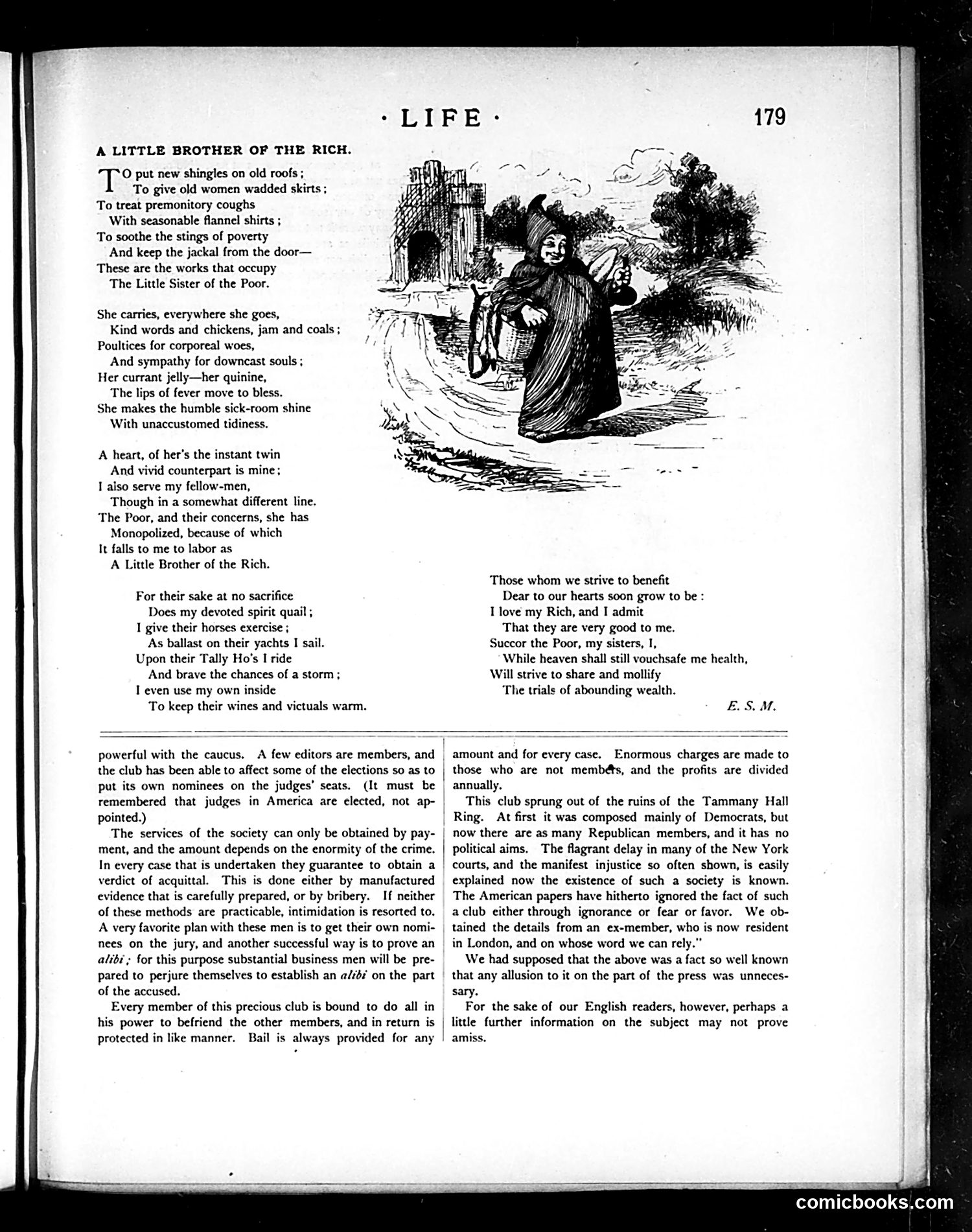
This poem satirizes wealthy philanthropists by contrasting them with the "Little Sister of the Poor" (a reference to an actual Catholic charitable organization). The speaker ironically claims to be a "Little Brother of the Rich," serving the wealthy by exercising their horses, sailing on their yachts, and keeping their wine warm—trivial tasks masquerading as noble service. The satire's bite: while religious sisters genuinely help the poor (providing food, medicine, comfort), the wealthy's "little brother" performs useless services for people already drowning in luxury, yet claims equal moral standing. The closing couplet delivers the joke—he'll "strive to share and mollify / The trials of abounding wealth," mocking the notion that the rich face genuine hardship requiring compassionate intervention. The accompanying prose discusses a corrupt New York club guaranteeing acquittals through bribery and perjured alibis, suggesting that wealth-serving corruption extended far beyond charity into actual justice.
📄 Transcribed text from this page (OCR, searchable)
Machine-transcribed from the original scan — historical spelling and the odd misread are preserved.
A LITTLE BROTHER OF THE RICH. Ee. put new shingles on old roofs ; To give old women wadded skirts ; To treat premonitory coughs With seasonable flannel shirts ; To soothe the stings of poverty And keep the jackal from the door— These are the works that occupy The Little Sister of the Poor. She carries, everywhere she goes, Kind words and chickens, jam and coals ; Poultices for corporeal woes, And sympathy for downcast souls ; Her currant jelly—her quinine, The lips of fever move to bless. She makes the humble sick-room shine With unaccustomed tidiness. A heart, of her's the instant twin And vivid counterpart is mine; I also serve my fellow-men, Though in a somewhat different line. The Poor, and their concerns, she has Monopolized, because of which It falls to me to labor as A Little Brother of the Rich. For their sake at no sacrifice Does my devoted spirit quail ; I give their horses exercise ; As ballast on their yachts I sail. Upon their Tally Ho's I ride And brave the chances of a storm ; I even use my own inside To keep their wines and victuals warm. Those whom we strive to benefit Dear to our hearts soon grow to be : T love my Rich, and I admit That they are very good to me. Succor the Poor, my sisters, I, While heaven shall still vouchsafe me health, Will strive to share and mollify The trials of abounding wealth. E.S.M. powerful with the caucus. A few editors are members, and the club has been able to affect some of the elections so as to | put its own nominees on the judges’ seats. (It must be remembered that judges in America are elected, not ap- pointed.) The services of the society can only be obtained by pay- ment, and the amount depends on the enormity of the crime. In every case that is undertaken they guarantee to obtain a | verdict of acquittal. This is done either by manufactured evidence that is carefully prepared, or by bribery. If neither of these methods are practicable, intimidation is resorted to. A very favorite plan with these men is to get their own nomi- nees on the jury, and another successful way is to prove an alibi ; for this purpose substantial business men will be pre- pared to perjure themselves to establish an a/¢és' on the part of the accused. Every member of this precious club is bound to do all in his power to befriend the other members, and in return is | protected in like manner. Bail is always provided for any amount and for every case. Enormous charges are made to those who are not membéts, and the profits are divided annually, This club sprung out of the ruins of the Tammany Hall Ring. At first it was composed mainly of Democrats, but now there are as many Republican members, and it has no political aims. The flagrant delay in many of the New York courts, and the manifest injustice so often shown, is easily explained now the existence of such a society is known. The American papers have hitherto ignored the fact of such aclub either through ignorance or fear or favor. We ob- tained the details from an ex-member, who is now resident in London, and on whose word we can rely.” We had supposed that the above was a fact so well known that any allusion to it on the part of the press was unneces- sary. For the sake of our English readers, however, perhaps a little further information on the subject may not prove amiss. comicbooks.com