
Life, 1885-03-26 · page 10 of 16
Life — March 26, 1885 — page 10: what you’re looking at
What you’re looking at
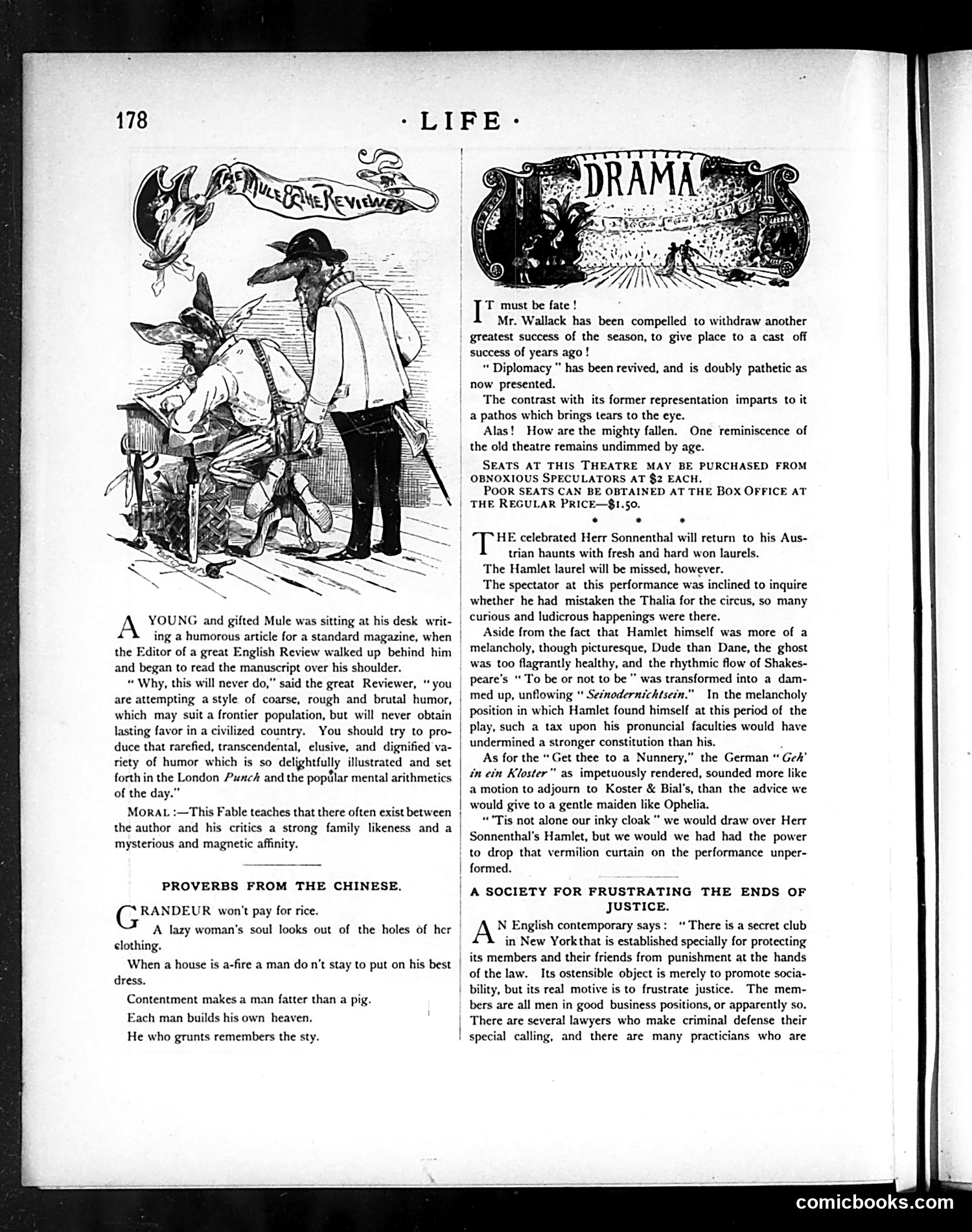
**The Mule Cartoon (Top Left):** A young American writer ("Mule") is criticized by a pompous English Review editor for writing "coarse, rough and brutal humor" suited only to "frontier population." The editor insists he should imitate London's *Punch* magazine's "rarefied, transcendental" style. The moral: critics often resemble those they criticize—suggesting the editor's pretentiousness mirrors his own limitations. This satirizes the American anxiety about European cultural superiority and mocks affected literary elitism. **Drama Section (Right):** Theater criticism attacking actor Herr Sonnenthal's performance of *Hamlet*. The review ridicules his interpretation—portraying Hamlet as a vain "Dude," the Ghost as "too flagrantly healthy," and his German pronunciation of "Geh' in ein Kloster" sounding like an adjournment to a dance hall (Koster & Bial's). The satire targets both pretentious foreign actors and absurd theatrical excess. **Lower Section:** Reports on a secretive New York club allegedly protecting wealthy members and friends from legal consequences—ostensibly social, actually enabling injustice through lawyer members.
📄 Transcribed text from this page (OCR, searchable)
Machine-transcribed from the original scan — historical spelling and the odd misread are preserved.
YOUNG and gifted Mule was sitting at his desk writ- ing a humorous article for a standard magazine, when the Editor of a great English Review walked up behind him and began to read the manuscript over his shoulder. “ Why, this will never do,” said the great Reviewer, “you are attempting a style of coarse, rough and brutal humor, which may suit a frontier population, but will never obtain lasting favor in a civilized country. You should try to pro- duce that rarefied, transcendental, elusive, and dignified va- | riety of humor which is so delightfully illustrated and set | forth in the London Punch and the popilar mental arithmetics of the day.” MorAL :—This Fable teaches that there often exist between | the author and his critics a strong family likeness and a | mysterious and magnetic affinity. PROVERBS FROM THE CHINESE. RANDEUR won't pay for rice. A lazy woman's soul looks out of the holes of her clothing. When a house is a-fire a man don’t stay to put on his best dress. Contentment makes a man fatter than a pig. Each man builds his own heaven. He who grunts remembers the sty. | T must be fate! Mr. Wallack has been compelled to withdraw another greatest success of the season, to give place to a cast off success of years ago! “ Diplomacy " has been revived, and is doubly pathetic as now presented. The contrast with its former representation imparts to it a pathos which brings tears to the eye. Alas! How are the mighty fallen. One reminiscence of the old theatre remains undimmed by age. SEATS AT THIS THEATRE MAY BE PURCHASED FROM OBNOXIOUS SPECULATORS AT $2 EACH. POOR SEATS CAN BE OBTAINED AT THE BOX OFFICE AT THE REGULAR PRICE—$1.50. . . . HE celebrated Herr Sonnenthal will return to his Aus- trian haunts with fresh and hard won laurels. The Hamlet laurel will be missed, however. The spectator at this performance was inclined to inquire whether he had mistaken the Thalia for the circus, so many curious and ludicrous happenings were there. Aside from the fact that Hamlet himself was more of a melancholy, though picturesque, Dude than Dane, the ghost was too flagrantly healthy, and the rhythmic flow of Shakes- peare’s “ To be or not to be” was transformed into a dam- med up, unflowing “ Secnodernichtsein.” In the melancholy position in which Hamlet found himself at this period of the play, such a tax upon his pronuncial faculties would have undermined a stronger constitution than his. As for the “Get thee to a Nunnery,” the German “ Geh’ in ein Kloster” as impetuously rendered, sounded more like a motion to adjourn to Koster & Bial's, than the advice we would give to a gentle maiden like Ophelia. “Tis not alone our inky cloak” we would draw over Herr Sonnenthal’s Hamlet, but we would we had had the power to drop that vermilion curtain on the performance unper- formed. A SOCIETY FOR FRUSTRATING THE ENDS OF JUSTICE. N English contemporary says: “There is a secret club in New York that is established specially for protecting its members and their friends from punishment at the hands of the law. Its ostensible object is merely to promote socia- bility, but its real motive is to frustrate justice. The mem- bers are all men in good business positions, or apparently so. There are several lawyers who make criminal defense their special calling, and there are many practicians who are n comicbooks.com