
A complete issue · 16 pages · 1884
Life — December 18, 1884
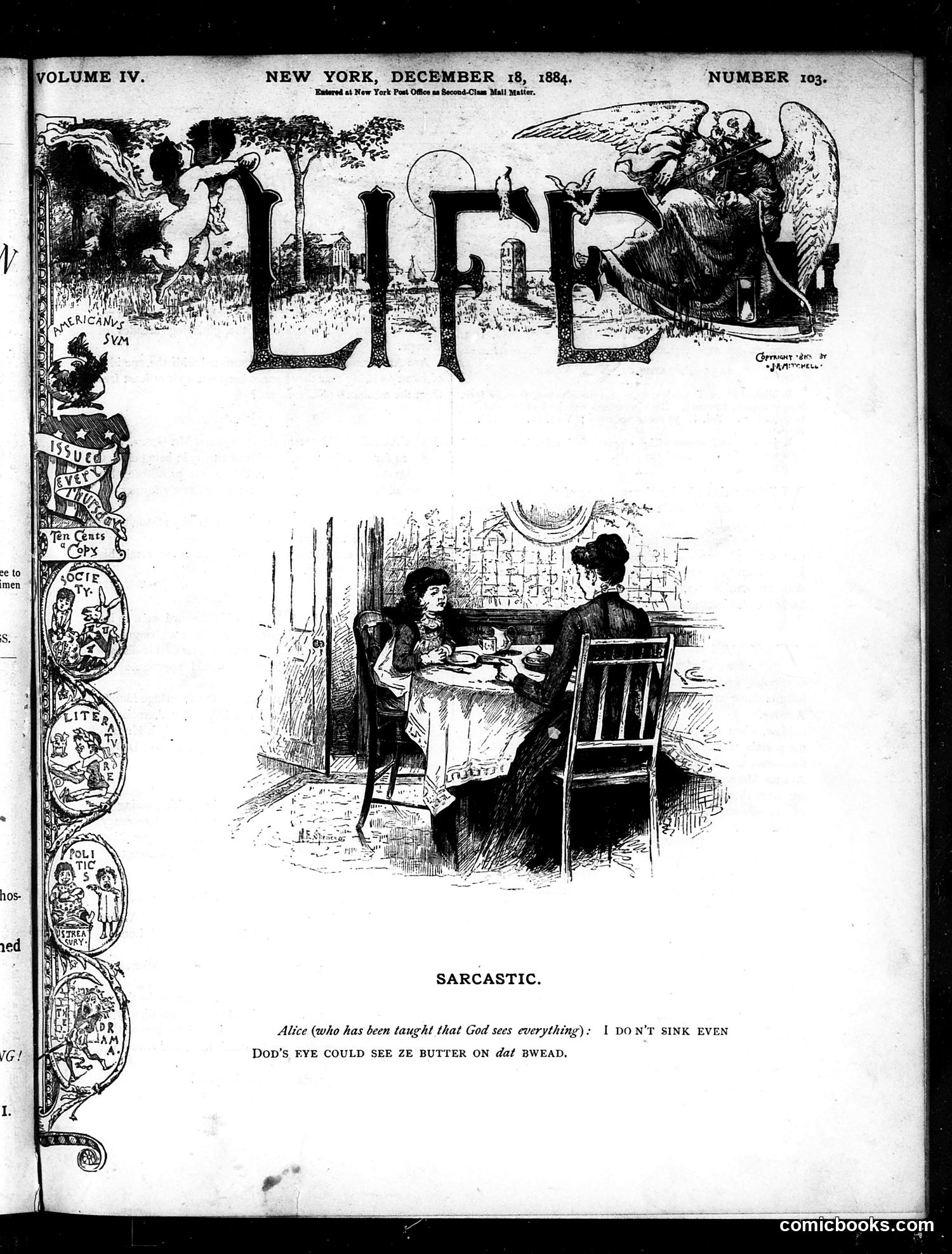
**Main Cartoon (bottom):** Titled "Sarcastic," this shows a domestic scene with a woman and man at a table. The caption quotes Alice (presumably the woman), who's been "taught that God sees everything," sarcastically remarking: "I DON'T SINK EVEN DOD'S EYE COULD SEE ZE BUTTER ON DAT SWEAD." The joke targets domestic dishonesty—specifically, skimping on butter portions. The dialectal speech ("Dod," "swead") suggests a working-class or immigrant character. The satire ridicules petty household economies where people cheat on small amounts while claiming moral virtue. The religious reference to God seeing "everything" creates ironic contrast with such trivial deception. The elaborate decorative masthead and ornamental borders are typical of 1880s Life magazine design.
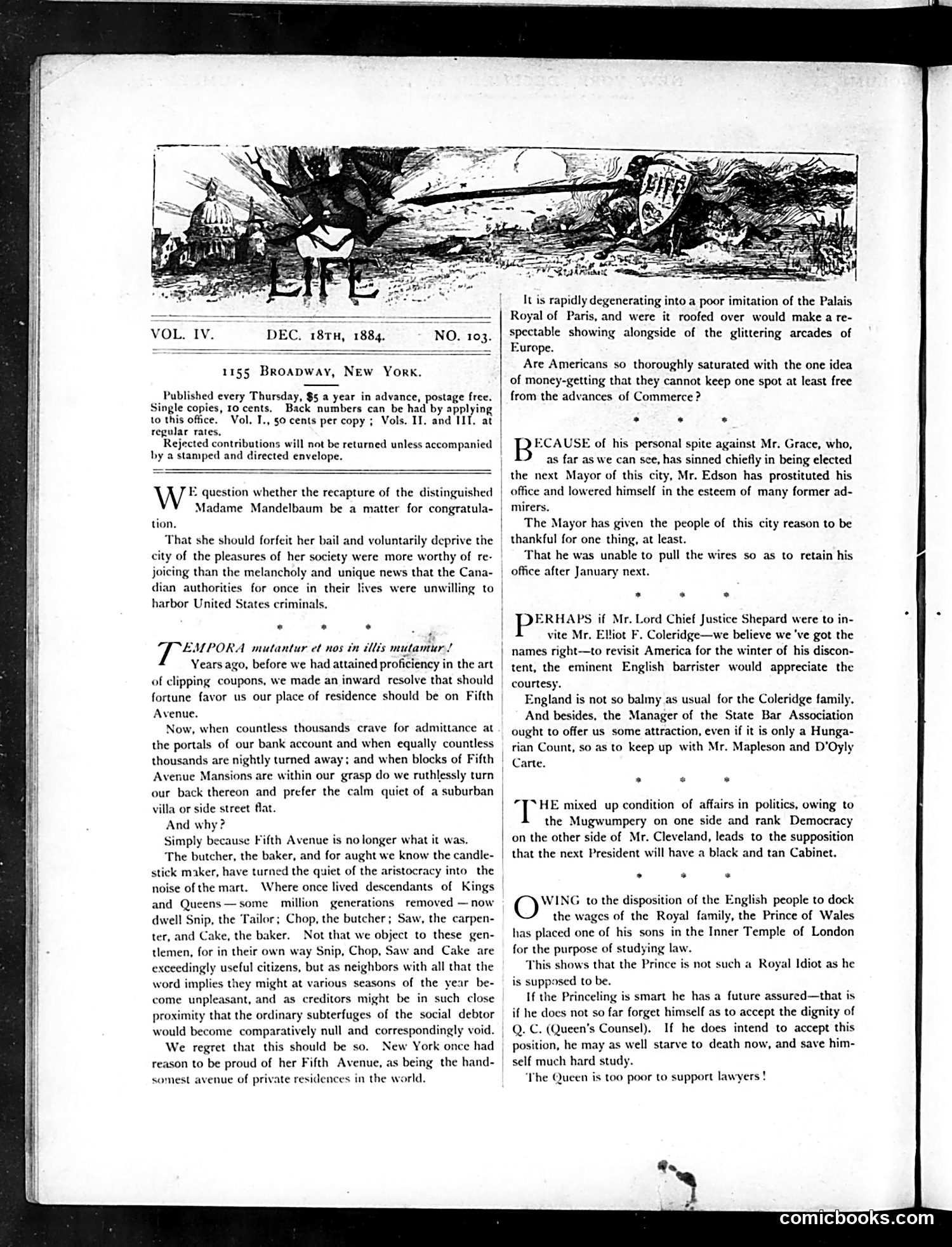
The header illustration depicts "LIFE" with classical and allegorical imagery, though specific figures are unclear from the image quality. The editorial content critiques several topics: 1. **Madame Mandelbaum's recapture**: The editors debate whether her extradition is cause for congratulation, noting the Canadian authorities' unusual willingness to harbor a U.S. criminal. 2. **Fifth Avenue's decline**: The piece laments how Fifth Avenue has lost its prestige as the finest residential street, now attracting "countless thousands" seeking admission—implying overcrowding and commercialization have ruined its exclusivity. 3. **English visitors and politics**: References to Lord Chief Justice Shepard, the Coleridge family, and American political divisions (Cleveland presidency, Democracy vs. Republicans) suggest satirizing both English visitors' observations and domestic political instability. The satire targets social decay, political confusion, and America's changing urban character.
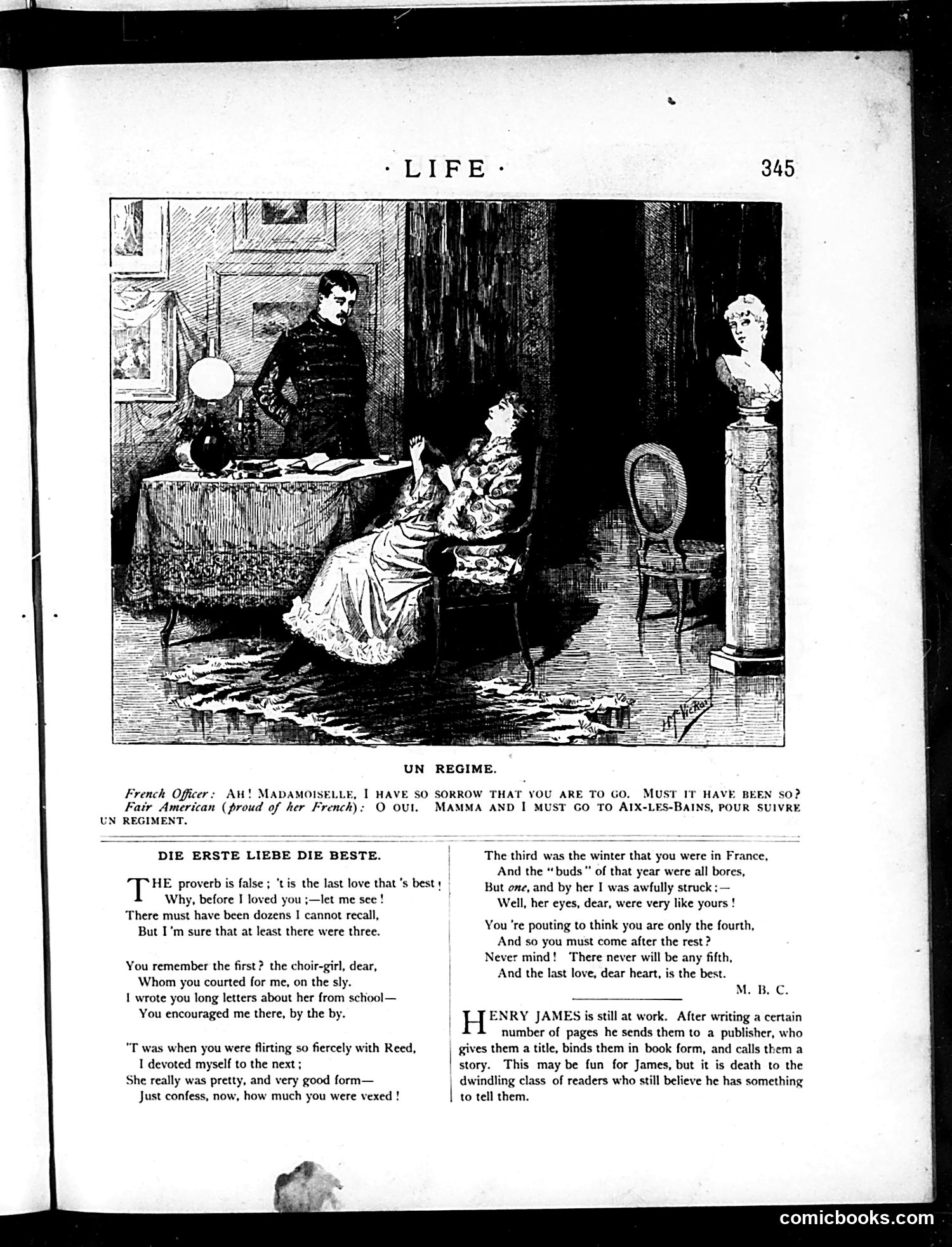
This satirical cartoon depicts a romantic/domestic scene titled "Un Regime" (French for "A Diet" or "A Regime"). The dialogue shows a French officer telling a fair American woman he must leave to join his regiment at Aix-les-Bains. The humor works on multiple levels: the French phrase "un regime" suggests both military duty and romantic constraint. The poem below, "Die Erste Liebe Die Beste" (German: "First Love is Best"), presents a cynical meditation on love and infidelity, with the speaker recounting multiple romantic entanglements and acknowledging the woman is "only the fourth." The satire targets both French militarism and romantic hypocrisy among officers. The accompanying prose about Henry James provides literary context, though it appears disconnected from the main cartoon's subject matter.
This page contains two main sections: **"By the Way"** - A column of brief satirical commentary on current events, including references to: - John C. Eno (Canadian society figure) - The Armstrong Petroleum well at Bradford, PA - Washington Monument completion - Egyptian antiquities - Irving as an artist - The Mahdi (appearing to reference the Mahdist War) - Cleveland's election impact on the hat trade **"An Old-Fashioned Villain"** - A humorous story about a cat named Ginger in Salem who schemes against a rival cat, using dramatic language typically reserved for serious villainy. **"Bookshelf"** - Book review section mentioning Andrew Carnegie and commentary on the *New Book of Kings*. The page is primarily text-based satire and commentary rather than visual cartoons. The humor relies on juxtaposing trivial matters (hats, cats) with grandiose language.
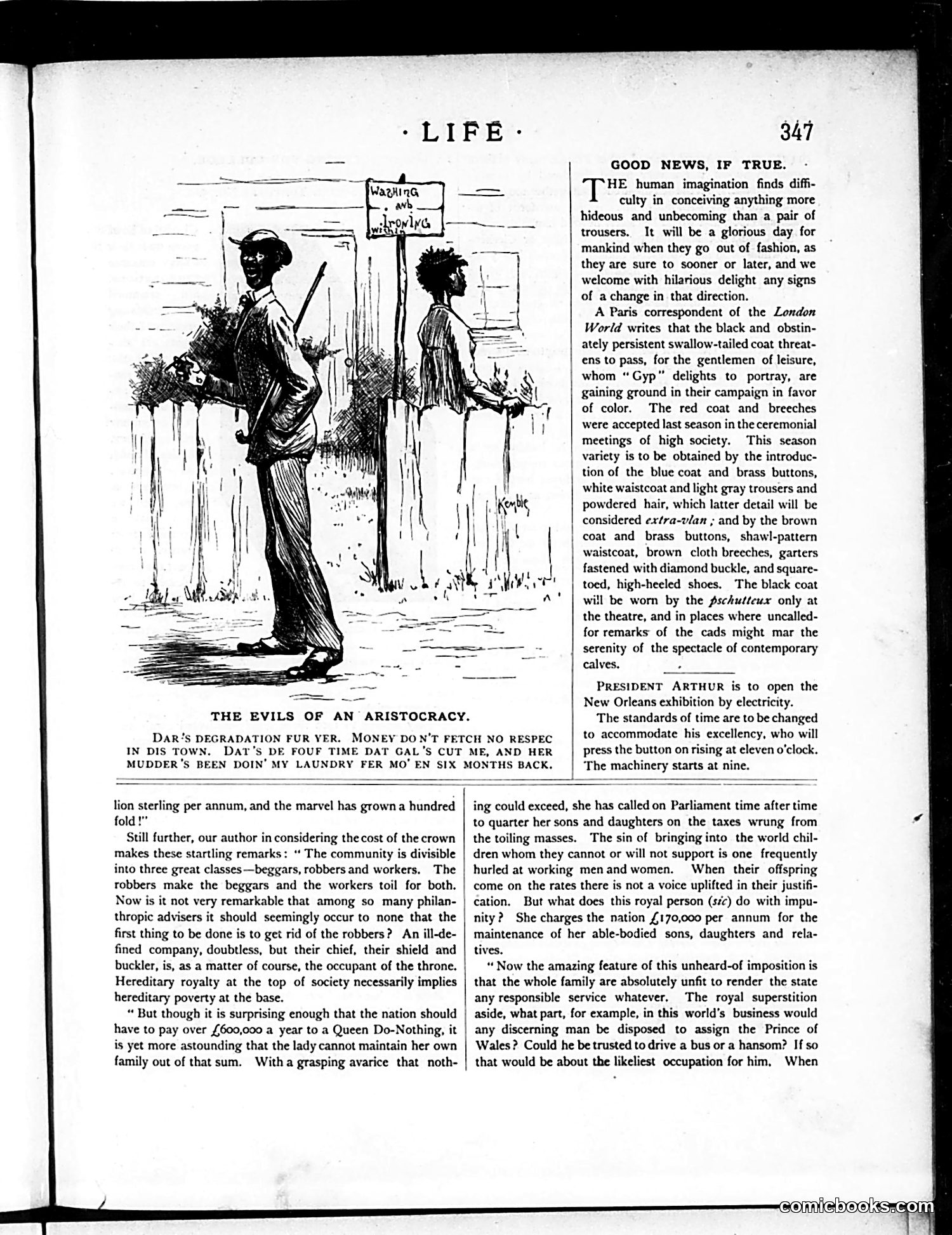
The main cartoon, titled "The Evils of an Aristocracy," depicts two fashionably dressed figures outside what appears to be a fashionable establishment. The caption mockingly quotes a woman complaining about her servant: "Dar's degradation fur ver. Money do n't fetch no respec' in dis town. Dar's de pouf time gal 's cut me, and her mudder's been doin' my laundry fer mo' en six months back." The satire targets aristocratic pretension and class hypocrisy—wealthy society women who employ working-class servants yet refuse them basic social respect. The exaggerated dialect emphasizes the servant's perspective, highlighting the absurdity of economic dependence coexisting with social contempt. The cartoon critiques how money alone fails to guarantee respect within rigid class hierarchies, exposing the disconnect between economic reality and social position.
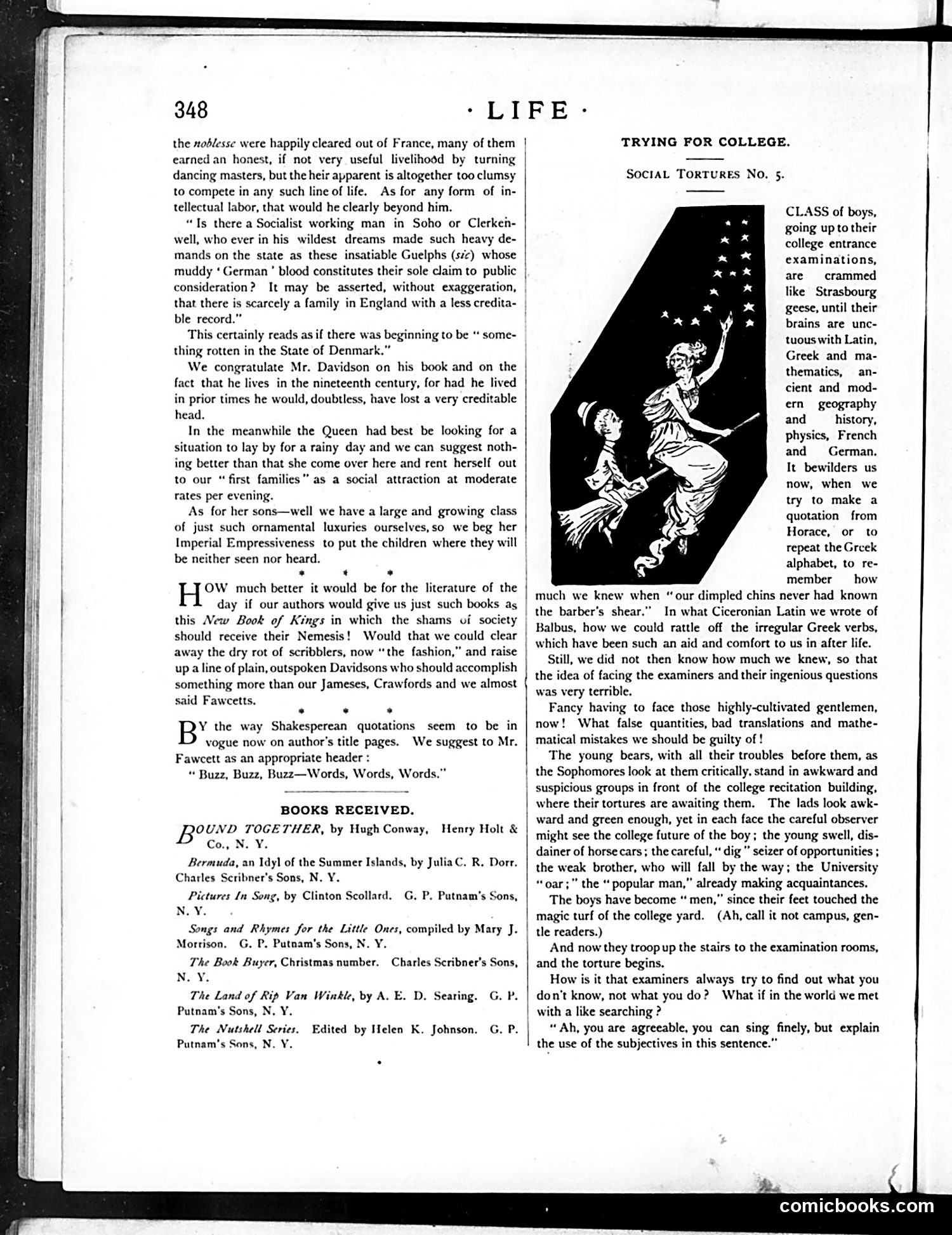
This cartoon satirizes the ordeal of college entrance examinations. The illustration shows two figures—likely representing anxious students—being literally tortured by an examiner wielding a whip or rod, depicted allegorically as Nemesis or a classical torture figure. The accompanying text describes the psychological torment: students are crammed with Latin, Greek, mathematics, and other subjects until their "brains are unscrupulous." The satire mocks how examiners deliberately ask questions testing knowledge students weren't taught, seeking "what you don't know, not what you do." The joke targets the arbitrary cruelty of college entrance examinations—their apparent design to confuse rather than fairly assess students' actual learning.
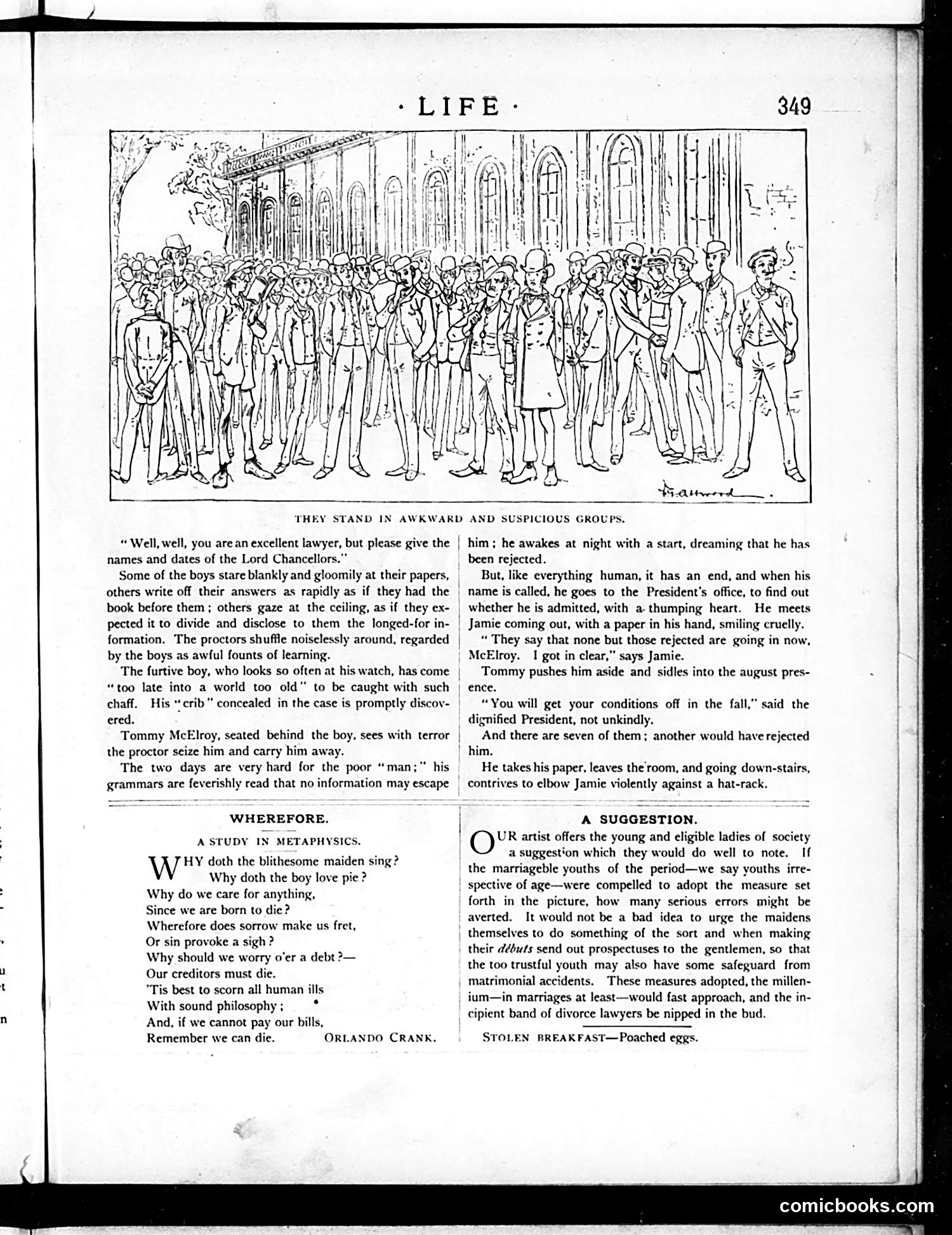
The main illustration shows a crowd of formally dressed men in awkward, suspicious groupings. The caption "They Stand in Awkward and Suspicious Groups" and accompanying narrative describe young men awaiting notification about their admission to an unnamed prestigious institution—likely a university or professional school. The story focuses on Tommy McElroy, who anxiously awaits news of his acceptance. The satire mocks the anxious waiting period and the arbitrary institutional processes that determine young men's futures, with particular attention to how rejection devastates applicants. The text also includes Orlando Crank's philosophical poem "Wherefore," a mock-serious meditation on suffering and debt, adding satirical commentary on youth, ambition, and financial hardship. The overall piece satirizes institutional gatekeeping and young male social anxiety.
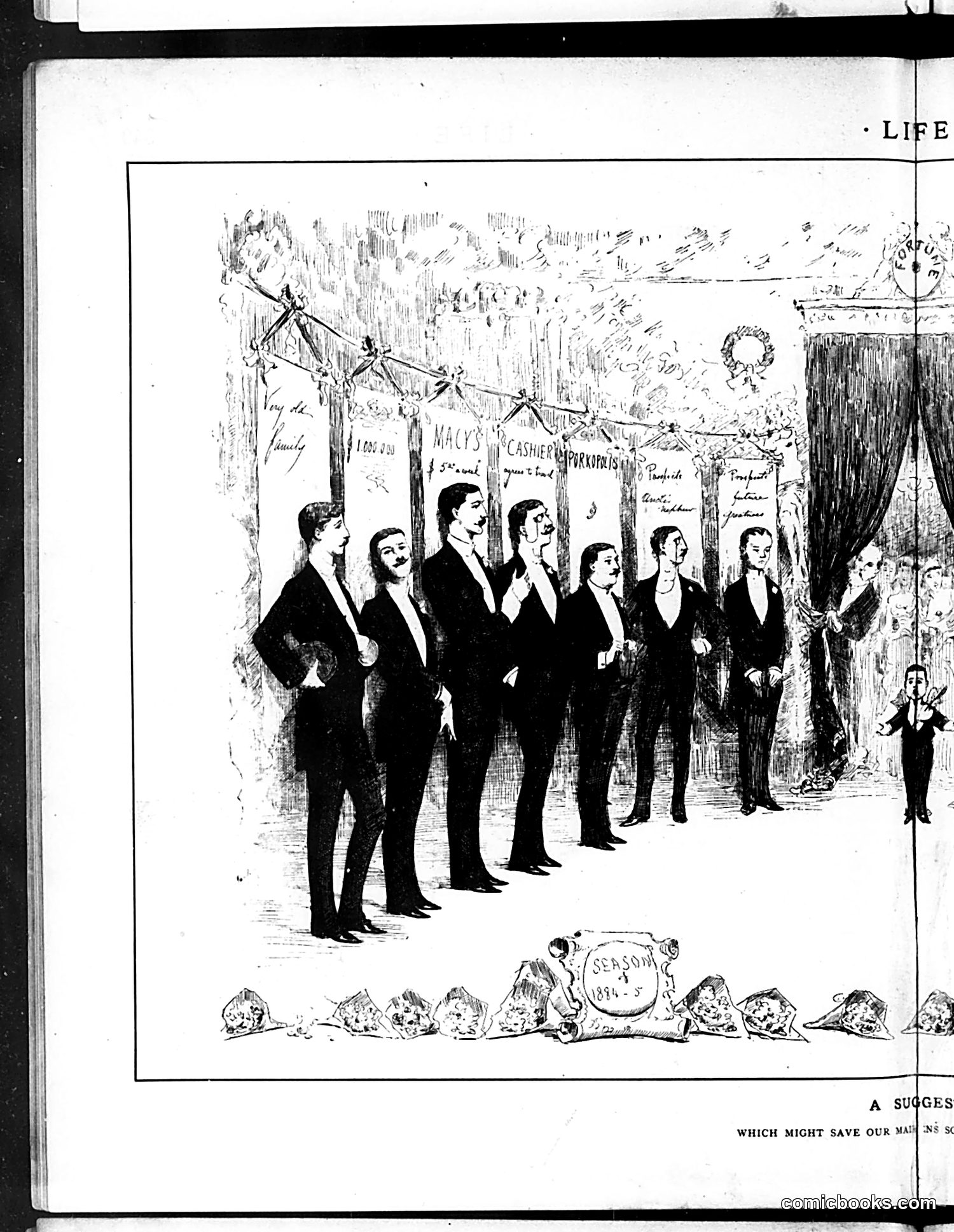
This cartoon depicts a line of formally dressed men in dark suits standing before a decorated storefront or display. The visible text references "CASHIER," "SHOPKEEPER," and what appears to be "SEASON'S [GREETINGS]" dated 1894. The caption reads: "A SUGGESTION WHICH MIGHT SAVE OUR MERCHANTS" (text partially cut off). The satirical point appears to concern holiday shopping and retail commerce during the 1894 season. The row of identical-looking businessmen suggests commentary on conformity in commercial practice or merchant behavior during the Christmas season. The decorative garland and holiday imagery indicate seasonal retail expectations. However, **without the complete caption and more historical context about 1894 economic conditions or specific merchant practices**, the precise satirical target—whether about pricing, labor practices, advertising, or competitive behavior—remains somewhat unclear.
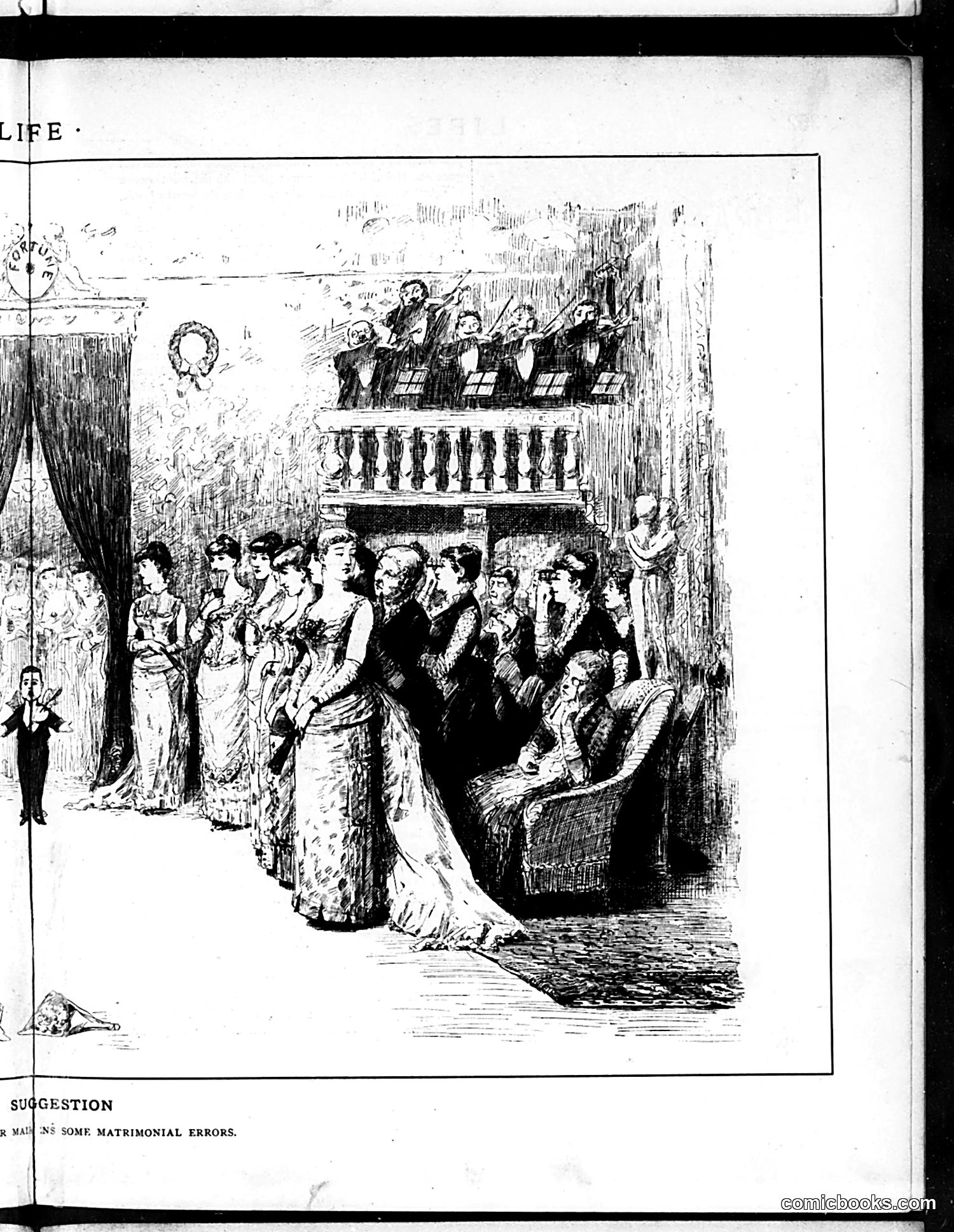
This is a satirical illustration about matrimonial problems, as indicated by the caption "Some Matrimonial Errors." The scene depicts an elegant indoor social gathering or concert, with well-dressed attendees viewing performers on a balcony stage above. The satire appears to target marital discord in high society. The formal setting—with musicians performing and fashionably dressed guests—contrasts with the caption's suggestion of domestic failures. The joke likely implies that even in refined social contexts, marriage problems persist, or perhaps that couples use public events as escapes from troubled relationships. The specific "errors" referenced are unclear without additional context, but the image satirizes the contrast between outward respectability and inward marital unhappiness among the upper classes.
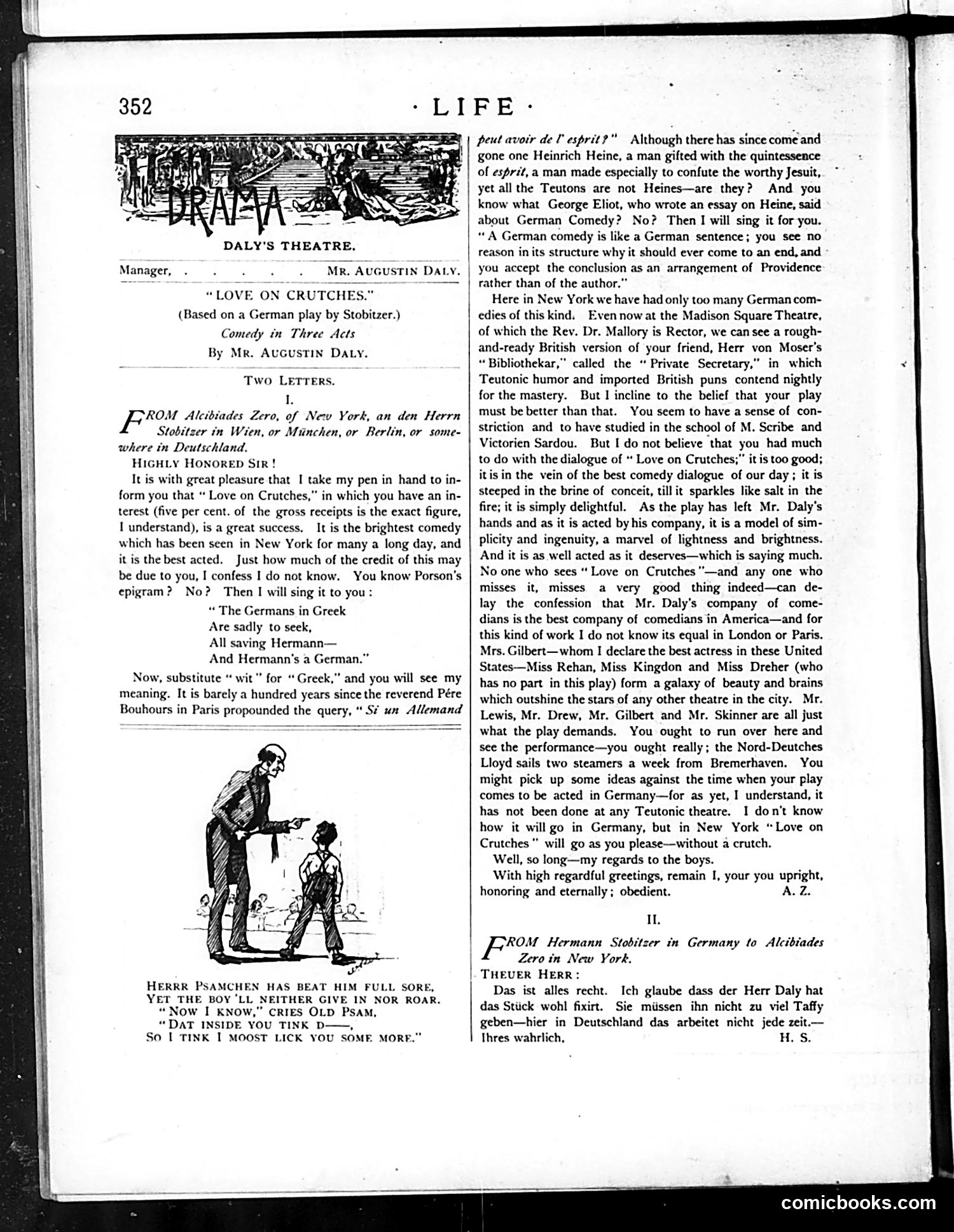
This page reviews Augustin Daly's American production of a German play by Stobitzer. The accompanying cartoon depicts a stern adult figure threatening a small boy with physical punishment—illustrating the crude, physical humor the text associates with German comedy. The review is structured as two letters debating German wit. The first (from "Alcibiades Zero" in New York to the original playwright) teases Germans for lacking sophistication in comedy, citing a classical epigram about German competence in Greek. It contrasts this stereotype with Heinrich Heine as an exception and George Eliot's famous quip that German comedies are structurally endless and arbitrary. However, the writer praises Daly's production as genuinely witty and well-acted—suggesting Daly's American adaptation transcends typical German theatrical crudeness. The review lavishes praise on the company, particularly actress Mrs. Gilbert, positioning American theatrical sophistication above both German and British efforts. The second letter (in German) appears to be the German playwright's response.
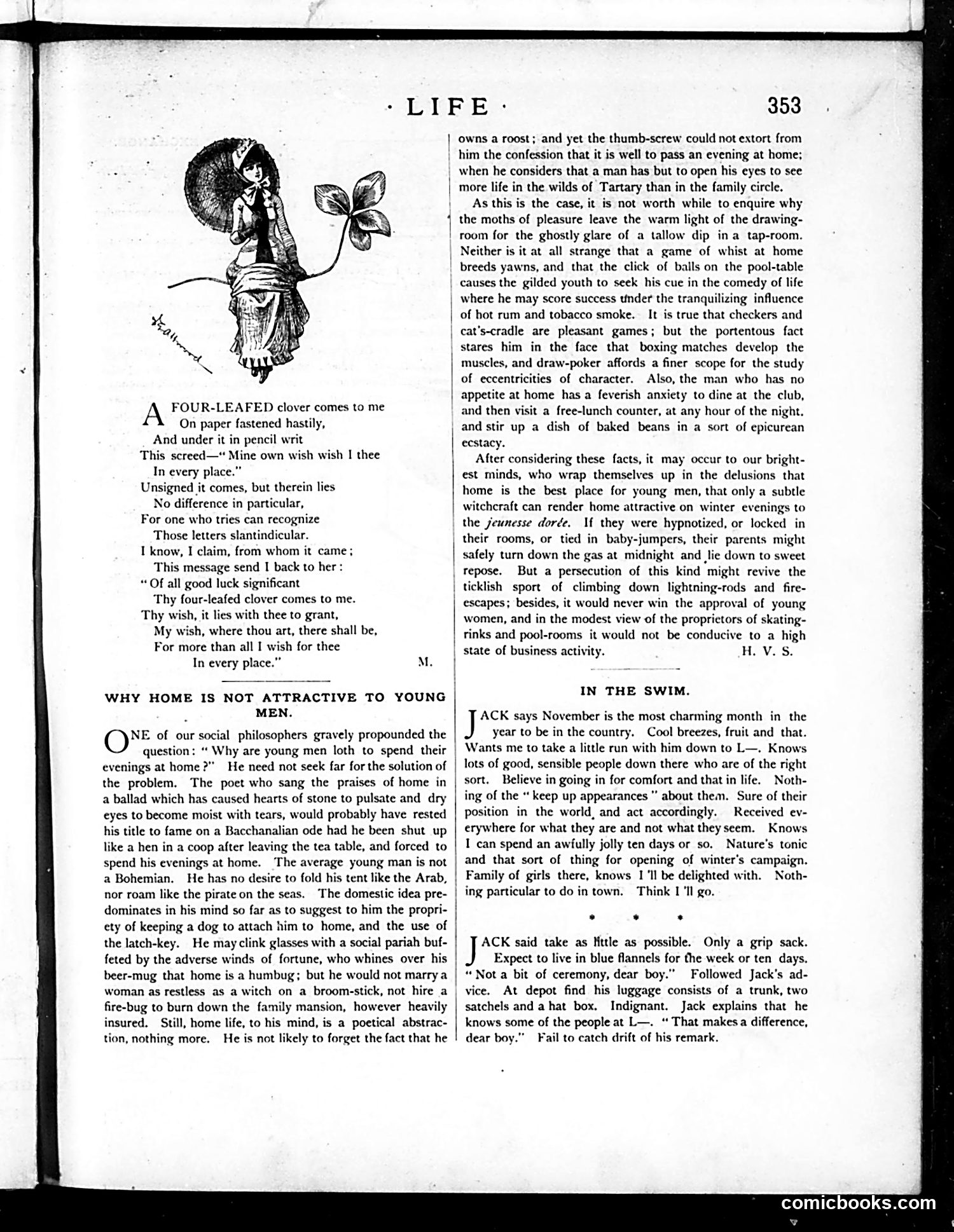
This Life magazine page (p. 353) contains social satire aimed at young men of the era. The illustrated poem at top depicts a romantic exchange of four-leaf clovers between correspondents—typical sentimental fare. The main article, "Why Home Is Not Attractive to Young Men," sarcastically defends young men's preference for clubs, bars, and pool halls over domestic life. The author argues that home—while theoretically virtuous—is unbearably boring: family evenings offer only checkers and conversation versus the excitement of boxing matches, draw-poker, drinking, and socializing in public establishments. The piece mocks both the young men (who abandon hearth for "hot rum and tobacco smoke") and their parents, who naively expect home to compete with urban entertainment. The satire suggests that Victorian domestic ideology clashed sharply with urban bachelor culture's attractions in the early 1900s.
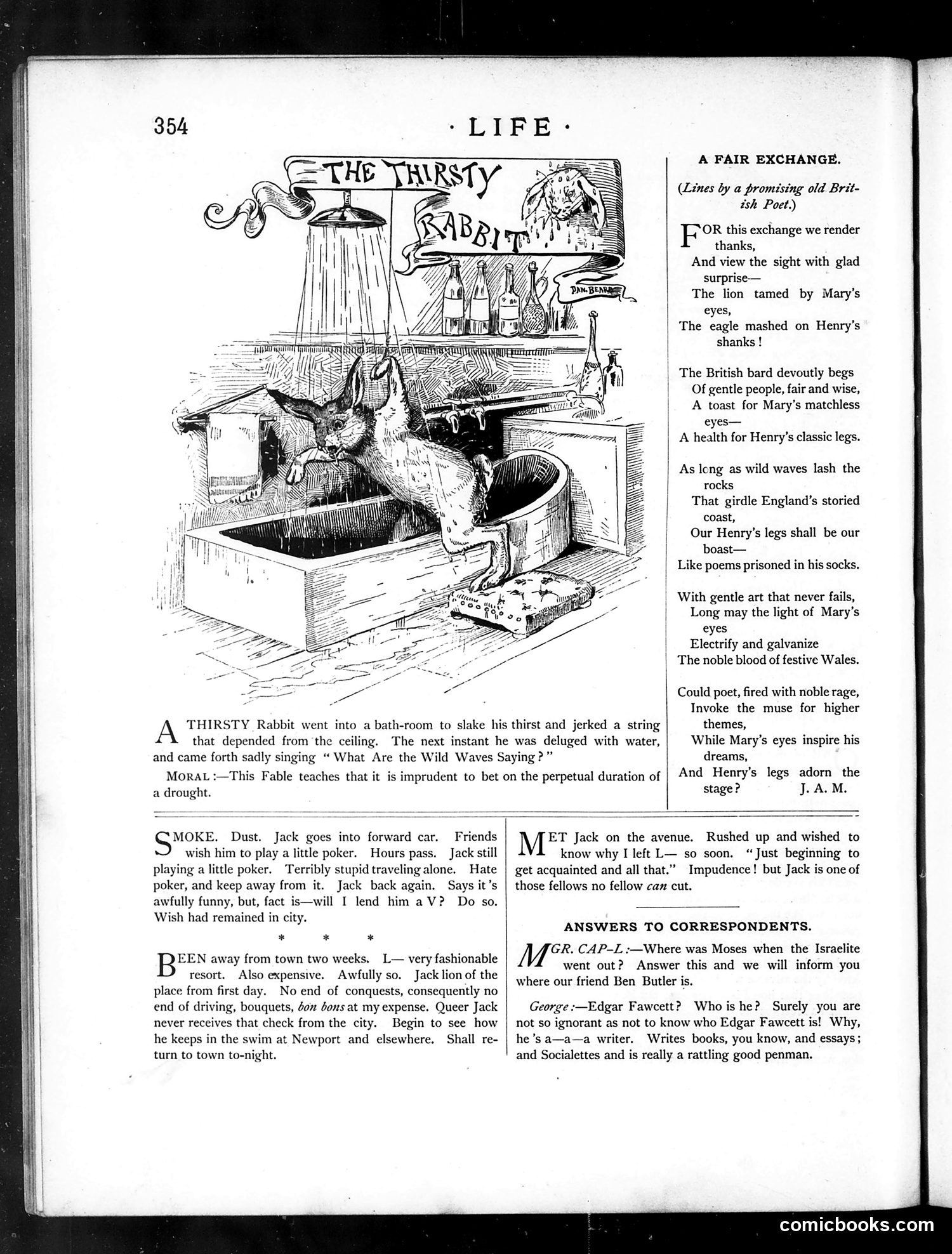
The main cartoon depicts a rabbit pulling a ceiling cord in a bathroom, expecting water but receiving a deluge instead. The moral warns against betting on perpetual drought—a commentary on human overconfidence in unchanging circumstances. The poem "A Fair Exchange" celebrates two British figures: Mary (praised for her eyes) and Henry (for his legs), using hyperbolic, mock-heroic language typical of Victorian satirical poetry. The exaggerated praise of body parts appears to mock either celebrity worship or romantic excess. The lower text includes brief comic anecdotes about a character named Jack—a charming but financially irresponsible friend who exploits the narrator's generosity during vacations. The final section, "Answers to Correspondents," contains humorous non-answers to reader questions, including a jest about Edgar Fawcett (an actual writer of the era) presented dismissively as merely "a writer." The page satirizes human folly, vanity, and social manipulation through absurdist humor typical of *Life* magazine's satirical tradition.
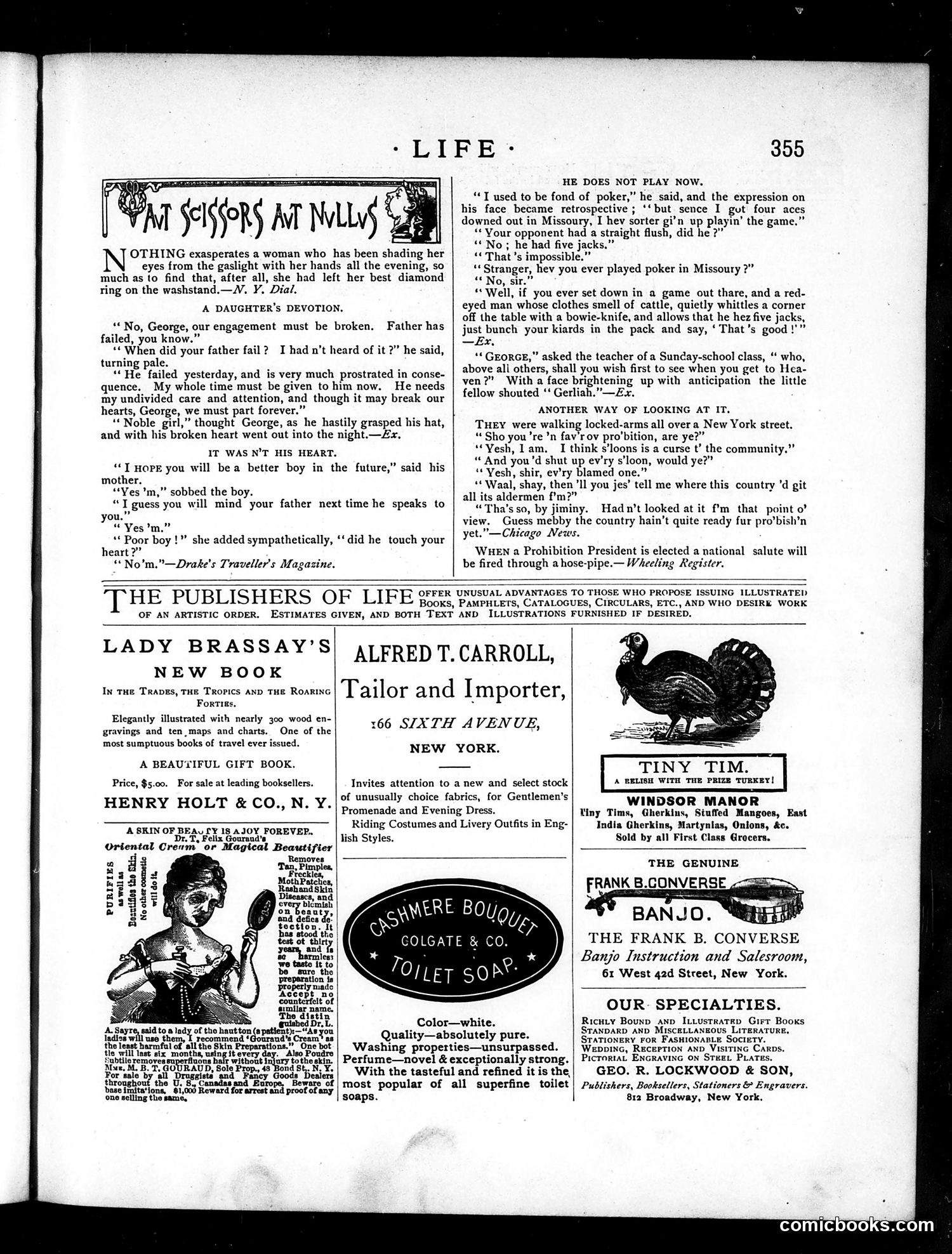
This page contains several brief humorous anecdotes typical of *Life* magazine's satirical style, plus advertisements. **The cartoons/jokes:** The pieces are text-based humor rather than visual cartoons. Key examples: - **"A Daughter's Devotion"**: A young woman breaks her engagement because her father failed financially. The joke's twist: the man realizes she didn't actually care about him—she was relieved to escape the relationship and use her father's misfortune as cover. - **"He Does Not Play Now"**: A tall-tale about poker in Missouri where a man claims to have lost to someone holding "five jacks" (impossible in standard poker). The humor relies on frontier exaggeration and the implicit message that cheating was rampant in rough frontier gambling. - **"Prohibition Paradox"**: Two men discussing closing saloons, until one points out: where would politicians get their aldermen? Implication: American politicians depended on saloon culture and corruption. These reflect *Life's* era of social satire—mocking romance, frontier lawlessness, and political hypocrisy—alongside period advertisements for beauty products and books.
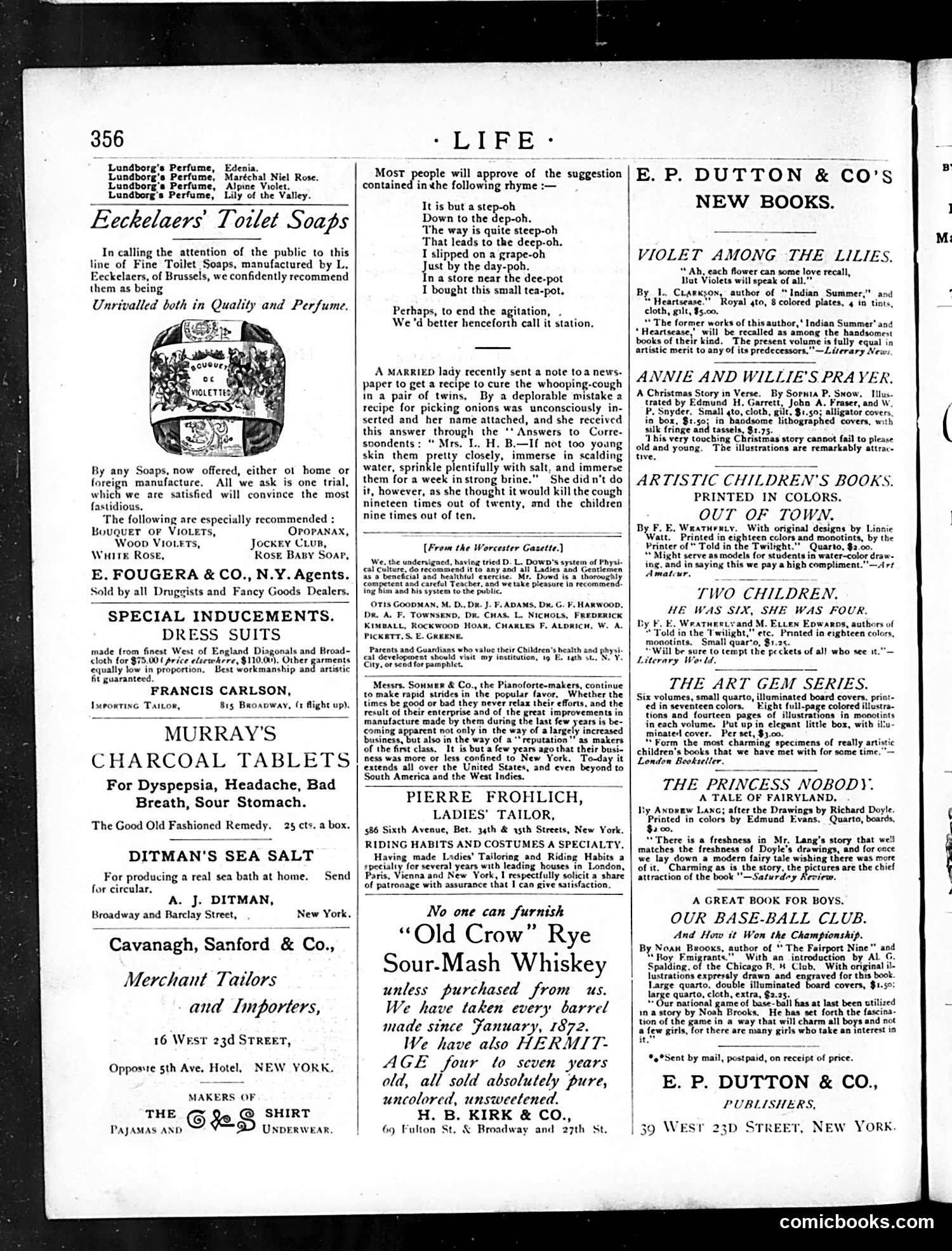
This page is primarily **advertising and filler content** rather than political satire. The main elements include: **Advertisement Section:** Multiple product ads (toilet soaps, charcoal tablets, merchant tailors, whiskey) typical of 1870s publications. **Humor Content:** Two brief satirical pieces: 1. A **rhyme mocking pronunciation inconsistency** around the word "depot" — poking fun at how Americans pronounce it differently ("dep-oh" vs "deep-oh"), suggesting standardizing it as "station" instead. 2. An anecdote about a **newspaper printing error** where a recipe for picking onions was mistakenly published as a cure for whooping cough in twins, satirizing both careless newspaper editing and readers' credulity. Neither piece contains identifiable political figures or major social commentary. The humor is domestic, lighthearted, and focused on everyday absurdities. This appears to be a typical advertising-heavy page from Life magazine's early period, with minor comedic filler rather than pointed political cartoons.
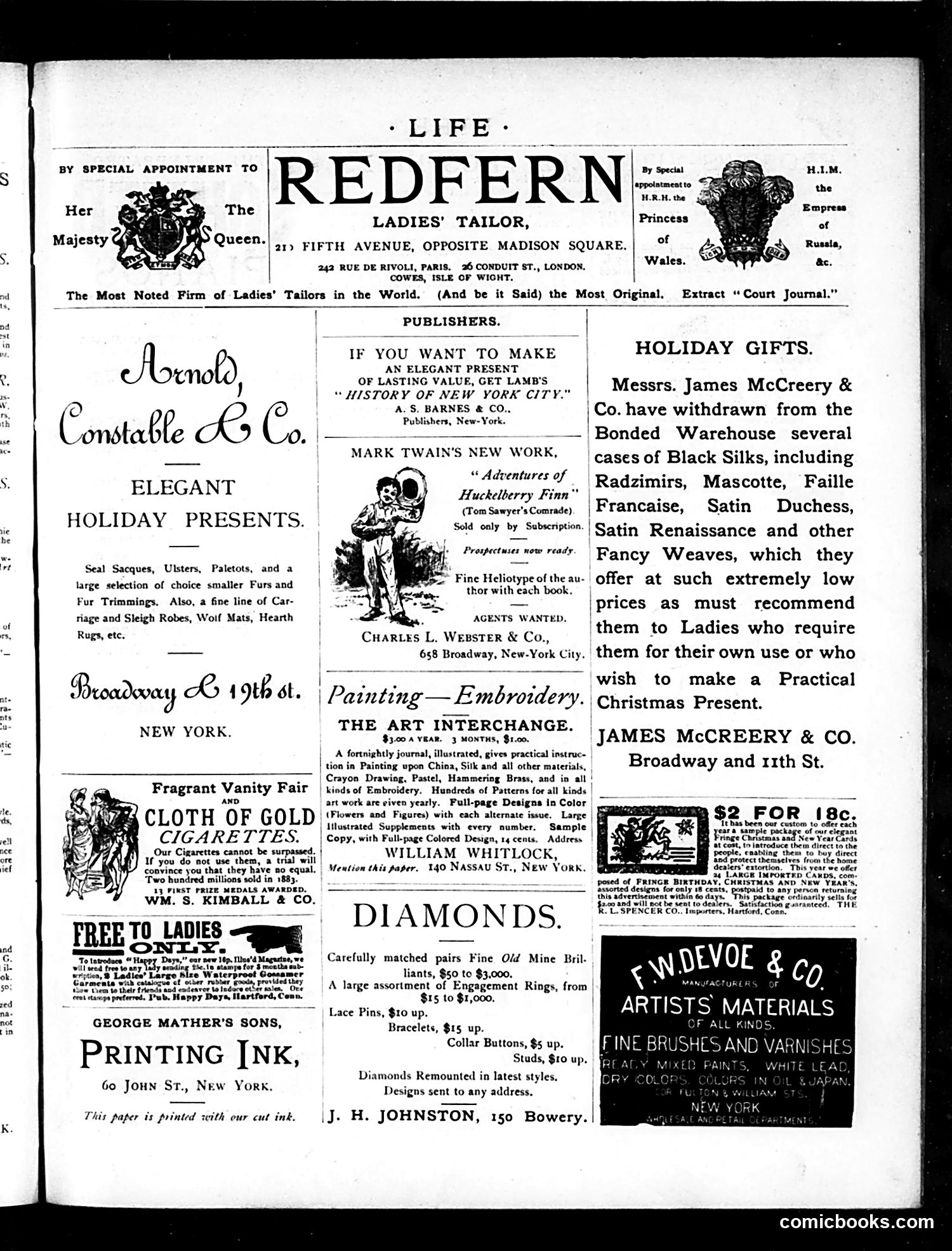
This page is primarily **advertising**, not satirical content. It's from Life magazine's advertisements section featuring luxury goods and services targeting wealthy consumers circa 1880s. The major advertisements include: - **Redfern Ladies' Tailor** (top): A high-end fashion house with royal patronage, emphasizing exclusivity - **Arnold, Constable & Co.**: Fur goods and holiday presents for the wealthy - **Mark Twain's "Adventures of Huckleberry Finn"**: Advertisement for the novel sold by subscription - **Diamonds and jewelry**: Fine jewelry offerings with substantial price ranges - **Artists' materials and luxury goods**: Printing inks, cigarettes, silk fabrics The page reflects **Gilded Age consumer culture**—advertisements target affluent New Yorkers seeking status symbols and imported luxury items. The repeated emphasis on "elegant," "finest," and royal appointments indicates marketing to the upper class. There is **no political satire** visible; this is straightforward commercial advertising from a magazine that mixed editorial content with ads.
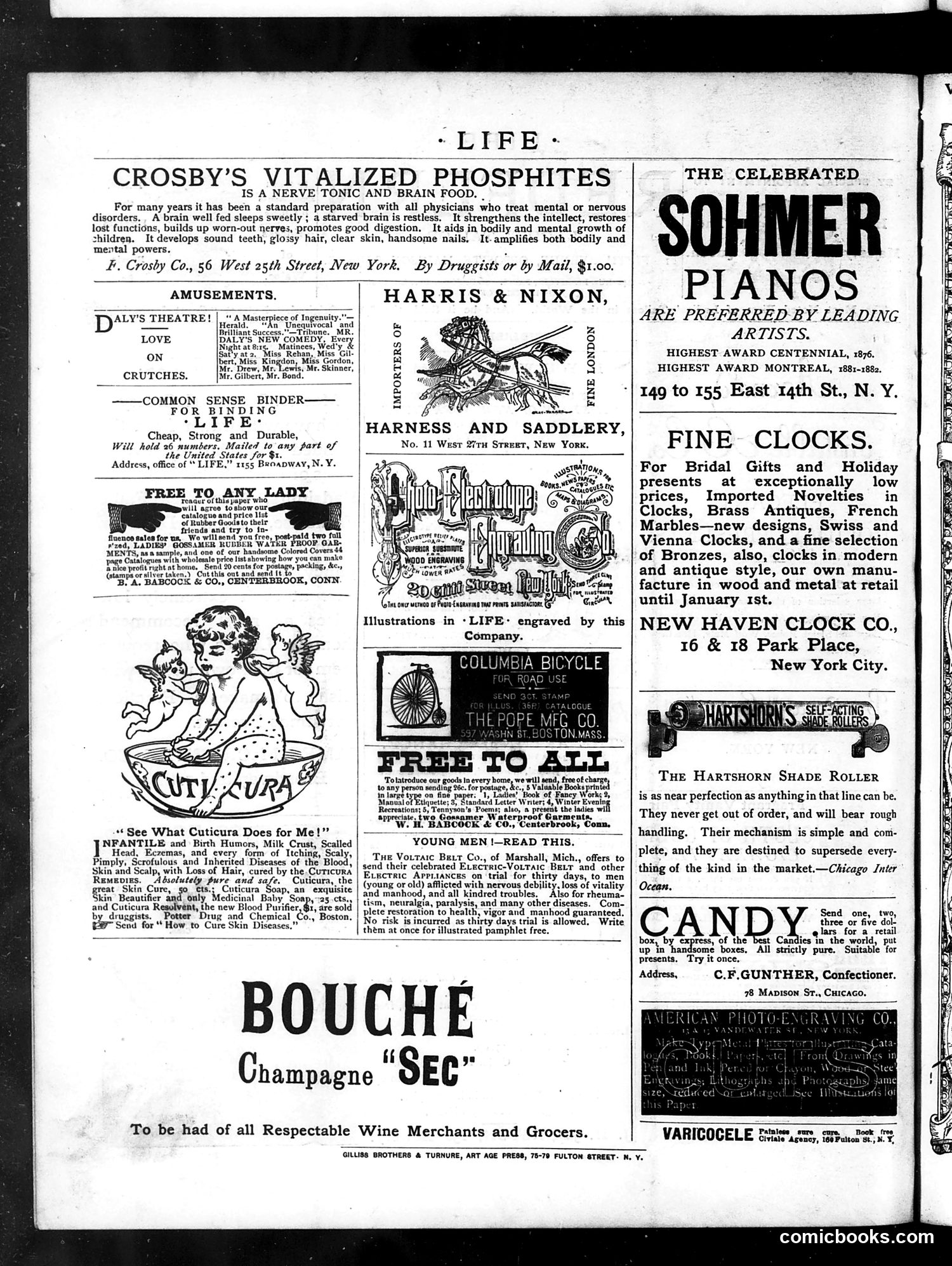
This is primarily an **advertising page** from Life magazine, with minimal editorial cartooning. The only cartoon element is a small cherub illustration labeled "See What Cuticura Does for Me!" accompanying a patent medicine advertisement. The page showcases late-19th-century advertisements for health products, musical instruments, and household goods. Notable are the numerous **quack medical remedies**: Crosby's Vitalized Phosphites (a "nerve tonic"), Cuticura (for skin diseases), and the Voltaic Electric Belt (claiming to cure "nervous debility" and "loss of manhood"). These reflect the era's predatory marketing of unproven treatments to vulnerable populations. The satirical content is **implicit rather than explicit**—Life magazine's role was partly to lampoon such dubious claims through their very inclusion in a humor publication. The page demonstrates the magazine's business model: selling advertising space while its editorial voice elsewhere critiqued American consumer culture and medical fraud.