
Life, 1884-12-18 · page 10 of 16
Life — December 18, 1884 — page 10: what you’re looking at
What you’re looking at
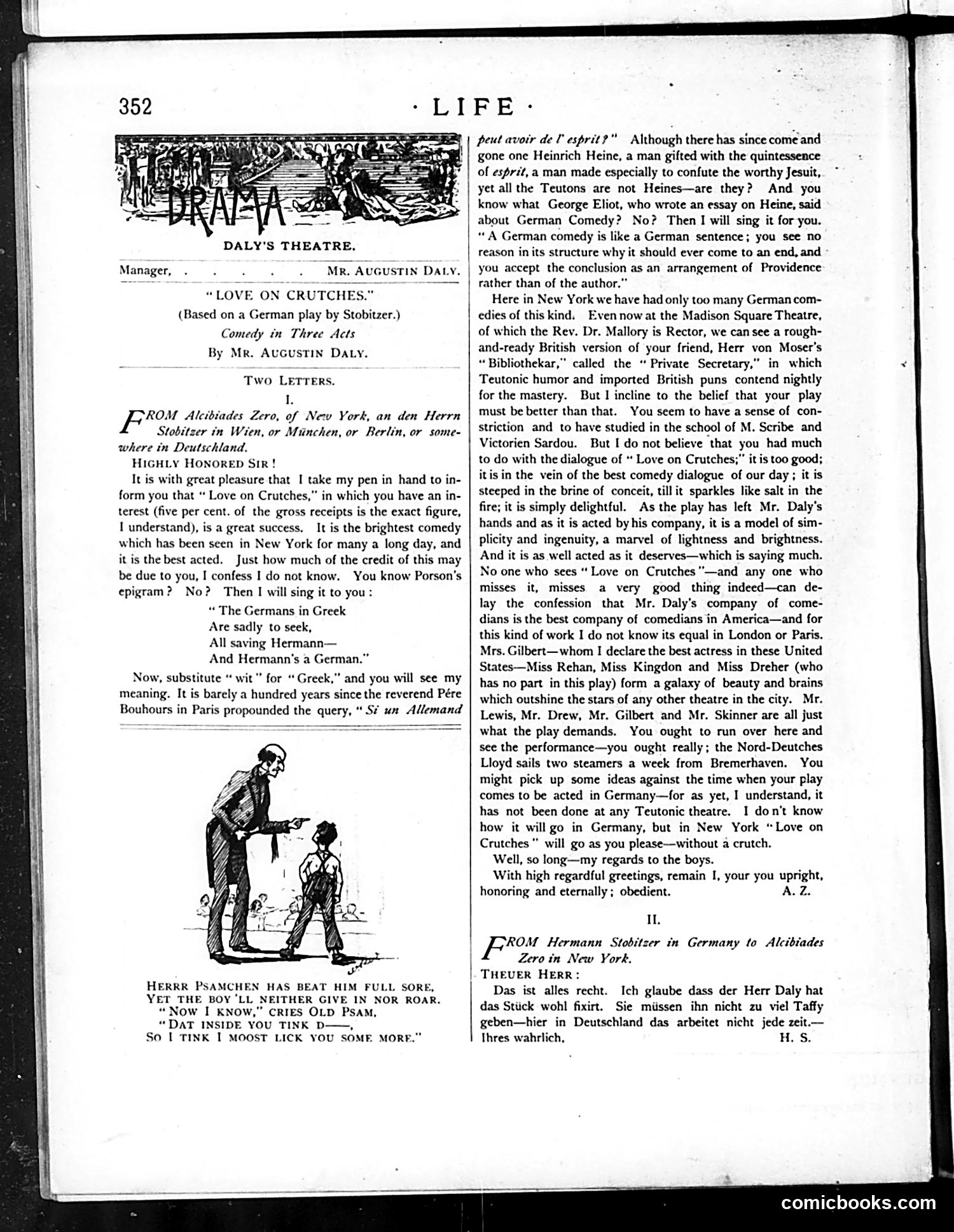
This page reviews Augustin Daly's American production of a German play by Stobitzer. The accompanying cartoon depicts a stern adult figure threatening a small boy with physical punishment—illustrating the crude, physical humor the text associates with German comedy. The review is structured as two letters debating German wit. The first (from "Alcibiades Zero" in New York to the original playwright) teases Germans for lacking sophistication in comedy, citing a classical epigram about German competence in Greek. It contrasts this stereotype with Heinrich Heine as an exception and George Eliot's famous quip that German comedies are structurally endless and arbitrary. However, the writer praises Daly's production as genuinely witty and well-acted—suggesting Daly's American adaptation transcends typical German theatrical crudeness. The review lavishes praise on the company, particularly actress Mrs. Gilbert, positioning American theatrical sophistication above both German and British efforts. The second letter (in German) appears to be the German playwright's response.
📄 Transcribed text from this page (OCR, searchable)
Machine-transcribed from the original scan — historical spelling and the odd misread are preserved.
oan) | (ay | a DALY'S THEATRE, Manager, “MR. Ik, AUGUSTIN Daty. “LOVE ON CRUTCH (Based on a German play by Stobitzer.) Comedy in Three Acts By Mr. AuGusTIN DaLy. Two LETTERS. I, ROM Alcibiades Zero, of New York, an den Herrn Stobitzer in Wien, or Munchen, or Berlin, or some- where in Deutschland. HIGHLY HONORED SiR! It is with great pleasure that I take my pen in hand to in- form you that “ Love on Crutches,” in which you have an in- terest (five per cent. of the gross receipts is the exact figure, I understand), is a great success. It is the brightest comedy which has been seen in New York for many a long day, and it is the best acted. Just how much of the credit of this may be due to you, I confess I do not know. You know Porson’s epigram? No? Then I will sing it to you: “ The Germans in Greek Are sadly to seek, All saving Hermann— And Hermann’s a German.” Now, substitute “ wit” for “Greek,” and you will see my meaning. It is barely a hundred years since the reverend Pére Bouhours in Paris propounded the query, “ Sé un Allemand “Now I KNow,” CRIES OLD Ps “DAT INSIDE YOU TINK D—, So I TINK I MOOST LICK YOU SOME MORE.” peut avoir del esprit?" Although there has since come and gone one Heinrich Heine, a man gifted with the quintessence of esprit, a man made especially to confute the worthy Jesuit, yet all the Teutons are not Heines—are they? And you know what George Eliot, who wrote an essay on Heine, said about German Comedy? No? Then I will sing it for you. “A German comedy is like a German sentence; you see no reason in its structure why it should ever come to an end, and | you accept the conclusion as an arrangement of Providence rather than of the author.” Here in New York we have had only too many German com- edies of this kind. Even now at the Madison Square Theatre, of which the Rev. Dr. Mallory is Rector, we can see a rough- and-ready British version of your friend, Herr von Moser’s “ Bibliothekar,” called the “ Private Secretary,” in which Teutonic humor and imported British puns contend nightly for the mastery. But I incline to the belief that your play must be better than that. You seem to have a sense of con- striction and to have studied in the school of M. Scribe and Victorien Sardou. But I do not believe that you had much to do with the dialogue of * Love on Crutches;” it is too good; itis in the vein of the best comedy dialogue of our day ; it is steeped in the brine of conceit, till it sparkles like salt in the fire; it is simply delightful. As the play has left Mr. Daly's hands and as it is acted by his company, it is a model of sim- plicity and ingenuity, a marvel of lightness and brightness. And it is as well acted as it deserves—which is saying much. No one who sees “Love on Crutches ""—and any one who misses it, misses a very good thing indeed—can de- lay the confession that Mr. Daly's company of come- dians is the best company of comedians in America—and for this kind of work I do not know its equal in London or Paris. Mrs. Gilbert—whom I declare the best actress in these United States—Miss Rehan, Miss Kingdon and Miss Dreher (who has no part in this play) form a galaxy of beauty and brains which outshine the stars of any other theatre in the city. Mr. Lewis, Mr. Drew, Mr. Gilbert and Mr. Skinner are all just what the play demands. You ought to run over here and see the performance—you ought really; the Nord-Deutches Lloyd sails two steamers a week from Bremerhaven. You might pick up some ideas against the time when your play comes to be acted in Germany—for as yet, I understand, it has not been done at any Teutonic theatre. I don’t know how it will go in Germany, but in New York “Love on Crutches" will go as you please—without a crutch. Well, so long—my regards to the boys. With high regardful greetings, remain I, your you ig honoring and eternally ; obedient. Il. ‘ROM Hermann Stobitzer in Germany to Alcibiades Zero in New York. THEUER HERR: Das ist alles recht. Ich glaube dass der Herr Daly hat das Stiick wohl fixirt. Sie miissen ihn nicht zu viel Taffy geben—hier in Deutschland das arbeitet nicht jede zeit.— Ihres wahrlich, H. S. comicbooks.com