
Life, 1884-12-18 · page 6 of 16
Life — December 18, 1884 — page 6: what you’re looking at
What you’re looking at
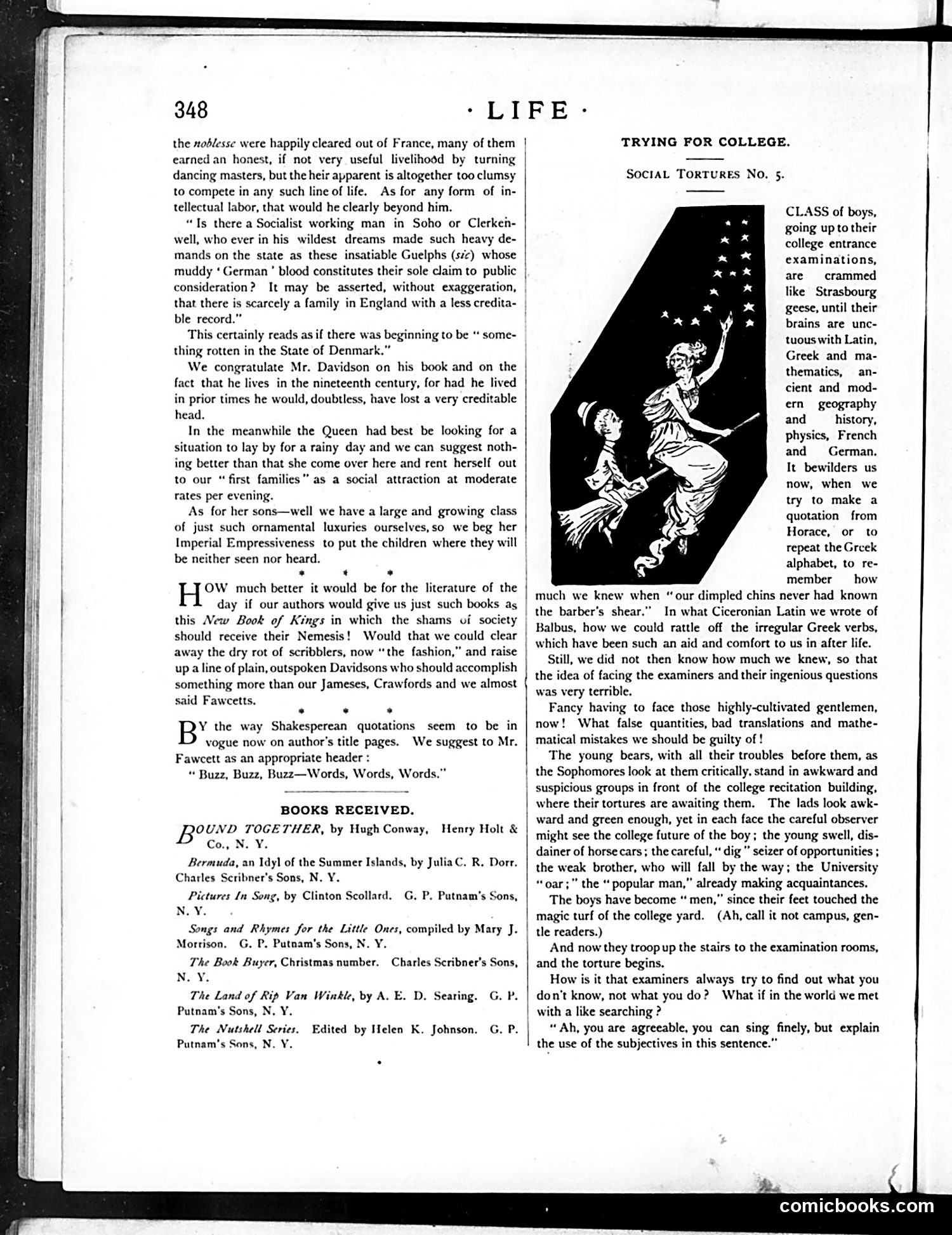
This cartoon satirizes the ordeal of college entrance examinations. The illustration shows two figures—likely representing anxious students—being literally tortured by an examiner wielding a whip or rod, depicted allegorically as Nemesis or a classical torture figure. The accompanying text describes the psychological torment: students are crammed with Latin, Greek, mathematics, and other subjects until their "brains are unscrupulous." The satire mocks how examiners deliberately ask questions testing knowledge students weren't taught, seeking "what you don't know, not what you do." The joke targets the arbitrary cruelty of college entrance examinations—their apparent design to confuse rather than fairly assess students' actual learning.
📄 Transcribed text from this page (OCR, searchable)
Machine-transcribed from the original scan — historical spelling and the odd misread are preserved.
the nodlesse were happily cleared out of France, many of them earned an honest, if not very useful livelihood by turning dancing masters, but the heir apparent is altogether too clumsy to compete in any such line of life. As for any form of in- tellectual labor, that would he clearly beyond him. “Ts there a Socialist working man in Soho or Clerken- well, who ever in his wildest dreams made such heavy de- mands on the state as these insatiable Guelphs (s7¢) whose muddy ‘German ’ blood constitutes their sole claim to public consideration? It may be asserted, without exaggeration, that there is scarcely a family in England with a less credita- ble record.” This certainly reads as if there was beginning to be “ some- thing rotten in the State of Denmark.” We congratulate Mr. Davidson on his book and on the fact that he lives in the nineteenth century, for had he lived in prior times he would, doubtless, have lost a very creditable head. In the meanwhile the Queen had best be looking for a situation to lay by for a rainy day and we can suggest noth- ing better than that she come over here and rent herself out to our “first families" as a social attraction at moderate rates per evening. As for her sons—well we have a large and growing class of just such ornamental luxuries ourselves,so we beg her Imperial Empressiveness to put the children where they will | be neither seen nor heard. . ' . OW much better it would be for the literature of the day if our authors would give us just such books as this New Book of Kings in which the shams vi society should receive their Nemesis! Would that we could clear away the dry rot of scribblers, now “the fashion,” and raise up a line of plain, outspoken Davidsons who should accomplish something more than our Jameses, Crawfords and we almost said Faweetts. * . * Y the way Shakesperean quotations seem to be in vogue now on author's title pages. We suggest to Mr. Fawcett as an appropriate header : “ Buzz, Buzz, Buzz—Words, Words, Words.” BOOKS RECEIVED. OUND TOGETHER, by Hugh Conway, Henry Holt & Cog N, Ys Bermuda, an ldy\ of the Summer Islands, by Julia. R. Dorr. Charles Scribner's Sons, N. Y. Pictures In Song, by Clinton Scollard. G. P. Putnam's Sons, Songs and Rhymes for the Little Ones, compiled by Mary J. Morrison. G. P. Putnam's Sons, N. Y. The Book Buyer, Christmas number. Charles Scribner's Sons, N.Y. The Land of Rip Van Winkle, by A. E. D. Searing. G. P. Putnam's Sons, N. Y. The Nutshell Series, Edited by Helen K. Johnson. G. P. Putnam's Sons, N. Y. - LIFE: TRYING FOR COLLEGE. SOCIAL TORTURES NO. 5. CLASS of boys, going uptotheir college entrance examinations, are crammed like Strasbourg geese, until their brains are unc- tuous with Latin, Greek and ma- thematics, an- cient and mod- ern geography and history, physics, French and German. It bewilders us now, when we try to make a quotation from Horace, or to repeat the Greek alphabet, to re- member how much we knew when “our dimpled chins never had known the barber's shear.” In what Ciceronian Latin we wrote of Balbus, how we could rattle off the irregular Greek verbs, which have been such an aid and comfort to us in after life. Still, we did not then know how much we knew, so that the idea of facing the examiners and their ingenious questions was very terrible. Fancy having to face those highly-cultivated gentlemen, now! What false quantities, bad translations and mathe- matical mistakes we should be guilty of ! The young bears, with all their troubles before them, as the Sophomores look at them critically, stand in awkward and suspicious groups in front of the college recitation building, where their tortures are awaiting them. The lads look awk- ward and green enough, yet in each face the careful observer might see the college future of the boy; the young swell, dis- dainer of horse cars; the careful, “ dig ” seizer of opportunities ; the weak brother, who will fall by the way; the University “oar ;" the “ popular man,” already making acquaintances. The boys have become “ men,” since their feet touched the magic turf of the college yard. (Ah, call it not campus, gen- tle readers.) And now they troop up the stairs to the examination rooms, and the torture begins. How is it that examiners always try to find out what you don’t know, not what you do? What if in the world we met with a like searching ? “Ah, you are agreeable, you can sing finely, but explain the use of the subjectives in this sentence.” comicbooks.com