
A complete issue · 16 pages · 1884
Life — December 4, 1884
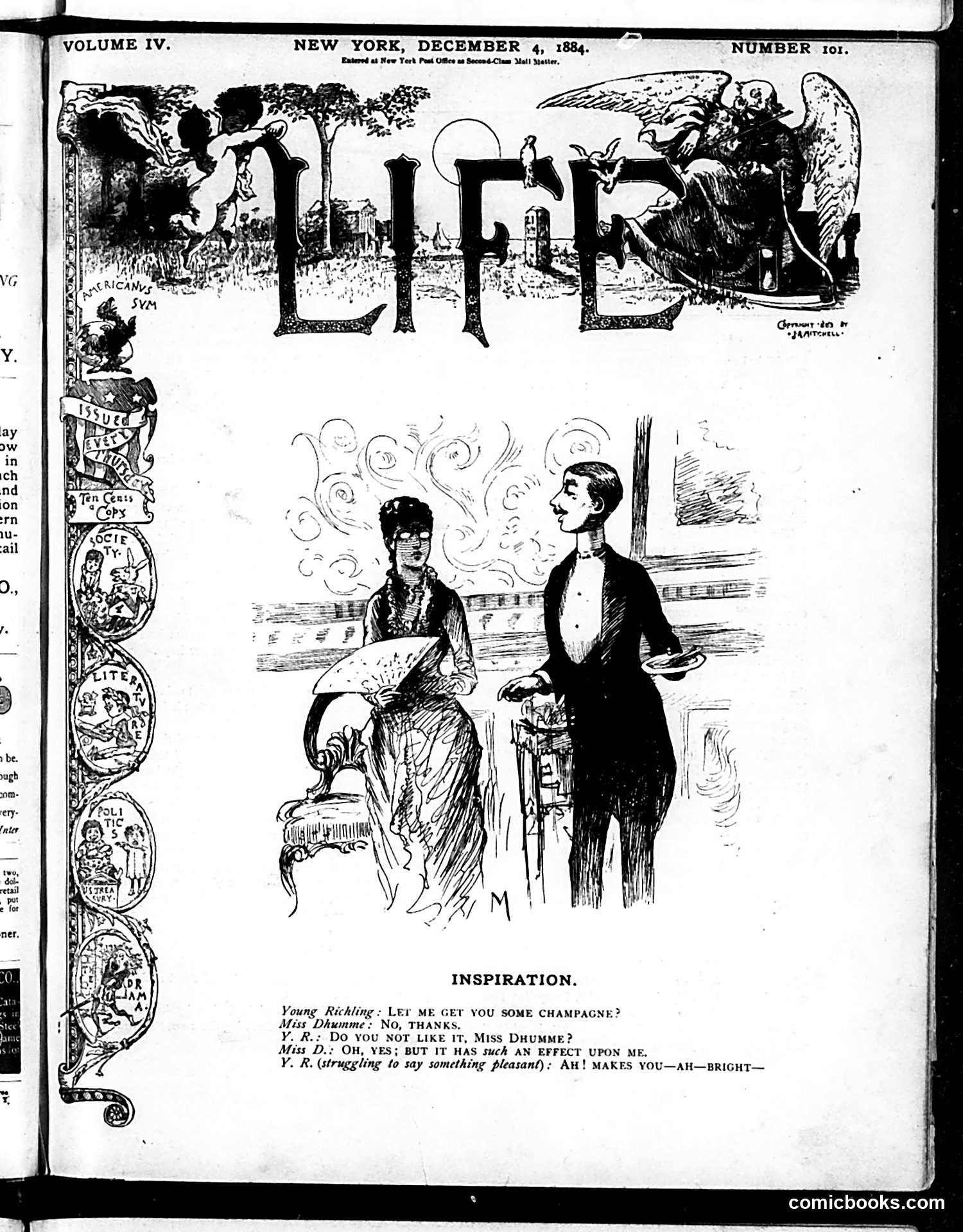
This cartoon satirizes social courtship rituals of the 1880s. A young man ("Young Rickling") offers champagne to a seated woman ("Miss Dhumme"), who refuses it, claiming the drink has an improper effect on her. The man then tries a different approach, suggesting the champagne makes her more agreeable—to which she responds positively ("Ah! makes you—ah—bright"). The satire targets feminine hypocrisy: Miss Dhumme publicly rejects alcohol as unseemly while secretly welcoming its disinhibiting effects. The cartoon mocks both Victorian propriety (women denying they drink) and the transparent pretense beneath polite society's moral standards. The title "Inspiration" sardonically refers to champagne as the true catalyst for romantic "inspiration."
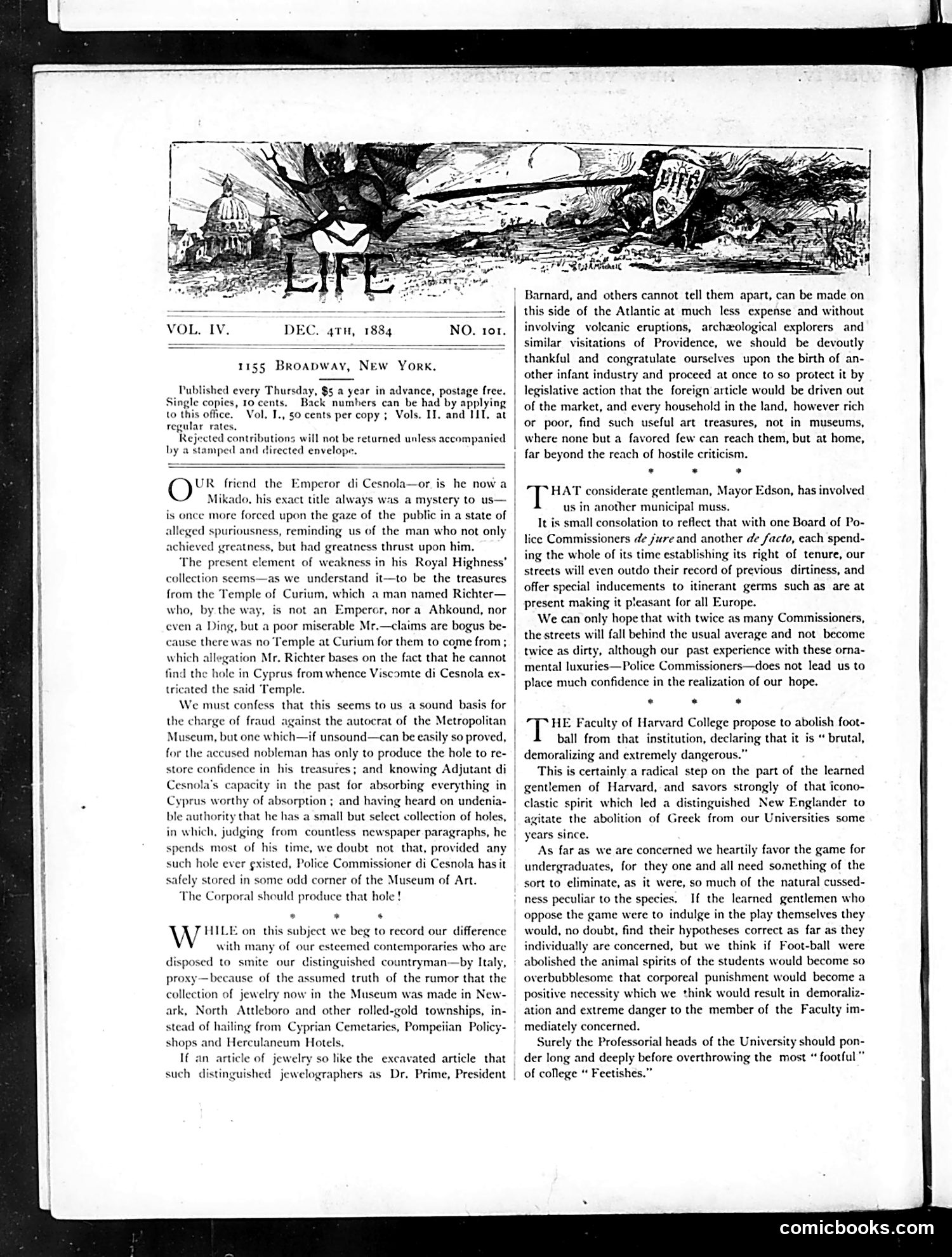
The header illustration depicts a chaotic scene with a large bird or creature and figures in apparent distress—likely a satirical commentary on contemporary events, though the specific reference is unclear from the image alone. The page's text discusses several topics: fraudulent antiquities allegedly sold to the Metropolitan Museum; Mayor Edson's involvement in a municipal "mess" regarding Police Commissioners; and Harvard College's proposal to abolish football, which Life defends as beneficial for undergraduates despite concerns about brutality and danger. The football debate reflects genuine late-19th-century anxieties about the sport's violence, while the museum and mayoral sections target New York corruption and incompetence. The tone is characteristically sardonic—mocking both civic failures and elite hand-wringing about student athletics.
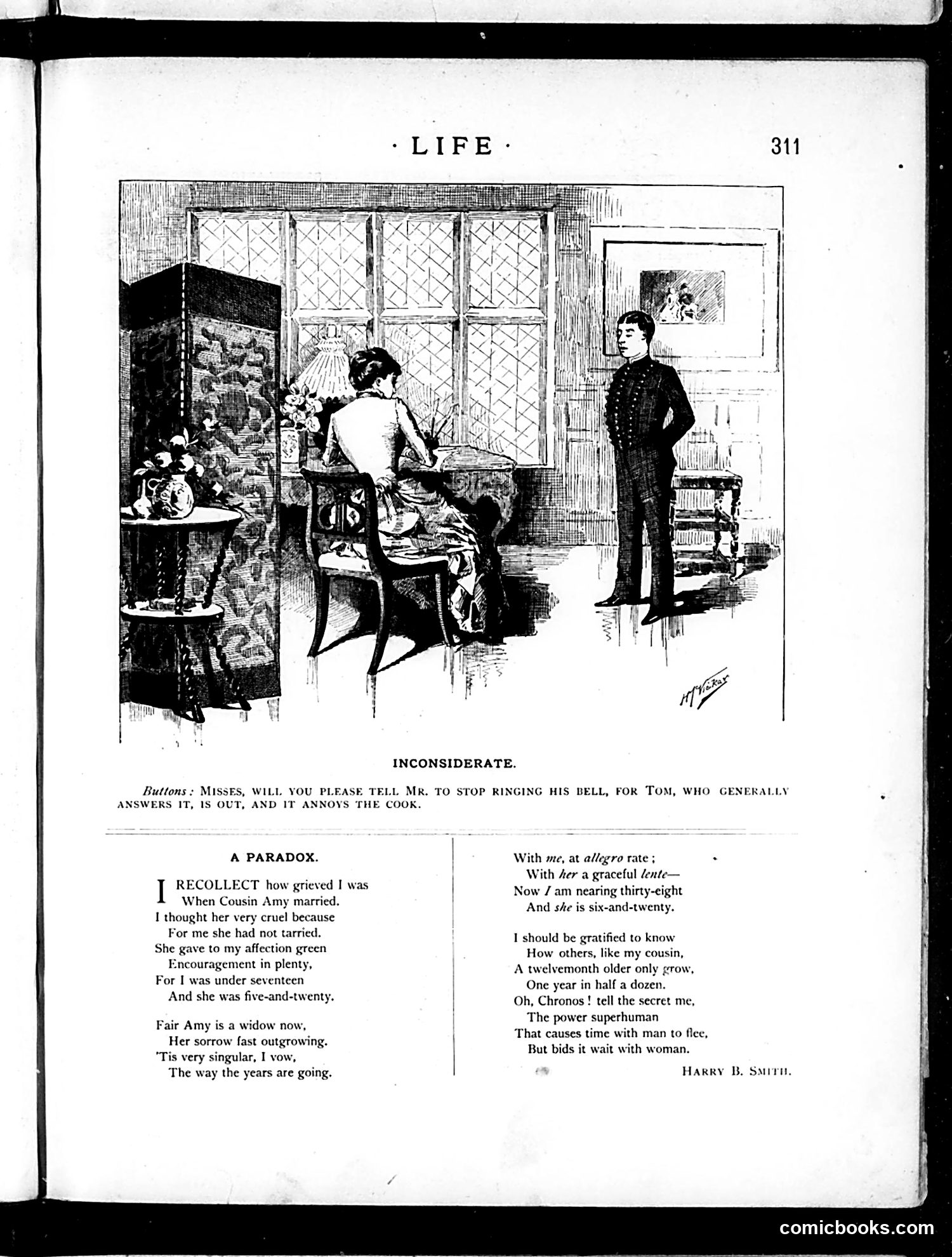
The cartoon depicts a domestic scene where a woman sits at a writing desk while a man stands nearby. The caption reads: "Buttons: Misses, will you please tell Mr. to stop ringing his bell, for Tom, who generally answers it, is out, and it annoys the cook." The satire targets inconsiderate behavior in upper-class households. The humor lies in the absurdity of the request: rather than simply not ring the bell themselves, the visitor asks the woman to relay a message asking someone else to stop ringing it—an unnecessarily convoluted and rude approach that ironically exemplifies the very inconsiderateness being complained about. The accompanying poems ("A Paradox" and an untitled piece) explore themes of aging and time's passage, likely unrelated to the cartoon.
This page contains humorous short items ("By the Way") rather than political cartoons. The content includes satirical commentary on contemporary issues: **"The Mugwump Canonized"** discusses F. Marion Crawford's novel "An American Politician," treating the Mugwump (independent political faction) as a subject worthy of literary "canonization." The satire mocks both the Mugwumps' self-importance and the book's romanticization of political independence. Other brief items mock various targets: a Dakota photographer's tornado photo, Mayor Edson and District Attorney receiving a prize-fight invitation, and Mrs. Spriggins' pretentious Latin phrase usage. The "Bookshelf" section provides literary criticism. Overall, this page represents Life's characteristic light satire of American society, politics, and pretension during the Mugwump era (late 19th century).
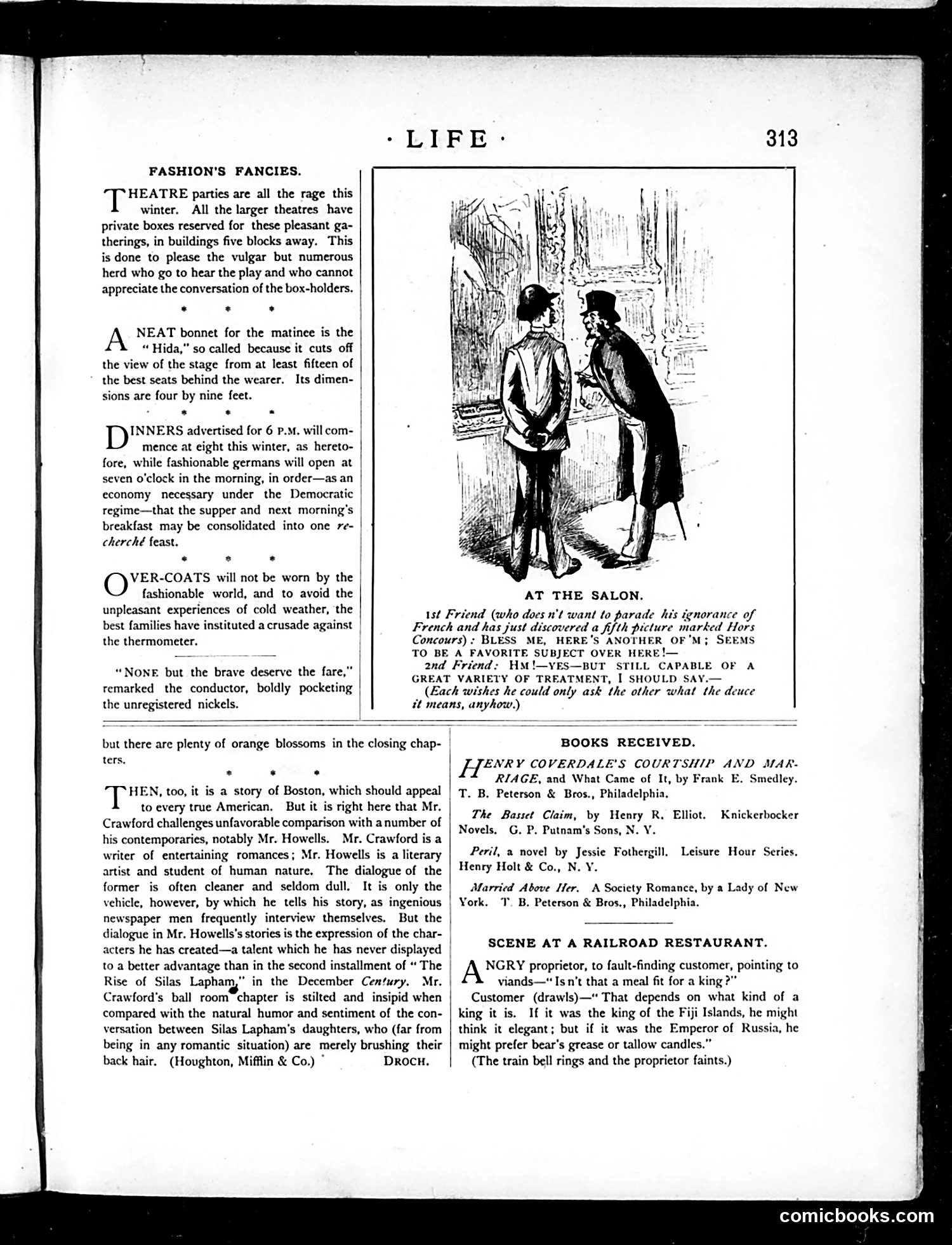
This cartoon satirizes fashionable society's pretensions at art exhibitions. Two well-dressed men examine a painting, with one delivering an affected critique about a French artist's work being "marked Hors Concours" (a prestigious award designation). The satire targets the pomposity of salon culture—how wealthy patrons adopt inflated artistic language to appear cultivated, even when discussing art superficially. The exaggerated conversation ("capable of a great variety of treatment") mocks the empty jargon used by fashionable society to discuss art without genuine understanding. The accompanying "Fashion's Fancies" column reinforces this theme, discussing theatre boxes, bonnets, and overcoats—showing how Life magazine simultaneously critiques both artistic and sartorial pretension among the elite class.
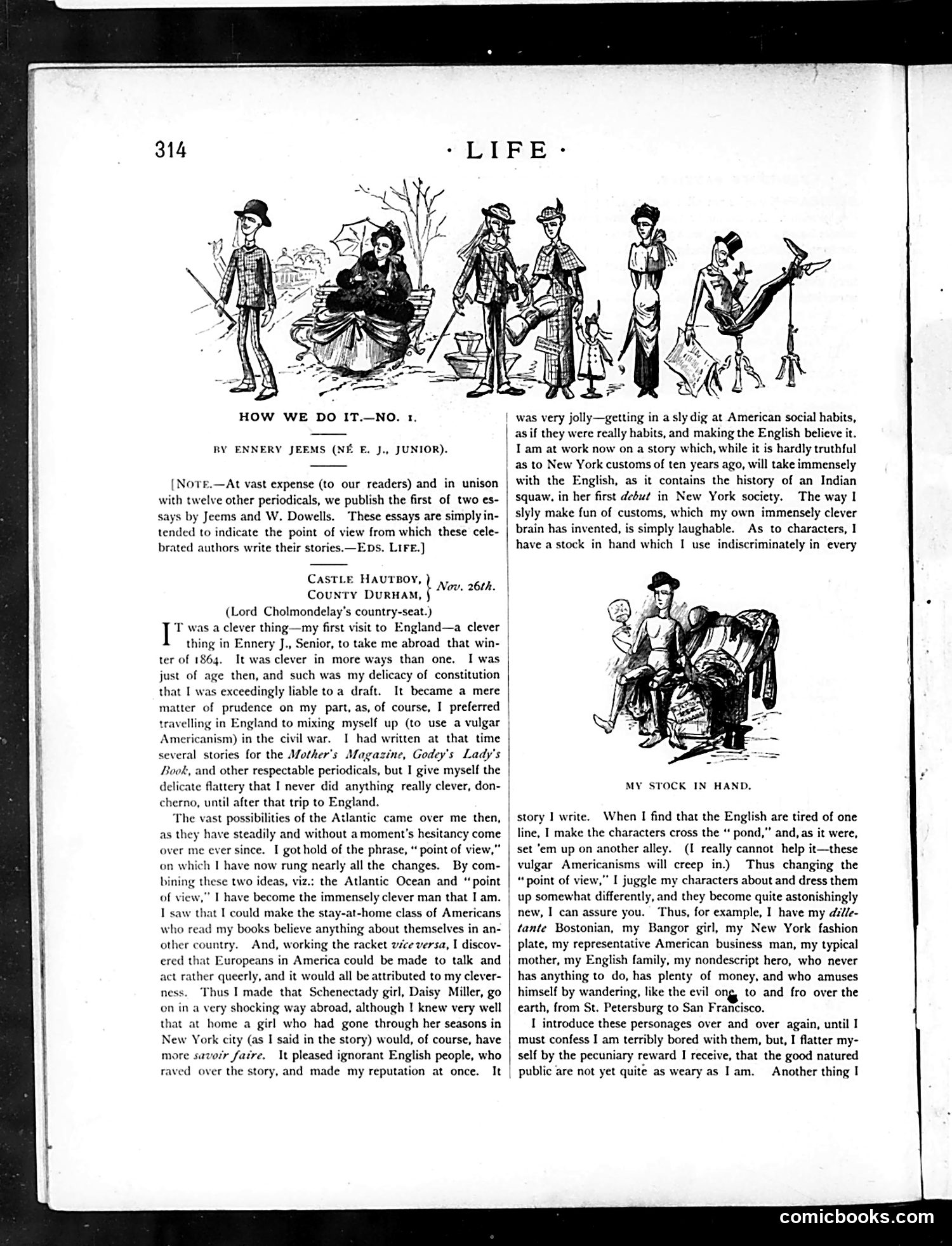
This page presents a satirical essay about American versus English customs and character writing. The author, an American visiting England, describes how he adapts his literary portrayals of characters to amuse readers—particularly by changing "point of view." The cartoon strip at top shows various character types the author claims to stock "in hand" for his stories. The accompanying illustration (labeled "MY STOCK IN HAND") depicts a writer with a collection of character types ready to deploy. The satire targets American literary conventions: specifically, how American writers recycle stereotypical character archetypes and shift narrative perspectives to create novelty rather than genuine creativity. It's a self-aware critique of formula-driven popular fiction and the commercialization of writing.
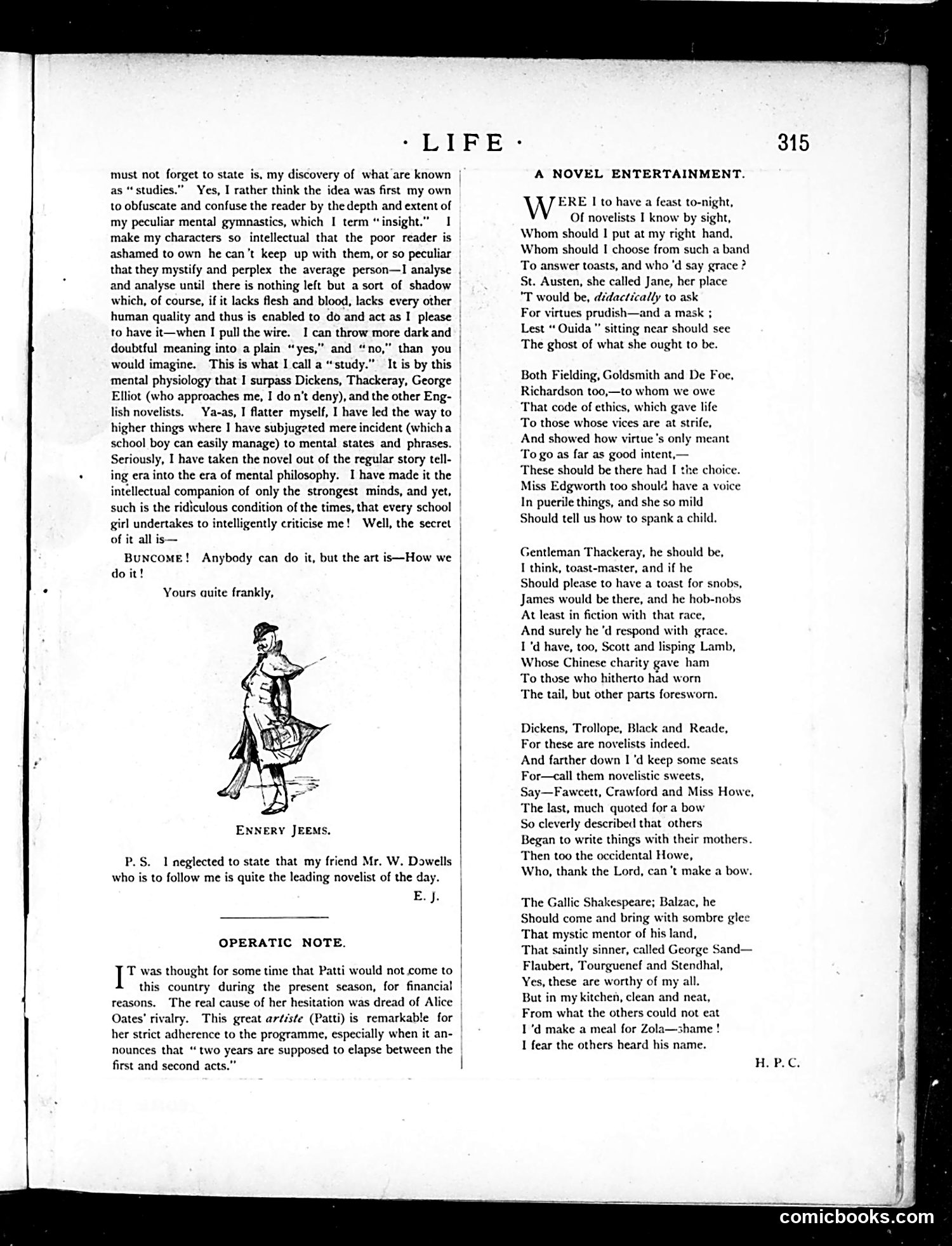
This page contains three distinct sections: 1. **A letter from "Ennery Jeems"** (likely a pseudonym) discussing literary analysis and character development in novels, signed "Yours quite frankly." 2. **"A Novel Entertainment"** — a poem by H.P.C. humorously proposing a dinner party of famous literary figures, including Jane Austen, Fielding, Goldsmith, Dickens, Thackeray, and others. The satire lies in imagining these canonical authors together, with witty commentary on their characteristics. 3. **"Operatic Note"** — a brief note about the opera singer Patti potentially not performing in the country due to financial reasons and rivalry with Alice Oates. The illustration shows a figure in period dress, likely representing one of the literary figures discussed. The page is primarily literary/cultural commentary rather than political satire.
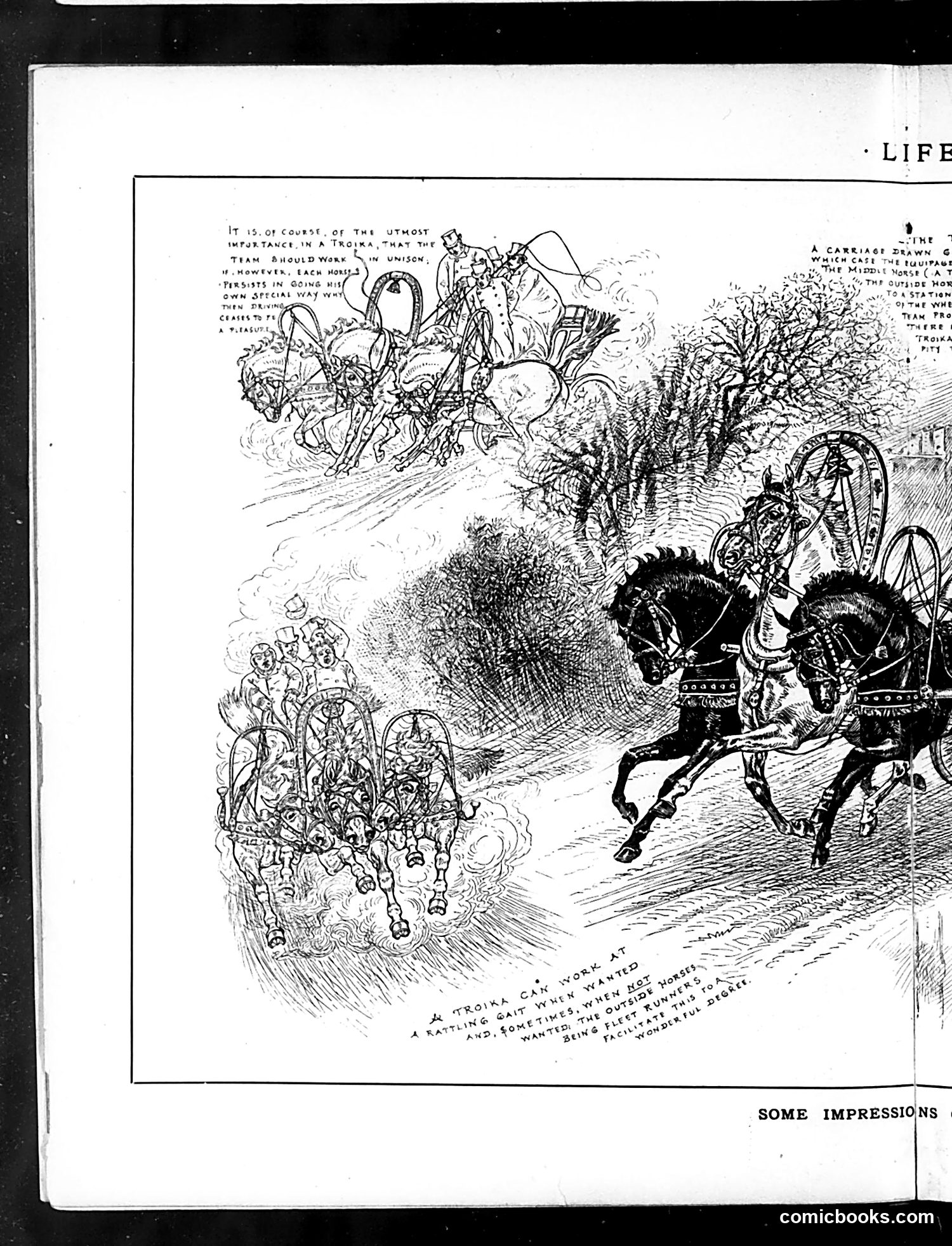
This page contains a satirical illustration titled "Some Impressions" depicting a horse-drawn carriage scene. The cartoon shows two contrasting processions: an ornate carriage in the foreground pulled by decorated horses, and a crowded, chaotic cart in the background filled with multiple figures. The text above references union work and team coordination, suggesting this is political satire about labor organization or workplace hierarchy. The contrast between the orderly, well-equipped carriage and the overcrowded, disorganized cart likely represents differing approaches to organizing workers or managing labor disputes. However, without clearer identification of specific figures or visible signatures confirming the artist and exact publication date, I cannot definitively state which historical labor conflict or political situation this satirizes.
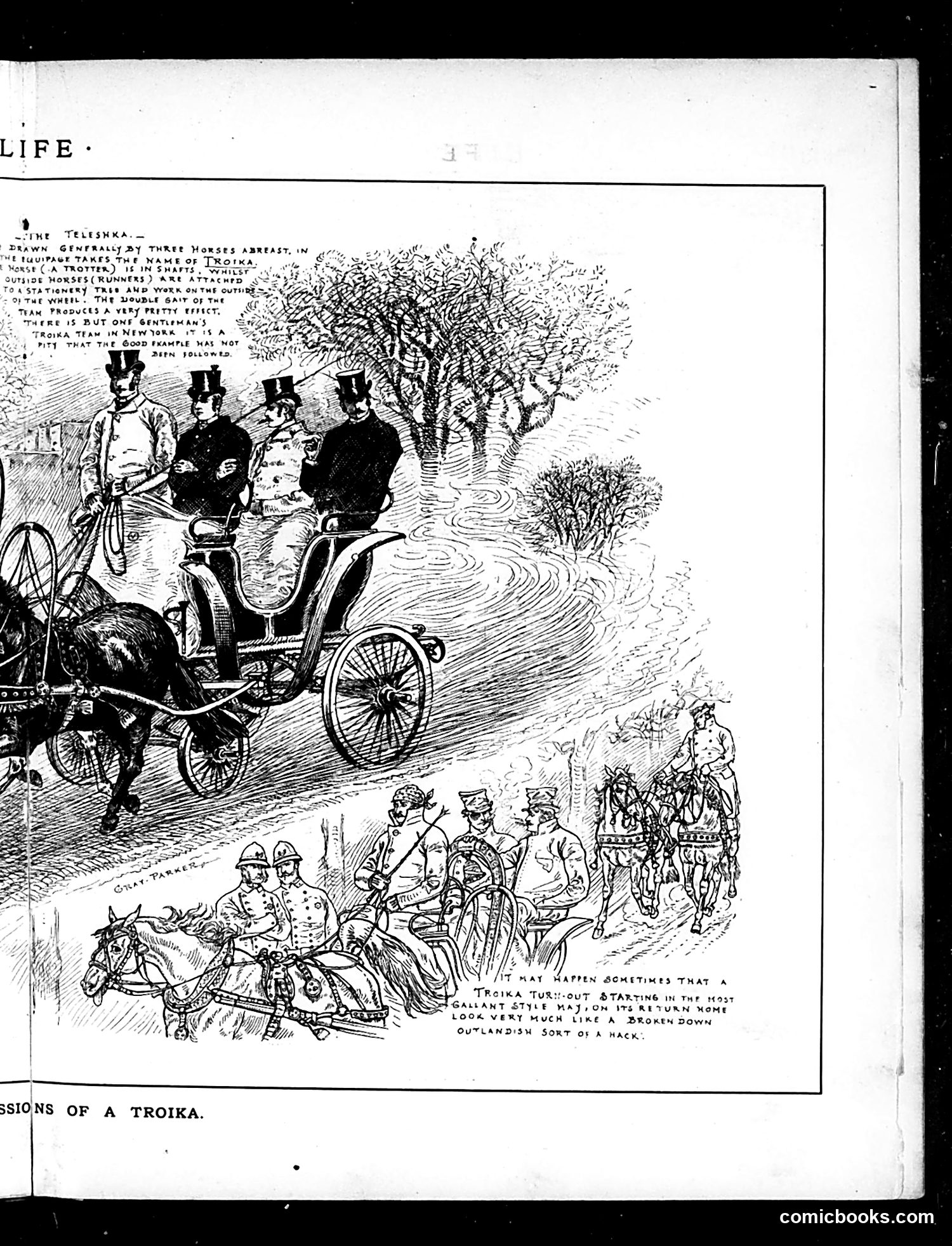
This satirical illustration depicts a **Russian troika** (a traditional three-horse carriage) as a social commentary. The text indicates the troika "takes the name of Drotka" and describes how Russian nobility conduct themselves. The cartoon shows well-dressed gentlemen in top hats riding in the troika while soldiers on horseback follow below. The satire appears to mock **Russian aristocratic pretension and military excess**—the contrast between the leisured nobility in their carriage and the common soldiers suggests critiques of class hierarchy and militarism. The caption notes that a "troika turn-out starting in the mist" resembles "a broken-down outlander sort of hack," mocking the carriage's appearance despite its prestigious associations. This likely reflects turn-of-the-century American attitudes toward Russian society.
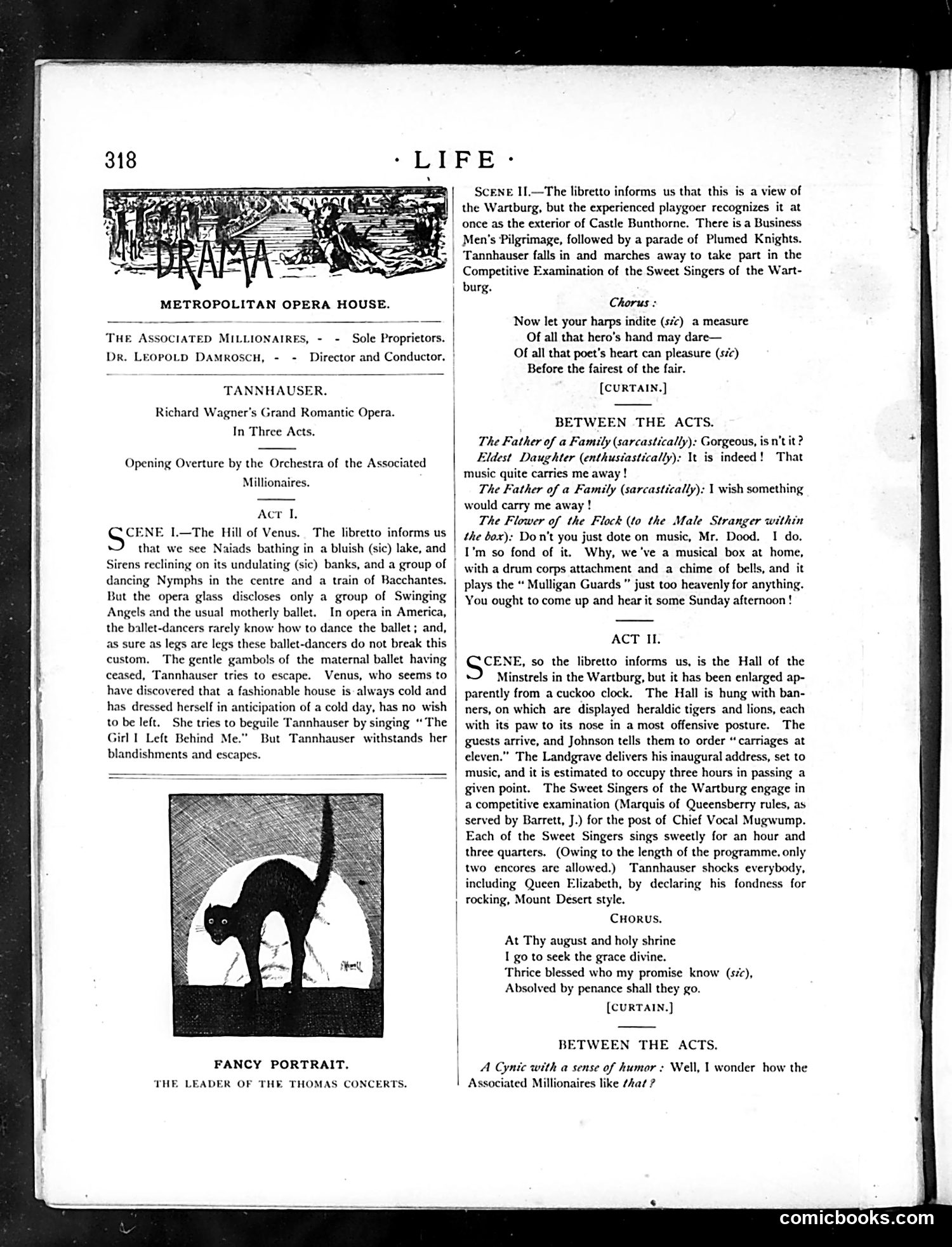
This page mocks an 1884 Metropolitan Opera production of Richard Wagner's *Tannhäuser*, presenting it as a pretentious spectacle funded by "Associated Millionaires." The satire targets several absurdities: **The opera itself**: The review notes the gap between Wagner's ambitious libretto (depicting mythological scenes) and the actual production's mediocrity—ballet dancers who "do not break" bad habits, uninspired staging. **High society pretension**: A famous illustration ("Fancy Portrait") shows a cat arching its back in a concert hall—likely mocking the affectations of opera-goers. Between-act dialogue satirizes wealthy patrons' superficial engagement: a father finds it tedious while his daughter gushes; a young woman compares the opera to her home's musical box. **Wagner's reputation**: The lengthy, tedious performance (estimated to take three hours for one address) becomes the joke itself—suggesting even millionaires' money cannot make Wagner's grand ambitions work in practice. The underlying critique: American wealth and the Metropolitan Opera establishment cannot manufacture genuine culture.
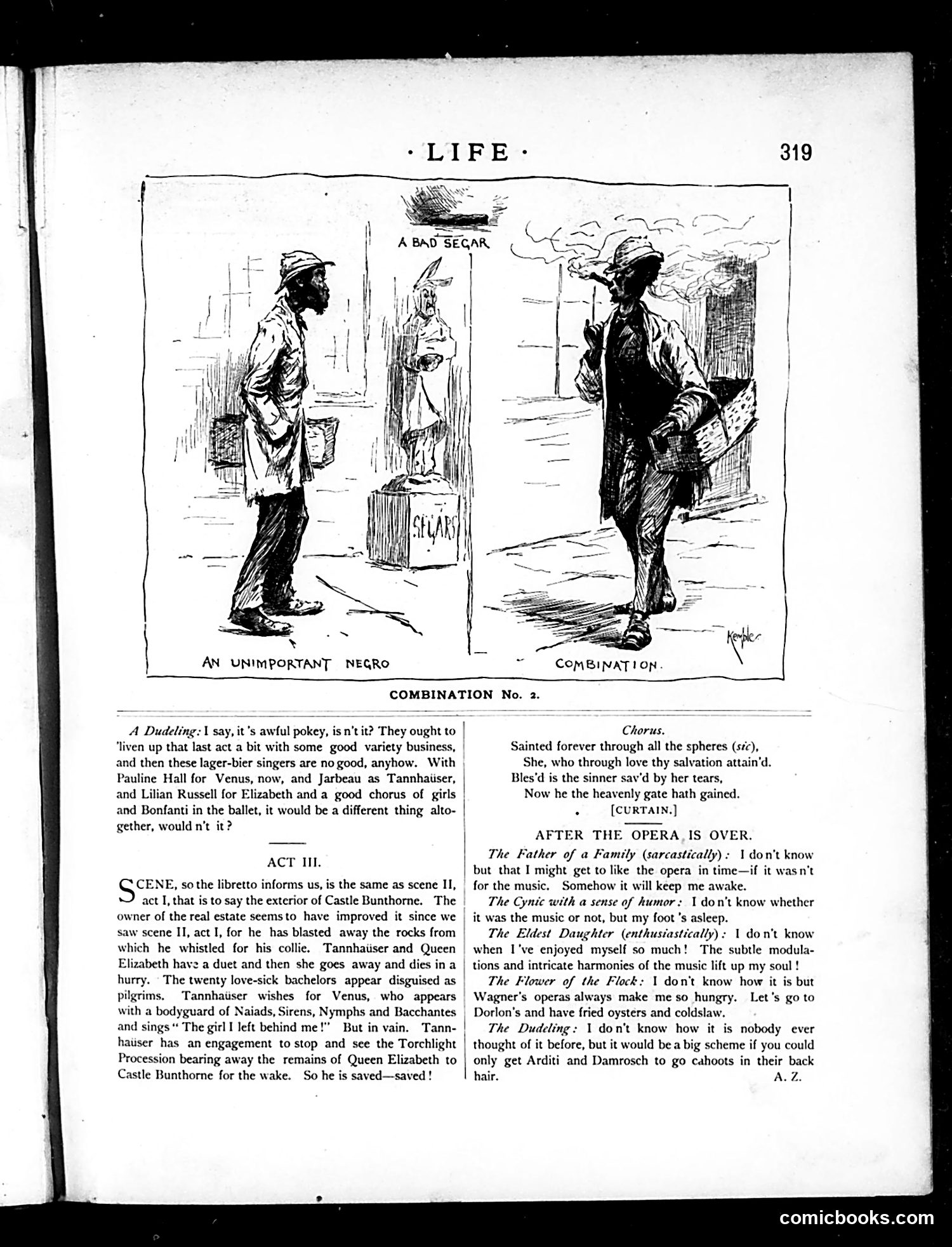
This page satirizes operatic pretension and audience reactions. The cartoon "Combination No. 2" depicts two figures labeled "An Unimportant Negro" and "Combination"—likely caricatures mocking opera performers or attendees. Below, the text skewers operagoers' affected responses after performances. Various characters claim ignorance or boredom despite professing enjoyment: a father finds the music keeps him awake, a cynic's foot falls asleep, the eldest daughter pretends deep appreciation of "subtle modulations," while the youngest simply gets hungry and wants oysters. The humor targets the hypocrisy of opera audiences who pose as cultured while experiencing discomfort or indifference. The final joke about getting conductors Arditi and Damrosch to collaborate "in their back hair" appears to be nonsensical mockery of operatic pretension itself. The racial caricature in the cartoon reflects period attitudes but appears secondary to the primary satire of opera-house affectation.
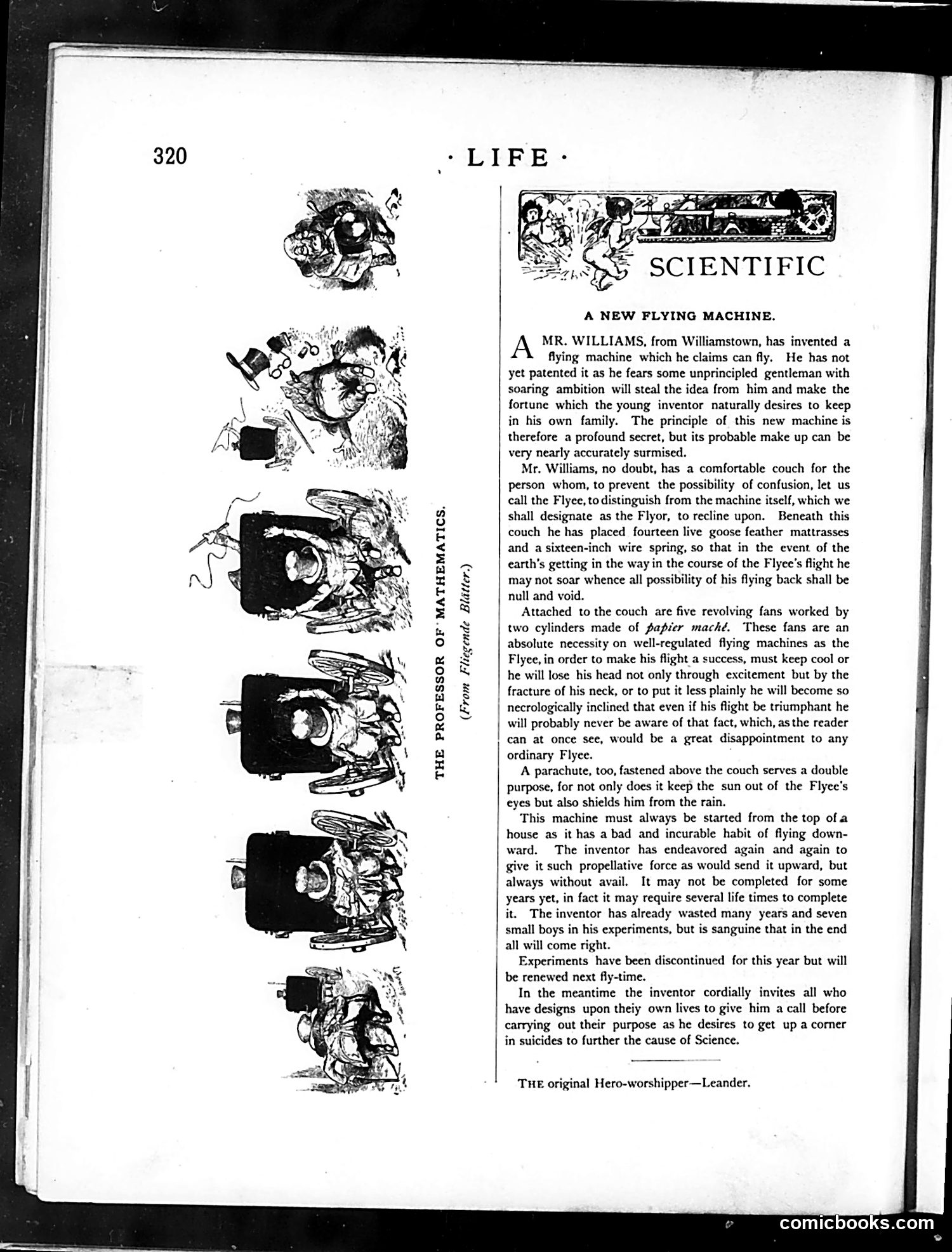
This is satirical commentary on the era's amateur flying machine inventors—a common topic of ridicule in the late 19th/early 20th century. The text mocks "Mr. Williams from Williamstown" and his absurd contraption through deadpan, elaborate description. The joke centers on an obviously doomed flying apparatus: a couch with fourteen goose-feather mattresses (for crash landing), papier-mâché fans for cooling, and a parachute that doubles as a sunshade. The inventor can't get it to fly upward—only downward. The satire peaks in the final paragraph's dark humor: Williams has already "wasted many years and seven small boys in his experiments" and invites suicidal people to test-fly it, hoping to "get up a corner in suicides to further the cause of Science." This mocks both delusional inventors and the public's fascination with aviation during this experimental period. The sidebar illustrations show the evolving design from multiple perspectives—emphasizing the mechanical absurdity Life's audience would recognize.
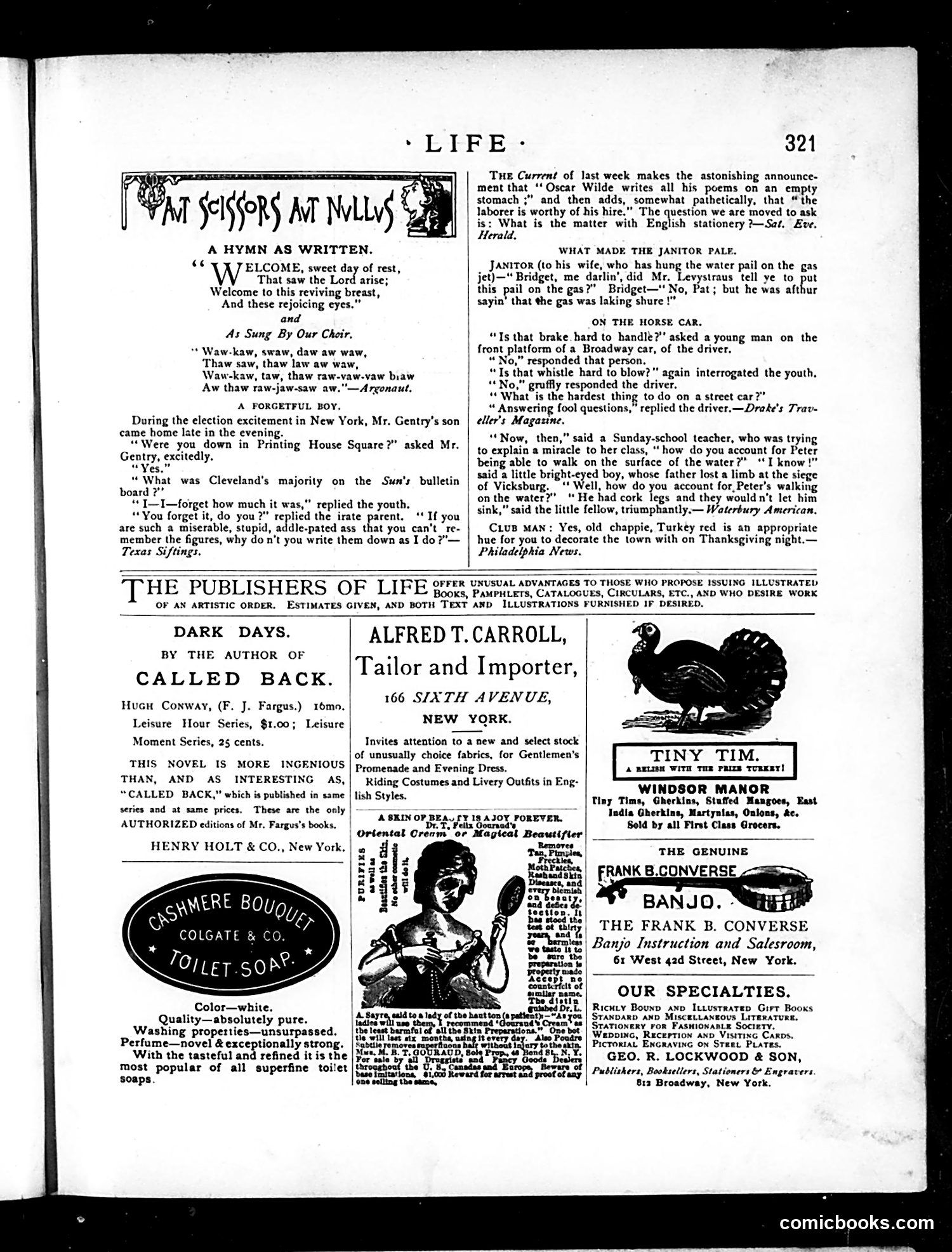
This page features brief comic anecdotes typical of Life magazine's satirical style. The jokes mock forgetfulness (a boy can't recall election returns), Irish domestic servants (janitor and wife's malapropism about a "leaking" gas), and foolish behavior (passengers pestering a streetcar driver with obvious questions). One joke obliquely references the recent Civil War, with a child offering a darkly absurd explanation for Peter walking on water, referencing someone who lost a limb at Vicksburg. The page is primarily filled with period advertisements for luxury goods—tailor services, toilet soap, banjo instruction—reflecting the magazine's affluent readership. A header announces Life's printing services. The "Scissors at Nulls" heading and hymn parody appear to reference religious hypocrisy or performance, though exact context is unclear from the visible text.
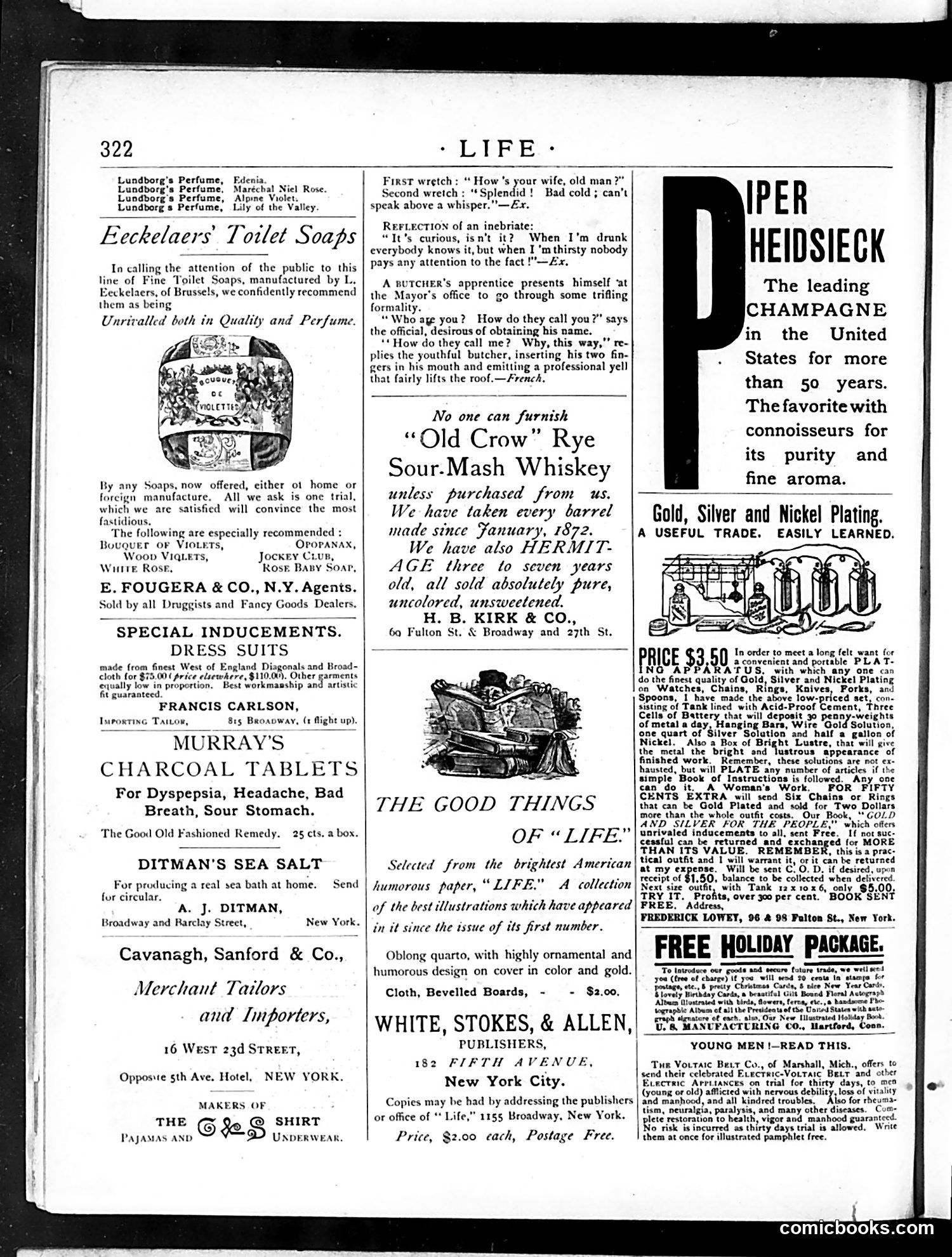
This page is primarily **advertisements and humor snippets**, typical of Life magazine's format. The few satirical items are brief, disconnected jokes rather than sustained cartoons: **The humor pieces** include: - A drunk man's observation that nobody notices when he's thirsty (social commentary on alcoholism awareness) - A butcher's apprentice responding to "How do they call you?" by literally yelling like he does at work (physical comedy about working-class culture) **The advertisements** dominate, hawking: - French toilet soaps and perfumes - Dress suits and men's clothing - Patent medicines (charcoal tablets, sea salt) - "Old Crow" whiskey and Piper Heidsieck champagne - A mail-order gold/silver plating kit - A book collecting "good things" from Life magazine itself The page reflects **late-19th century consumer culture**—targeting middle and upper-class readers with luxury imports, dubious medicinal remedies, and self-improvement schemes. The humor is gentle, observational rather than political, focused on everyday absurdities rather than social critique.
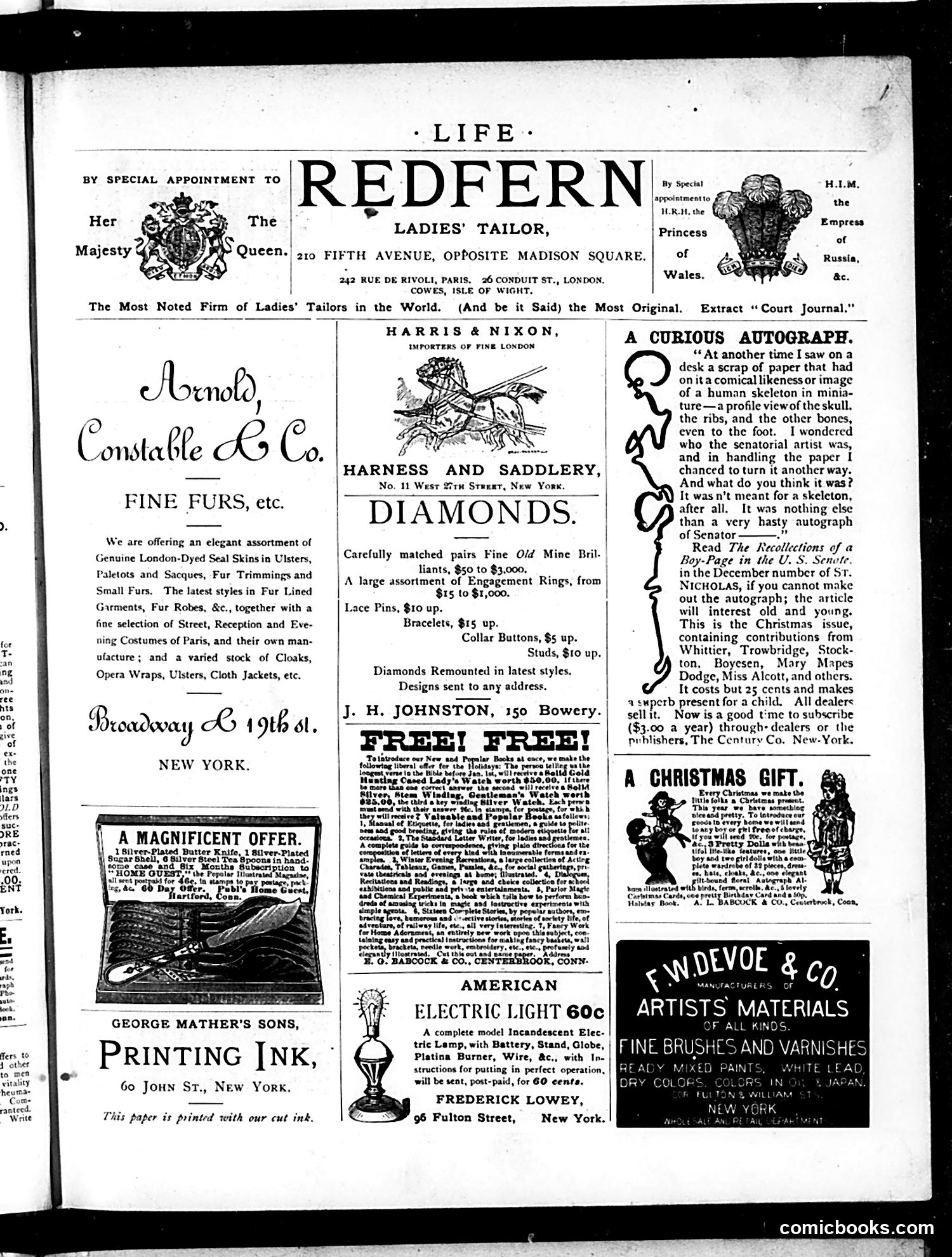
This is primarily an **advertising page** from Life magazine, not a political cartoon. The page consists almost entirely of commercial advertisements for luxury goods and services popular in late 19th-century New York. The major advertiser is **Redfern**, a prestigious ladies' tailor with royal appointments (note the royal coats of arms), promoting their Fifth Avenue location. Other notable ads include diamond merchants, fur dealers, printing ink, and artists' materials. The only editorial content is a small feature titled "A Curious Autograph," which describes a senator's hasty handwriting that accidentally resembles a skeleton. This appears to be promotional material for *St. Nicholas* magazine's December Christmas issue, which featured contributions from notable writers like Whittier and Louisa May Alcott. There are **no political cartoons or satire** visible on this page—it represents the commercial foundation that supported literary magazines of the period.
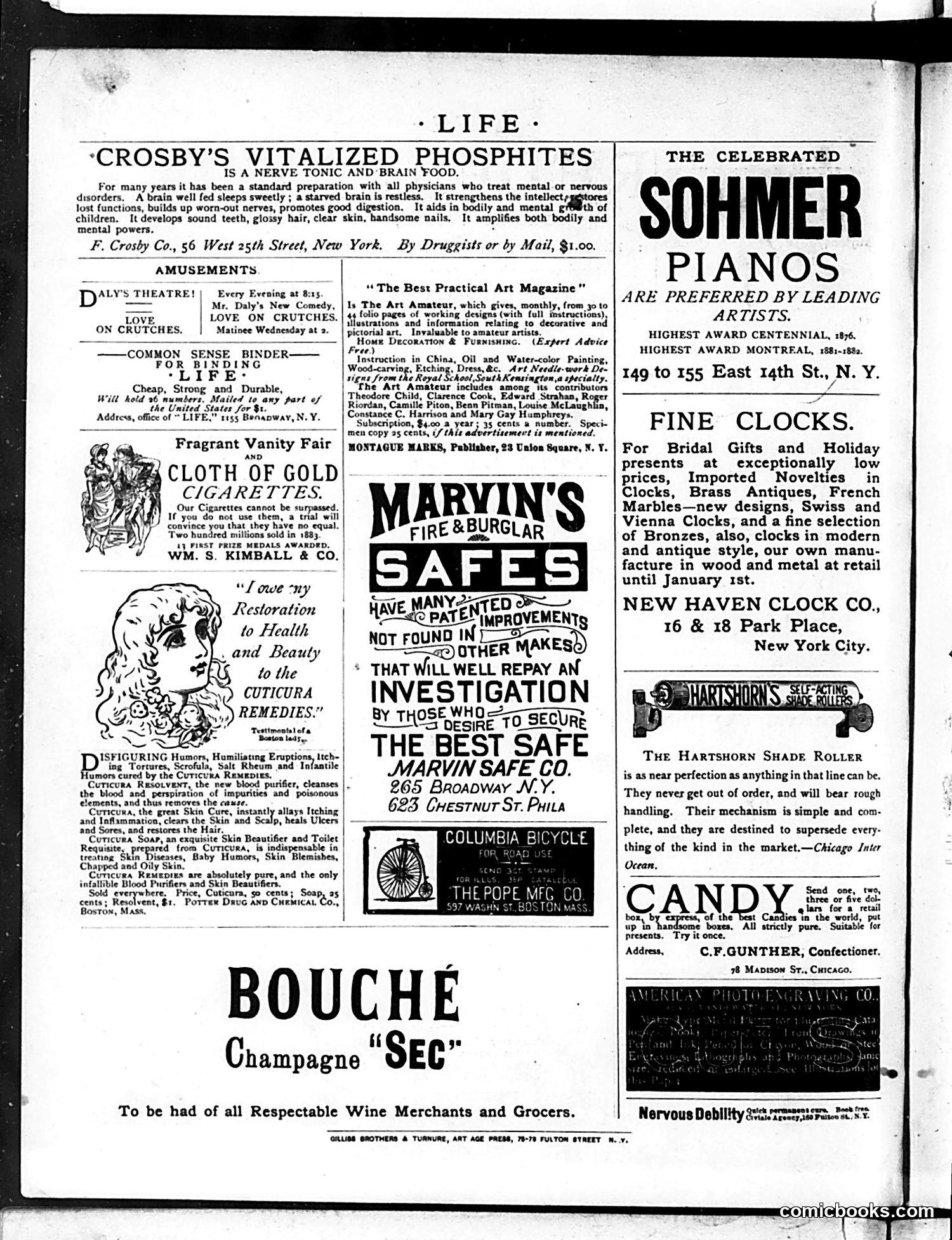
This page is primarily **advertisements** rather than editorial cartoons or satire. It's a typical late-19th-century magazine page mixing product pitches with theater notices. The only illustration with potential satirical content is a small classical female head (labeled "Cuticura Remedies"), which appears decorative rather than satirical—a common Victorian-era advertising aesthetic. The ads themselves reflect period concerns and attitudes: Crosby's Phosphites promises to cure "mental or nervous disorders" through nutrition; Cuticura remedies treat skin conditions; and products like "Cloth of Gold Cigarettes" and Bouché Champagne target affluent consumers. These ads reveal contemporary beliefs about medicine and consumption but lack explicit satire or political commentary. The theater notice for "Love on Crutches" is straightforward promotion rather than commentary. Overall, this is a commercial page documenting late-1800s consumer culture and medical pseudoscience rather than satirical content.