
Life, 1884-12-04 · page 6 of 16
Life — December 4, 1884 — page 6: what you’re looking at
What you’re looking at
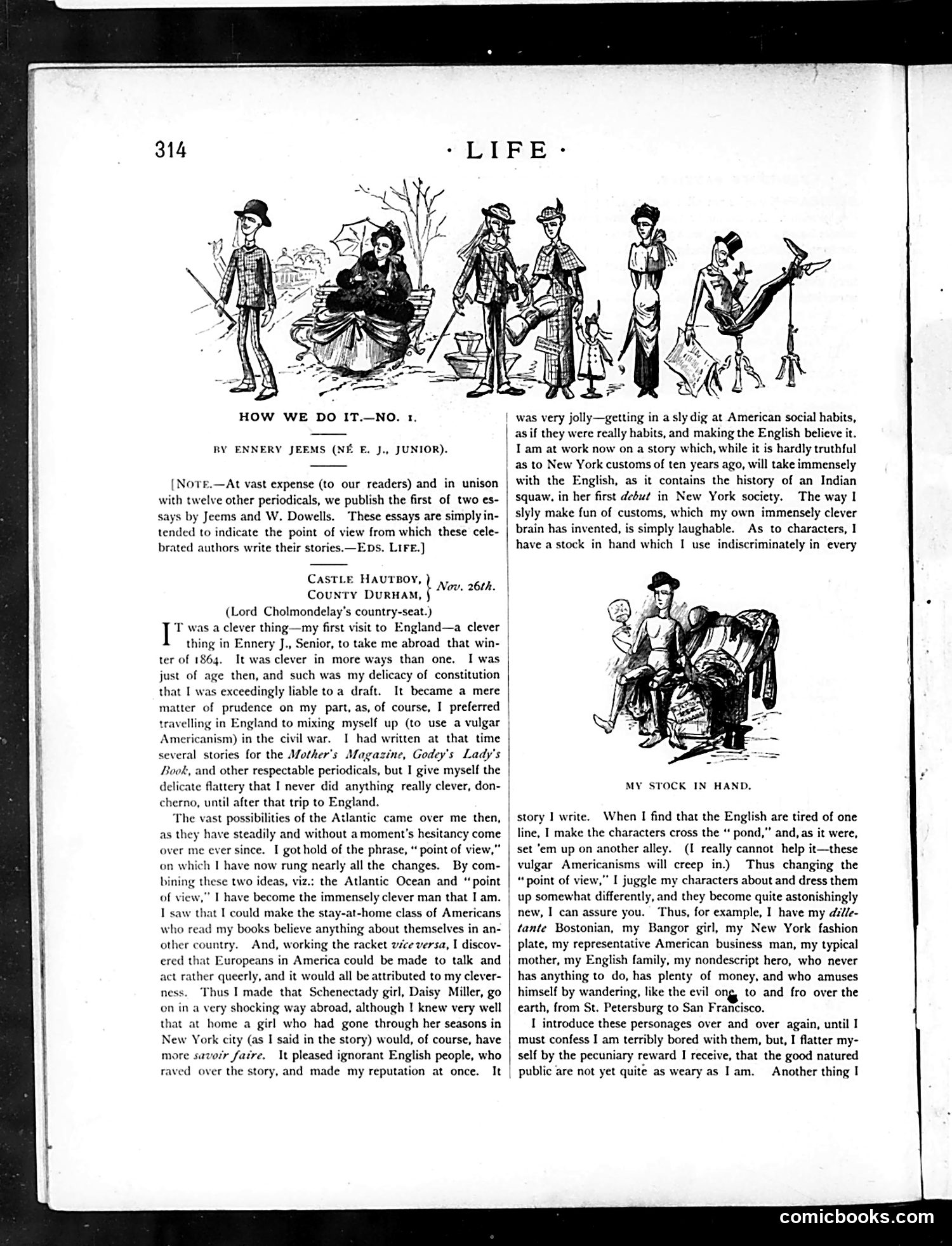
This page presents a satirical essay about American versus English customs and character writing. The author, an American visiting England, describes how he adapts his literary portrayals of characters to amuse readers—particularly by changing "point of view." The cartoon strip at top shows various character types the author claims to stock "in hand" for his stories. The accompanying illustration (labeled "MY STOCK IN HAND") depicts a writer with a collection of character types ready to deploy. The satire targets American literary conventions: specifically, how American writers recycle stereotypical character archetypes and shift narrative perspectives to create novelty rather than genuine creativity. It's a self-aware critique of formula-driven popular fiction and the commercialization of writing.
📄 Transcribed text from this page (OCR, searchable)
Machine-transcribed from the original scan — historical spelling and the odd misread are preserved.
HOW WE DO IT.—NO. 1. BY ENNERY JEEMS (NE E. J., JUNIOR). {Nove.—At vast expense (to our readers) and in unison with twelve other periodicals, we publish the first of two es- says by Jeems and W. Dowells. These essays are simply in- tended to indicate the point of view from which these cele- brated authors write their stories.—Eps. LIFE.) CasTLe HAUTBOY, County DuRHAM, (Lord Cholmondelay’s country-seat.) T was a clever thing—my first visit to England—a clever \ Nov. 26th. thing in Ennery J., Senior, to take me abroad that win- | ter of 1864. It was clever in more ways than one. I was just of age then, and such was my delicacy of constitution that I was exceedingly liable to a draft. It became a mere matter of prudence on my part, as, of course, I preferred travelling in England to mixing myself up (to use a vulgar Americanism) in the civil war. several stories for the Mother's Magazine, Godey's Lady's nd other respectable periodicals, but I give myself the delicate flattery that I never did anything really clever, don- | cherno, until after that trip to England. The vast possibilities of the Atlantic came over me then, as they have steadily and without a moment's hesitancy come over me ever since. I got hold of the phrase, “ point of view,” on which | have now rung nearly all the changes. bining these two ideas, viz.: the Atlantic Ocean and “point * I have become the immensely clever man that I am. I saw that I could make the stay-at-home class of Americans who read my books believe anything about themselves in an- other country. And, working the racket vice versa, I discov- ered that Europeans in America could be made to talk and act rather queerly, and it would all be attributed to my clever- ness. Thus I made that Schenectady girl, Daisy Miller, go on in a very shocking way abroad, although I knew very well that at home a girl who had gone through her seasons in New York city (as I said in the story) would, of course, have more savorr fatre. It pleased ignorant English people, who raved over the story, and made my reputation at once. It of view I had written at that time | By com- | was very jolly—getting in a sly dig at American social habits, as if they were really habits, and making the English believe it. 1 am at work now on a story which, while it is hardly truthful as to New York customs of ten years ago, will take immensely | with the English, as it contains the history of an Indian | squaw, in her first debut in New York society. The way I slyly make fun of customs, which my own immensely clever brain has invented, is simply laughable. As to characters, I have a stock in hand which I use indiscriminately in every MY STOCK IN HAND, | story I write. When I find that the English are tired of one line, I make the characters cross the “ pond,” and, as it were, set ‘em up on another alley. (I really cannot help it—these vulgar Americanisms will creep in.) Thus changing the “point of view,” I juggle my characters about and dress them up somewhat differently, and they become quite astonishingly new, I can assure you. Thus, for example, 1 have my dédle- tante Bostonian, my Bangor girl, my New York fashion plate, my representative American business man, my typical mother, my English family, my nondescript hero, who never has anything to do, has plenty of money, and who amuses himself by wandering, like the evil ong to and fro over the earth, from St. Petersburg to San Francisco. I introduce these personages over and over again, until I must confess I am terribly bored with them, but, I flatter my- self by the pecuniary reward I receive, that the good natured public are not yet quite as weary as Iam. Another thing I comicbooks.com