
Life, 1884-12-04 · page 12 of 16
Life — December 4, 1884 — page 12: what you’re looking at
What you’re looking at
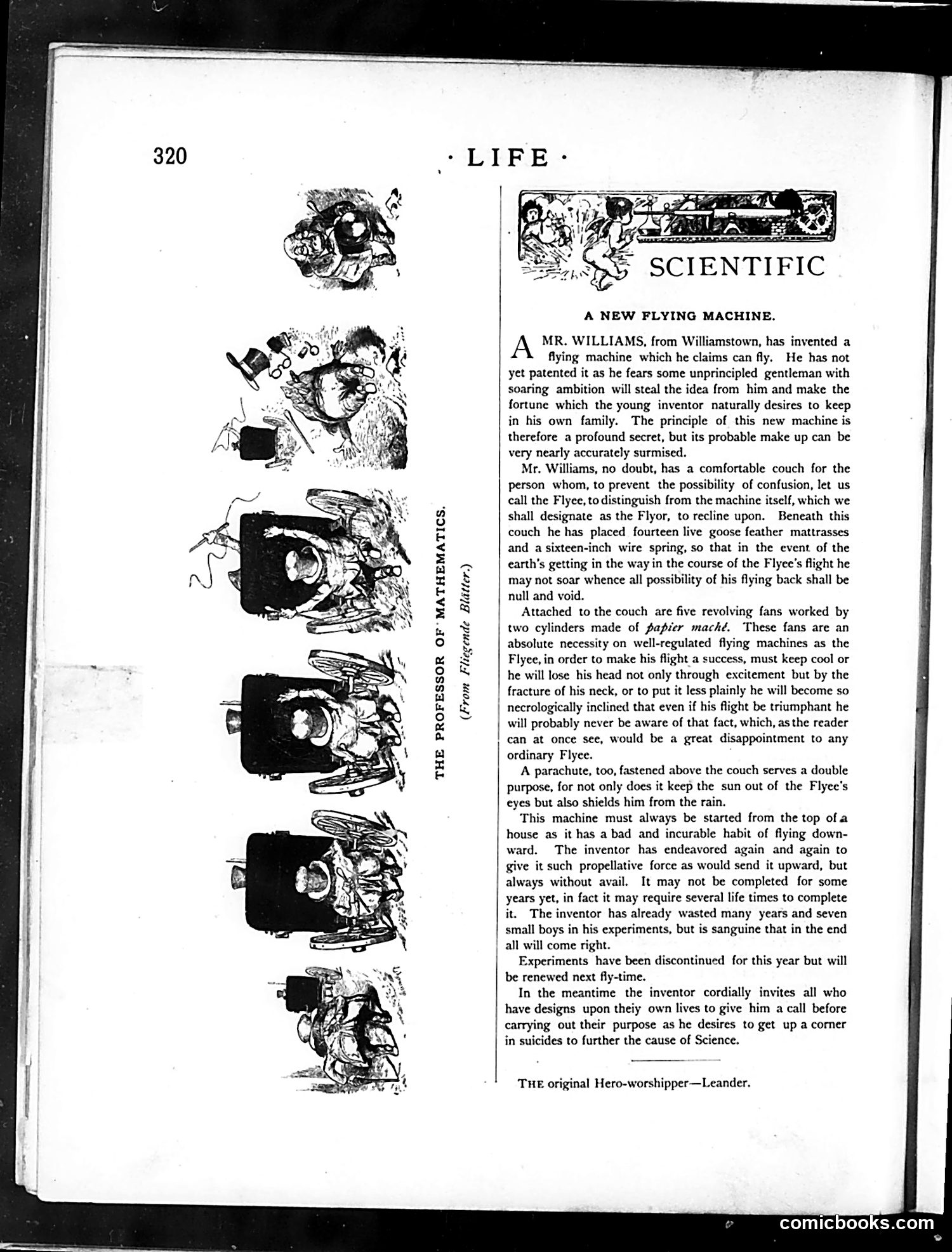
This is satirical commentary on the era's amateur flying machine inventors—a common topic of ridicule in the late 19th/early 20th century. The text mocks "Mr. Williams from Williamstown" and his absurd contraption through deadpan, elaborate description. The joke centers on an obviously doomed flying apparatus: a couch with fourteen goose-feather mattresses (for crash landing), papier-mâché fans for cooling, and a parachute that doubles as a sunshade. The inventor can't get it to fly upward—only downward. The satire peaks in the final paragraph's dark humor: Williams has already "wasted many years and seven small boys in his experiments" and invites suicidal people to test-fly it, hoping to "get up a corner in suicides to further the cause of Science." This mocks both delusional inventors and the public's fascination with aviation during this experimental period. The sidebar illustrations show the evolving design from multiple perspectives—emphasizing the mechanical absurdity Life's audience would recognize.
📄 Transcribed text from this page (OCR, searchable)
Machine-transcribed from the original scan — historical spelling and the odd misread are preserved.
‘MATHEMATICS, be ° 4 fe} a an ry fe fo} iJ Oe a x & (From Fliegende Blitter.) A NEW FLYING MACHINE, MR. WILLIAMS, from Williamstown, has invented a flying machine which he claims can fly. He has not yet patented it as he fears some unprincipled gentleman with soaring ambition will steal the idea from him and make the fortune which the young inventor naturally desires to keep in his own family. The principle of this new machine is therefore a profound secret, but its probable make up can be very nearly accurately surmised. Mr. Williams, no doubt, has a comfortable couch for the person whom, to prevent the possibility of confusion, let us call the Flyee, to distinguish from the machine itself, which we shall designate as the Flyor, to recline upon. Beneath this couch he has placed fourteen live goose feather mattrasses and a sixteen-inch wire spring, so that in the event of the earth’s getting in the way in the course of the Flyee’s flight he may not soar whence all possibility of his flying back shall be null and void. Attached to the couch are five revolving fans worked by two cylinders made of papier macké. These fans are an absolute necessity on well-regulated flying machines as the Flyece, in order to make his flight a success, must keep cool or he will lose his head not only through excitement but by the fracture of his neck, or to put it less plainly he will become so necrologically inclined that even if his flight be triumphant he will probably never be aware of that fact, which, asthe reader can at once see, would be a great disappointment to any ordinary Flyee. A parachute, too, fastened above the couch serves a double purpose, for not only does it keep the sun out of the Flyee’s eyes but also shields him from the rain. This machine must always be started from the top of a house as it has a bad and incurable habit of flying down- ward. The inventor has endeavored again and again to give it such propellative force as would send it upward, but always without avail. It may not be completed for some years yet, in fact it may require several life times to complete it. The inventor has already wasted many years and seven small boys in his experiments, but is sanguine that in the end | all will come right. Experiments have been discontinued for this year but will be renewed next fly-time. In the meantime the inventor cordially invites all who have designs upon theiy own lives to give him a call before carrying out their purpose as he desires to get up a corner in suicides to further the cause of Science. THE original Hero-worshipper—Leander. comicbooks.com °