
Life, 1884-12-04 · page 5 of 16
Life — December 4, 1884 — page 5: what you’re looking at
What you’re looking at
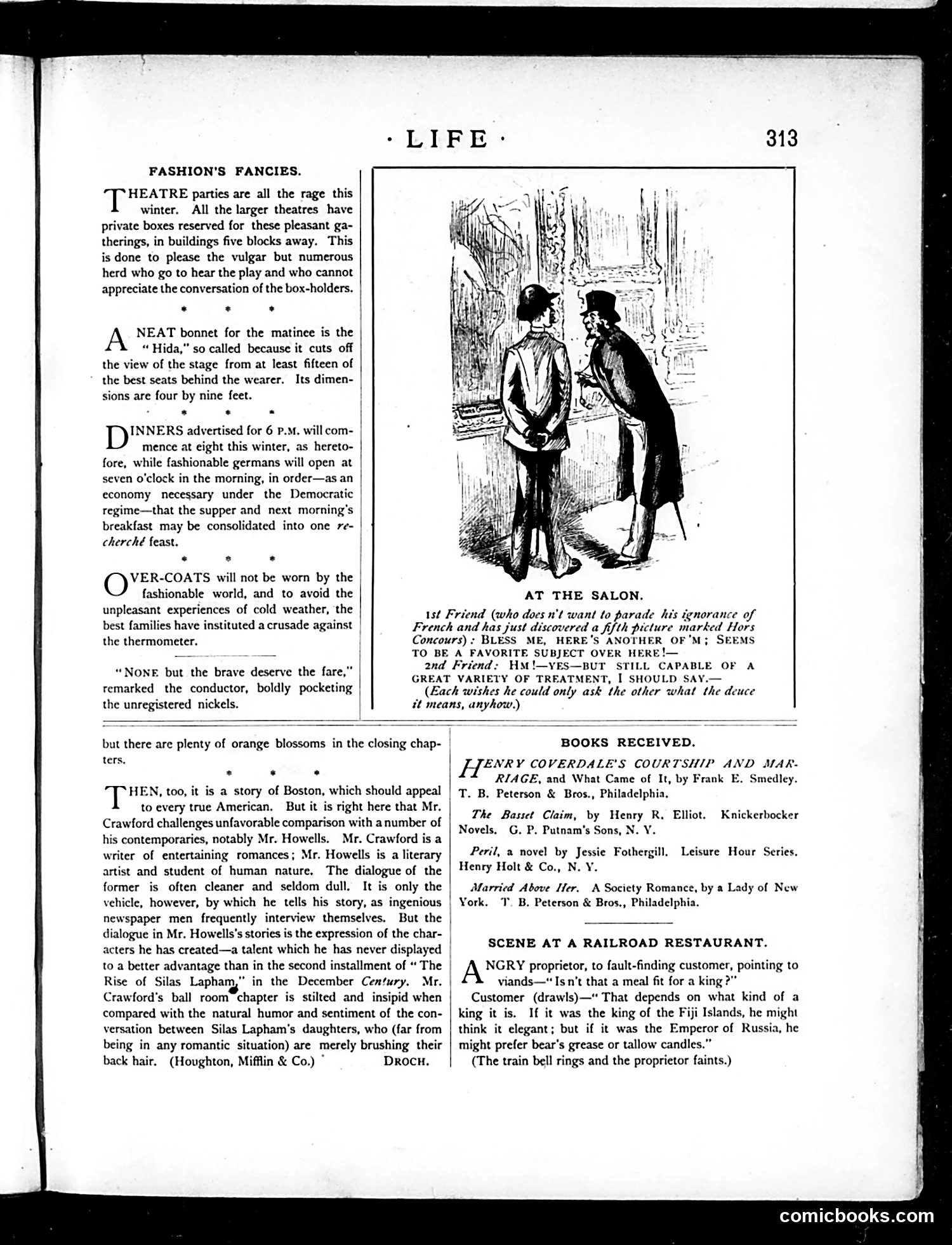
This cartoon satirizes fashionable society's pretensions at art exhibitions. Two well-dressed men examine a painting, with one delivering an affected critique about a French artist's work being "marked Hors Concours" (a prestigious award designation). The satire targets the pomposity of salon culture—how wealthy patrons adopt inflated artistic language to appear cultivated, even when discussing art superficially. The exaggerated conversation ("capable of a great variety of treatment") mocks the empty jargon used by fashionable society to discuss art without genuine understanding. The accompanying "Fashion's Fancies" column reinforces this theme, discussing theatre boxes, bonnets, and overcoats—showing how Life magazine simultaneously critiques both artistic and sartorial pretension among the elite class.
📄 Transcribed text from this page (OCR, searchable)
Machine-transcribed from the original scan — historical spelling and the odd misread are preserved.
FASHION'S FANCIES. HEATRE parties are all the rage this winter. All the larger theatres have private boxes reserved for these pleasant ga- therings, in buildings five blocks away. This is done to please the vulgar but numerous herd who go to hear the play and who cannot appreciate the conversation of the box-holders. | * * * NEAT bonnet for the matinee is the “ Hida,” so called because it cuts off the view of the stage from at least fifteen of the best seats behind the wearer. Its dimen- | sions are four by nine feet. | . . . | INNERS advertised for 6 P.M. will com- | mence at eight this winter, as hereto- | fore, while fashionable germans will open at | seven o'clock in the morning, in order—as an economy necessary under the Democratic regime—that the supper and next morning's breakfast may be consolidated into one re- cherché feast. . . . VER-COATS will not be worn by the | fashionable world, and to avoid the unpleasant experiences of cold weather, the AT THE SALON. best families have instituted a crusade against the thermometer. “NONE but the brave deserve the fare,” | remarked the conductor, boldly pocketing | the unregistered nickels. 1st Friend (who does n't want to parade hi's ignorance of French and has just discovered a fifth picture marked Hors Concours): BLESS ME, HERE'S ANOTHER OF'M; SEEMS TO BE A FAVORITE SUBJECT OVER HERE !— and Friend: HM!—YES—BUT STILL CAPABLE OF A GREAT VARIETY OF TREATMENT, I SHOULD SAY.— (Each wishes he could only ask the other what the deuce st means, anyhow.) but there are plenty of orange blossoms in the closing chap- ters, . . . HEN, too, it is a story of Boston, which should appeal to every true American. But it is right here that Mr. Crawford challenges unfavorable comparison with anumber of his contemporaries, notably Mr. Howells. Mr. Crawford is a writer of entertaining romances; Mr. Howells is a literary artist and student of human nature, The dialogue of the former is often cleaner and seldom dull. It is only the vehicle, however, by which he tells his story, as ingenious newspaper men frequently interview themselves. But the dialogue in Mr. Howells’s stories is the expression of the char- acters he has created—a talent which he has never displayed to a better advantage than in the second installment of “ The Rise of Silas Lapham,” in the December Century. Mr. | Crawford's ball room chapter is stilted and insipid when compared with the natural humor and sentiment of the con- versation between Silas Lapham’'s daughters, who (far from being in any romantic situation) are merely brushing their back hair. (Houghton, Mifflin & Co.) © Drocn. BOOKS RECEIVED. | Wa ENRY COVERDALE'S COURTSHIP AND MAR- | RIAGE, and What Came of It, by Frank E. Smedley. | T. B, Peterson & Bros., Philadelphia, The Basset Claim, by Henry R. Elliot. Novels, G. P. Putnam's Sons, N. Y. Knickerbocker Peril, a novel by Jessie Fothergill, Leisure Hour Series, Henry Holt & Co., N.Y. Married Above Her. A Society Romance, by a Lady of New | York. T. B. Peterson & Bros., Philadelphia. SCENE AT A RAILROAD RESTAURANT. NGRY proprietor, to fault-finding customer, pointing to viands—“ Is n't that a meal fit for a king ?” Customer (drawls)—" That depends on what kind of a king it is. If it was the king of the Fiji Islands, he might think it elegant; but if it was the Emperor of Russia, he might prefer bear's grease or tallow candles.” (The train bell rings and the proprietor faints.) comicbooks.com