
Life, 1884-12-04 · page 7 of 16
Life — December 4, 1884 — page 7: what you’re looking at
What you’re looking at
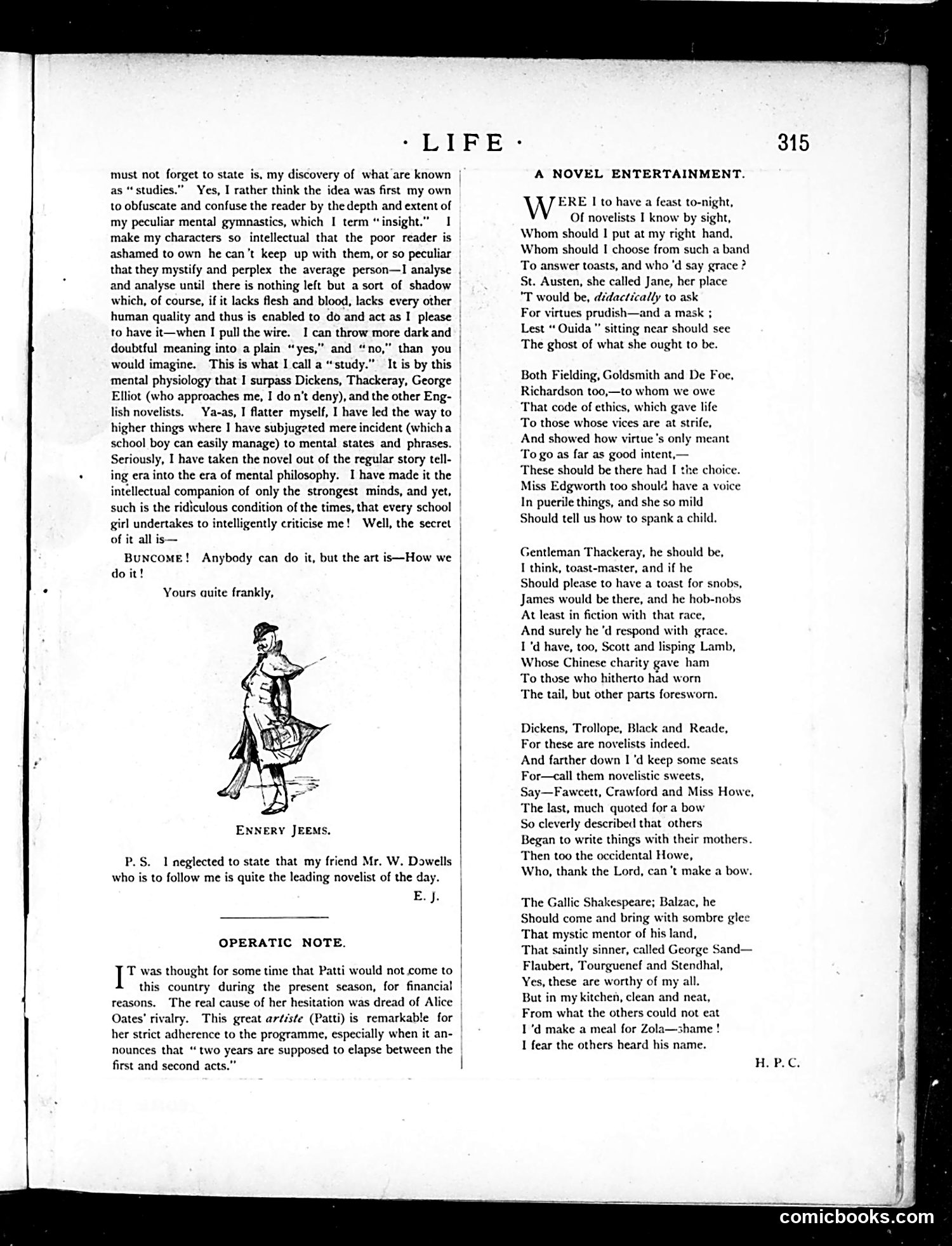
This page contains three distinct sections: 1. **A letter from "Ennery Jeems"** (likely a pseudonym) discussing literary analysis and character development in novels, signed "Yours quite frankly." 2. **"A Novel Entertainment"** — a poem by H.P.C. humorously proposing a dinner party of famous literary figures, including Jane Austen, Fielding, Goldsmith, Dickens, Thackeray, and others. The satire lies in imagining these canonical authors together, with witty commentary on their characteristics. 3. **"Operatic Note"** — a brief note about the opera singer Patti potentially not performing in the country due to financial reasons and rivalry with Alice Oates. The illustration shows a figure in period dress, likely representing one of the literary figures discussed. The page is primarily literary/cultural commentary rather than political satire.
📄 Transcribed text from this page (OCR, searchable)
Machine-transcribed from the original scan — historical spelling and the odd misread are preserved.
> LIFE - must not forget to state is, my discovery of what are known | as “studies.” Yes, I rather think the idea was first my own to obfuscate and confuse the reader by the depth and extent of my peculiar mental gymnastics, which I term “insight.” I make my characters so intellectual that the poor reader is ashamed to own he can’t keep up with them, or so peculiar that they mystify and perplex the average person—I analyse and analyse until there is nothing left but a sort of shadow which, of course, if it lacks flesh and blood, lacks every other human quality and thus is enabled to do and act as I please to have it—when I pull the wire. 1 can throw more dark and doubtful meaning into a plain “yes,” and “no,” than you would imagine. This is what I call a “study.” It is by this mental physiology that I surpass Dickens, Thackeray, George Elliot (who approaches me, I do n’t deny), and the other Eng- lish novelists. Ya-as, I flatter myself, I have led the way to higher things where I have subjugeted mere incident (whicha school boy can easily manage) to mental states and phrases. Seriously, I have taken the novel out of the regular story tell- ing era into the era of mental philosophy. I have made it the intellectual companion of only the strongest minds, and yet, such is the ridiculous condition of the times, that every school girl undertakes to intelligently criticise me! Well, the secret of it all is— Buncome! Anybody can do it, but the art is—How we do it! Yours auite frankly, ENNERY JEEMS. P.S. 1 neglected to state that my friend Mr. W. Dowells who is to follow me is quite the leading novelist of the day. E. J. OPERATIC NOTE. T was thought for some time that Patti would not come to | | this country during the present season, for financial | reasons. The real cause of her hesitation was dread of Alice Oates’ rivalry. This great art/ste (Patti) is remarkable for her strict adherence to the programme, especially when it an- nounces that “ two years are supposed to elapse between the first and second acts.” A NOVEL ENTERTAINMENT. ERE I to have a feast to-night, Of novelists I know by sight, Whom should I put at my right hand, Whom should I choose from such a band To answer toasts, and who 'd say grace ? St. Austen, she called Jane, her place ‘T would be, dédactically to ask For virtues prudish—and a mask ; Lest “ Ouida ” sitting near should see The ghost of what she ought to be. Both Fielding, Goldsmith and De Foe, Richardson too,—to whom we owe That code of ethics, which gave life To those whose vices are at strife, And showed how virtue'’s only meant Togo as far as good intent,— These should be there had I the choice. Miss Edgworth too should have a voice In puerile things, and she so mild Should tell us how to spank a child. Gentleman Thackeray, he should be, I think, toast-master, and if he Should please to have a toast for snobs, James would be there, and he hob-nobs At least in fiction with that race, And surely he 'd respond with grace. I ‘d have, too, Scott and lisping Lamb, Whose Chinese charity gave ham To those who hitherto had worn The tail, but other parts foresworn. Dickens, Trollope, Black and Reade, For these are novelists indeed. And farther down I ‘d keep some seats For—call them novelistic sweets, Say—Fawcett, Crawford and Miss Howe, The last, much quoted for a bow So cleverly described that others Began to write things with their mothers. Then too the occidental Howe, Who, thank the Lord, can 't make a bow. The Gallic Shakespeare; Balzac, he Should come and bring with sombre glee That mystic mentor of his land, That saintly sinner, called George Sand— Flaubert, Tourguenef and Stendhal, Yes, these are worthy of my all. But in my kitchen, clean and neat, From what the others could not eat 1 ‘d make a meal for Zola—shame ! I fear the others heard his name. comicbooks.com