
A complete issue · 18 pages · 1884
Life — November 20, 1884
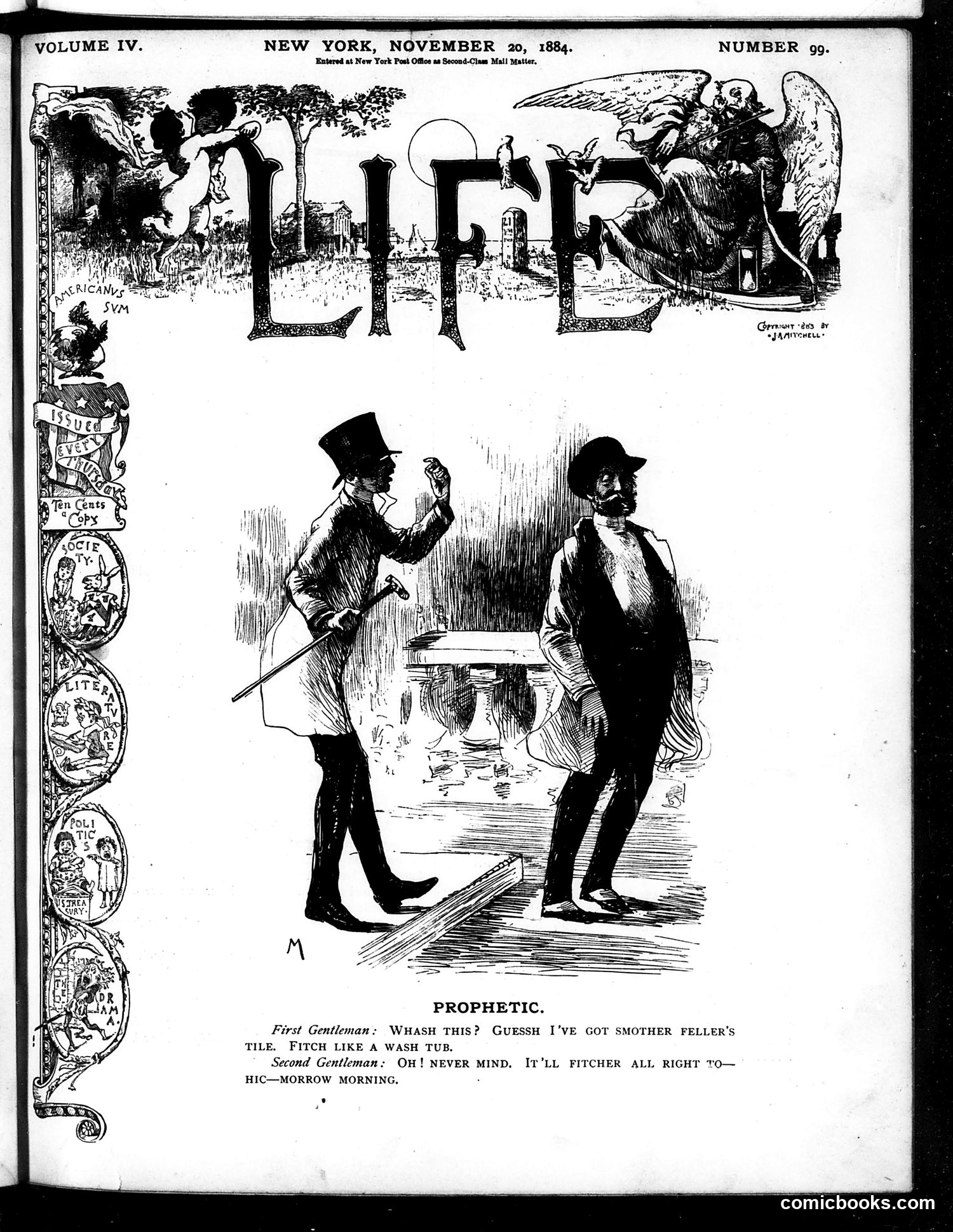
This cartoon satirizes a conversation between two gentlemen in top hats. The first man shows the second a "wash tub," claiming he's "got smother feller's title" and it "pitch like a wash tub." The second responds he'll overlook it—it will "pitcher all right" by tomorrow morning. The humor appears to play on baseball terminology ("pitcher") and domestic imagery (wash tubs). The reference to obtaining someone else's "title" suggests property or legal disputes. The cartoon likely mocks either political corruption regarding property claims or commentary on an ongoing legal/election dispute from 1884, though the specific reference remains unclear without additional historical context about what "title" dispute dominated that period.
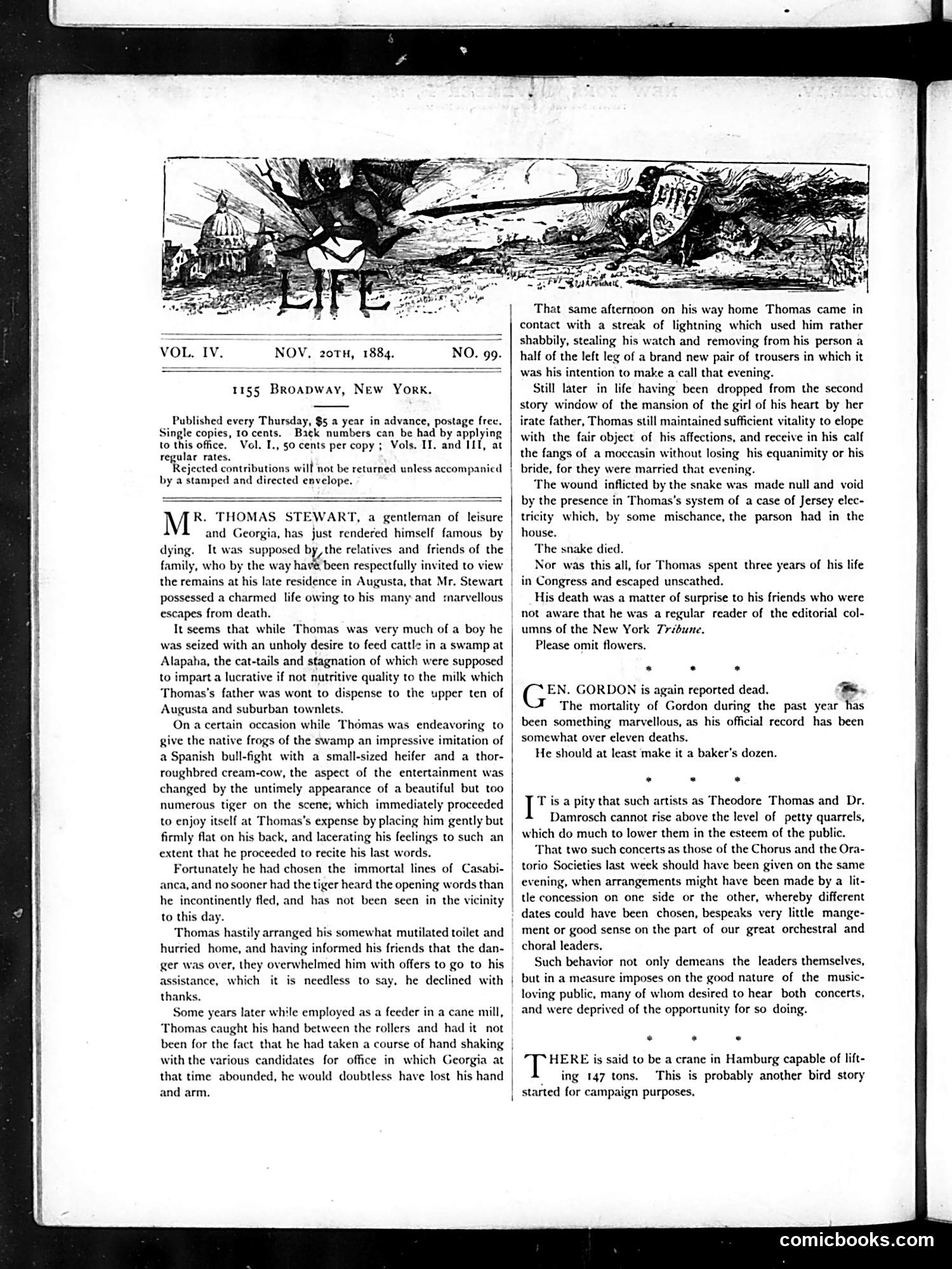
The page contains three satirical pieces rather than a unified cartoon: 1. **"Mr. Thomas Stewart"** - A humorous biographical sketch mocking a Georgia gentleman's repeated narrow escapes from death, particularly through absurd incidents involving cattle, tigers, and a snake bite. The satire targets his improbable survival stories. 2. **"Gen. Gordon"** - A brief notice sarcastically commenting that the military figure's death rate over the past year "has been something marvellous" with over eleven deaths, suggesting he's been reported dead repeatedly—likely referencing exaggerated or false war reports. 3. **"Theodore Thomas and Dr. Damrosch"** - Criticism of competing orchestra conductors for scheduling concerts simultaneously, damaging both institutions through poor coordination. 4. **Hamburg crane anecdote** - A skeptical final note about an implausibly large crane capacity claim.
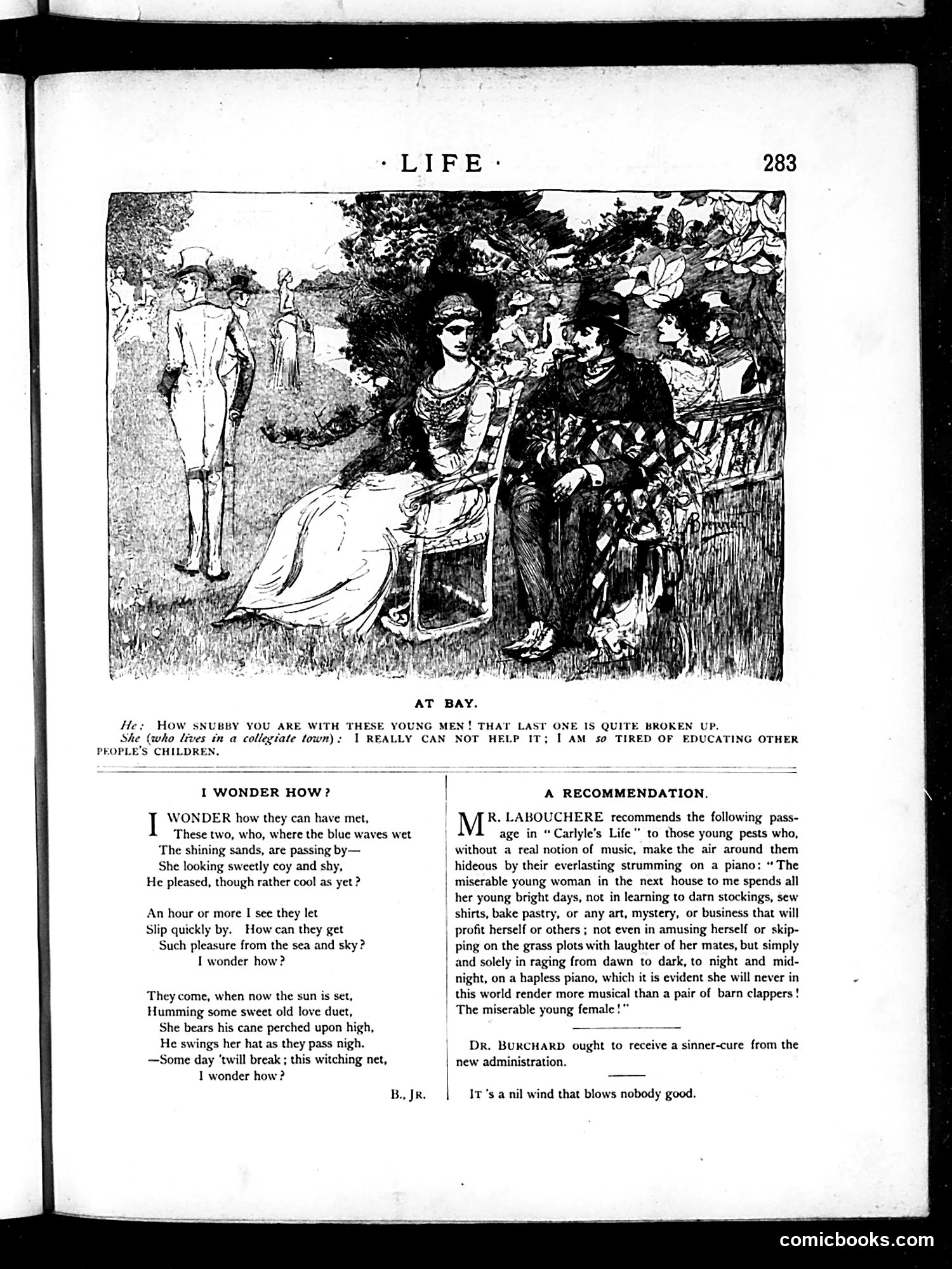
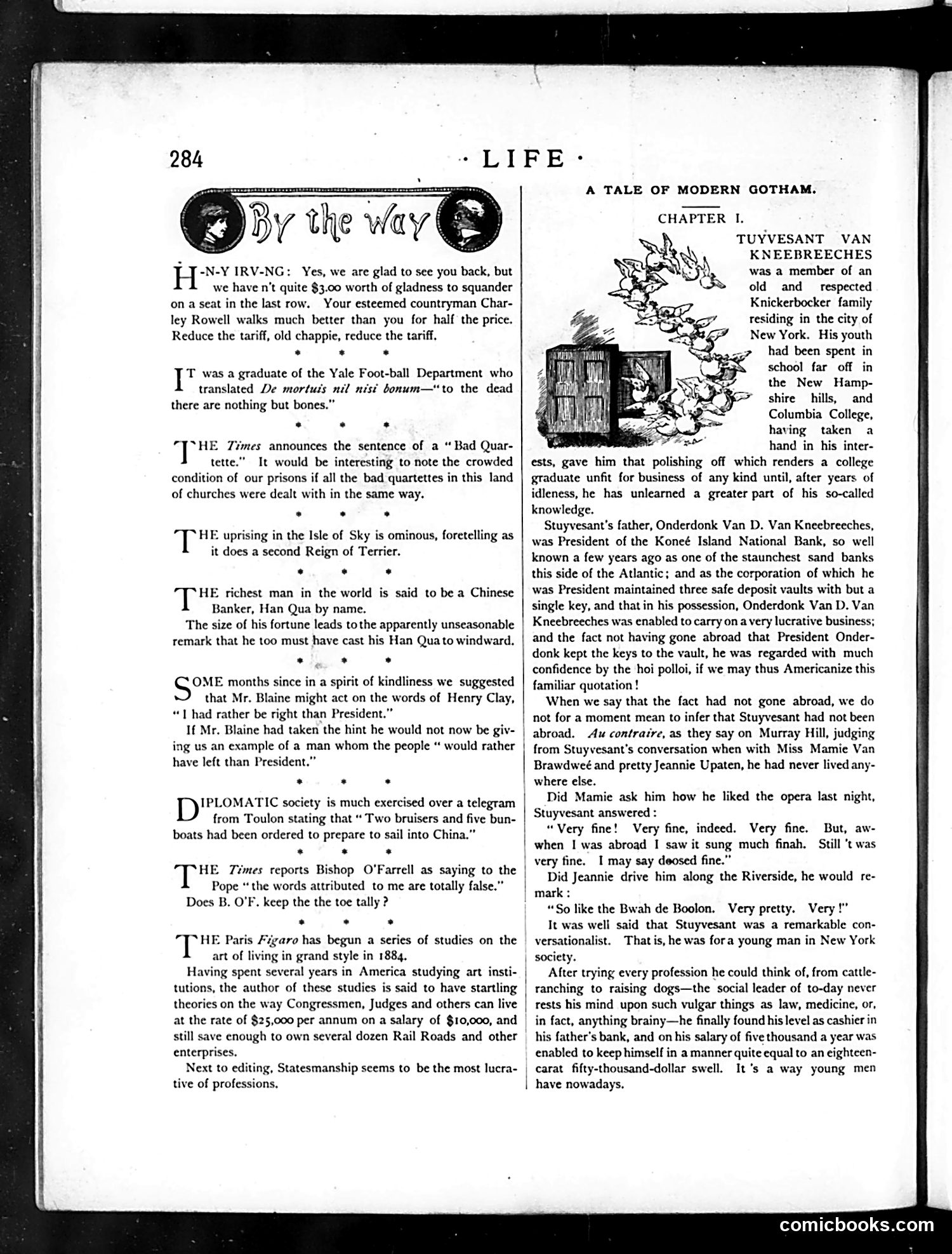
The page combines satirical commentary with a serialized fiction story ("A Tale of Modern Gotham"). The left column, "By the Way," contains brief topical jokes rather than a formal political cartoon. The satire targets: - **American tariff policy**: A mock dialogue about reducing import duties - **Yale's football program**: A Latin phrase joke about "the dead" (De mortuis nil nisi bonum) - **Social inequality**: Comments on urban slums and church conditions - **Current events**: References to the Isle of Skye uprising, a Chinese banker named Han Qua, and diplomatic tensions The right side begins a serialized story about Stuyvesant Van Kneebreeches, a wealthy New York banker's son, using humor to satirize wealthy idleness and social pretension typical of Gilded Age Life magazine content.
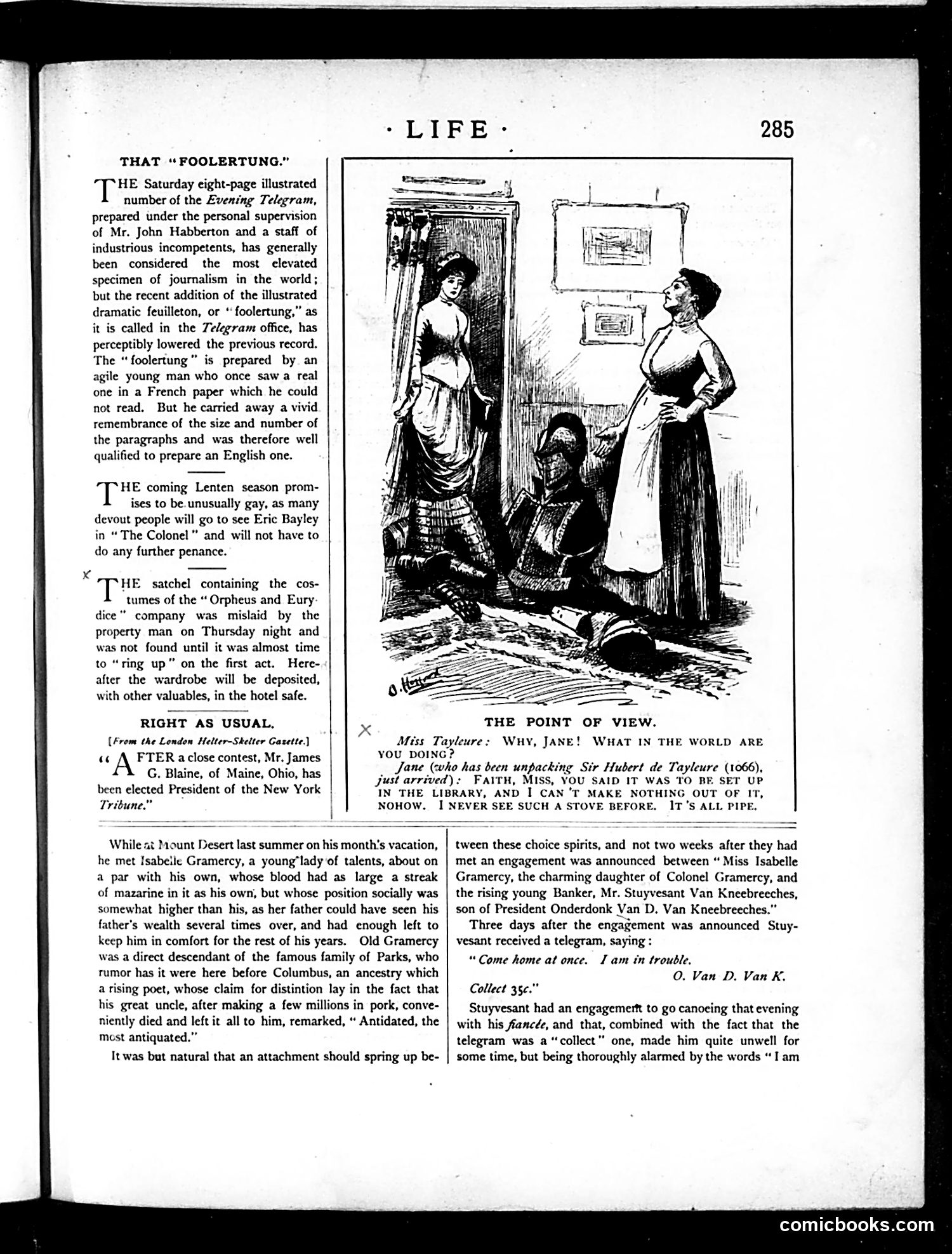
This cartoon satirizes a domestic dispute about unpacking. Miss Tayleure discovers her friend Jane has been storing Sir Hubert de Tayleure's belongings in the library rather than properly arranging them. Jane dismisses the concern, calling it "all pipe" (nonsense), while Miss Tayleure expresses exasperation at the disorder. The humor lies in contrasting perspectives: what Jane considers a minor, temporary arrangement, Miss Tayleure views as an embarrassing household management failure. The cartoon's title ironically emphasizes how differently the two women evaluate the same situation—a common domestic conflict about standards and domestic order that would resonate with early 20th-century readers familiar with servant management and household propriety.
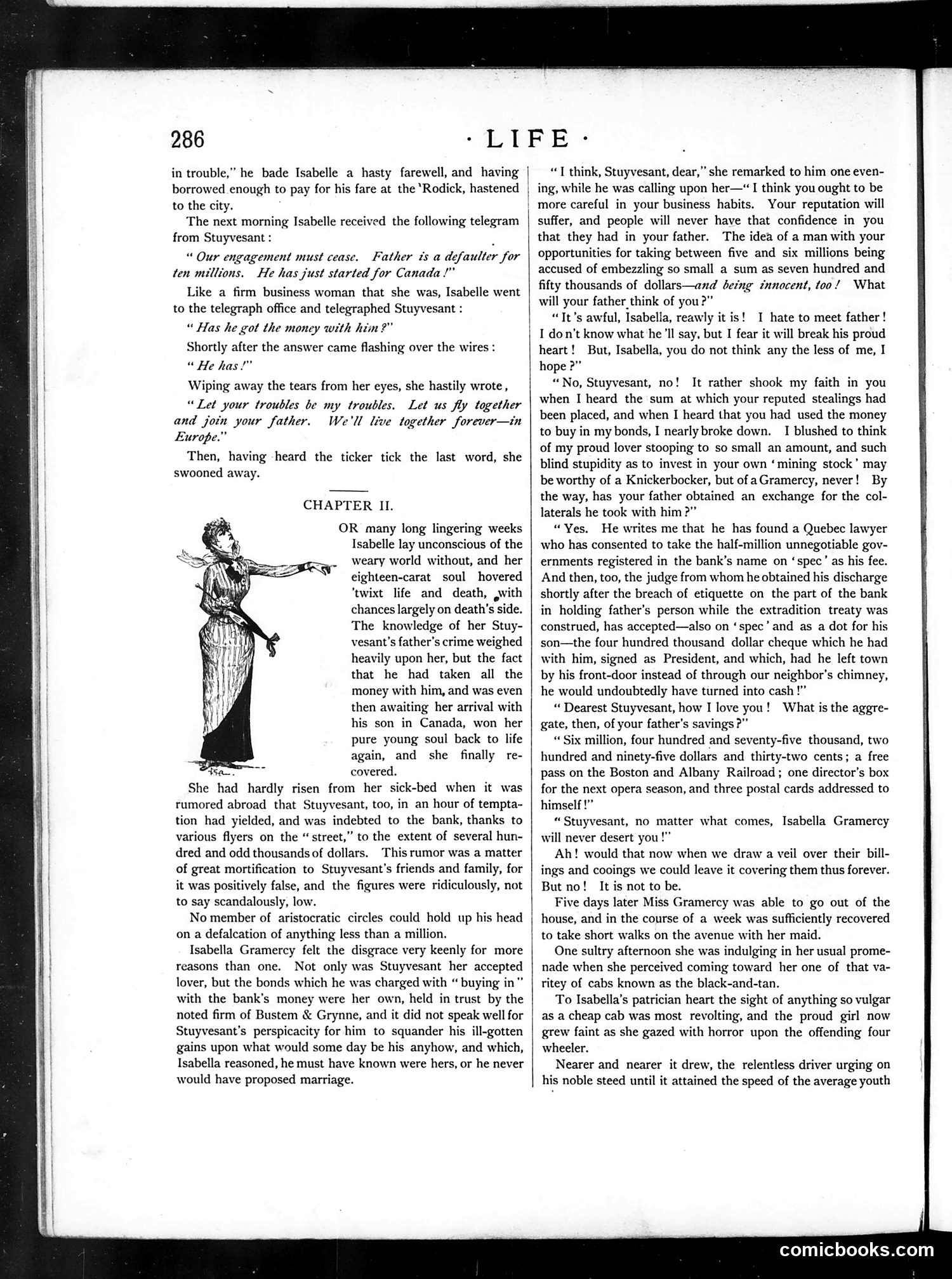
This page contains narrative fiction rather than political satire or cartoons. The story follows Isabella Gramercy, a wealthy woman whose lover Stuyvesant faces financial scandal—his father embezzled millions and defaulted on debts. Isabella receives telegrams addressing the crisis, ultimately pledging her loyalty despite the reputational damage. The single illustration shows a woman in period dress gesturing expressively, likely depicting Isabella's dramatic response to the scandal. The content satirizes high-society anxiety about financial impropriety and social disgrace among the wealthy class. It reflects turn-of-the-century concerns about banking scandals and the fragility of aristocratic reputation—themes relevant to Life magazine's audience of educated, affluent readers who would recognize the social stakes depicted.
This page contains literary content rather than political cartoons. The main sections discuss: 1. **"A New Picture of Hawthorne"** — A review of a new biography of author Nathaniel Hawthorne by J.R. Osgood & Co. The text argues this biography presents Hawthorne as more relatable and morally grounded than his popular mystical reputation suggests, particularly compared to his "Scarlet Letter" image. 2. **"Books Received"** — A brief listing of new publications. 3. **"Foot-Ball"** — Commentary on the upcoming college football season, noting games between Yale, Harvard, and Princeton, with discussion of new rules designed to make play more organized and reduce injuries. The page appears to be primarily book reviews and cultural commentary rather than satirical cartoons.
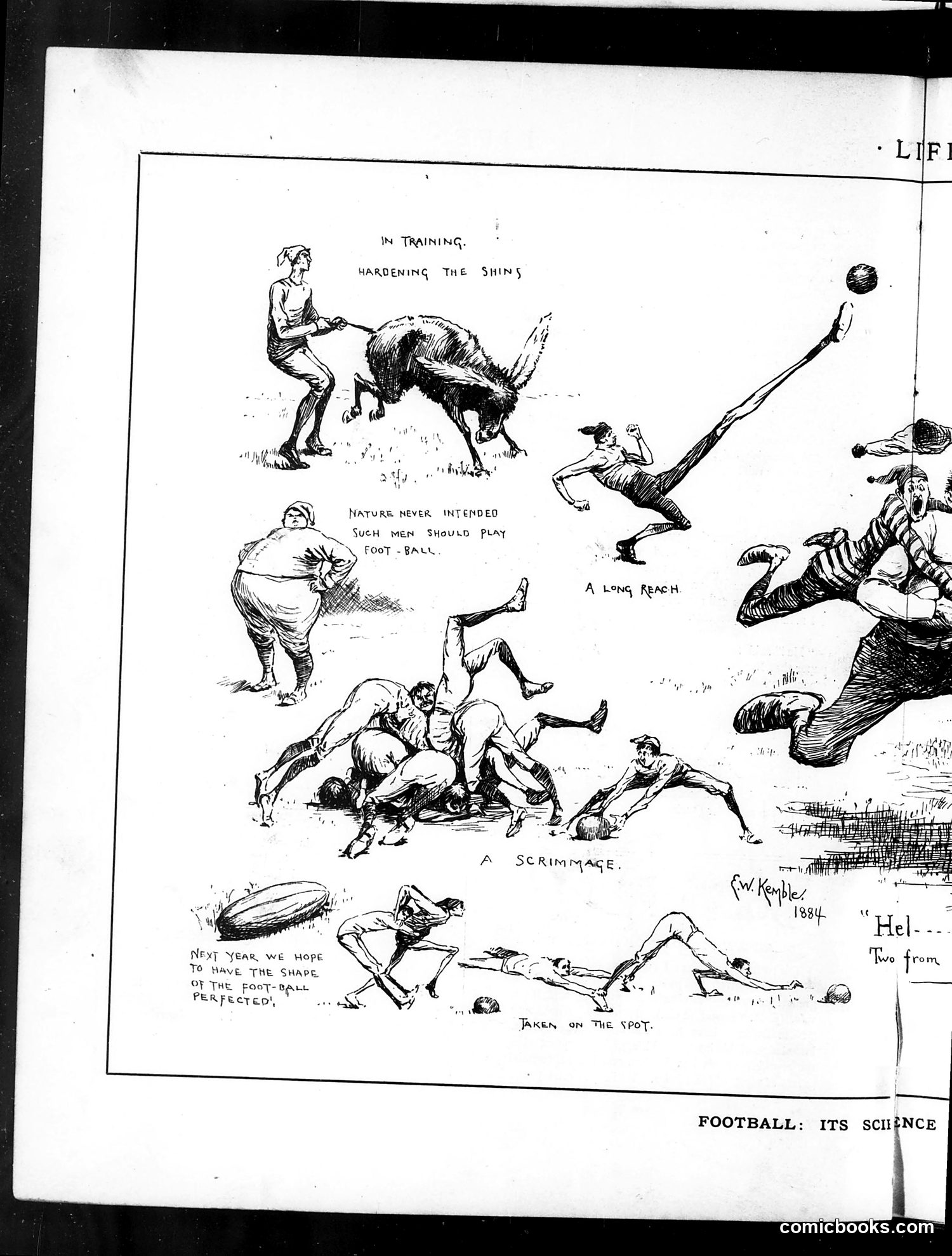
This 1884 illustration by W. Kemble mocks the emerging sport of American football through exaggerated physical comedy. The cartoon depicts various training methods and playing scenarios with absurd, injury-prone results: - "In Training: Hardening the Shins" shows a man being kicked by a donkey - "A Long Reach" depicts an improbable athletic stretch - "A Scrimmage" portrays a chaotic pile-up of bodies - "Taken on the Spot" shows players sprawled on the ground The accompanying text sarcastically suggests "Nature never intended such men should play foot-ball" and hopes next year will perfect the sport. The joke targets football's violent, brutal reputation and the absurdity of treating such dangerous collisions as a "science." This reflects contemporary concern about football's brutality during its early years.
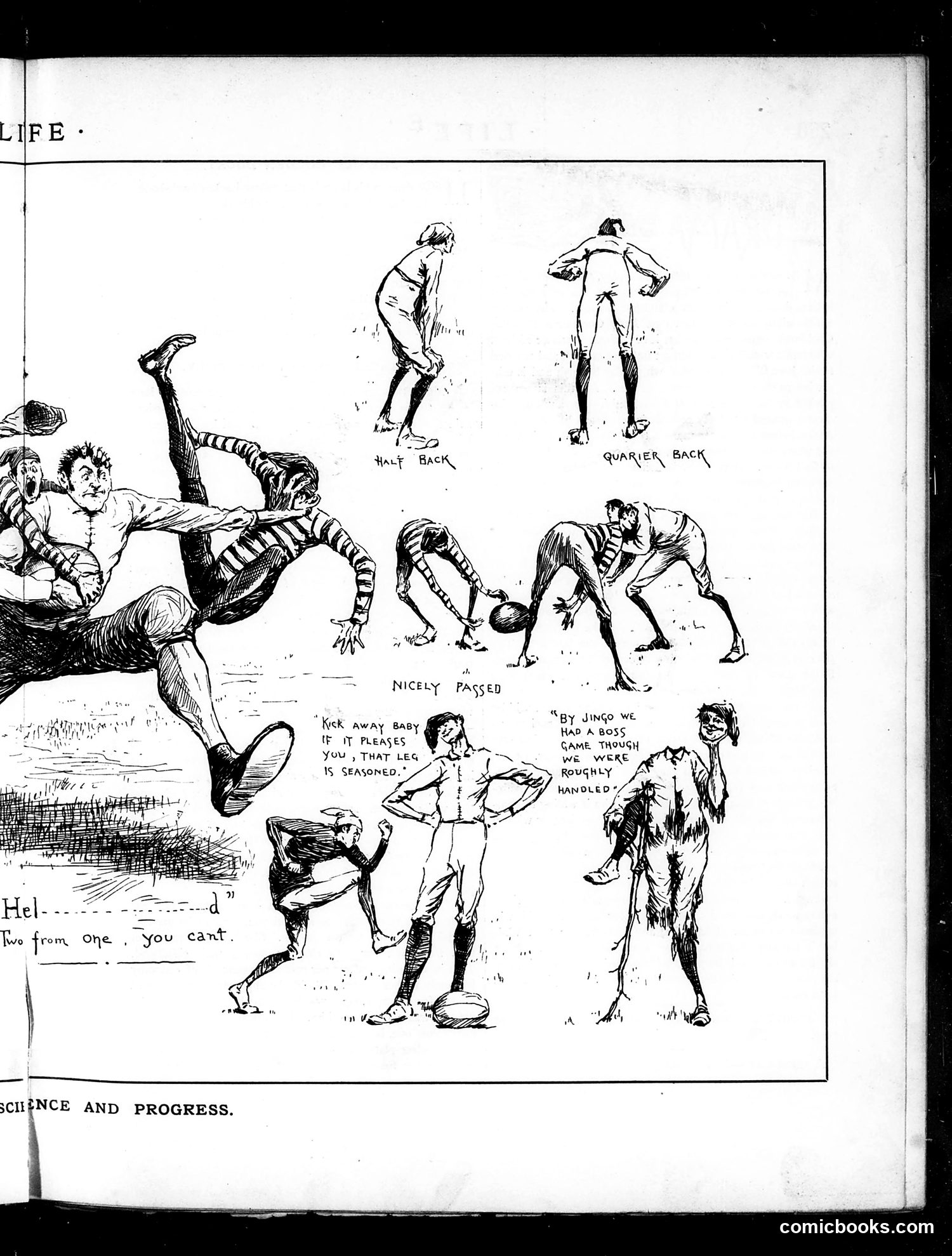
This page from *Life* magazine illustrates rugby football techniques through humorous drawings. The labeled diagrams show proper player positions: "Half Back," "Quarter Back," and a "Nicely Passed" ball exchange. The cartoon satirizes rough sports instruction by depicting exaggerated physical contact and comedic violence. One figure says "Kick away baby if it pleases you, that leg is seasoned," mocking how brutally players are trained. Another character responds, "By jingo we had a boss time though we were roughly handled"—suggesting players accept harsh treatment as normal. The final image shows a woman (possibly a player or instructor) with an actual dog, absurdly suggesting animals also participate in this violent sport. The overall joke mocks both rugby's brutality and the era's glorification of masculine toughness.
**The Drama Section** reviews Robert Buchanan's play "Constance"—a melodrama about adultery and class conflict. The critic dismisses it as morally confused: audiences couldn't sympathize with characters willing to compromise married women for love. The review mocks the plot's absurdities (a man fainting on a sofa, a duel resolution) while praising the actors for salvaging the piece through sheer skill. **"The Old Golden Ducat"** is a sentimental poem about a financially ruined man whose only remaining wealth consists of two old gold coins—a bittersweet memento of better days when he drew freely from his account. **"Princes for Revenue Only"** satirizes British royalty, contrasting America's republican system favorably with Britain's burden of supporting numerous royal "Princelings." The piece criticizes Queen Victoria's children as financial drains on the Treasury, sarcastically praising America for avoiding this expense by having no hereditary nobility requiring state support.
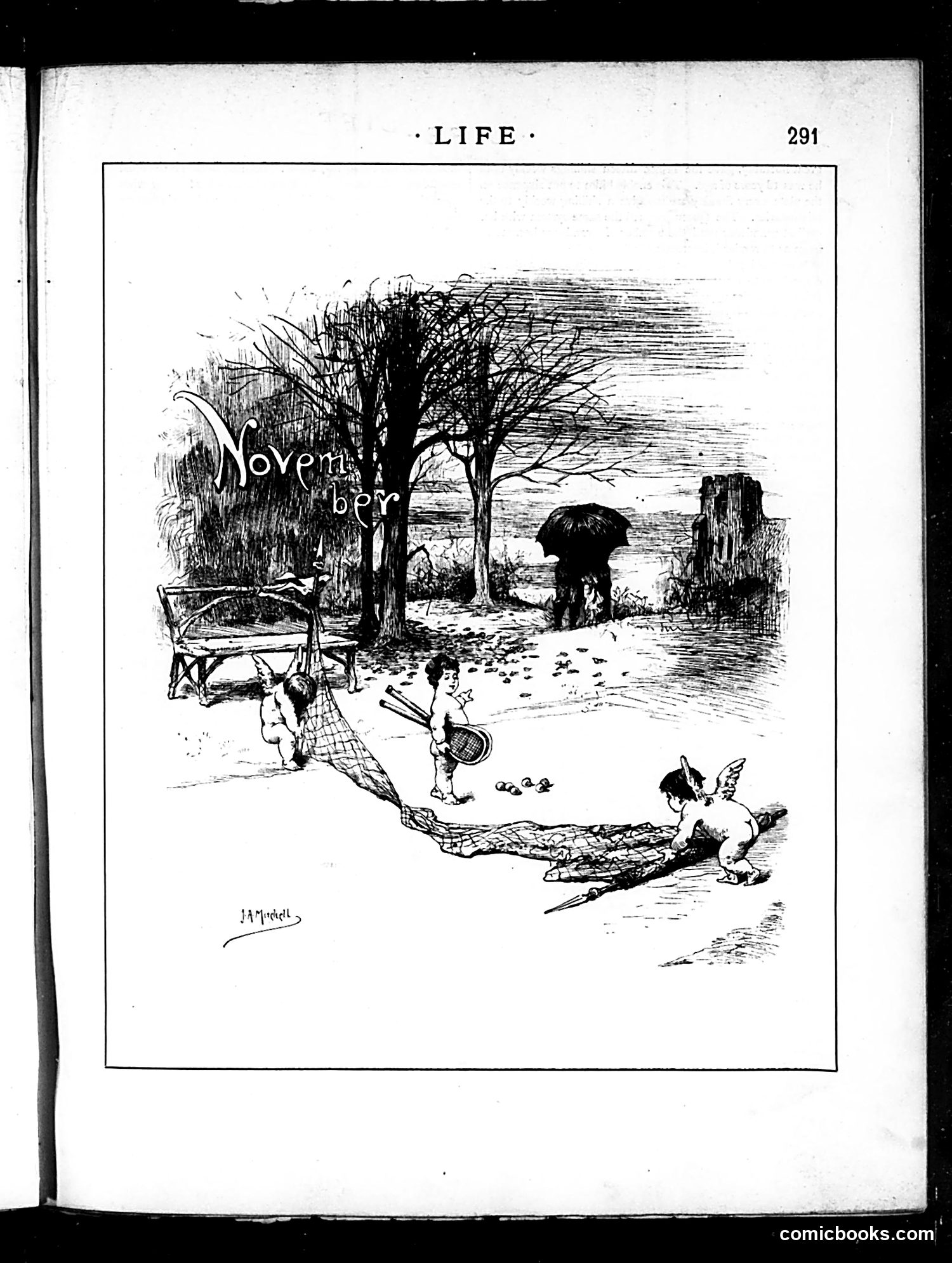
This is an illustration from *Life* magazine (page 291) titled "November" by artist Jarett. The sketch depicts a seaside or waterfront scene with bare, windswept trees. Children are playing—two hold nets (suggesting they're catching something, possibly fish or insects), while a cherub-like figure lies on the ground in the foreground. An adult with an umbrella stands in the background, and benches line the landscape. The cartoon appears to be a gentle seasonal commentary on November weather and activities rather than political satire. It captures the melancholy atmosphere of late autumn—the barren trees, grey mood, and children's outdoor play despite unfavorable conditions. The piece seems designed to humorously illustrate the character of the month through everyday scenes rather than to critique specific political figures or events.
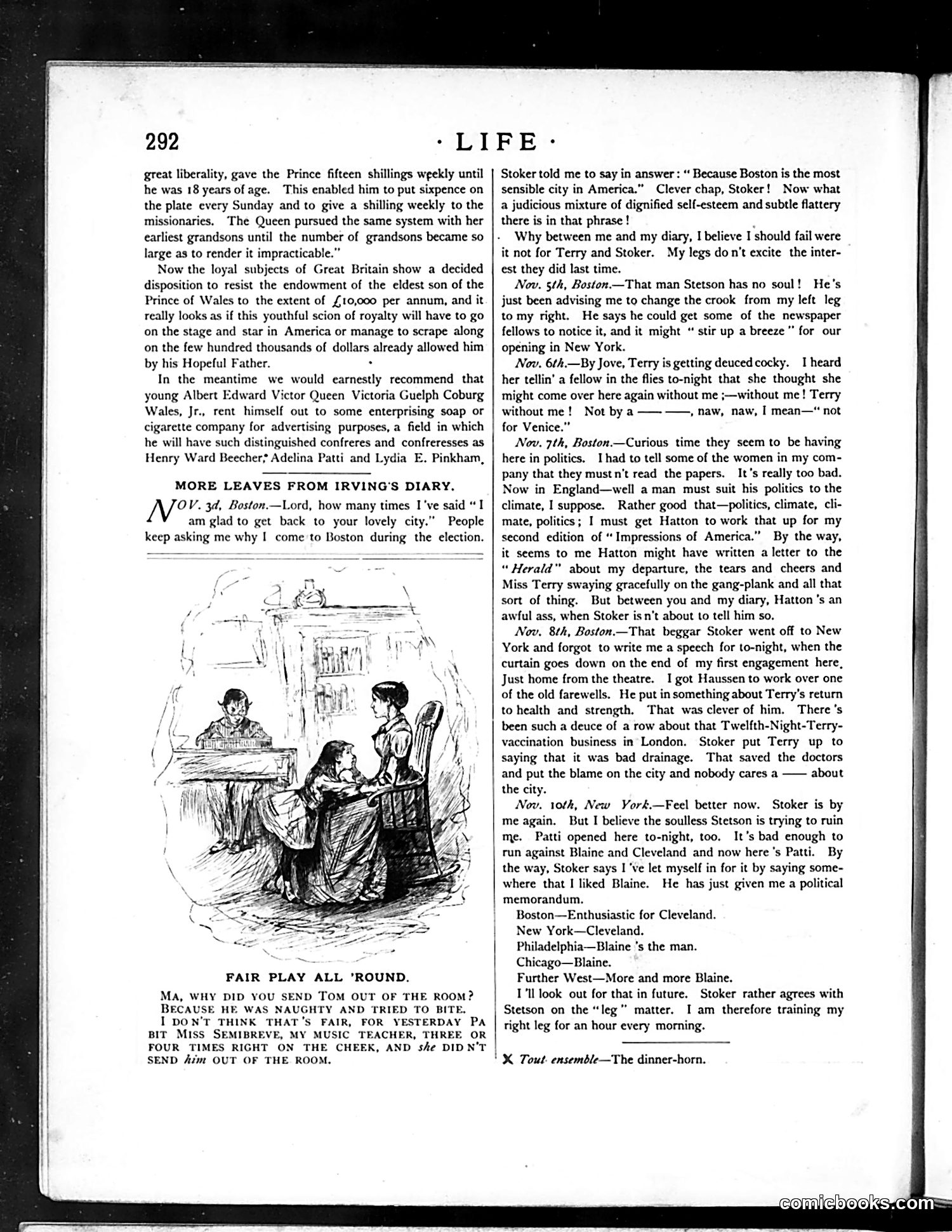
## "Fair Play All 'Round" Cartoon The small cartoon depicts a child's logic exposing parental hypocrisy. A mother explains she sent Tom out for being naughty and biting. The child points out the father bit Miss Semibreve (the music teacher) multiple times yesterday without consequence. The satire mocks Victorian double standards—parents enforcing rules on children while breaking them themselves. The humor relies on the absurdity of the father's unpunished "biting" of the teacher, suggesting inappropriate behavior goes unchecked for adults. ## Irving's Diary Section This appears to be satirical diary entries from Henry Irving (a famous actor), mocking his vanity, his reliance on assistants (Stoker, Terry), and his self-absorbed concerns during theatrical tours. The satire targets his preoccupation with minor physical details and his manipulation of press coverage. The "Prince of Wales" section above critiques British royal finances—mocking the young prince's potential need to endorse commercial products if denied government funds.
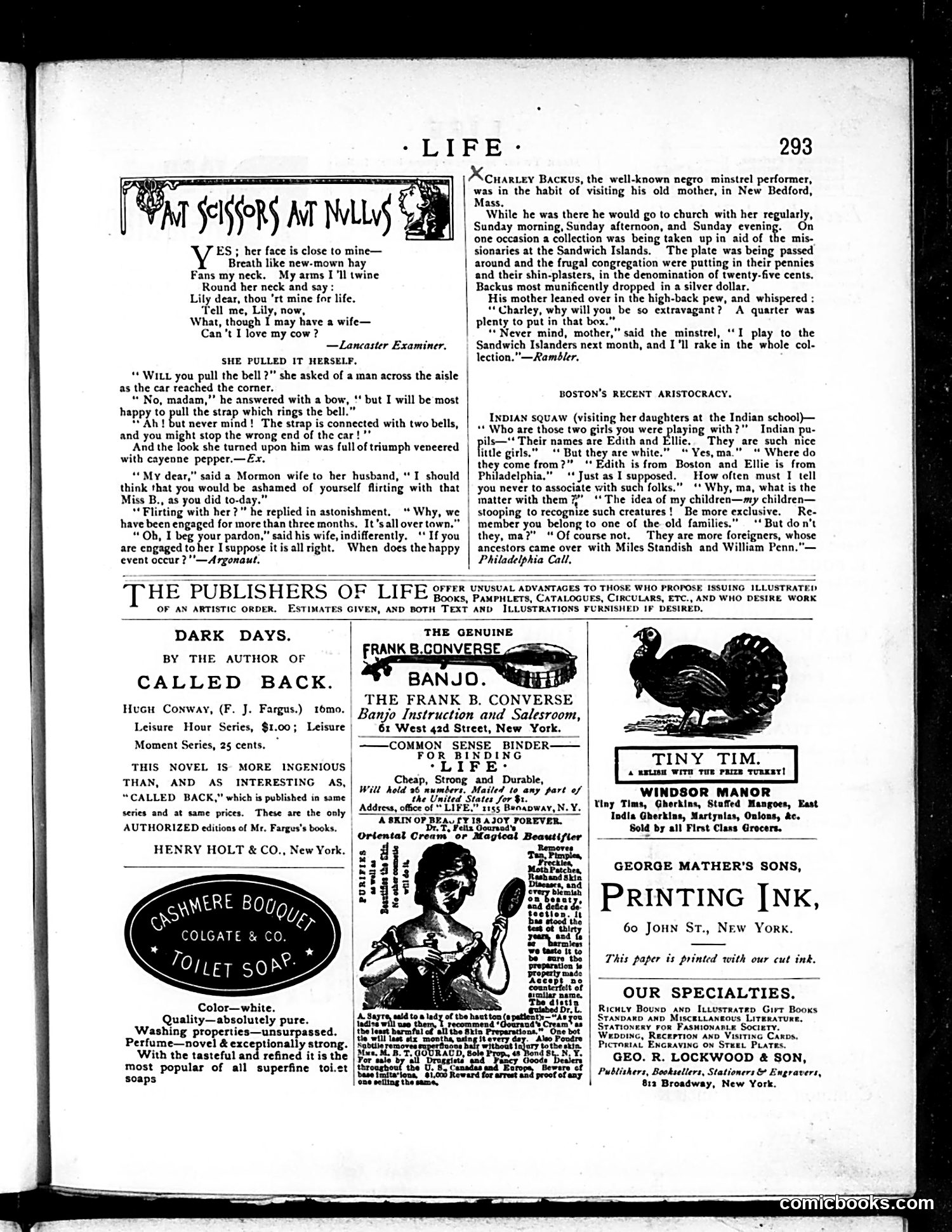
This page contains several brief humorous anecdotes typical of Life's satirical format, plus advertisements. **The cartoons/jokes:** The main content consists of short comic pieces mocking social pretension and gender relations. "At Scissors at Nulls" presents a rustic lover comparing devotion to his cow with his wife—satirizing rural simplicity. "She Pulled It Herself" mocks an overly pedantic woman correcting a man about streetcar bells, suggesting female know-it-all behavior. The Mormon wife anecdote jokes about polygamy being normalized. **"Boston's Recent Aristocracy"** offers sharper satire: an Indigenous mother forbids her daughters from befriending white schoolmates, claiming superiority because their ancestors arrived with Miles Standish and William Penn. The satire cuts both ways—mocking both Indigenous claims to aristocracy and the absurdity of American "old family" snobbery. The piece ironically reveals how recent arrivals (white colonists) pretend to ancient pedigree while considering others "foreigners." The page is otherwise **advertising** for books, soap, and printing services.
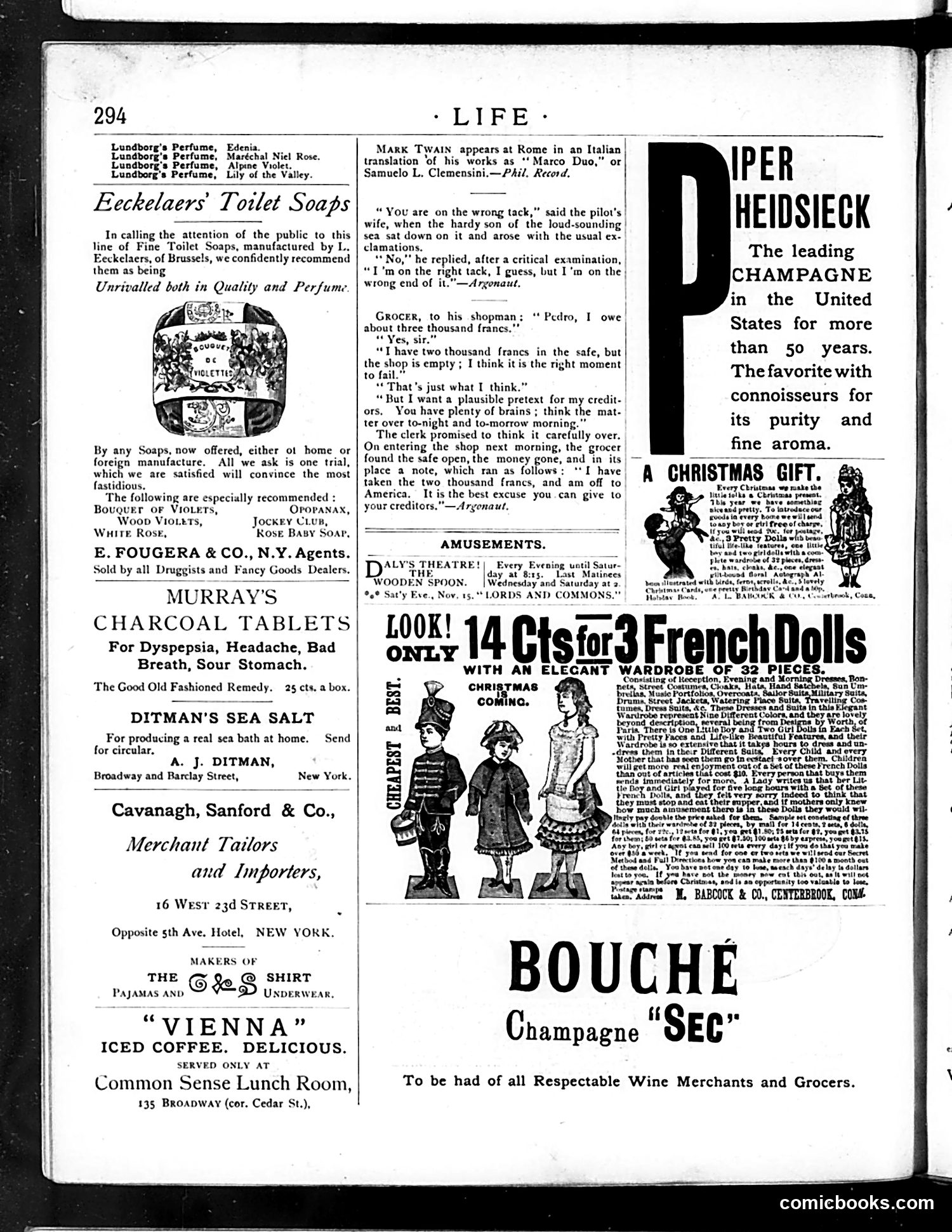
This page is primarily **advertising** with brief satirical content. The main elements are: **Satirical Snippets:** - A Mark Twain reference notes his Italian works are translated as "Marco Duo" or "Samuelo L. Clemensini"—a joke about Americanisms being "Italianized" - Two short anecdotes mock foolish behavior: a sailor sitting on the wrong end of a ship's tack, and a clerk who steals his employer's money as a "pretext" for creditors—both playing on misunderstandings or absurd logic **Advertisements:** The bulk of the page advertises luxury goods: French perfumes and soaps (Eeckelaers, Lundborg's), charcoal tablets, sea salt, tailoring services, champagne (Piper Heidsieck, Bouché), iced coffee, and notably a Christmas gift offer for French dolls priced at "14 cts for 3." **Context:** This reflects a wealthy, cosmopolitan readership in the early 1900s with disposable income for imported European luxuries. The satirical humor is mild—typical of *Life*'s genteel approach to comedy.
This is primarily an **advertising and literary page** with minimal visual satire. The page consists mostly of book advertisements for poetry collections and novels, along with commercial advertisements for clocks, furnishings, and art supplies. The only satirical content appears in **brief text jokes** at the top of the right column—short, anonymous quips poking fun at: 1. **Politicians' dishonesty** about election outcomes 2. **Economic anxiety**—debtors hoarding old currency hoping for value increases 3. **American entrepreneurship gone absurd**—the joke about selling a tunnel as a refrigerator mocks American commercialism and exploitation These are mild, whimsical observations rather than pointed political satire. The page reflects *Life* magazine's character as a publication mixing literary criticism, advertising, and light humor—sophisticated entertainment for educated, affluent readers who purchased expensive leather-bound poetry editions.
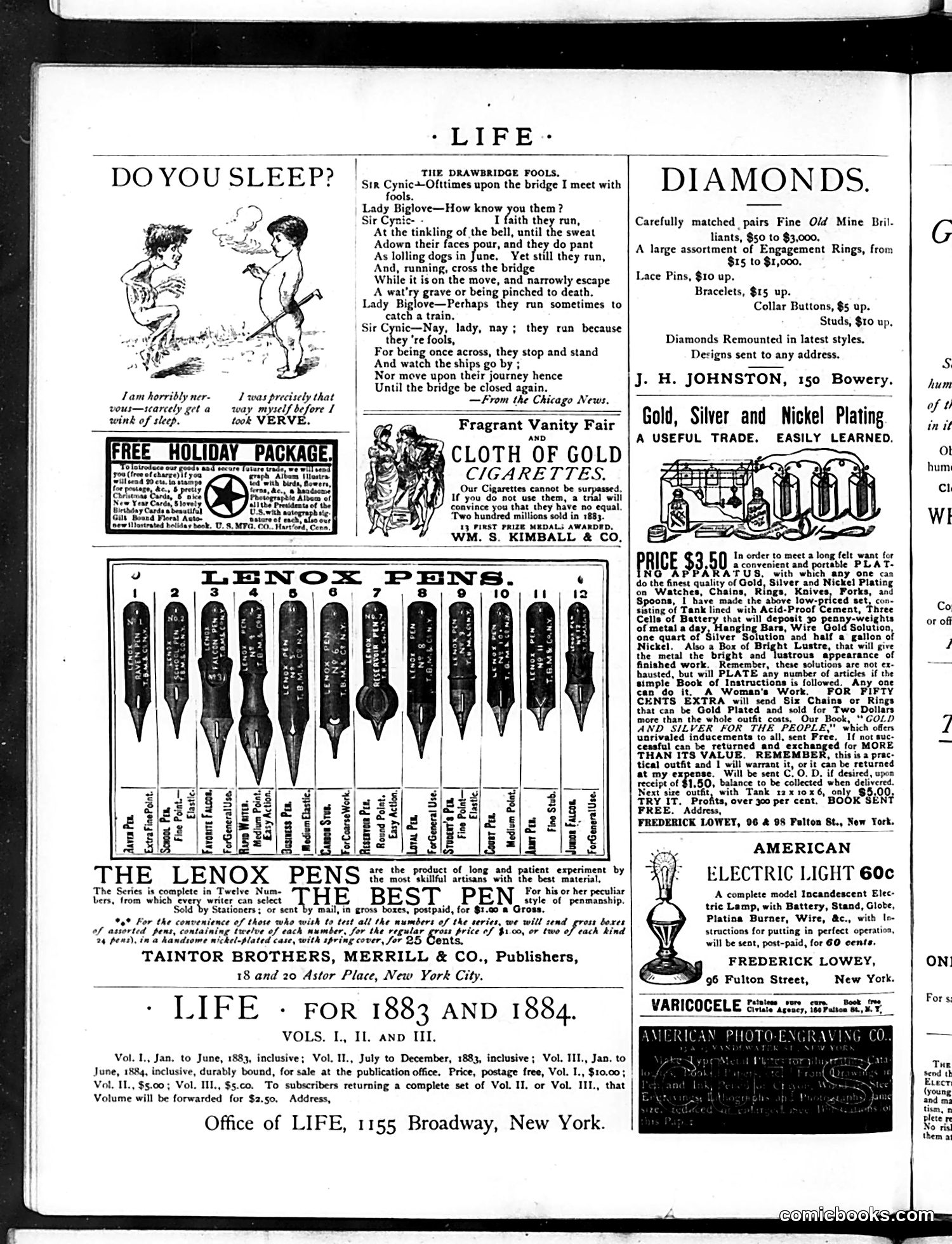
This cartoon satirizes the foolish behavior of pedestrians at a movable drawbridge (likely in Chicago, per the attribution). The dialogue between "Sir Cynic" and "Lady Biglove" mocks commuters who, upon hearing the warning bell, frantically dash across the opening bridge—risking death by drowning or being crushed—despite the obvious danger. The joke's punchline: once safely across, these same "fools" inexplicably stop and *watch the ships pass*, then wait idle until the bridge closes before continuing their journey. They've risked their lives for no practical purpose—they weren't actually hurrying to catch a train or meet an urgent need, they were simply reacting panic to the bell. This critiques herd mentality and irrational human behavior—how people mindlessly follow others' actions without logical reason. It's social commentary on the absurdity of urban life and human nature rather than political satire. The rest of the page consists of period advertisements (pens, cigarettes, diamonds, plating services).
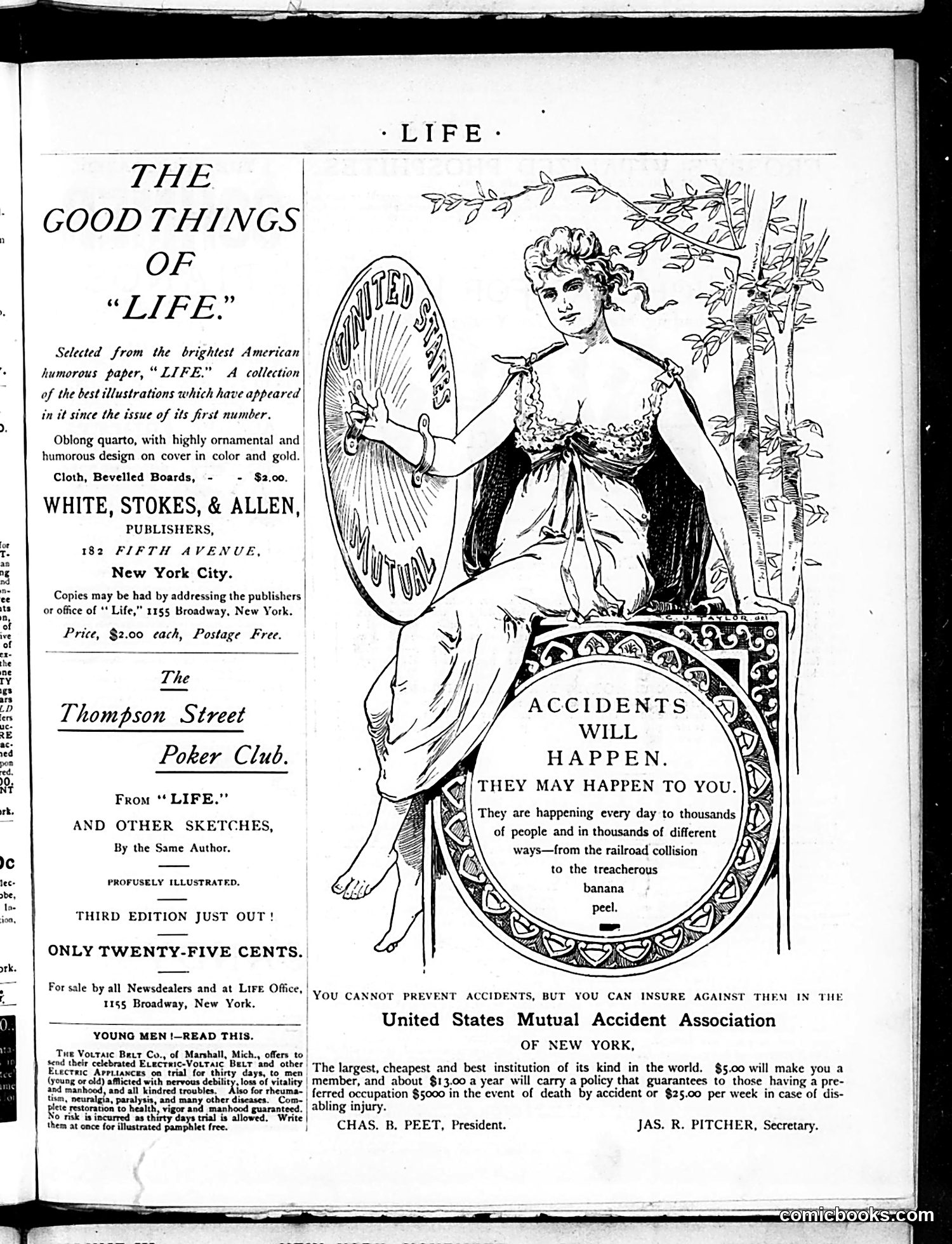
This page is primarily advertising, not satire or political content. The main illustration shows an idealized woman in classical dress holding a decorative fan, accompanying an insurance advertisement for the United States Mutual Accident Association. The ad uses the loose theme "Accidents Will Happen" and pairs the elegant female figure with a cautionary message about life's dangers—from railroad collisions to banana peels. This juxtaposition of refined imagery with mundane hazards appears to be the only "humor" present. The page also advertises several products: a collection of humorous illustrations from Life magazine itself; "The Thompson Street Poker Club" sketches; and a patent medicine device (the "Voltaic Belt") making dubious health claims for nervous debility and various ailments. These advertisements reflect late 19th/early 20th-century commercial practices and consumer products typical of the era, including fraudulent medical devices.
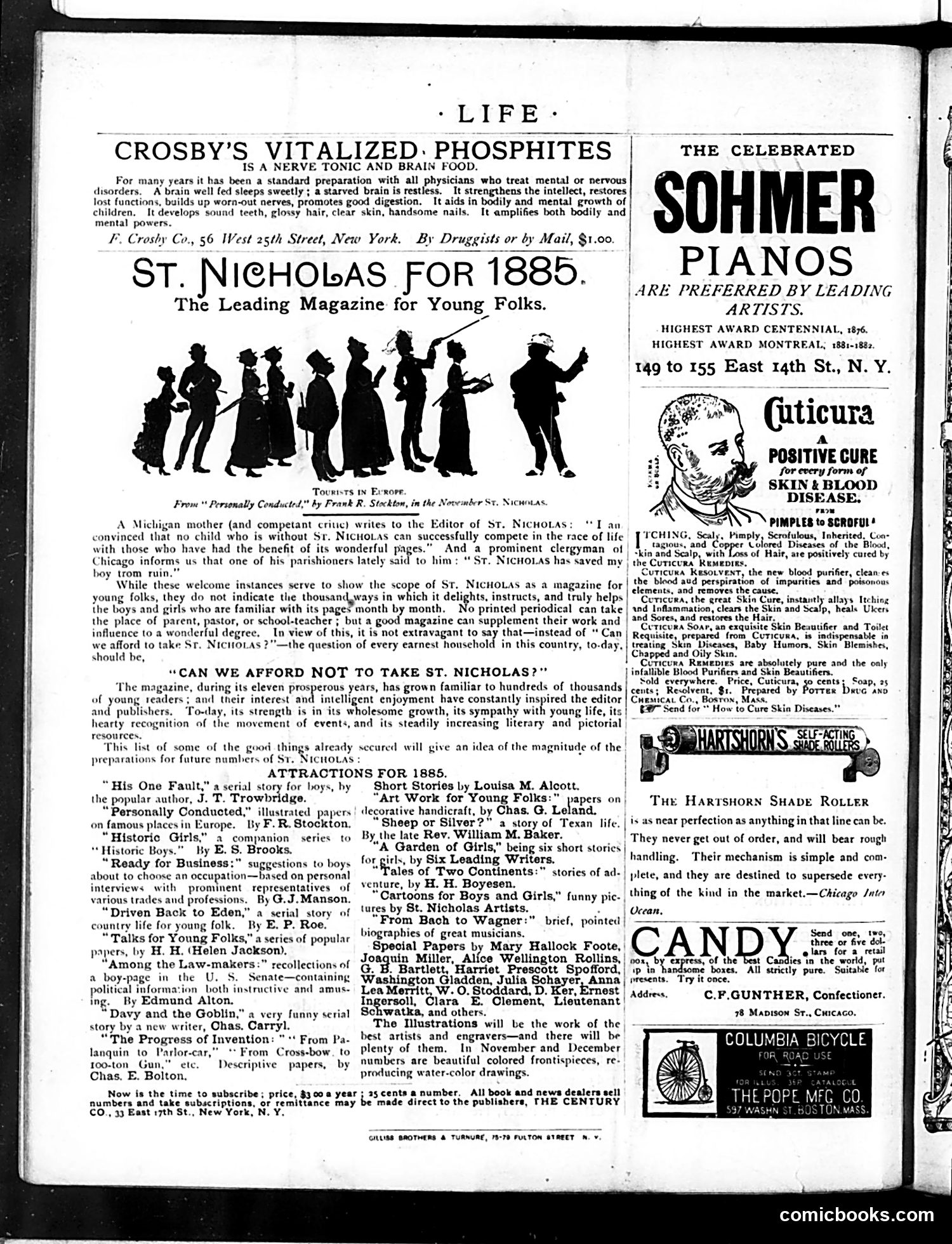
This page is primarily **advertising and promotional content** for *St. Nicholas*, a children's magazine, rather than satirical commentary. The central illustration depicts silhouetted figures labeled "Tourists in Europe," drawn by Frank R. Stockton (a notable children's author). It appears to accompany an article about European travel. The page is dominated by **product advertisements**: Crosby's Phosphites (a "nerve tonic"), Sohmer Pianos, Cuticura remedies for skin diseases, and other goods. These ads occupy more space than editorial content. The testimonials praising *St. Nicholas*—from a Michigan mother and Chicago clergyman—are effectively advertisements promoting the magazine's educational value to families. **For modern readers**: This reflects 1880s publishing economics, where magazines relied heavily on advertising revenue. The "personal endorsement" format predates modern influencer marketing but serves a similar purpose.