
Life, 1884-11-20 · page 4 of 18
Life — November 20, 1884 — page 4: what you’re looking at
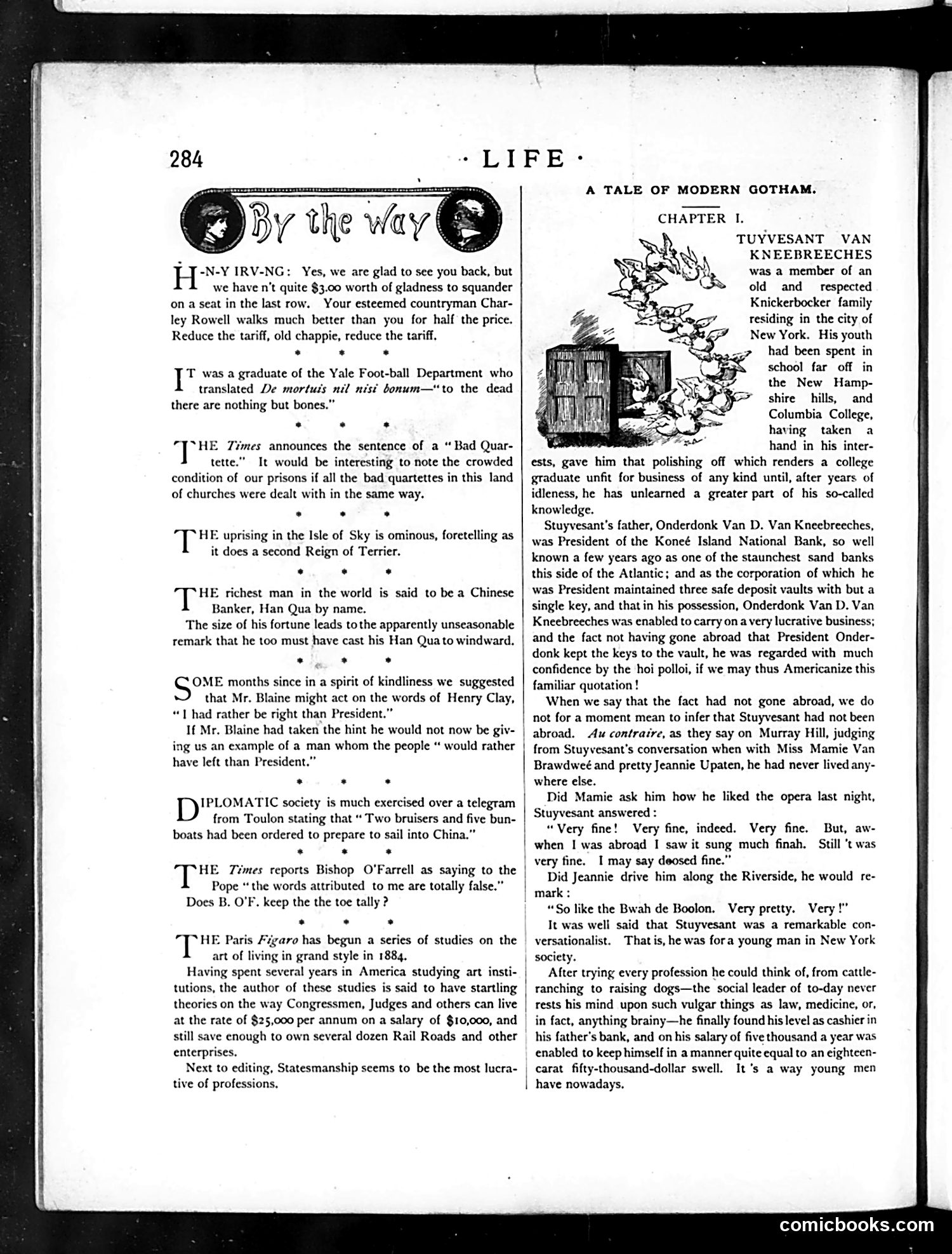
What you’re looking at
The page combines satirical commentary with a serialized fiction story ("A Tale of Modern Gotham"). The left column, "By the Way," contains brief topical jokes rather than a formal political cartoon. The satire targets: - **American tariff policy**: A mock dialogue about reducing import duties - **Yale's football program**: A Latin phrase joke about "the dead" (De mortuis nil nisi bonum) - **Social inequality**: Comments on urban slums and church conditions - **Current events**: References to the Isle of Skye uprising, a Chinese banker named Han Qua, and diplomatic tensions The right side begins a serialized story about Stuyvesant Van Kneebreeches, a wealthy New York banker's son, using humor to satirize wealthy idleness and social pretension typical of Gilded Age Life magazine content.
📄 Transcribed text from this page (OCR, searchable)
Machine-transcribed from the original scan — historical spelling and the odd misread are preserved.
~LIFE- H* IRV-NG: Yes, we are glad to see you back, but we have n't quite $3.00 worth of gladness to squander on a seat in the last row. Your esteemed countryman Char- ley Rowell walks much better than you for half the price. Reduce the tariff, old chappie, reduce the tariff. . * . T was a graduate of the Yale Foot-ball Department who translated De morturs nil nisi bonum—to the dead there are nothing but bones.” . . * TN" Times announces the sentence of a “ Bad Quar- tette.” It would be interesting to note the crowded condition of our prisons if all the bad quartettes in this land of churches were dealt with in the same way. . . . HE uprising in the Isle of Sky is ominous, foretelling as it does a second Reign of Terrier. * * * HE richest man in the world is said to be a Chinese Banker, Han Qua by name. The size of his fortune leads tothe apparently unseasonable | remark that he too must have cast his Han Qua to windward. * * * OME months since in a spirit of kindliness we suggested that Mr. Blaine might act on the words of Henry Clay, “| had rather be right than President.” If Mr. Blaine had taken the hint he would not now be giv- ing us an example of a man whom the people “ would rather have left than President.” IPLOMATIC society is much exercised over a telegram from Toulon stating that “ Two bruisers and five bun- boats had been ordered to prepare to sail into China.” . . . HE 7Z?mes reports Bishop O'Farrell as saying to the Pope “the words attributed to me are totally false.” Does B. O'F. keep the the toe tally ? . . . HE Paris Figaro has begun a series of studies on the art of living in grand style in 1884. Having spent several years in America studying art insti- | tutions, the author of these studies is said to have startling theories on the way Congressmen, Judges and others can live at the rate of $25,000 per annum on a salary of $10,000, and still save enough to own several dozen Rail Roads and other enterprises. Next to editing, Statesmanship seems to be the most lucra- tive of professions, A TALE OF MODERN GOTHAM. CHAPTER I. TUYVESANT VAN KNEEBREECHES was a member of an old and _ respected Knickerbocker family residing in the city of New York. His youth had been spent in school far off in the New Hamp- shire hills, and Columbia College, having taken a hand in his inter- renders a college graduate unfit for business of any kind until, after years of idleness, he has unlearned a greater part of his so-called knowledge. Stuyvesant's father, Onderdonk Van D. Van Knecbreeches, was President of the Koneé Island National Bank, so well known a few years ago as one of the staunchest sand banks this side of the Atlantic; and as the corporation of which he was President maintained three safe deposit vaults with but a single key, and that in his possession, Onderdonk Van D. Van Kneebreeches was enabled to carry on a very lucrative business; and the fact not having gone abroad that President Onder- donk kept the keys to the vault, he was regarded with much confidence by the hoi polloi, if we may thus Americanize this familiar quotation! When we say that the fact had not gone abroad, we do not for a moment mean to infer that Stuyvesant had not been abroad. Au contratre, as they say on Murray Hill, judging from Stuyvesant's conversation when with Miss Mamie Van Brawdweé and pretty Jeannie Upaten, he had never lived any- where else. Did Mamie ask him how he liked the opera last night, Stuyvesant answered : “Very fine! Very fine, indeed. Very fine. But, aw- when I was abroad I saw it sung much finah. Still 't was very fine. I may say deosed fine.” Did Jeannie drive him along the Riverside, he would re- | mark: “So like the Bwah de Boolon. Very pretty. Very!" It was well said that Stuyvesant was a remarkable con- versationalist. That is, he was fora young man in New York society. After trying every profession he could think of, from cattle- ranching to raising dogs—the social leader of to-day never rests his mind upon such vulgar things as law, medicine, or, in fact, anything brainy—he finally found his level as cashier in his father's bank, and on his salary of five thousand a year was enabled to keep himself in a manner quite equal to an eightcen- | carat fifty-thousand-dollar swell. It's a way young men have nowadays. comicbooks.com