
Life, 1884-11-20 · page 12 of 18
Life — November 20, 1884 — page 12: what you’re looking at
What you’re looking at
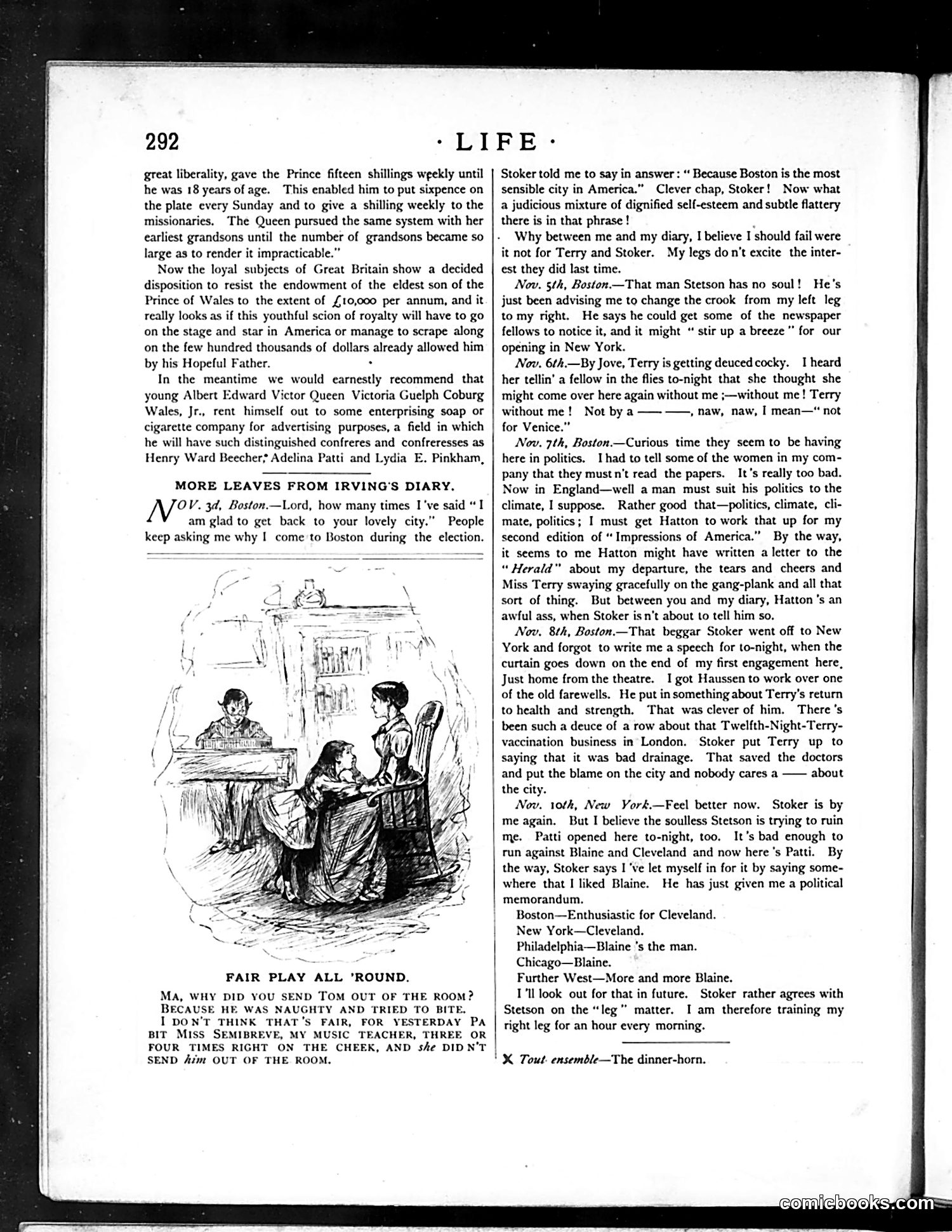
## "Fair Play All 'Round" Cartoon The small cartoon depicts a child's logic exposing parental hypocrisy. A mother explains she sent Tom out for being naughty and biting. The child points out the father bit Miss Semibreve (the music teacher) multiple times yesterday without consequence. The satire mocks Victorian double standards—parents enforcing rules on children while breaking them themselves. The humor relies on the absurdity of the father's unpunished "biting" of the teacher, suggesting inappropriate behavior goes unchecked for adults. ## Irving's Diary Section This appears to be satirical diary entries from Henry Irving (a famous actor), mocking his vanity, his reliance on assistants (Stoker, Terry), and his self-absorbed concerns during theatrical tours. The satire targets his preoccupation with minor physical details and his manipulation of press coverage. The "Prince of Wales" section above critiques British royal finances—mocking the young prince's potential need to endorse commercial products if denied government funds.
📄 Transcribed text from this page (OCR, searchable)
Machine-transcribed from the original scan — historical spelling and the odd misread are preserved.
292 great liberality, gave the Prince fifteen shillings weekly until he was 18 years of age. This enabled him to put sixpence on the plate every Sunday and to give a shilling weekly to the missionaries. The Queen pursued the same system with her earliest grandsons until the number of grandsons became so large as to render it impracticable.” Now the loyal subjects of Great Britain show a decided disposition to resist the endowment of the eldest son of the Prince of Wales to the extent of £10,000 per annum, and it really looks as if this youthful scion of royalty will have to go on the stage and star in America or manage to scrape along on the few hundred thousands of dollars palready allowed him by his Hopeful Father. In the meantime we would earnestly recommend that young Albert Edward Victor Queen Victoria Guelph Coburg Wales, Jr., rent himself out to some enterprising soap or cigarette company for advertising purposes, a field in which he will have such distinguished confreres and confreresses as Henry Ward Beecher? Adelina Patti and Lydia E. Pinkham, MORE LEAVES FROM IRVING'S DIARY. OV. 3d, Boston.—Lord, how many times I ‘ve said “I am glad to get back to your lovely city.” People keep asking me why I come to Boston during the election. FAIR PLAY ALL 'ROUND. MA, WHY DID YOU SEND TOM OUT OF THE ROOM? BECAUSE HE WAS NAUGHTY AND TRIED TO BITE, I DON’T THINK THAT'S FAIR, FOR YESTERDAY PA BIT Miss SEMIBREVE, MY MUSIC TEACHER, THREE OR FOUR TIMES RIGHT 0} SEND Aim OUT OF THE ROOM. LIFE Stoker told me to say in answer : “ Because Boston is the most sensible city in America.” Clever chap, Stoker! Now what a judicious mixture of dignified self-esteem and subtle flattery there is in that phrase ! Why between me and my diary, I believe T should fail were it not for Terry and Stoker. My legs don’t excite the inter- est they did last time. Nov. 5th, Boston.—That man Stetson has no soul! He's just been advising me to change the crook from my left leg to my right. He says he could get some of the newspaper fellows to notice it, and it might “ stir up a breeze” for our opening in New York. Nov. 6th.—By Jove, Terry is getting deuced cocky. I heard her tellin’ a fellow in the flies to-night that she thought she might come over here again without me ;—without me ! Terry without me! Not by a —~——, naw, naw, I mean—“ not for Venice.” Nov. 7th, Boston —Curious time they seem to be having here in politics. I had to tell some of the women in my com- pany that they mustn't read the papers. It’s really too bad. Now in England—well a man must suit his politics to the climate, I suppose. Rather good that—politics, climate, cli- mate, politics; I must get Hatton to work that up for my second edition of “Impressions of America.” By the way, it seems to me Hatton might have written a letter to the “ Herald” about my departure, the tears and cheers and Miss Terry swaying gracefully on the gang-plank and all that sort of thing. But between you and my diary, Hatton ‘s an awful ass, when Stoker isn’t about to tell him so. You. 8th, Boston.—That beggar Stoker went off to New York and forgot to write me a speech for to-night, when the curtain goes down on the end of my first engagement here, Just home from the theatre. I got Haussen to work over one of the old farewells. He put in something about Terry's return to health and strength. That was clever of him. There's been such a deuce of a row about that Twelfth-Night-Terry- vaccination business in London. Stoker put Terry up to saying that it was bad drainage. That saved the doctors and put the blame on the city and nobody cares a —— about the city. Nov. 10th, New York.—Feel better now. Stoker is by me again. But I believe the soulless Stetson is trying to ruin me. Patti opened here to-night, too. It’s bad enough to run against Blaine and Cleveland and now here's Patti. By the way, Stoker says I ‘ve let myself in for it by saying some- where that I liked Blaine. He has just given me a political | memorandum, Boston—Enthusiastic for Cleveland. New York—Cleveland. Philadelphia—Blaine 's the man. Chicago—Blaine. Further West—More and more Blaine. I'll look out for that in future. Stoker rather agrees with Stetson on the “leg” matter. I am therefore training my right leg for an hour every morning. 'X Tout: ensemble—The dinner-horn.