
Life, 1884-11-20 · page 10 of 18
Life — November 20, 1884 — page 10: what you’re looking at
What you’re looking at
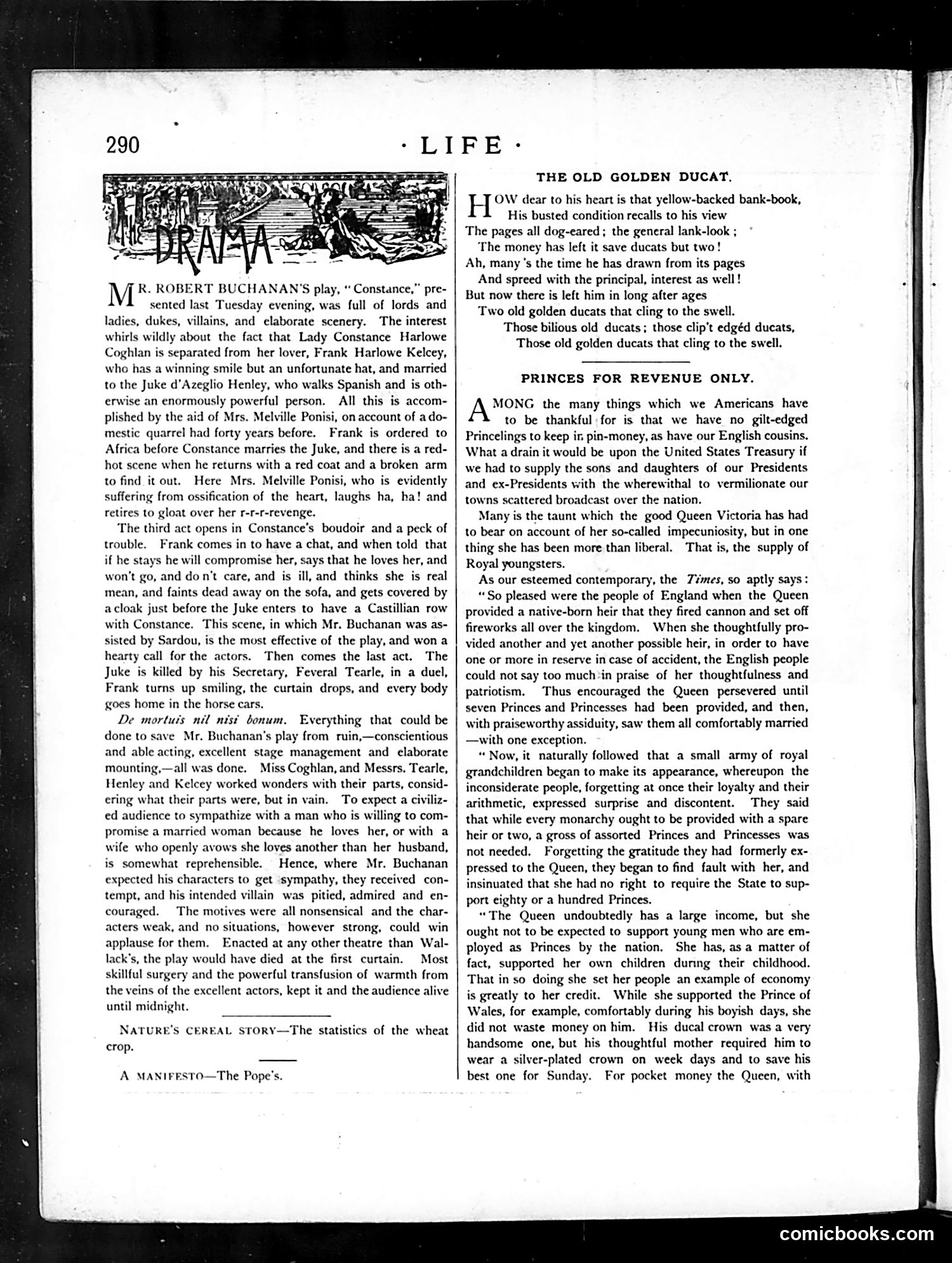
**The Drama Section** reviews Robert Buchanan's play "Constance"—a melodrama about adultery and class conflict. The critic dismisses it as morally confused: audiences couldn't sympathize with characters willing to compromise married women for love. The review mocks the plot's absurdities (a man fainting on a sofa, a duel resolution) while praising the actors for salvaging the piece through sheer skill. **"The Old Golden Ducat"** is a sentimental poem about a financially ruined man whose only remaining wealth consists of two old gold coins—a bittersweet memento of better days when he drew freely from his account. **"Princes for Revenue Only"** satirizes British royalty, contrasting America's republican system favorably with Britain's burden of supporting numerous royal "Princelings." The piece criticizes Queen Victoria's children as financial drains on the Treasury, sarcastically praising America for avoiding this expense by having no hereditary nobility requiring state support.
📄 Transcribed text from this page (OCR, searchable)
Machine-transcribed from the original scan — historical spelling and the odd misread are preserved.
M R. ROBERT BUCHANAN'S play, “ Constance,” pre- sented last Tuesday evening, was full of lords and ladies, dukes, villains, and elaborate scenery. The interest whirls wildly about the fact that Lady Constance Harlowe Coghlan is separated from her lover, Frank Harlowe Kelcey, who has a winning smile but an unfortunate hat, and married to the Juke d’Azeglio Henley, who walks Spanish and is oth- erwise an enormously powerful person. All this is accom- plished by the aid of Mrs. Melville Ponisi, on account of ado- mestic quarrel had forty years before. Frank is ordered to Africa before Constance marries the Juke, and there is a red- hot scene when he returns with a red coat and a broken arm to find it out. Here Mrs. Melville Ponisi, who is evidently suffering from ossification of the heart, laughs ha, ha! and retires to gloat over her r-r-r-revenge. ‘The third act opens in Constance’s boudoir and a peck of trouble. Frank comes in to have a chat, and when told that if he stays he will compromise her, says that he loves her, and won't go, and do n't care, and is ill, and thinks she is real mean, and faints dead away on the sofa, and gets covered by acloak just before the Juke enters to have a Castillian row with Constance. This scene, in which Mr. Buchanan was as- sisted by Sardou, is the most effective of the play, and won a hearty call for the actors. Then comes the last act. The Juke is killed by his Secretary, Feveral Tearle, in a duel, Frank turns up smiling, the curtain drops, and every body goes home in the horse cars. De mortuis nil nist bonum. Everything that could be done to save Mr. Buchanan's play from ruin,—conscientious and able acting, excellent stage management and elaborate mounting,—all was done. iss Coghlan, and Messrs. Tearle, Henley and Kelcey worked wonders with their parts, consid- ering what their parts were, but in vain. To expect a civil ed audience to sympathize with a man who is willing to com- promise a married woman because he loves her, or with a wife who openly avows she loves another than her husband, is somewhat reprehensible. Hence, where Mr. Buchanan expected his characters to get sympathy, they received con- tempt, and his intended villain was pitied, admired and en- couraged. The motives were all nonsensical and the char- acters weak, and no situations, however strong, could win applause for them. Enacted at any other theatre than Wal- lack’s, the play would have died at the first curtain. Most skillful surgery and the powerful transfusion of warmth from the veins of the excellent actors, kept it and the audience alive until midnight. NATURE'S CEREAL STORY—The statistics of the wheat crop. THE OLD GOLDEN DUCAT. H OW dear to his heart is that yellow-backed bank-book, His busted condition recalls to his view The pages all dog-eared ; the general lank-look ; ‘The money has left it save ducats but two! Ah, many's the time he has drawn from its pages And spreed with the principal, interest as well! But now there is left him in long after ages Two old golden ducats that cling to the swell. Those bilious old ducats; those clip’t edgéd ducats, Those old golden ducats that cling to the swell. PRINCES FOR REVENUE ONLY. MONG the many things which we Americans have to be thankful for is that we have no gilt-edged Princelings to keep ir, pin-money, as have our English cousins. What a drain it would be upon the United States Treasury if we had to supply the sons and daughters of our Presidents and ex-Presidents with the wherewithal to vermilionate our towns scattered broadcast over the nation. Many is the taunt which the good Queen Victoria has had to bear on account of her so-called impecuniosity, but in one thing she has been more than liberal. That is, the supply of Royal youngsters. As our esteemed contemporary, the 7%mes, so aptly says: “So pleased were the people of England when the Queen provided a native-born heir that they fired cannon and set off fireworks all over the kingdom. When she thoughtfully pro- vided another and yet another possible heir, in order to have one or more in reserve in case of accident, the English people could not say too much:in praise of her thoughtfulness and patriotism. Thus encouraged the Queen persevered until seven Princes and Princesses had been provided, and then, with praiseworthy assiduity, saw them all comfortably married —with one exception. “ Now, it naturally followed that a small army of royal grandchildren began to make its appearance, whereupon the inconsiderate people, forgetting at once their loyalty and their arithmetic, expressed surprise and discontent. They said that while every monarchy ought to be provided with a spare heir or two, a gross of assorted Princes and Princesses was not needed. Forgetting the gratitude they had formerly ex- pressed to the Queen, they began to find fault with her, and insinuated that she had no right to require the State to sup- port eighty or a hundred Princes. “The Queen undoubtedly has a large income, but she ought not to be expected to support young men who are em- ployed as Princes by the nation. She has, as a matter of fact, supported her own children dumng their childhood. That in so doing she set her people an example of economy is greatly to her credit. While she supported the Prince of Wales, for example, comfortably during his boyish days, she did not waste money on him. His ducal crown was a very handsome one, but his thoughtful mother required him to wear a silver-plated crown on week days and to save his best one for Sunday. For pocket money the Queen, with } | A MANIFESTO—The Pope's. i comicbooks.com