
Life, 1884-11-20 · page 6 of 18
Life — November 20, 1884 — page 6: what you’re looking at
What you’re looking at
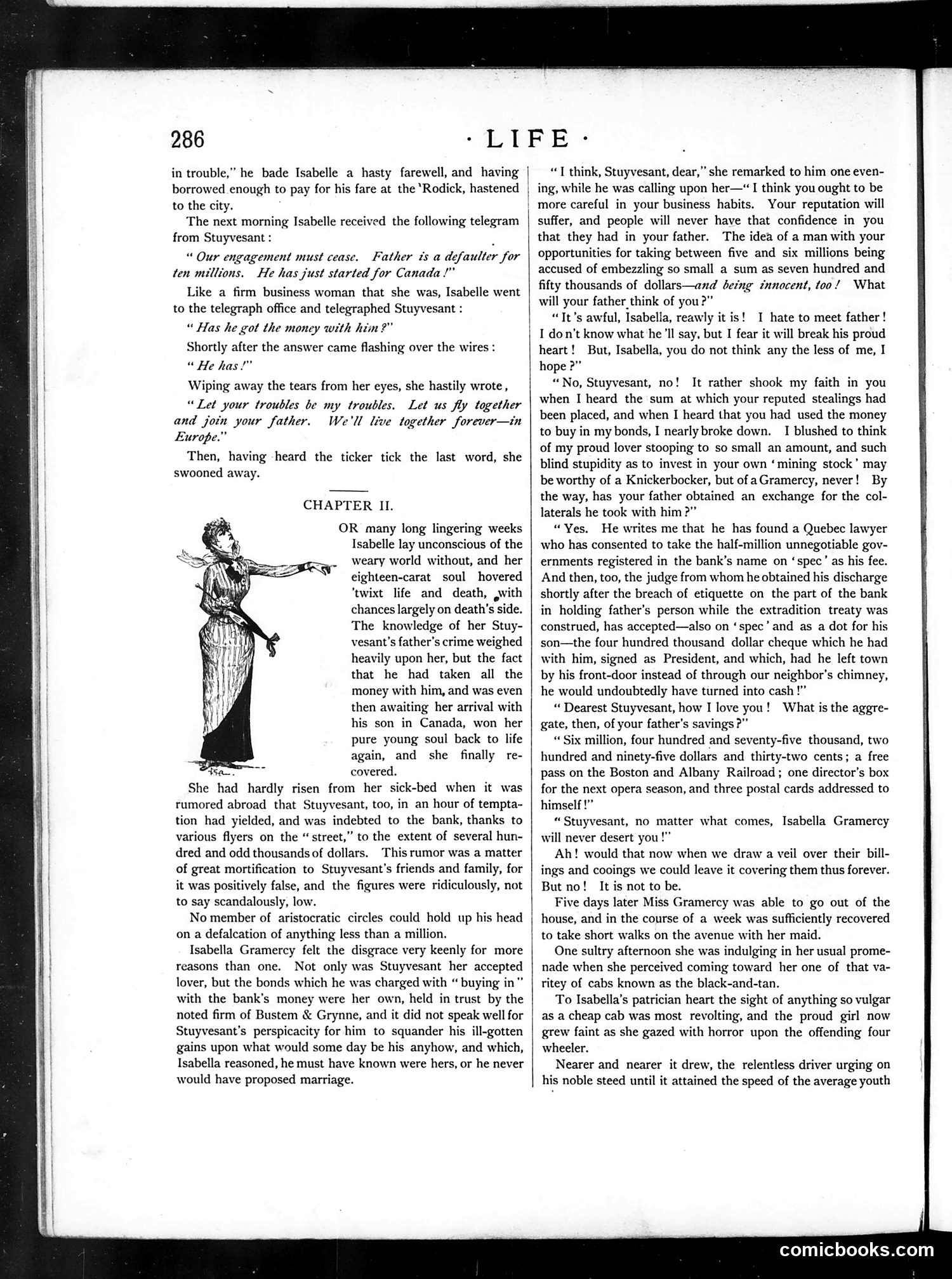
This page contains narrative fiction rather than political satire or cartoons. The story follows Isabella Gramercy, a wealthy woman whose lover Stuyvesant faces financial scandal—his father embezzled millions and defaulted on debts. Isabella receives telegrams addressing the crisis, ultimately pledging her loyalty despite the reputational damage. The single illustration shows a woman in period dress gesturing expressively, likely depicting Isabella's dramatic response to the scandal. The content satirizes high-society anxiety about financial impropriety and social disgrace among the wealthy class. It reflects turn-of-the-century concerns about banking scandals and the fragility of aristocratic reputation—themes relevant to Life magazine's audience of educated, affluent readers who would recognize the social stakes depicted.
📄 Transcribed text from this page (OCR, searchable)
Machine-transcribed from the original scan — historical spelling and the odd misread are preserved.
286 in trouble,” he bade Isabelle a hasty farewell, and having | borrowed enough to pay for his fare at the ‘Rodick, hastened | to the city. The next morning Isabelle received the following telegram from Stuyvesant : ; “ Our engagement must cease. Father is a defaulter for ten millions. He has just started for Canada!” Like a firm business woman that she was, Isabelle went to the telegraph office and telegraphed Stuyvesant : “ Has he got the money with him?” Shortly after the answer came flashing over the wires : “ He has!" Wiping away the tears from her eyes, she hastily wrote, “Let your troubles be my troubles. Let us fly together and join your father. We'll live together forever—in Europe.” Then, having -heard the ticker tick the last word, she swooned away. CHAPTER II. OR many long lingering weeks Isabelle lay unconscious of the weary world without, and her eighteen-carat soul hovered ‘twixt life and death, with chances largely on death’s side. The knowledge of her Stuy- vesant’s father’s crime weighed heavily upon her, but the fact that he had taken all the money with him, and was even then awaiting her arrival with his son in Canada, won her pure young soul back to life again, and she finally re- 5 covered. She had hardly risen from her sick-bed when it was rumored abroad that Stuyvesant, too, in an hour of tempta- tion had yielded, and was indebted to the bank, thanks to various flyers on the “street,” to the extent of several hun- dred and odd thousands of dollars. This rumor was a matter of great mortification to Stuyvesant’s friends and family, for it was positively false, and the figures were ridiculously, not to say scandalously, low. No member of aristocratic circles could hold up his head on a defalcation of anything less than a million. Isabella Gramercy felt the disgrace very keenly for more reasons than one. Not only was Stuyvesant her accepted lover, but the bonds which he was charged with “ buying in” with the bank's money were her own, held in trust by the | noted firm of Bustem & Grynne, and it did not speak well for Stuyvesant’s perspicacity for him to squander his ill-gotten gains upon what would some day be his anyhow, and which, Isabella reasoned, he must have known were hers, or he never | more careful in your business habits. would have proposed marriage. -LIFE- “T think, Stuyvesant, dear,” she remarked to him one even- ing, while he was calling upon her—“ I think you ought to be Your reputation will suffer, and people will never have that confidence in you that they had in your father. The idea of a man with your opportunities for taking between five and six millions being accused of embezzling so small a sum as seven hundred and fifty thousands of dollars—and being innocent, too! What will your father think of you?” “It’s awful, Isabella, reawly it is!’ I hate to meet father ! I don’t know what he'll say, but I fear it will break his proud heart! But, Isabella, you do not think any the less of me, I hope ?” “No, Stuyvesant, no! It rather shook my faith in you when I heard the sum at which your reputed stealings had been placed, and when I heard that you had used the money to buy in my bonds, I nearly broke down. I blushed to think of my proud lover stooping to so small an amount, and such blind stupidity as to invest in your own ‘mining stock’ may be worthy of a Knickerbocker, but of aGramercy, never! By the way, has your father obtained an exchange for the col- laterals he took with him?” “Yes. He writes me that he has found a Quebec lawyer who has consented to take the half-million unnegotiable gov- ernments registered in the bank’s name on ‘spec’ as his fee. And then, too, the judge from whom he obtained his discharge shortly after the breach of etiquette on the part of the bank in holding father’s person while the extradition treaty was construed, has accepted—also on ‘spec’ and as a dot for his son—the four hundred thousand dollar cheque which he had with him, signed as President, and which, had he left town by his front-door instead of through our neighbor’s chimney, he would undoubtedly have turned into cash!” “ Dearest Stuyvesant, how I love you! What is the aggre- gate, then, of your father’s savings ?” “Six million, four hundred and seventy-five thousand, two hundred and ninety-five dollars and thirty-two cents; a free pass on the Boston and Albany Railroad ; one director's box for the next opera season, and three postal cards addressed to himself!” “Stuyvesant, no matter what comes, Isabella Gramercy will never desert you !” Ah! would that now when we draw a veil over their bill- ings and cooings we could leave it covering them thus forever. But no! It is not to be. Five days later Miss Gramercy was able to go out of the house, and in the course of a week was sufficiently recovered to take short walks on the avenue with her maid. One sultry afternoon she was indulging in her usual prome- nade when she perceived coming toward her one of that va- ritey of cabs known as the black-and-tan. To Isabella’s patrician heart the sight of anything so vulgar as a cheap cab was most revolting, and the proud girl now grew faint as she gazed with horror upon the offending four wheeler. Nearer and nearer it drew, the relentless driver urging on his noble steed until it attained the speed of the average youth comicbooks.com