
A complete issue · 17 pages · 1884
Life — June 26, 1884
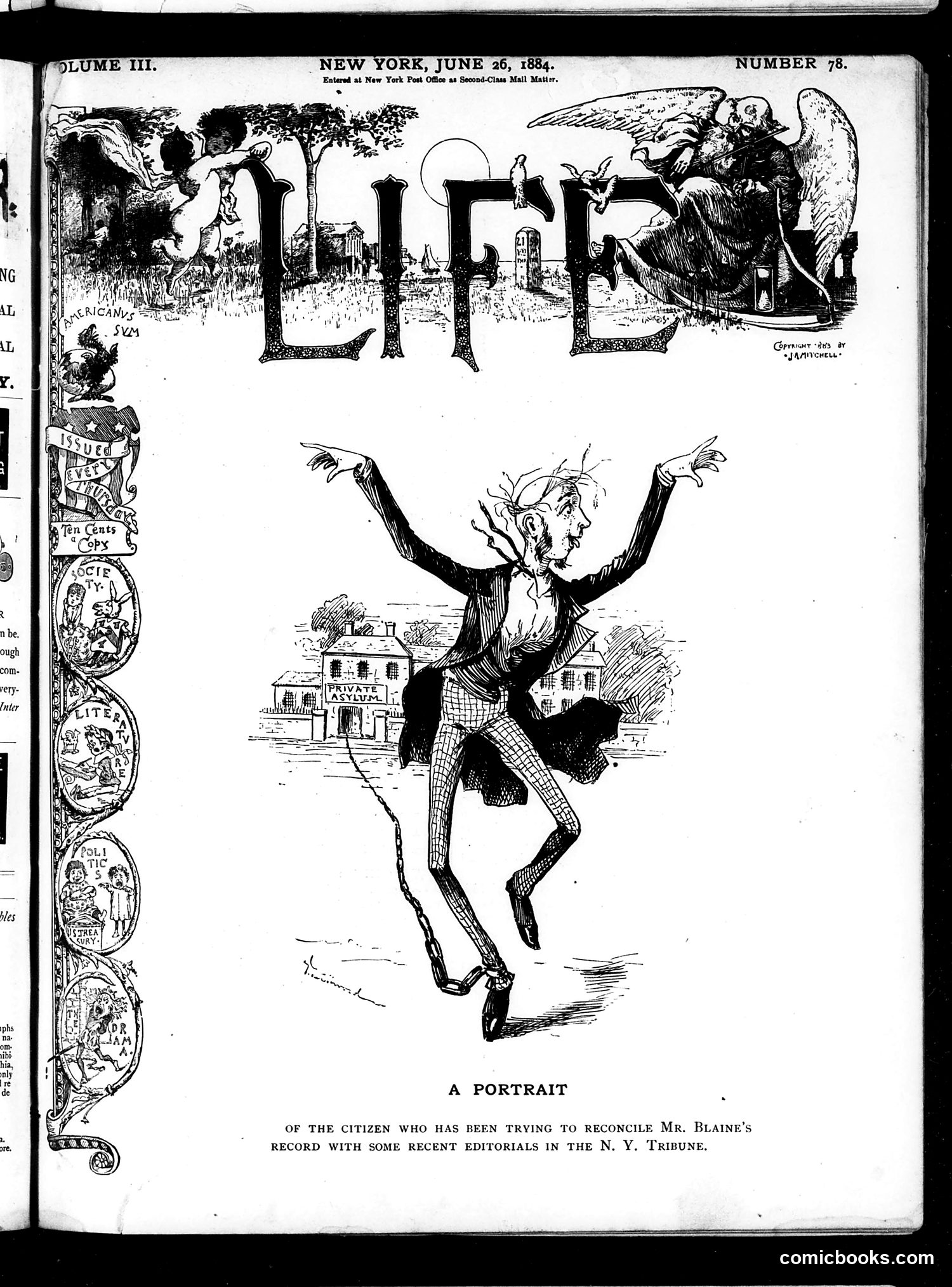
This page satirizes a citizen attempting to defend James G. Blaine's political record against recent critical editorials in the New York Tribune. The main cartoon depicts a thin, contorted figure performing an impossible balancing act—arms raised triumphantly despite obvious strain—standing before row houses. The satire suggests that defending Blaine's record requires such absurd, gymnastic mental contortions that only a deranged person would attempt it. Blaine, the 1884 Republican presidential nominee, faced serious corruption allegations during his campaign. The Tribune's editorials likely criticized his record, and this cartoon mocks anyone defending him as engaging in laughably impossible logical gymnastics.
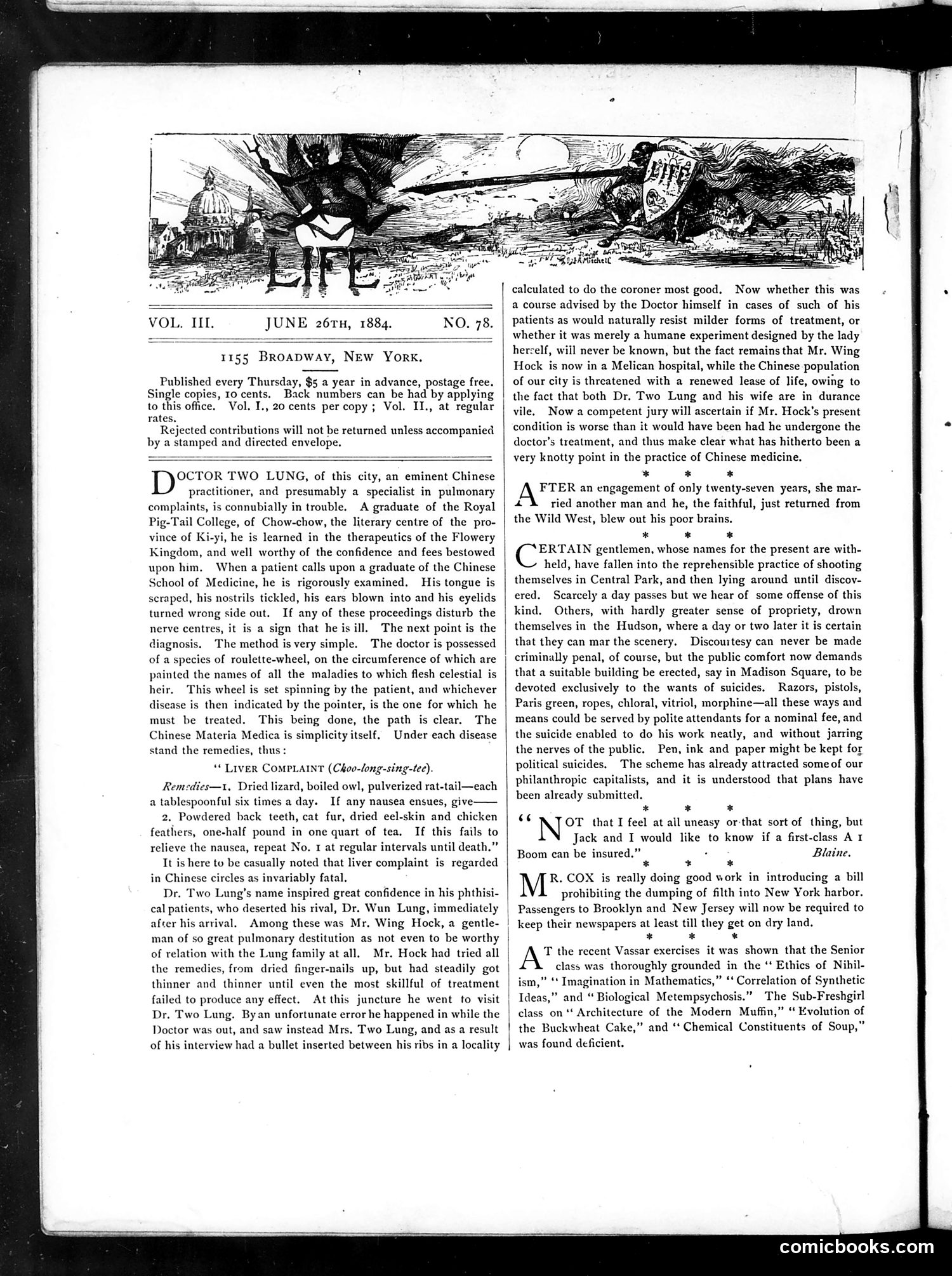
The masthead cartoon depicts **"Life"** as an allegorical figure confronting Death, with European landmarks (including what appears to be St. Peter's Basilica) in the background. This appears to be Life magazine's recurring visual identity rather than commentary on a specific event. The text articles criticize **Doctor Two Lung**, a Chinese medical practitioner in New York, and discuss gentlemen shooting themselves in Central Park—presented as a social problem requiring regulation. Other brief items mention **Mr. Cox** introducing legislation against fish-dumping in New York harbors, and criticism of Vassar College's curriculum choices. The overall tone reflects 1880s Progressive-era concerns: charlatan medicine, urban public safety hazards, and educational standards.
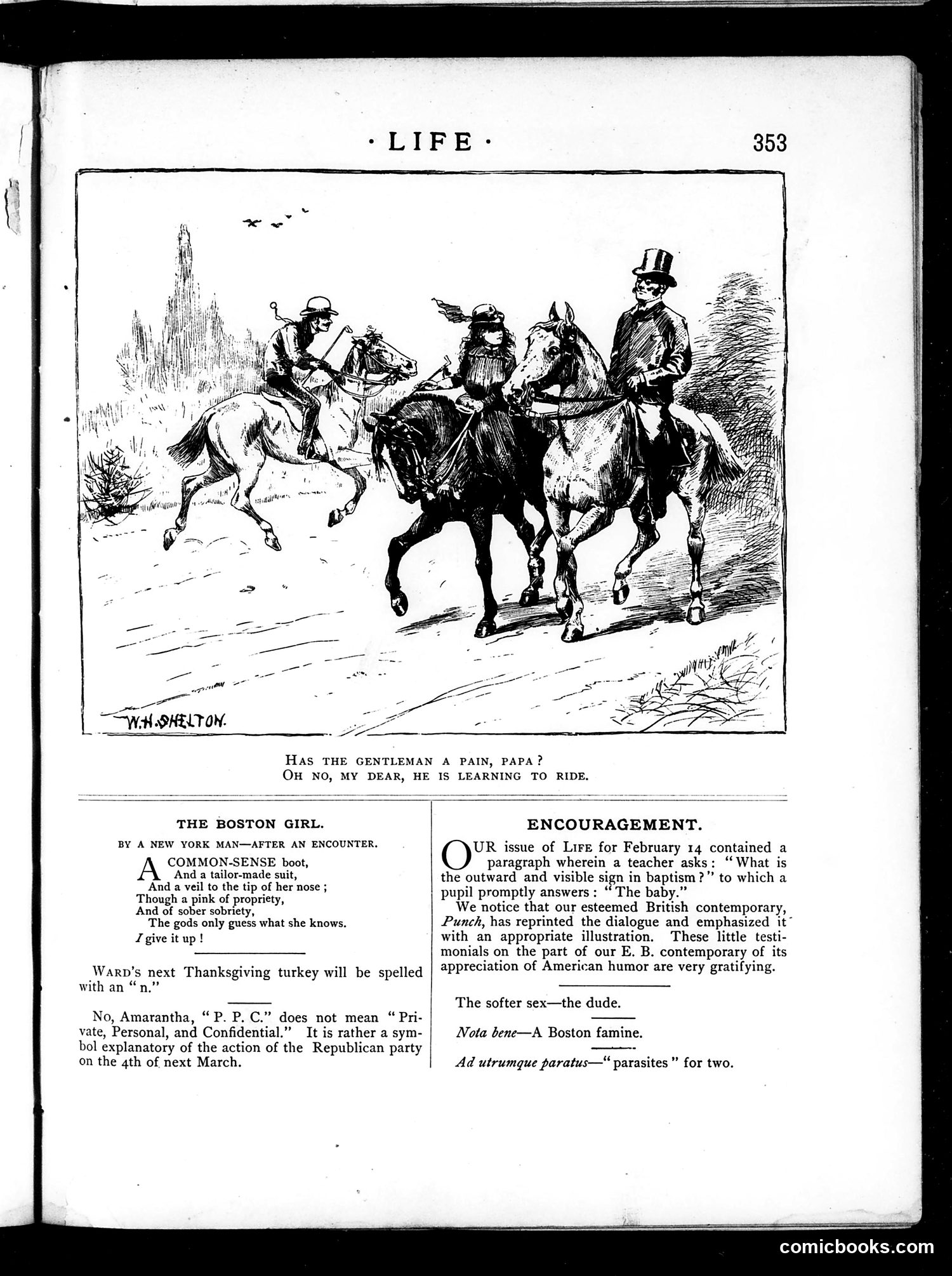
**Main Cartoon:** The illustration by W.H. Shelton depicts four mounted figures on horseback with the caption "HAS THE GENTLEMAN A PAIN, PAPA? OH NO, MY DEAR, HE IS LEARNING TO RIDE." The cartoon appears to satirize riding instruction or someone struggling to master horsemanship, with the child's innocent question masking the obvious difficulty of the central rider. **Text Section:** "The Boston Girl" poem mocks Boston women as pretentious and superficial ("common-sense body / But a tailor-made suit"). The "Encouragement" section references Life's February 14 issue and notes that British satirical magazine *Punch* reprinted American humor favorably, suggesting international appreciation for American satirical wit. The brief notes about "P.P.C." and Ward's turkey are minor editorial commentary.
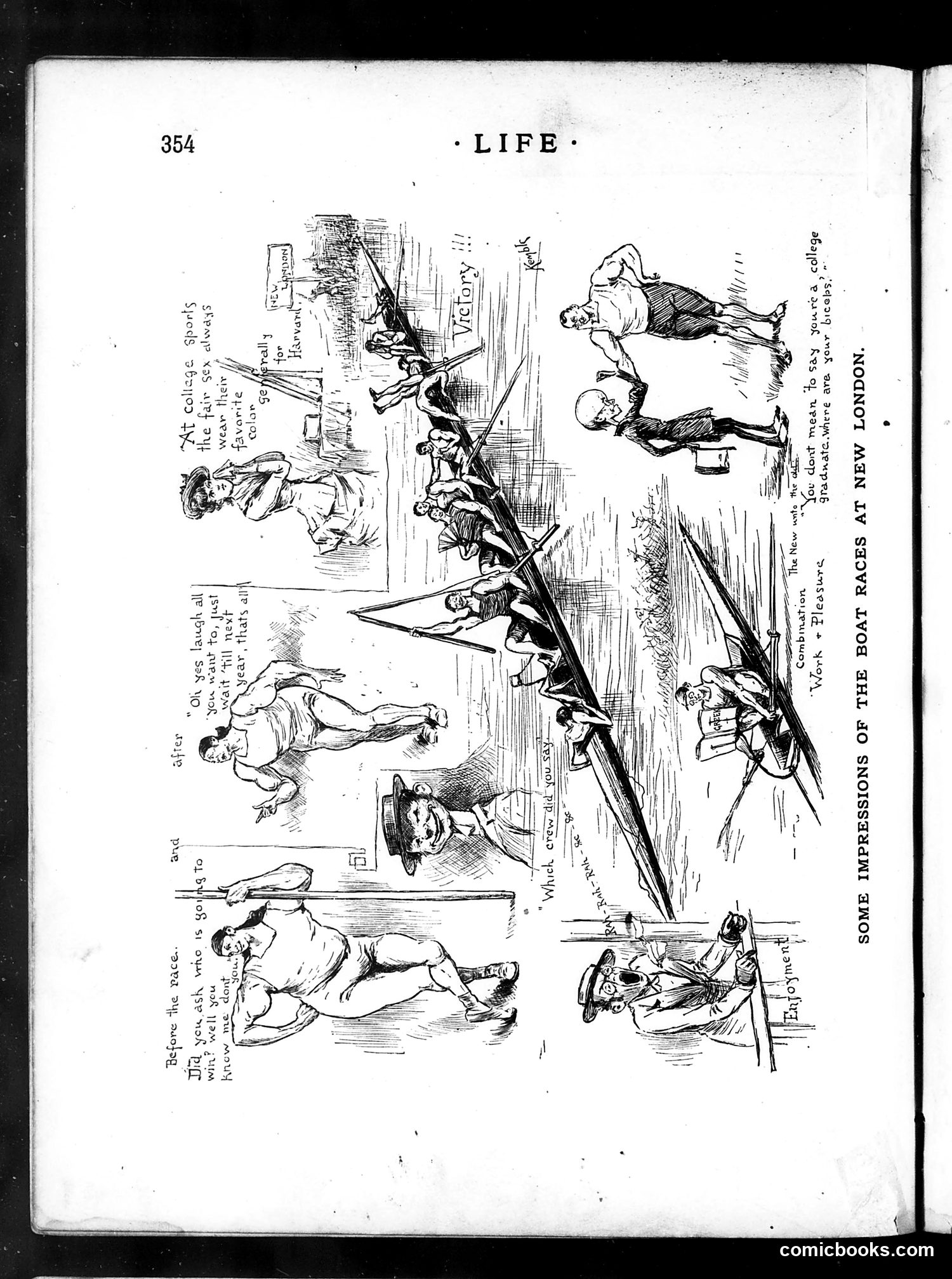
This is a satirical depiction of competitive rowing races at New London, Connecticut—a major collegiate sporting event of the era. The cartoon shows various humorous "impressions" of boat racing mishaps and spectator reactions, rendered in exaggerated comic style. The sketches appear to mock both the athletes' efforts and the enthusiastic crowd's responses. Typical elements include rowers struggling or capsizing, spectators in theatrical poses of excitement or dismay, and the general chaos surrounding such sporting events. The satire likely targets both the pretensions of elite collegiate athletics and the sometimes undignified behavior of spectators caught up in competitive fervor. The fragmented, comic-strip approach emphasizes the absurdity and disorder of the scene.
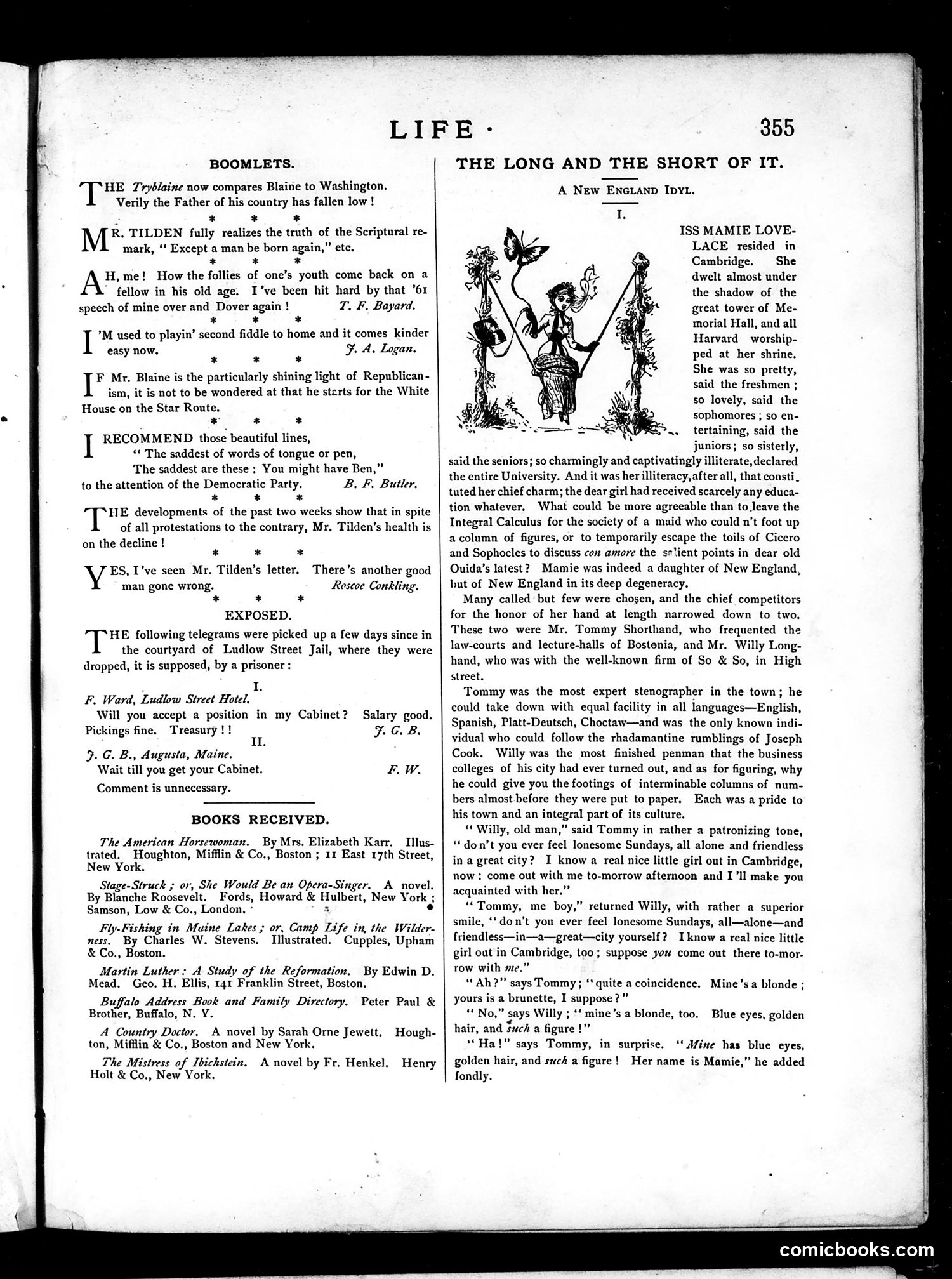
This page combines political commentary with literary content. The "Boomlets" section contains brief political jabs, including a comparison of James G. Blaine to George Washington and criticism of Republican leadership. One item recommends "beautiful lines" about sad words to the Democratic Party, suggesting partisan debate over messaging. The main illustrated story, "The Long and the Short of It," depicts a romantic narrative about Miss Mamie Love-Lace, a Cambridge woman sought after by two suitors: Tommy Shorthand (a stenographer) and Willy Longhand (a penman). The story plays on their names as they compete for her affection—a lighthearted romantic comedy rather than political satire. The page also lists newly received books for review.
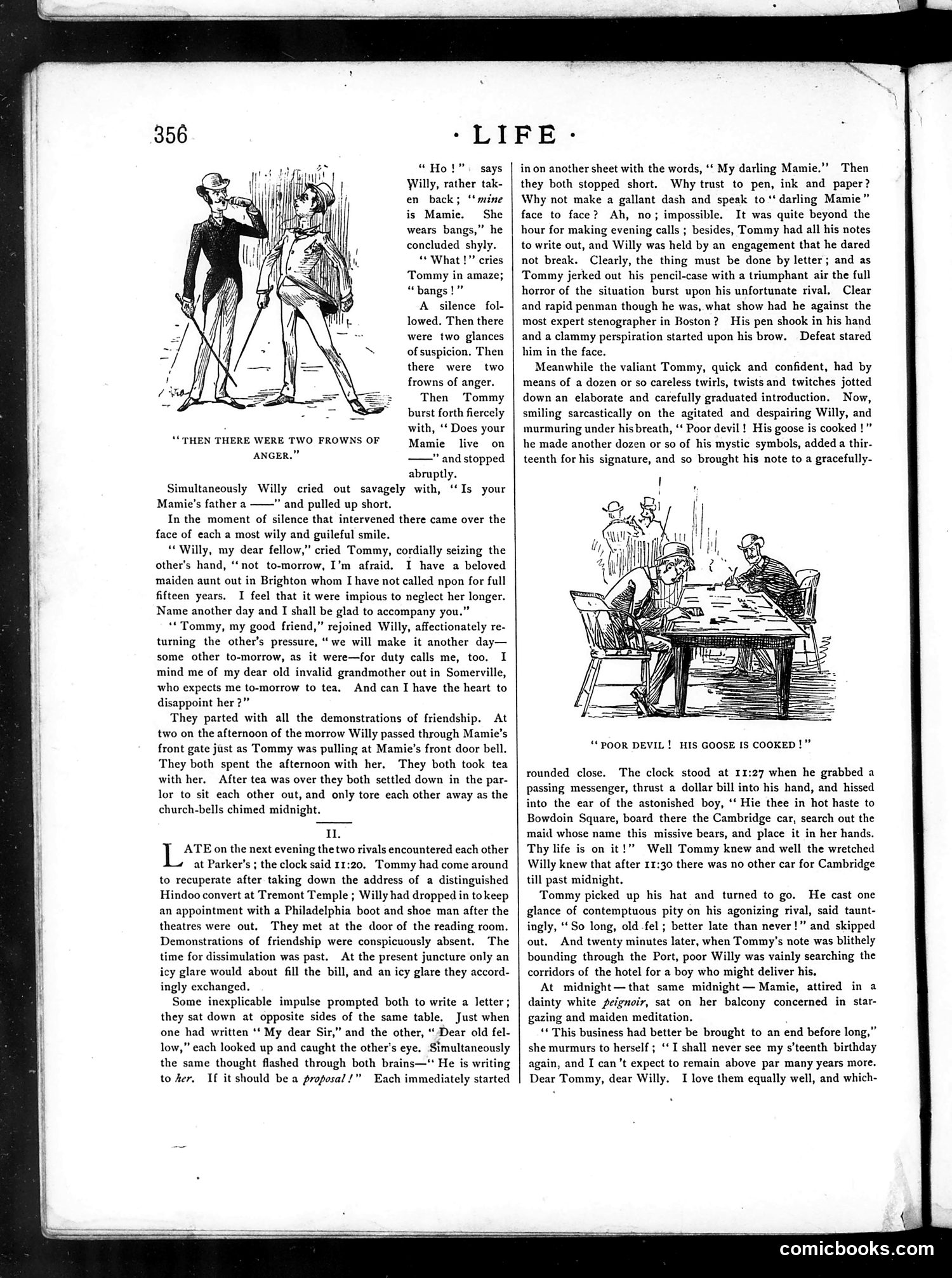
This page contains illustrations accompanying a serialized fictional story about two young men named Tommy and Willy who are rivals competing for the affections of a woman named Mamie. The two cartoon panels show: 1. **Top illustration**: Two men in confrontational poses with canes, labeled "THEN THERE WERE TWO FROWNS OF ANGER" — depicting the rivals' heated disagreement. 2. **Bottom illustration**: Two men at a table with the caption "POOR DEVIL! HIS GOOSE IS COOKED!" — showing Tommy's apparent romantic misfortune. The narrative concerns their competition over writing letters to Mamie and arranging evening calls. This appears to be lighthearted romantic comedy rather than political satire—typical of Life magazine's fiction serialization during this era.
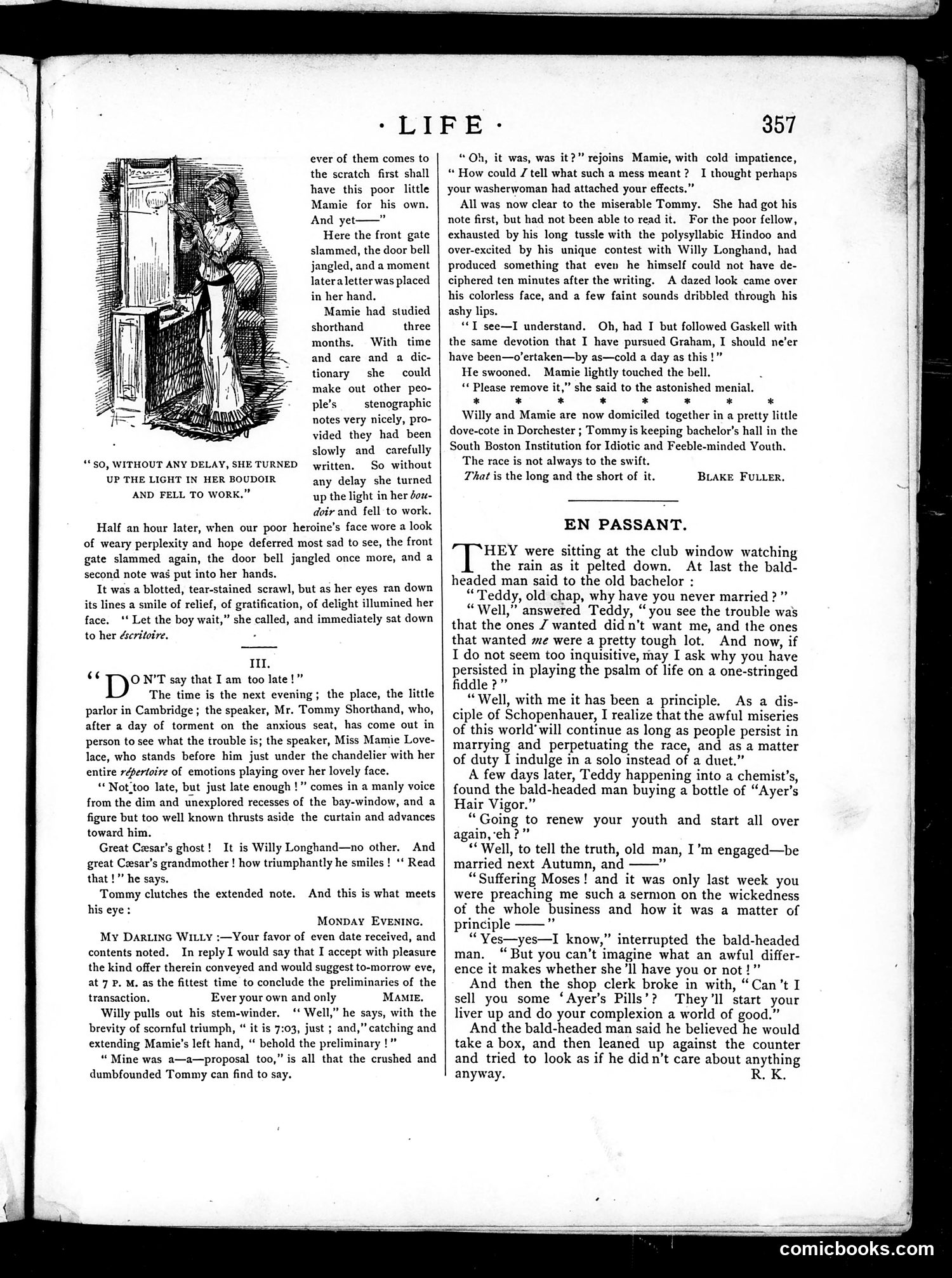
This page contains two distinct pieces of satirical fiction rather than political cartoons. The illustration shows a woman at a doorway—likely depicting a domestic scene from the accompanying story about "Mamie" learning stenography. The main satirical content is "En Passant," a dialogue between two club members discussing marriage. One man asks why a bachelor never married; the response mocks earnest philosophical commitment to bachelorhood "as a matter of duty." The satire targets pretentious intellectualism—the bachelor invokes Schopenhauer while rationalizing his unmarried status, then is immediately undercut when revealed as engaged. The final joke concerns a shop clerk hawking Ayer's Hair Vigor, reducing the would-be philosopher to vain self-concern. The satire attacks masculine pretense and hypocrisy regarding marriage and self-improvement products.
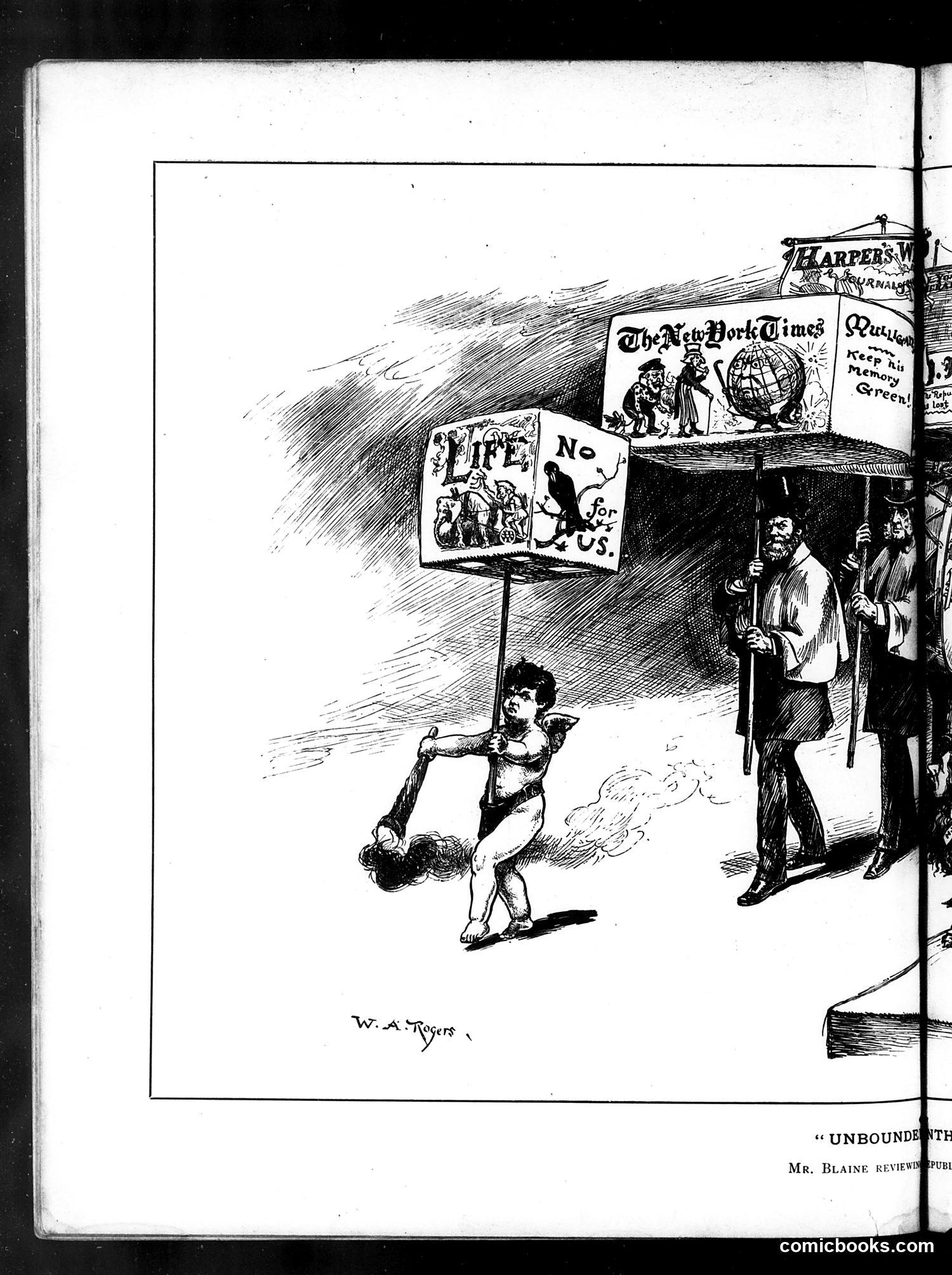
This cartoon by W.A. Rogers depicts a cherub or Cupid figure holding a sign reading "LIFE No — for US," clearly protesting against what appears to be warfare or military conflict. The cherub represents innocence and peace. In the background, newsstand displays show *The New York Times* and *Harper's Weekly* alongside military/wartime imagery, suggesting these publications are covering armed conflict. The well-dressed men observing the protest likely represent political or media establishment figures. The cartoon satirizes how major American institutions and publications were promoting or sensationalizing war, while innocent figures (represented by Cupid) opposed it. The specific conflict referenced remains unclear from the visible text, though this style suggests late 19th or early 20th-century American military involvement.
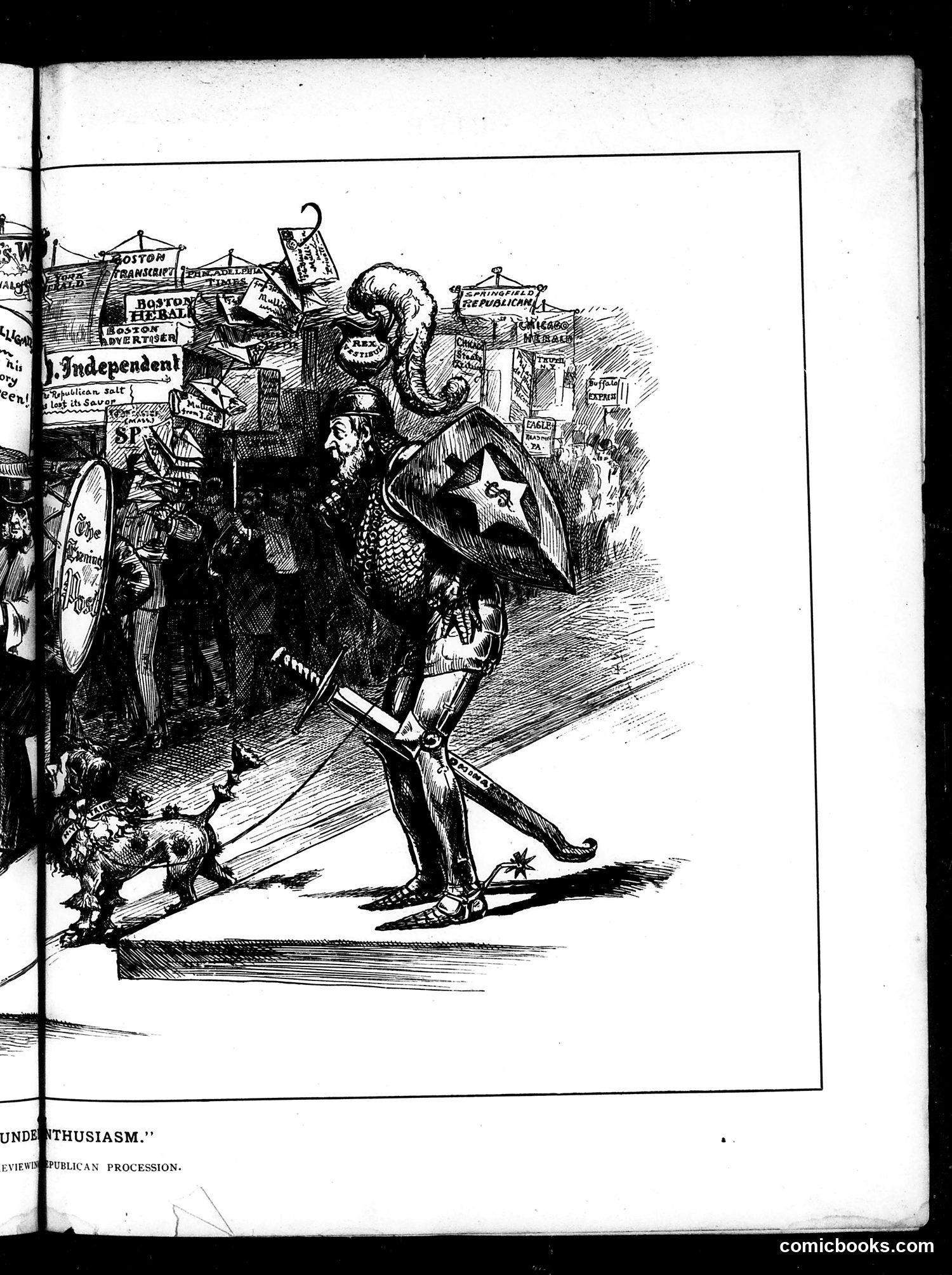
This is a satirical cartoon titled "Undemocratic Enthusiasm" depicting an "Evening Republican Procession." The central figure appears to be an elephant (the Republican Party symbol) wearing a star-emblazoned garment, surrounded by various newspaper mastheads and publications stacked like a load it's carrying. A smaller figure in formal dress stands to the left observing the scene. The satire critiques Republican political enthusiasm and media manipulation—suggesting the party is literally carrying newspaper propaganda and editorial support. The newspapers visible include references to Boston, Philadelphia, and Chicago publications. The cartoon mocks how media outlets amplify and promote Republican messaging, portraying this coordinated press support as an undignified burden rather than genuine grassroots enthusiasm.
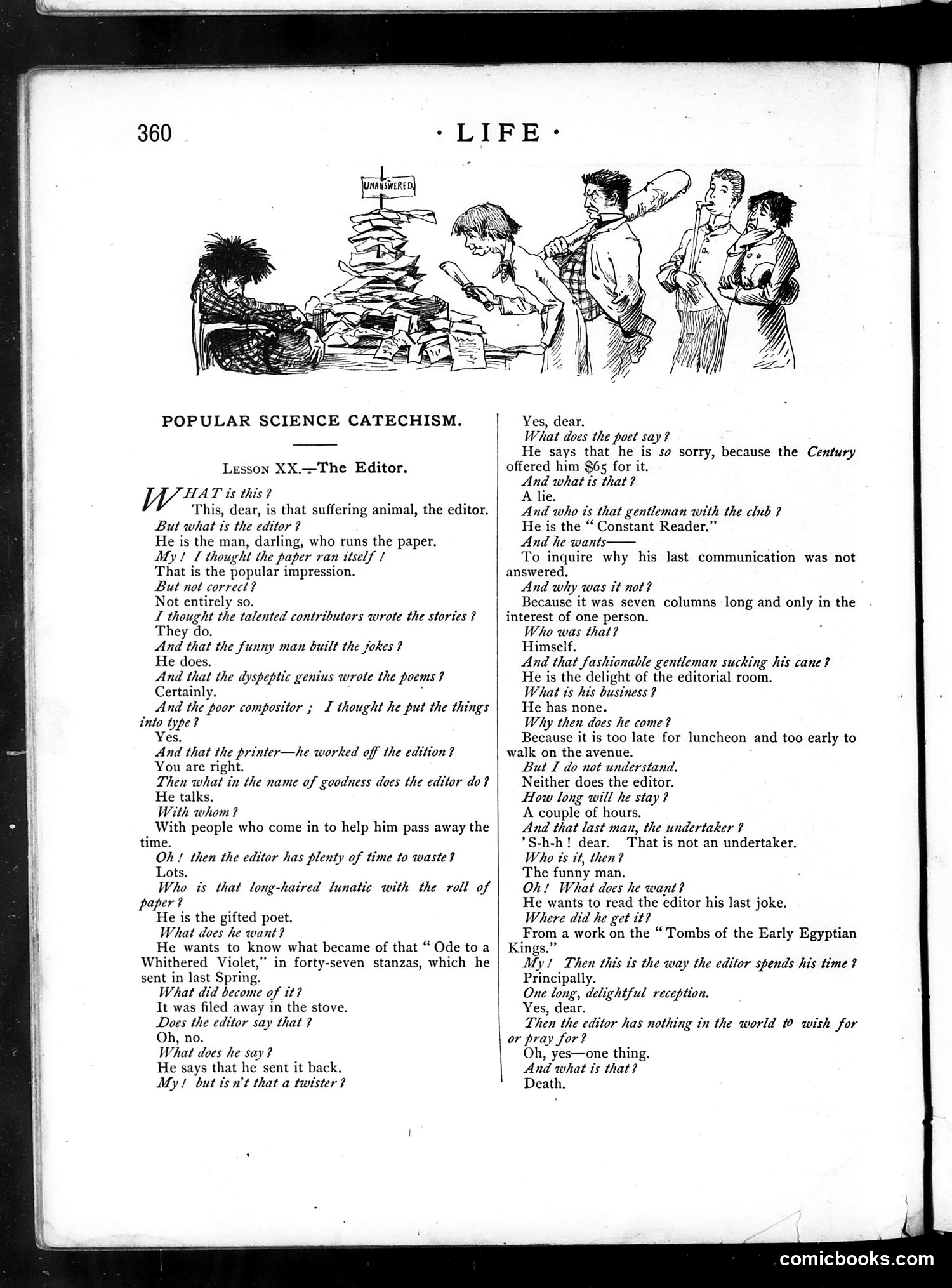
This satirical lesson mocks newspaper editors and their work through a Q&A format. The illustration shows various types of visitors interrupting the editor's day. The satire targets: 1. **The Editor's actual job**: Despite appearing to "run the paper," he mainly talks to visitors and wastes time—contributors, poets, and printers do the real work. 2. **Specific character types**: A long-haired poet whose submitted work gets burned in the stove (editor claims he rejected it), a "Constant Reader" with unsolicited seven-column letters about himself, an idle gentleman killing time between meals, and a "funny man" (appearing to be an undertaker, a visual pun) who wants to share stale jokes. 3. **The punchline**: The editor's only wish is death—a dark joke suggesting editorial work is soul-crushing drudgery. The humor relies on recognizing the editor's powerlessness amid workplace chaos and time-wasting visitors, presenting newspaper office culture as absurd and exhausting.
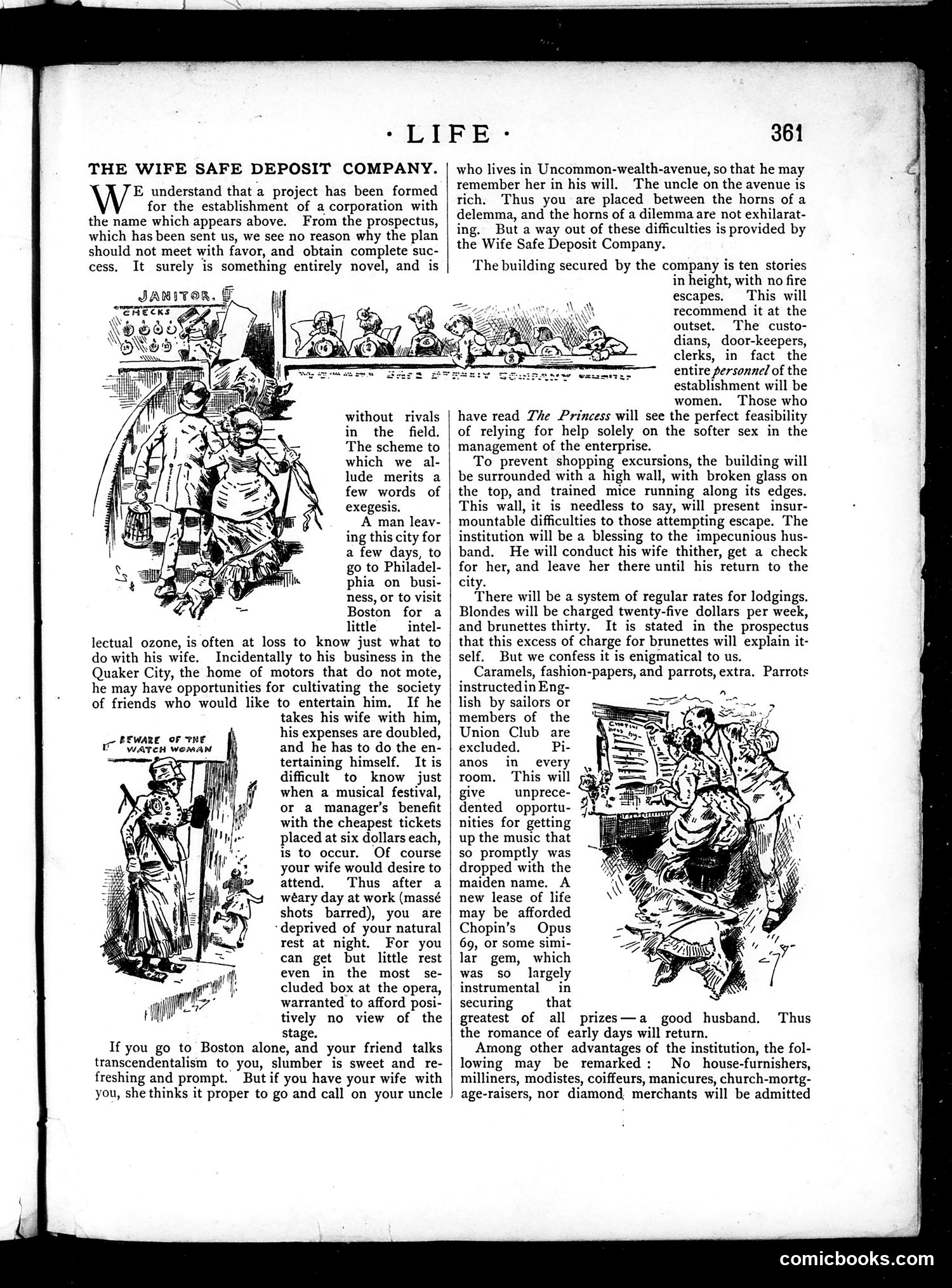
This is satirical commentary on married life and gender relations in Gilded Age America. The piece mocks a fictional company proposing to warehouse wives while husbands travel on business or socialize. The satire targets **married men's complaints**: wives increase expenses, prevent socializing, demand social calls on wealthy relatives (hoping to be remembered in wills), and monopolize evenings at opera and concerts. The "solution" — a secure facility staffed entirely by women, surrounded by walls with broken glass and trained mice — is obviously absurd. The cartoons depict the chaos of wives and children overwhelming husbands, illustrating their desperation. References to *The Princess* (likely Tennyson's poem about women's education) and pricing brunettes higher than blondes add layers of period-specific absurdity about women's perceived value. The piece ultimately mocks both husbands' selfishness and the era's assumptions about wives as impediments to male leisure and ambition.
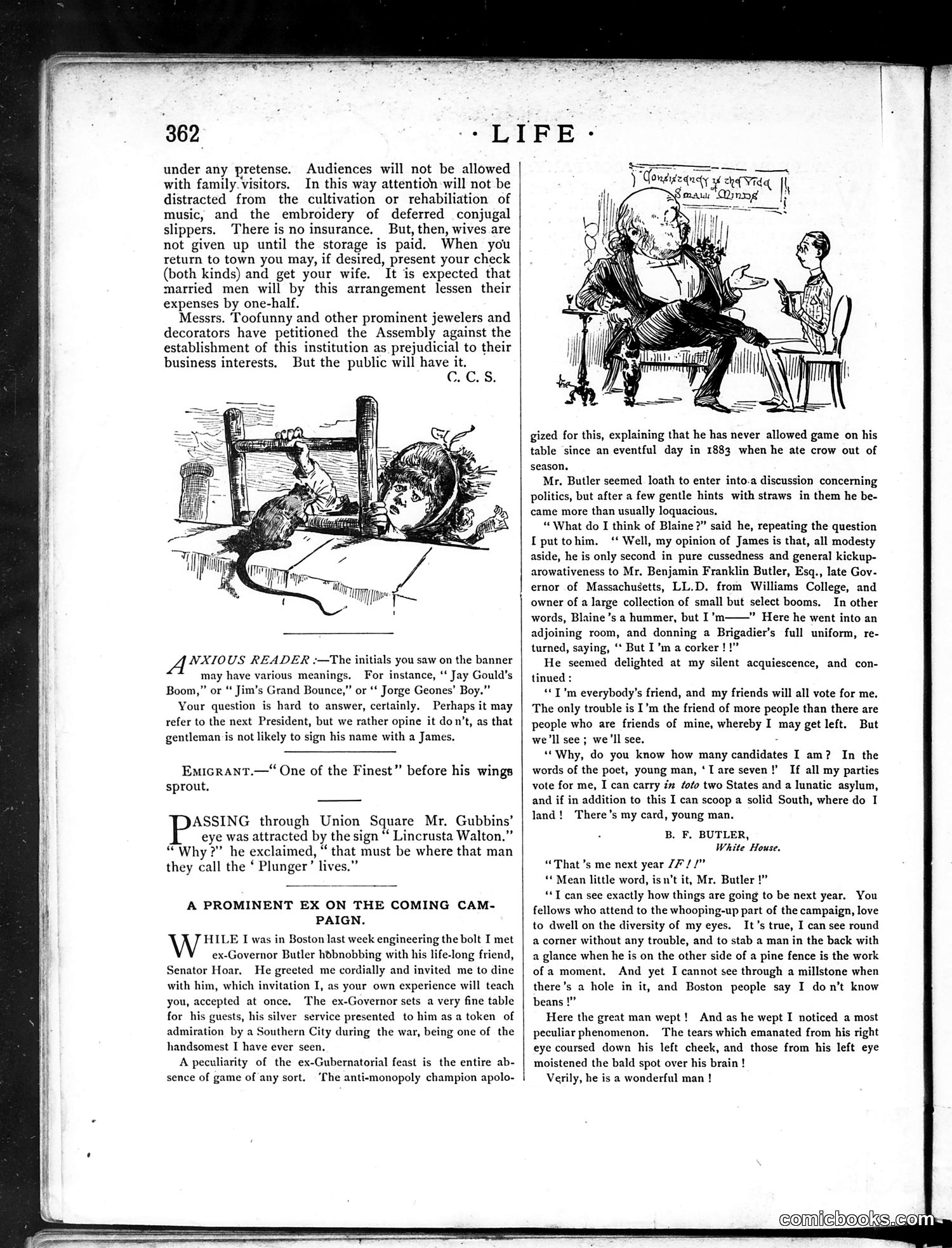
This 1884 *Life* magazine page satirizes **Benjamin Franklin Butler**, a controversial ex-Governor of Massachusetts and perennial political candidate. The main article depicts Butler at dinner boasting about his presidential ambitions, comparing himself favorably (or "second") to James G. Blaine, the Republican frontrunner. The satire targets Butler's: - **Contradictions**: He claims to be "everybody's friend" yet worries about being "left" by supporters - **Inflated ego**: He calls himself a "corker" and sees himself splitting votes across multiple states and "a lunatic asylum" - **Political opportunism**: The famous joke about him never serving game since 1883 when he "ate crow out of season" mocks his flip-flopping and humiliating political defeats The cartoons mock Butler's eccentric persona and his habit of appearing in military uniform—referencing his controversial Civil War record. The satire suggests Butler's perpetual candidacy is absurd and self-deluding rather than serious.
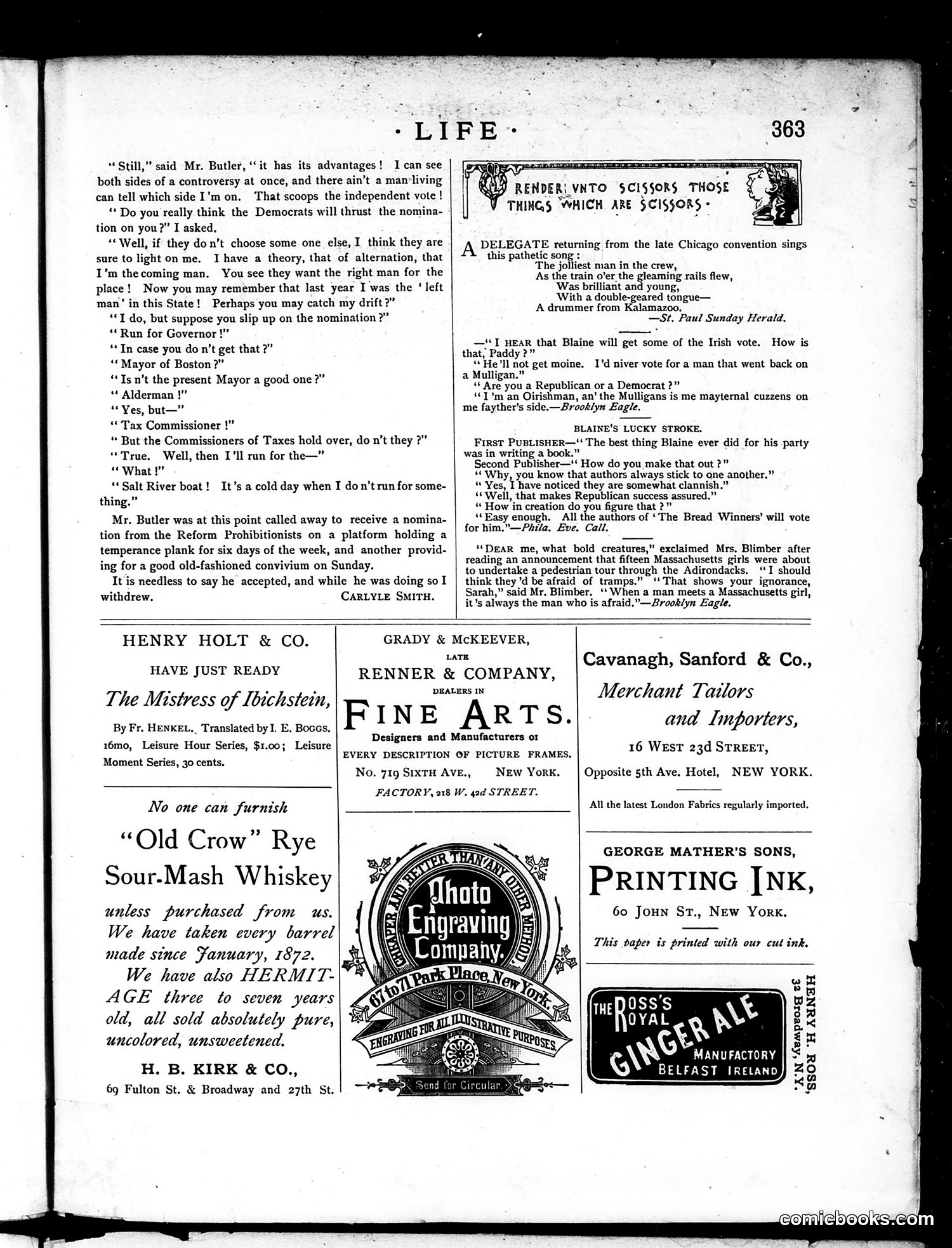
This page contains **humorous political commentary** from an election period (the "Chicago convention" reference suggests the 1884 or 1888 presidential race). The main article mocks **Mr. Butler**, an opportunistic politician who claims to be a "coming man" through a theory of "alternation." Butler comically lists increasingly absurd offices he'll run for if rejected—Governor, Mayor of Boston, Alderman, Tax Commissioner—culminating in running for a "Salt River boat" (a 19th-century idiom for defeat/failure). The joke satirizes **ambitious politicians with no real principles**, willing to accept any platform, including one from "Reform Prohibitionists" offering temperance on weekdays but a "good old-fashioned convivium" (drinking party) on Sundays. Supporting items mock **James G. Blaine's** 1884 presidential bid: one jokes that authors will vote for him because he wrote a book; another references the "Mulligan" controversy (a scandal involving Blaine's letters). The page is otherwise **advertisements** for books, tailors, and whiskey.
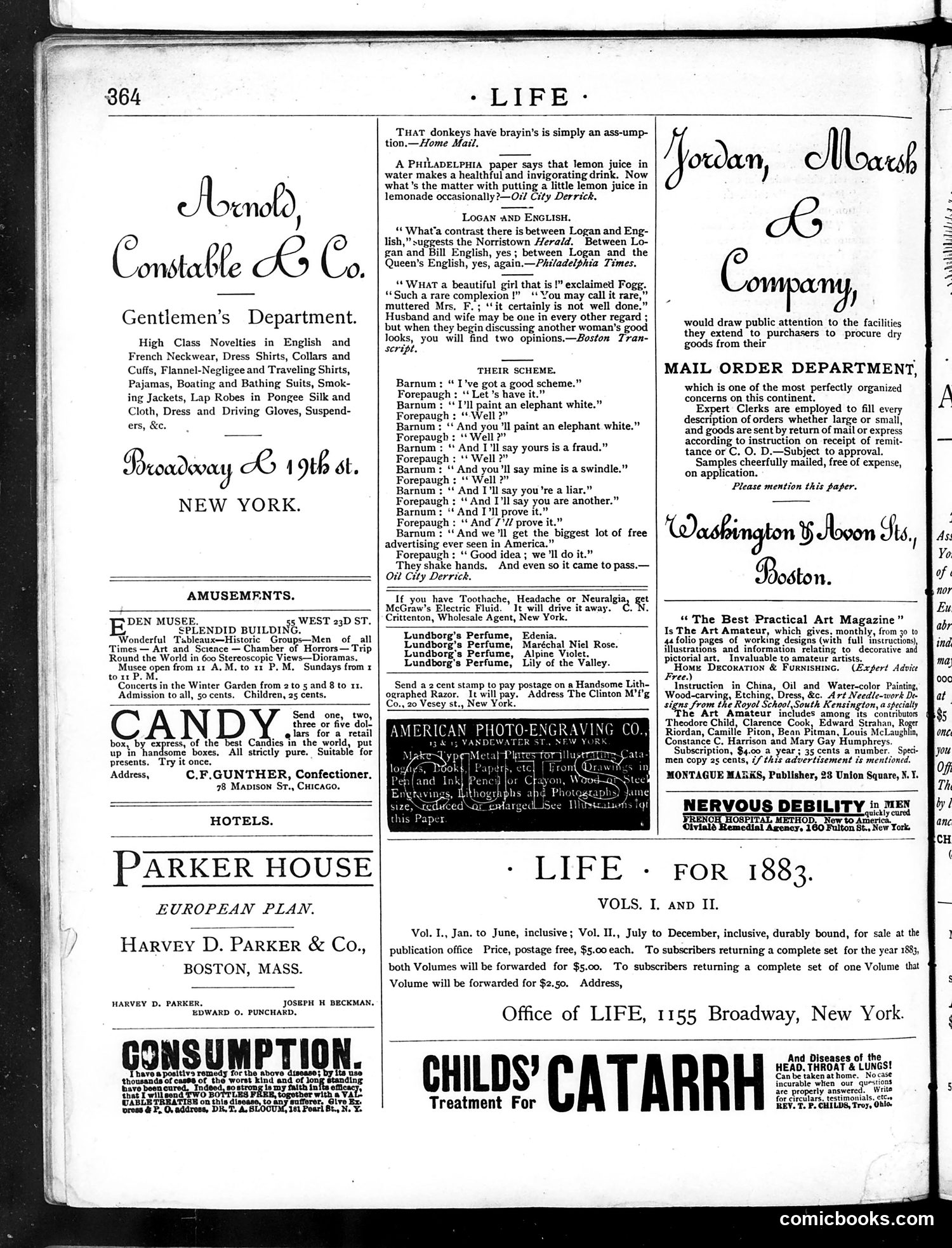
This page is primarily an **advertising section** from Life magazine, circa 1883. The bulk of the content consists of commercial advertisements for retailers, hotels, and patent medicines typical of that era. However, there is one notable **satirical piece**: "Their Scheme," a dialogue between circus impresarios **P.T. Barnum and James Bailey** (Forepaugh). The satire mocks these rival showmen, depicting their cynical plan to stage a public feud by each claiming the other's painted white elephant is fraudulent. They agree to publicly call each other liars and swindlers—purely to generate publicity and "advertising." This references the real 19th-century rivalry between Barnum and Bailey and their exploitative marketing tactics. The joke satirizes American circus culture and deliberate sensationalism masquerading as genuine competition. The rest of the page is unremarkable advertising for clothing, hotels, perfumes, and dubious patent medicines.
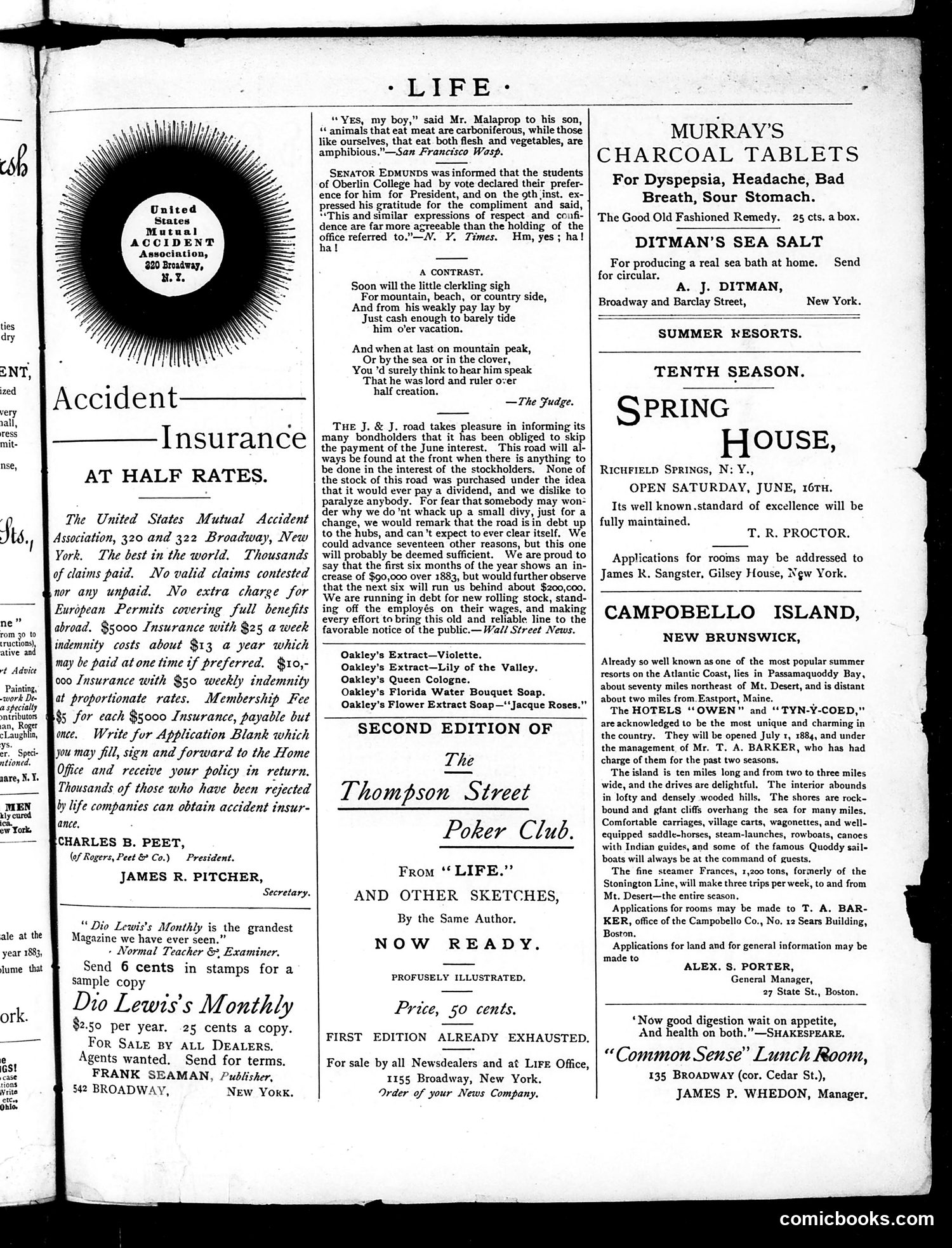
This page is primarily **advertisements and short satirical pieces** from Life magazine (likely 1880s based on references). The main cartoon/humor content consists of brief satirical items: 1. **"A Contrast"** (poem): Mocks working-class clerks who save meager wages for vacations, then imagine themselves as lords—social satire about temporary escapism masking actual powerlessness. 2. **The Senator Edmunds anecdote**: Ridicules the senator's false modesty—he claims to prefer "respect" over actually *holding office*, which Life suggests is obviously insincere flattery. 3. **The J. & J. railroad notice**: Satirizes corporate double-speak. The railroad apologizes for skipping interest payments while boasting about minor gains, then admits massive debt—exposing how companies obscure financial failures with misleading language. 4. **The "Malaprop" quote**: Simple wordplay humor—confusing "carboniferous" (coal-bearing) with "carnivorous," mocking pretentious misuse of scientific terms. The rest is straightforward period advertising for insurance, magazines, and patent medicines—typical of Life's revenue model.
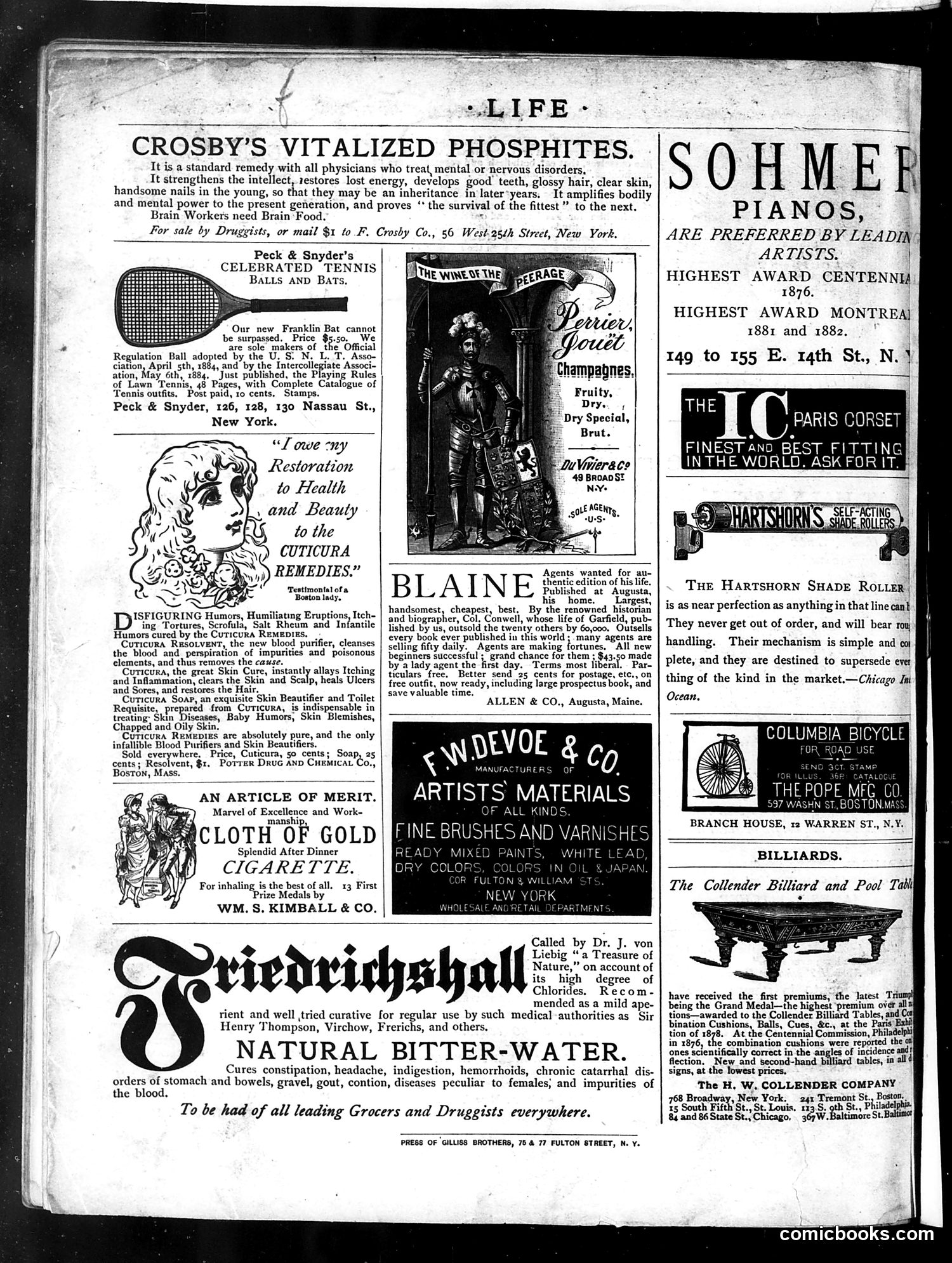
This page is primarily **advertisements** rather than editorial content or political cartoons. It's from an 1880s American magazine featuring patent medicines and consumer goods typical of that era. Key ads include: - **Crosby's Vitalized Phosphites**: A nerve tonic claiming to strengthen intellect and restore energy—reflecting period pseudoscience linking mental health to brain "food" - **Cuticura Remedies**: Skin treatments advertised with testimonials, using language about "humors" and blood purification common to 19th-century medical claims - **Friedrichshall**: A natural mineral water marketed as medicinal cure-all - **Cloth of Gold Cigarettes**: Promoted as suitable for "after dinner" consumption The page reflects **no obvious political satire**. Rather, it documents how Life magazine monetized itself through patent medicine advertising—a standard practice before FDA regulations. The pseudoscientific claims and testimonial format reveal contemporary attitudes toward health and marketing that modern readers would find dubious.
I can see this is a page from *Life* magazine, but the image is almost entirely black with only fragmentary text visible along the left margin. The OCR text provides only "comicbooks.com," which appears to be a watermark rather than original magazine content. The left margin shows partial text including words like "CLER," "CLE," and "ANY," along with what appear to be advertisement sections, but these fragments are too incomplete to identify specific cartoons, figures, or satirical content with confidence. Without legible cartoon imagery or coherent OCR text, I cannot reliably identify the political or social references, caricatures, or the satire's intent. The page quality and contrast make analysis impossible.