
Life, 1884-06-26 · page 10 of 17
Life — June 26, 1884 — page 10: what you’re looking at
What you’re looking at
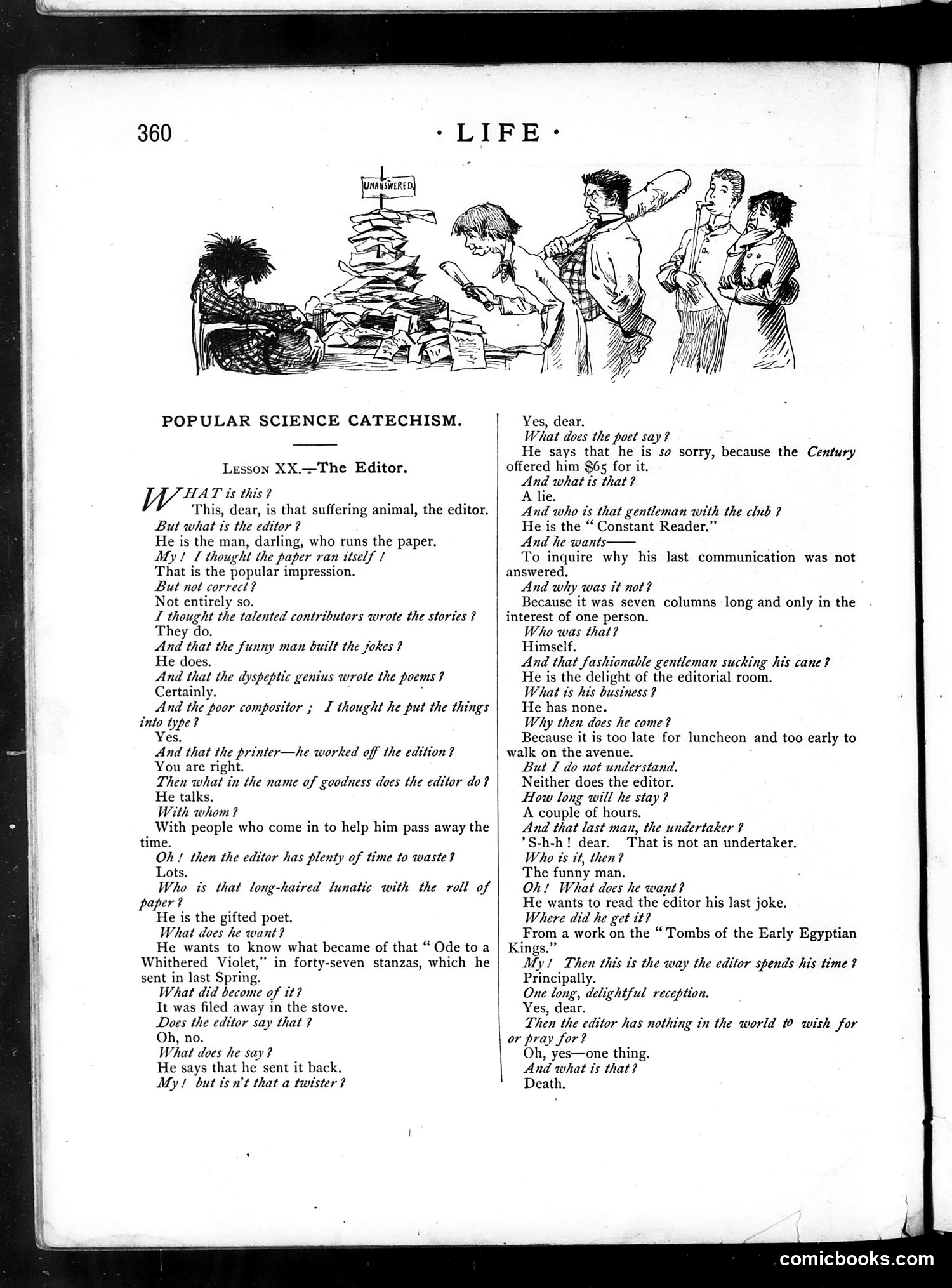
This satirical lesson mocks newspaper editors and their work through a Q&A format. The illustration shows various types of visitors interrupting the editor's day. The satire targets: 1. **The Editor's actual job**: Despite appearing to "run the paper," he mainly talks to visitors and wastes time—contributors, poets, and printers do the real work. 2. **Specific character types**: A long-haired poet whose submitted work gets burned in the stove (editor claims he rejected it), a "Constant Reader" with unsolicited seven-column letters about himself, an idle gentleman killing time between meals, and a "funny man" (appearing to be an undertaker, a visual pun) who wants to share stale jokes. 3. **The punchline**: The editor's only wish is death—a dark joke suggesting editorial work is soul-crushing drudgery. The humor relies on recognizing the editor's powerlessness amid workplace chaos and time-wasting visitors, presenting newspaper office culture as absurd and exhausting.
📄 Transcribed text from this page (OCR, searchable)
Machine-transcribed from the original scan — historical spelling and the odd misread are preserved.
POPULAR SCIENCE CATECHISM. Lesson XX.~The Editor. HAT is this? This, dear, is that suffering animal, the editor. But what is the editor ? He is the man, darling, who runs the paper. My! L thought the paper ran itself ! That is the popular impression. But not correct? Not entirely so. L thought the talented contributors wrote the stories ? They do. And that the funny man built the jokes ? He does. And that the dyspeptic genius wrote the poems? Certainly. . And the poor compositor ; I thought he put the things into type? Yes. And that the printer—he worked off the edition? You are right. Then what in the name of goodness does the editor do? He talks. With whom? With people who come in to help him pass away the time. Oh! then the editor has plenty of time to waste? Lots. Who is that long-haired lunatic with the roll of paper? He is the gifted poet. What does he want? He wants to know what became of that “ Ode to a Whithered Violet,” in forty-seven stanzas, which he sent in last Spring. What did become of it? It was filed away in the stove. Does the editor say that ? Oh, no. What does he say? He says that he sent it back. My! but isn’t that a twister? Yes, dear. What does the poet say? He says that he is so sorry, because the Century offered him $65 for it. And what ts that? A lie. And who ts that gentleman with the club? He is the “ Constant Reader.” And he wants—— To inquire why his last communication was not answered. And why was it not? Because it was seven columns long and only in the interest of one person. Who was that? Himself. And that fashionable gentleman sucking his cane? He is the delight of the editorial room. What is his business ? He has none. Why then does he come? Because it is too late for luncheon and too early to walk on the avenue. But I do not understand. Neither does the editor. How long will he stay? A couple of hours. And that last man, the undertaker ? *S-h-h! dear. That is not an undertaker. Who is it, then? The funny man. Oh! What does he want? He wants to read the editor his last joke. Where did he get it? From a work on the “Tombs of the Early Egyptian Kings.” My! Then this is the way the editor spends his time? Principally. One long, delightful reception. Yes, dear. Then the editor has nothing in the world t0 wish for or pray for? Oh, yes—one thing. And what ts that? Death. comicbooks.com