
Life, 1884-06-26 · page 5 of 17
Life — June 26, 1884 — page 5: what you’re looking at
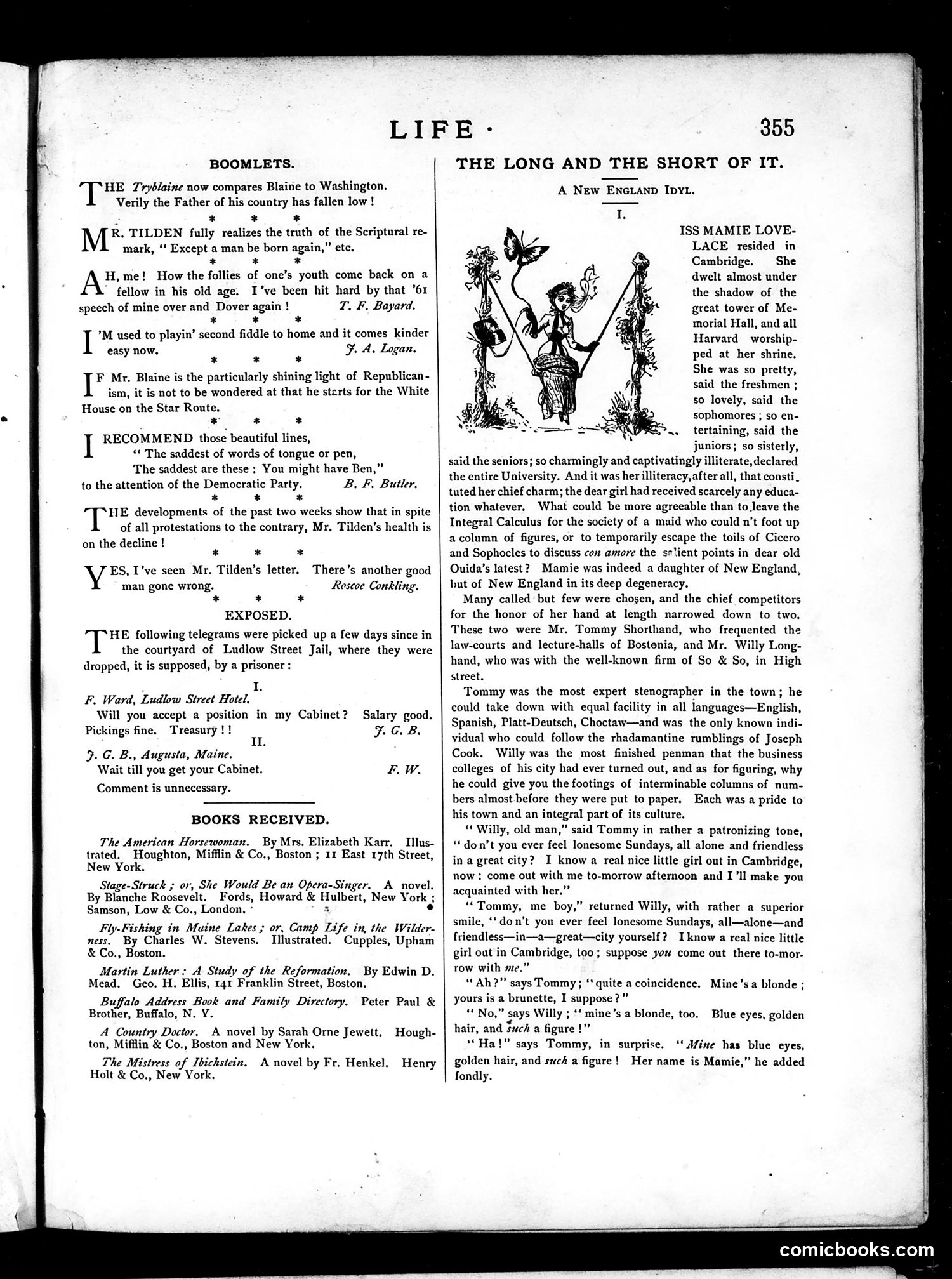
What you’re looking at
This page combines political commentary with literary content. The "Boomlets" section contains brief political jabs, including a comparison of James G. Blaine to George Washington and criticism of Republican leadership. One item recommends "beautiful lines" about sad words to the Democratic Party, suggesting partisan debate over messaging. The main illustrated story, "The Long and the Short of It," depicts a romantic narrative about Miss Mamie Love-Lace, a Cambridge woman sought after by two suitors: Tommy Shorthand (a stenographer) and Willy Longhand (a penman). The story plays on their names as they compete for her affection—a lighthearted romantic comedy rather than political satire. The page also lists newly received books for review.
📄 Transcribed text from this page (OCR, searchable)
Machine-transcribed from the original scan — historical spelling and the odd misread are preserved.
LIFE: BOOMLETS. HE 7ryblaine now compares Blaine to Washington. Verily the Father of his country has fallen low ! * * * R. TILDEN fully realizes the truth of the Scriptural re- mark, ‘‘ Except a man be born again,” ete. * * * H, me! How the follies of one’s youth come back on a fellow in his old age. I’ve been hit hard by that '6r speech of mine over and Dover again ! T. F. Bayard. * * * if ’M used to playin’ second fiddle to home and it comes kinder easy now. ¥. A. Logan. * * * F Mr. Blaine is the particularly shining light of Republican- ism, it is not to be wondered at that he starts for the White House on the Star Route. : * 4 * RECOMMEND those beautiful lines, “ The saddest of words of tongue or pen, The saddest are these : You might have Ben,” to the attention of the Democratic Party. B. F. Butler. * * * HE developments of the past two weeks show that in spite of all protestations to the contrary, Mr. Tilden’s health is on the decline ! * * * ES, I’ve seen Mr. Tilden’s letter. There’s another good man gone wrong. Roscoe Conkling. * * * EXPOSED, HE following telegrams were picked up a few days since in the courtyard of Ludlow Street Jail, where they were dropped, it is supposed, by a prisoner : I. F. Ward, Ludlow Street Hotel. Will you accept a position in my Cabinet ? Pickings fine. Treasury! ! Salary good. GB. IL. 4 95. G. B., Augusta, Maine. Wait till you get your Cabinet. FLW. Comment is unnecessary. BOOKS RECEIVED. The American Horsewoman. By Mrs. Elizabeth Karr. _Tllus- trated. Houghton, Mifflin & Co., Boston ; 11 East 17th Street, New York. Stage-Struck ; or, She Would Be an Opera-Singer. A novel. By Blanche Roosevelt. Fords, Howard & Hulbert, New York ; Samson, Low & Co., London, ° 3 e Fly-Fishing in Muine Lakes ; or, Camp Life in, the Wilder- ness. By Charles W. Stevens. Illustrated. Cupples, Upham & Co., Boston. Martin Luther: A Study of the Reformation, By Edwin D. Mead. Geo. H. Ellis, 141 Franklin Street, Boston. Buffalo Address Book and Family Directory. Peter Paul & Brother, Buffalo, N. Y. A Country Doctor, A novel by Sarah Orne Jewett. ton, Mifflin & Co., Boston and New York. The Mistress of Ibichstein, A novel by Fr. Henkel. Holt & Co., New York. Hough- Henry 355 THE LONG AND THE SHORT OF IT. A New Enctanp IpyL. I. ISS MAMIE LOVE- LACE resided in Cambridge. She dwelt almost under the shadow of the great tower of Me- morial Hall, and all Harvard worship- ped at her shrine. She was so pretty, said the freshmen ; so lovely, said the sophomores ; so en- tertaining, said the juniors ; so sisterly, said the seniors; so charmingly and captivatingly illiterate, declared the entire University. And it was her illiteracy, after all, that consti. tuted her chief charm; the dear girl had received scarcely any educa- tion whatever. What could be more agreeable than to leave the Integral Calculus for the society of a maid who could n’t foot up acolumn of figures, or to temporarily escape the toils of Cicero and Sophocles to discuss con amore the sc'ient points in dear old Ouida’s latest? Mamie was indeed a daughter of New England, but of New England in its deep degeneracy. Many called but few were chosen, and the chief competitors for the honor of her hand at length narrowed down to two. These two were Mr. Tommy Shorthand, who frequented the law-courts and lecture-halls of Bostonia, and Mr. Willy Long- hand, who was with the well-known firm of So & So, in High street. Tommy was the most expert stenographer in the town; he could take down with equal facility in all languages—English, Spanish, Platt-Deutsch, Choctaw—and was the only known indi- vidual who could follow the rhadamantine rumblings of Joseph Cook. Willy was the most finished penman that the business colleges of his city had ever turned out, and as for figuring, why he could give you the footings of interminable columns of num- bers almost before they were put to paper. Each was a pride to his town and an integral part of its culture. “« Willy, old man,” said Tommy in rather a patronizing tone, “don’t you ever feel lonesome Sundays, all alone and friendless in a great city? I know a real nice little girl out in Cambridge, now ; come out with me to-morrow afternoon and I'll make you acquainted with her.” “Tommy, me boy,” returned Willy, with rather a superior smile, ‘don’t you ever feel lonesome Sundays, all—alone—and friendless—in—a—great—city yourself? I know a real nice little girl out in Cambridge, too ; suppose you come out there to-mor- row with me.” “Ah?” says Tommy; ‘quite acoincidence. Mine’sa blonde ; yours is a brunette, I suppose ?” “No,” says Willy ; ‘‘ mine’s a blonde, too. hair, and Such a figure !” “Ha!” says Tommy, in surprise. golden hair, and such a figure! fondly. Blue eyes, golden “Mine has blue eyes, Her name is Mamie,” he added comicbooks.com