
Life, 1884-06-26 · page 6 of 17
Life — June 26, 1884 — page 6: what you’re looking at
What you’re looking at
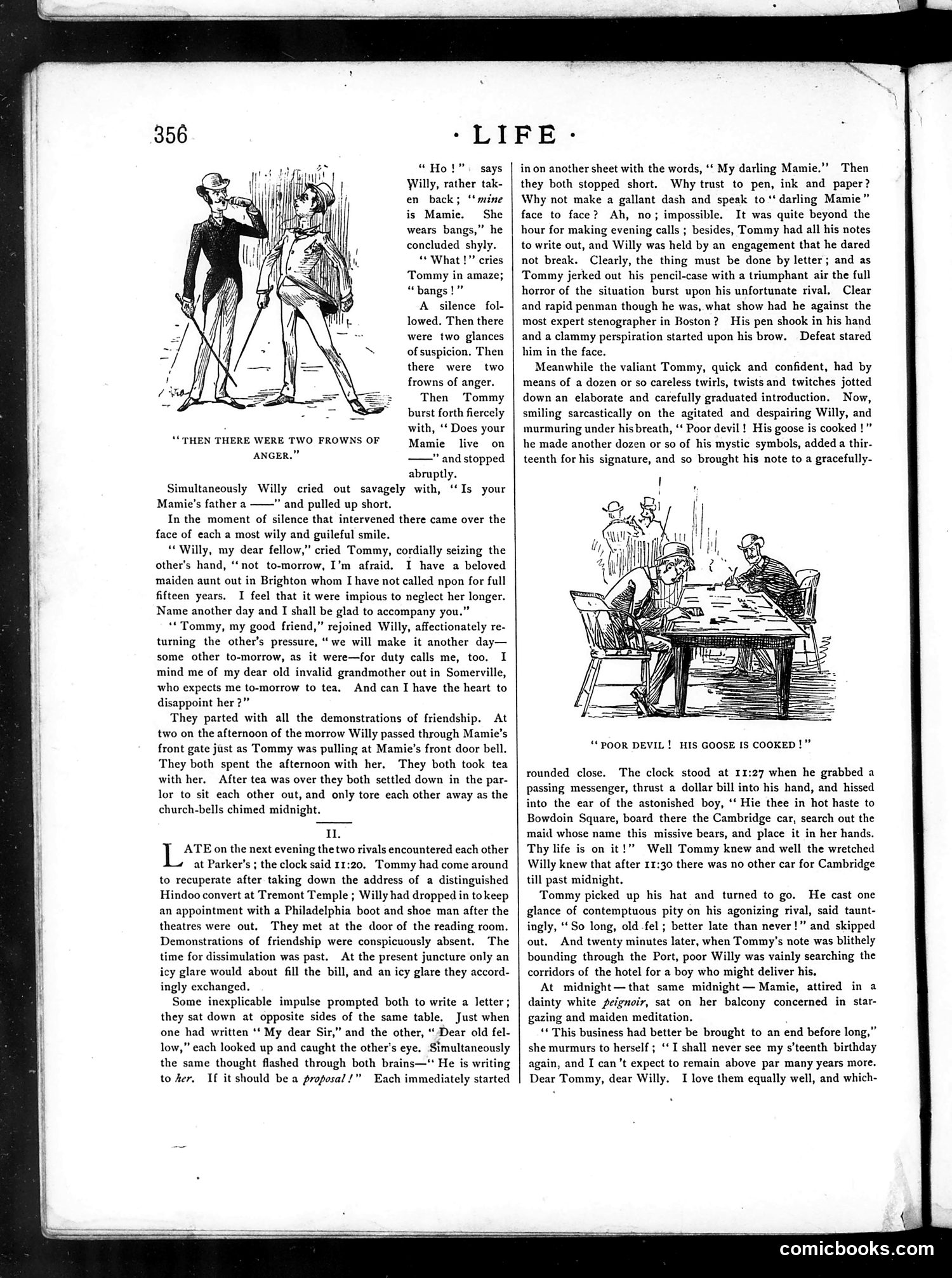
This page contains illustrations accompanying a serialized fictional story about two young men named Tommy and Willy who are rivals competing for the affections of a woman named Mamie. The two cartoon panels show: 1. **Top illustration**: Two men in confrontational poses with canes, labeled "THEN THERE WERE TWO FROWNS OF ANGER" — depicting the rivals' heated disagreement. 2. **Bottom illustration**: Two men at a table with the caption "POOR DEVIL! HIS GOOSE IS COOKED!" — showing Tommy's apparent romantic misfortune. The narrative concerns their competition over writing letters to Mamie and arranging evening calls. This appears to be lighthearted romantic comedy rather than political satire—typical of Life magazine's fiction serialization during this era.
📄 Transcribed text from this page (OCR, searchable)
Machine-transcribed from the original scan — historical spelling and the odd misread are preserved.
“Ho!” says Willy, rather tak- en back; ‘mine is Mamie. She wears bangs,” he concluded shyly. “What !” cries Tommy in amaze; “ bangs!” A silence fol- lowed. Then there were two glances of suspicion. Then there were two frowns of anger. Then Tommy burst forth fiercely with, ‘ Does your Mamie live on "and stopped abruptly. Simultaneously Willy cried out savagely with, ‘Is your Mamie’s father a ——” and pulled up short. In the moment of silence that intervened there came over the face of each a most wily and guileful smile. “Willy, my dear fellow,” cried Tommy, cordially seizing the other's hand, ‘‘not to-morrow, I’m afraid. I have a beloved maiden aunt out in Brighton whom I have not called npon for full fifteen years. I feel that it were impious to neglect her longer. Name another day and I shall be glad to accompany you.” “Tommy, my good friend,” rejoined Willy, affectionately re- ‘“THEN THERE WERE TWO FROWNS OF ANGER.” turning the other’s pressure, “we will make it another day— some other to-morrow, as it were—for duty calls me, too, I mind me of my dear old invalid grandmother out in Somerville, who expects me to-morrow to tea. disappoint her ?” They parted with all the demonstrations of friendship. At two on the afternoon of the morrow Willy passed through Mamie’s front gate just as Tommy was pulling at Mamie’s front door bell. They both spent the afternoon with her. They both took tea with her. After tea was over they both settled down in the par- lor to sit each other out, and only tore each other away as the church-bells chimed midnight. And can I have the heart to Il. ATE on the next evening the two rivals encountered each other at Parker's ; the clock said 11:20, Tommy had come around to recuperate after taking down the address of a distinguished Hindoo convert at Tremont Temple ; Willy had dropped in tokeep an appointment with a Philadelphia boot and shoe man after the theatres were out, They met at the door of the reading room. Demonstrations of friendship were conspicuously absent. The time for dissimulation was past. At the present juncture only an icy glare would about fill the bill, and an icy glare they accord- ingly exchanged. Some inexplicable impulse prompted both to write a letter; they sat down at opposite sides of the same table. Just when one had written ‘‘ My dear Sir,” and the other, “Dear old fel- low,” each looked up and caught the other's eye. Simultaneously the same thought flashed through both brains—‘ He is writing to ker, If it should be a proposal!” Each immediately started in on another sheet with the words, ‘‘ My darling Mamie.’’ Then they both stopped short. Why trust to pen, ink and paper? Why not make a gallant dash and speak to ‘darling Mamie” face to face? Ah, no; impossible. It was quite beyond the hour for making evening calls ; besides, Tommy had all his notes to write out, and Willy was held by an engagement that he dared not break. Clearly, the thing must be done by letter; and as Tommy jerked out his pencil-case with a triumphant air the full horror of the situation burst upon his unfortunate rival. Clear and rapid penman though he was, what show had he against the most expert stenographer in Boston? His pen shook in his hand and a clammy perspiration started upon his brow. Defeat stared him in the face. Meanwhile the valiant Tommy, quick and confident, had by means of a dozen or so careless twirls, twists and twitches jotted down an elaborate and carefully graduated introduction. Now, smiling sarcastically on the agitated and despairing Willy, and murmuring under his breath, ‘‘ Poor devil ! His goose is cooked !”” he made another dozen or so of his mystic symbols, added a thir- teenth for his signature, and so brought his note to a gracefully- ‘POOR DEVIL! HIS GOOSE IS COOKED!” rounded close. The clock stood at 11:27 when he grabbed a passing messenger, thrust a dollar bill into his hand, and hissed into the ear of the astonished boy, ‘‘ Hie thee in hot haste to Bowdoin Square, board there the Cambridge car, search out the maid whose name this missive bears, and place it in her hands. Thy life is on it!” Well Tommy knew and well the wretched Willy knew that after 11:30 there was no other car for Cambridge till past midnight. Tommy picked up his hat and turned to go. He cast one glance of contemptuous pity on his agonizing rival, said taunt- ingly, “So long, old-fel ; better late than never!” and skipped out. And twenty minutes later, when Tommy's note was blithely bounding through the Port, poor Willy was vainly searching the corridors of the hotel for a boy who might deliver his. At midnight—that same midnight — Mamie, attired in a dainty white Jeignoir, sat on her balcony concerned in star- gazing and maiden meditation. ‘* This business had better be brought to an end before long,” she murmurs to herself ; ‘‘ I shall never see my s’teenth birthday again, and I can’t expect to remain above par many years more. Dear Tommy, dear Willy. I love them equally well, and which- comicbooks.com