
A complete issue · 16 pages · 1884
Life — April 24, 1884
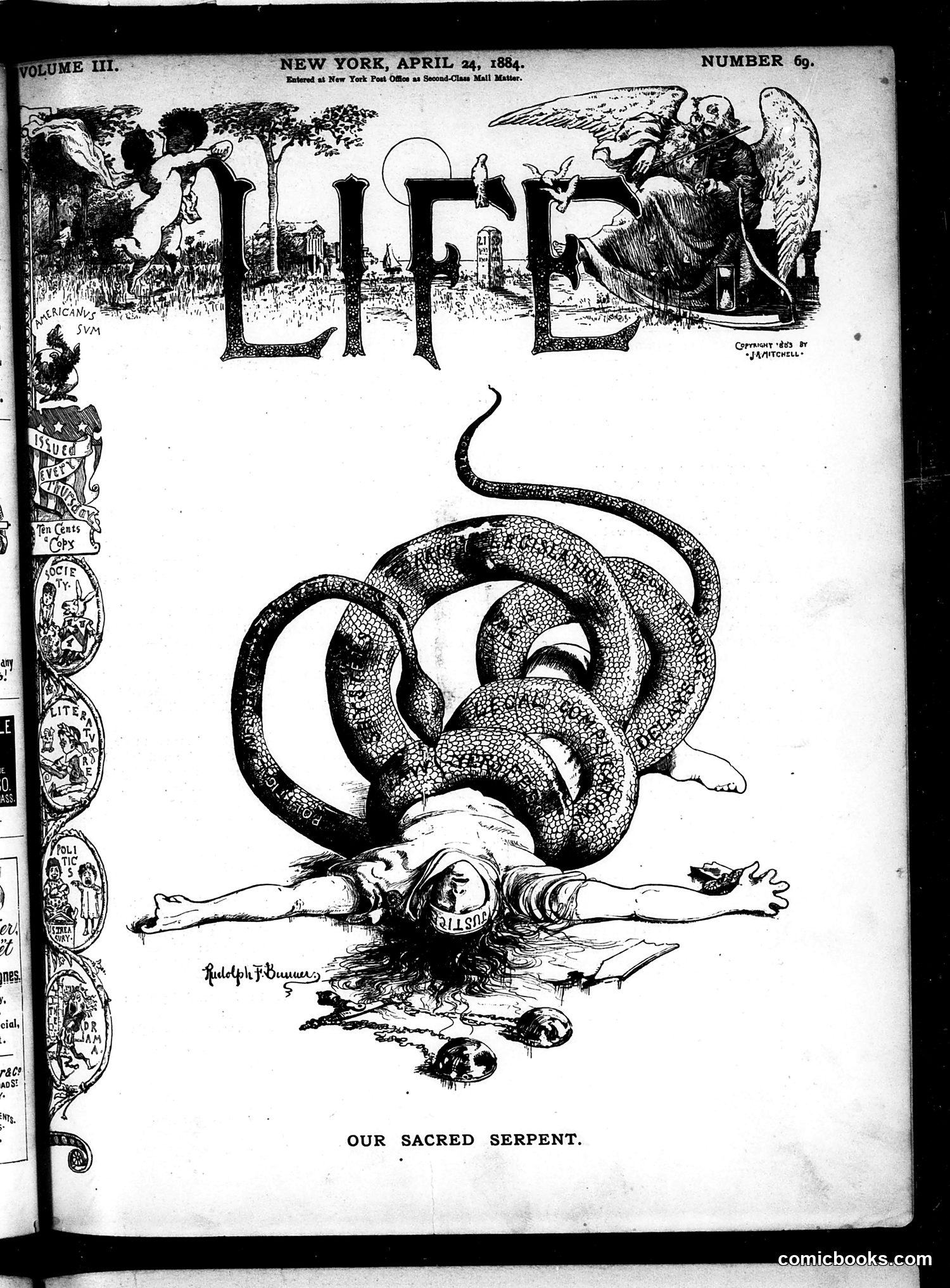
This satirical cartoon depicts a figure labeled "Blaine" being strangled or constricted by a large serpent. The image appears to reference James G. Blaine, the Republican presidential candidate in 1884, symbolizing political corruption or scandal consuming his campaign. The serpent represents what Life viewed as the corrupting force in American politics—likely referencing the "Mulligan Letters" scandal that dogged Blaine's career, revealing questionable financial dealings with railroad interests. The prone, helpless position of the figure emphasizes Life's critique that corruption was fatal to his political viability. The title's sarcastic use of "sacred" mocks those who defended Blaine despite these allegations, suggesting his supporters treated his candidacy as unquestionable despite evident wrongdoing.
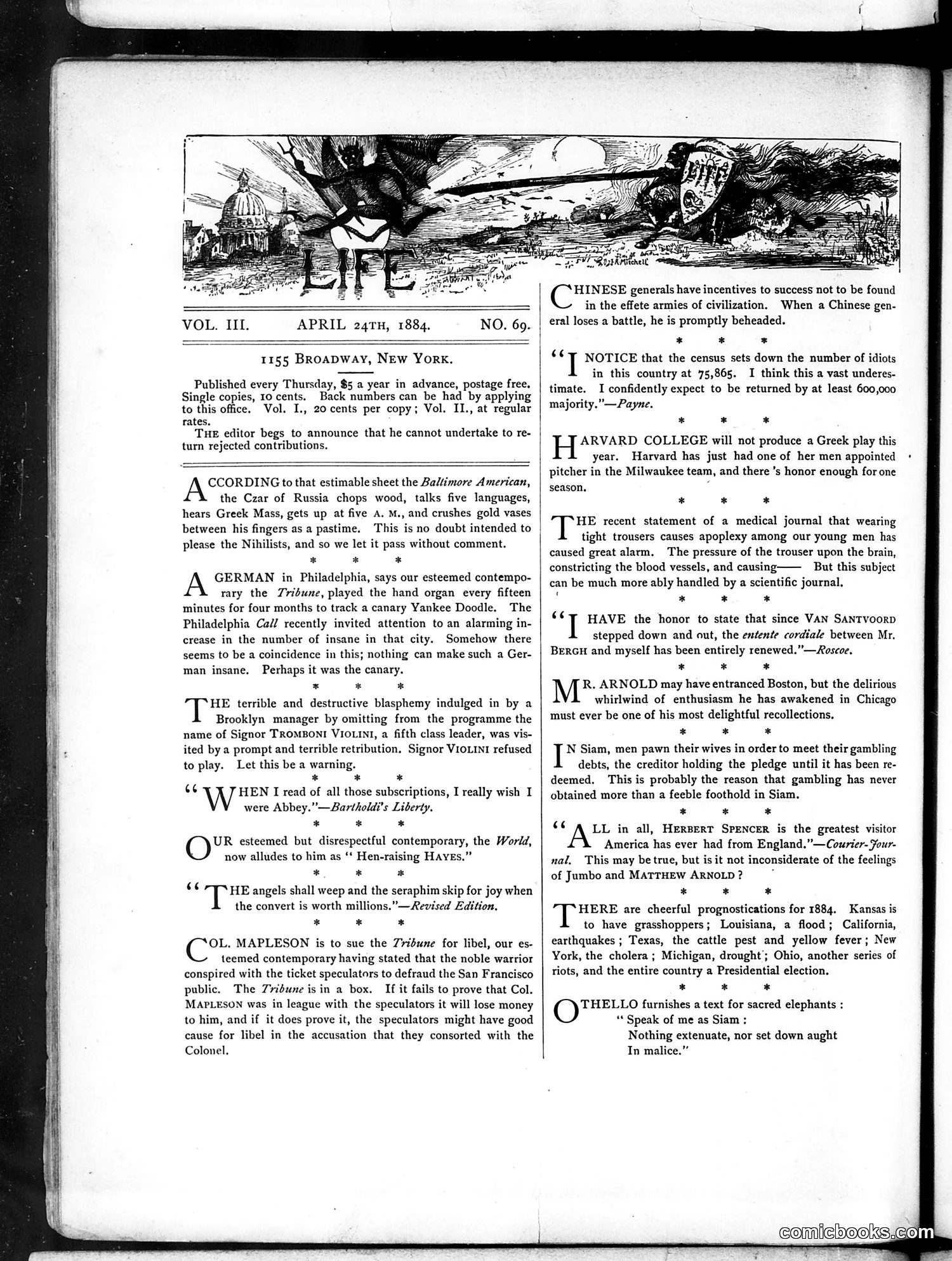
The page contains satirical commentary rather than traditional political cartoons. The header illustration depicts a pastoral scene with "LIFE" text. The content includes brief satirical observations on contemporary issues: - **Chinese generals**: Commentary on military ineffectiveness - **Census statistics**: Criticism of census underestimating idiots (mocking public intelligence) - **Harvard College**: Note about canceling a Greek play due to pitcher appointment - **Medical fashion**: Satire about tight trousers causing health concerns among young men - **Col. Mapelson libel case**: Extended commentary on a Tribune dispute with a theater manager, suggesting potential libel consequences The pieces use contemporary references (Van Santvoord, Herbert Spencer, Kansas grasshoppers) to mock social pretensions, pseudoscience, and institutional absurdities of 1880s America. The tone is witty, brief, and aimed at educated readers familiar with current events.
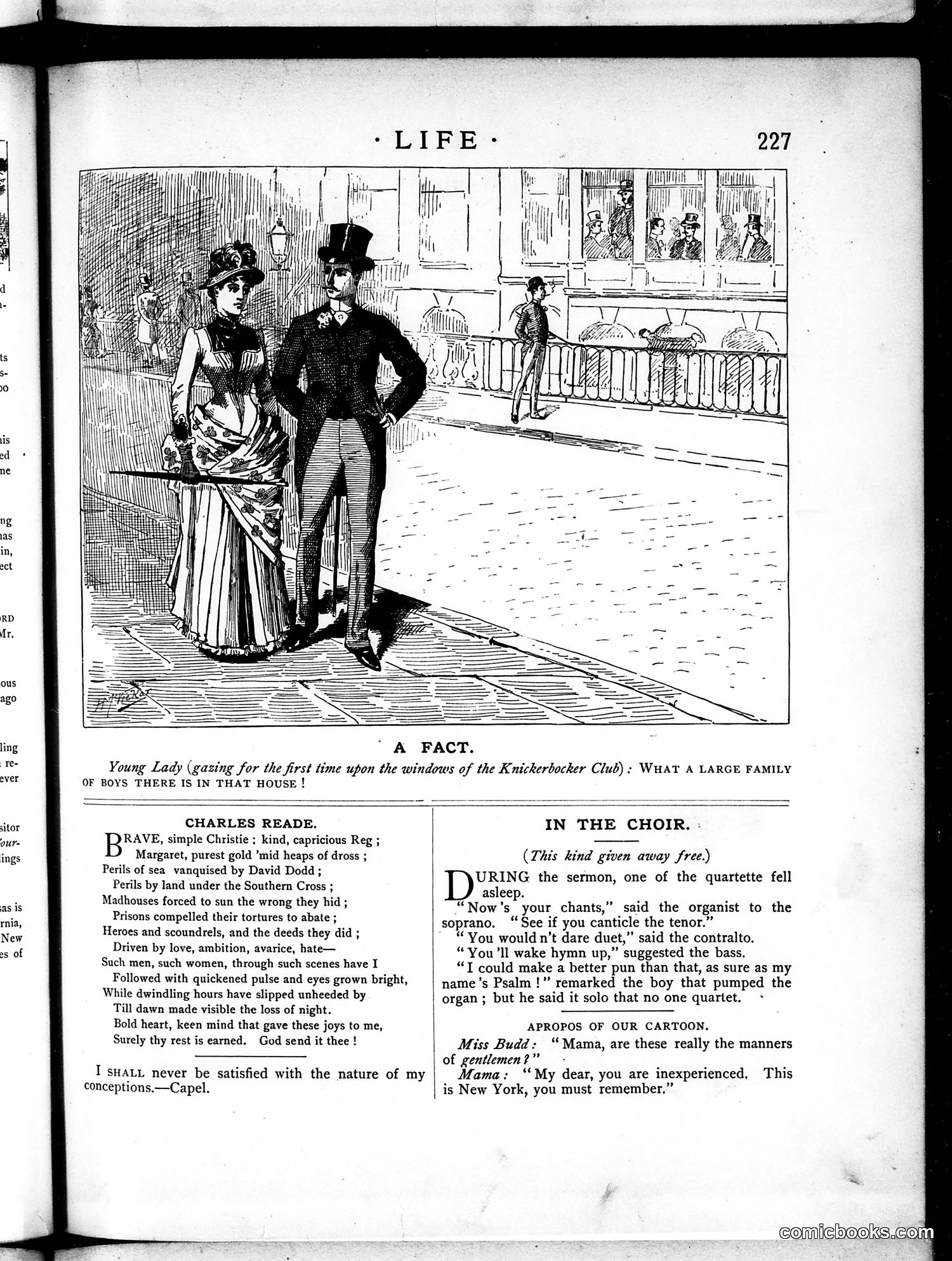
This cartoon satirizes the Knickerbocker Club, an exclusive New York gentlemen's club. The joke shows a young woman looking at the club's windows for the first time, remarking on "what a large family of boys" resides there—implying the club houses numerous men. The humor lies in treating the all-male club membership as though it were a household "family," mocking both the club's insularity and the woman's feigned innocence (or genuine naïveté) about its purpose as a bachelor institution. The accompanying text includes unrelated poem "Charles Reade" and humor pieces about choir singing and New York manners, typical of Life's miscellaneous satirical content from this era (appears to be late 19th century).
This page contains **no political cartoons**. Instead, it features: 1. **"Pater's Divine Dialogue"** — A satirical dialogue between a Professor and Daughter (18) mocking Matthew Arnold, a prominent 19th-century literary figure. The dialogue ridicules Arnold's American lecture tour as a financial failure and his pretentious intellectualism. The daughter sarcastically notes his "great thoughts" don't translate to popular success, while the Professor defends Arnold's cultural contributions despite his lack of commercial appeal. 2. **Poetry and miscellaneous pieces** including "A Tale" (humorous verse about a lawyer) and "Mutation" (romantic poetry by John Moran). The satire targets Arnold's gap between intellectual prestige and actual influence—a common theme in Life's literary criticism.
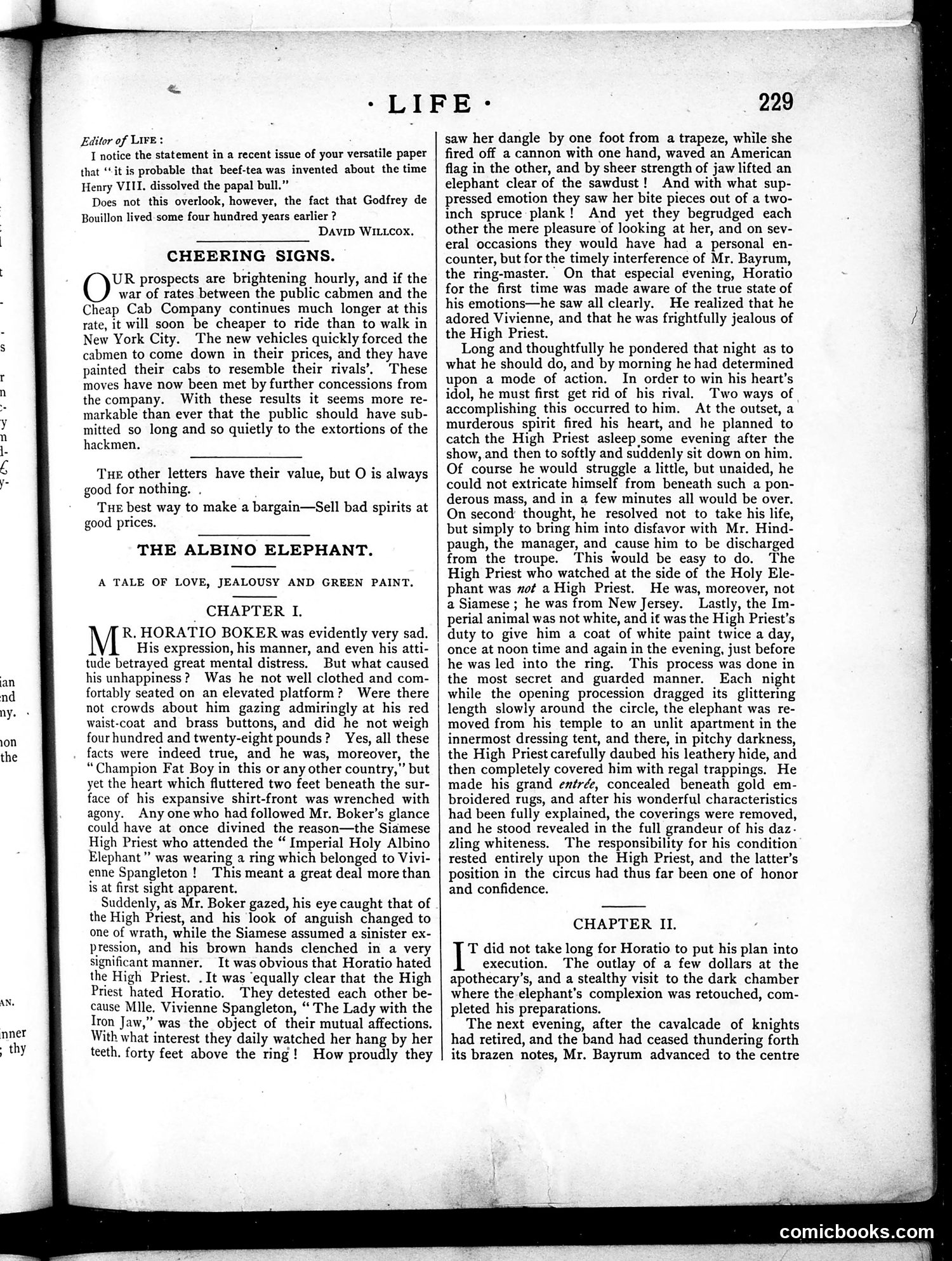
This page contains no political cartoons. Instead, it features: 1. **"Editor of Life" section**: A brief letter from reader David Willcox questioning a statement about beef-tea invention during Henry VIII's reign, followed by editorial notes on cab companies and streetcar pricing. 2. **"The Albino Elephant"**: A serialized story beginning with Chapter I, featuring Mr. Horatio Boker, a circus manager, and a valuable white elephant named Vivienne. The narrative involves romantic jealousy between Boker and a High Priest over Vivienne, with themes of betrayal and animal care. This page is primarily literary content—correspondence and fiction—rather than satirical commentary or political cartooning.
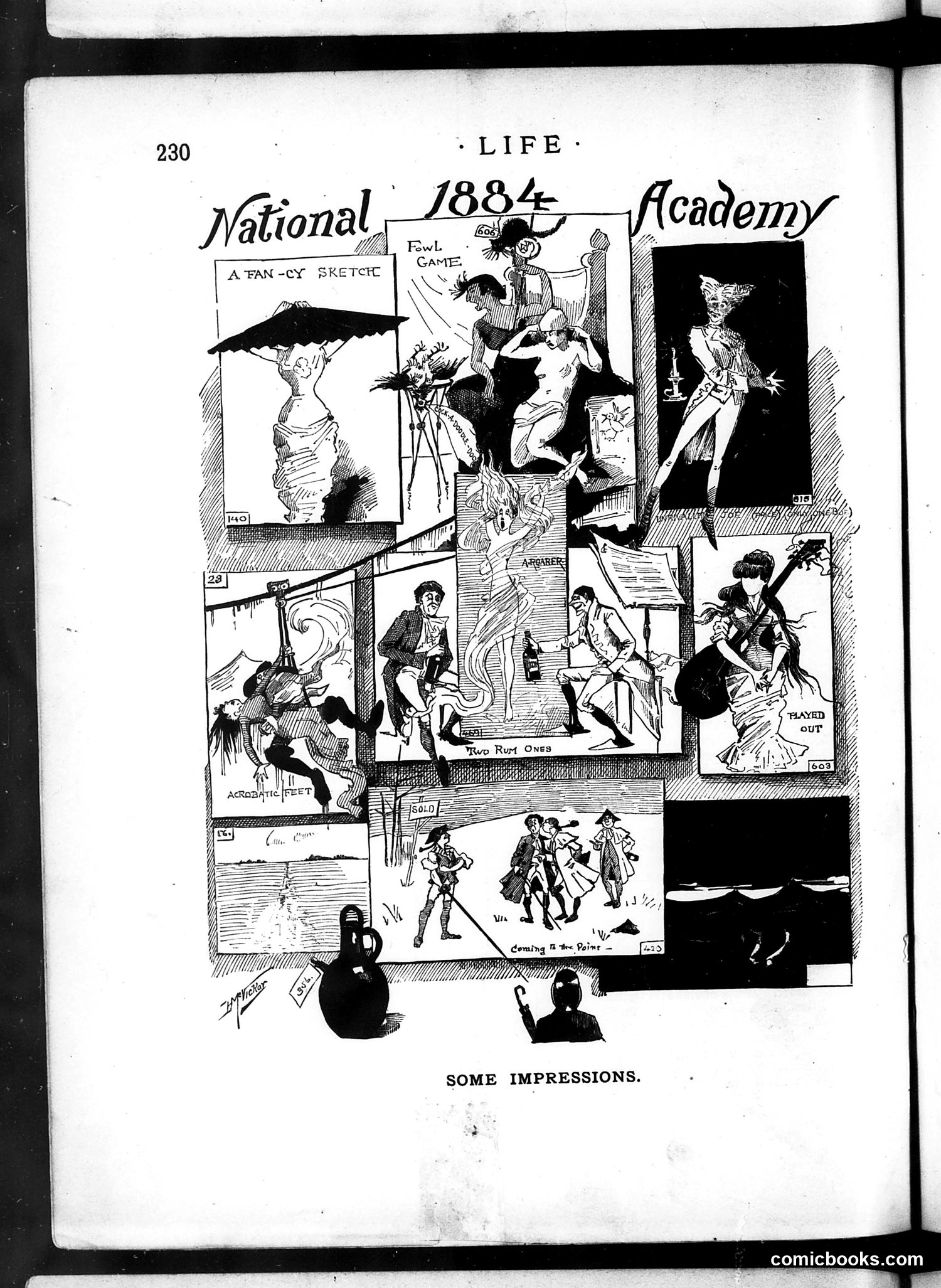
This satirical page depicts scenes from the 1884 National Academy (likely an art academy exhibition). The title "Some Impressions" suggests commentary on contemporary art movements, particularly Impressionism, which was controversial among academic traditionalists at this time. The various vignettes show figures engaged in artistic pursuits—painting, sculpture, music, and performance. The chaotic, layered composition itself parodies the "impressionist" style being mocked. The scenes appear to ridicule both the pretensions of academic art instruction and the eccentric behavior of artists and patrons. The silhouetted figures at the bottom, possibly viewers or critics observing these scenes, emphasize the satirical perspective. The overall effect mocks the artistic establishment's resistance to modern artistic movements while depicting the Academy as a somewhat absurd, chaotic institution.
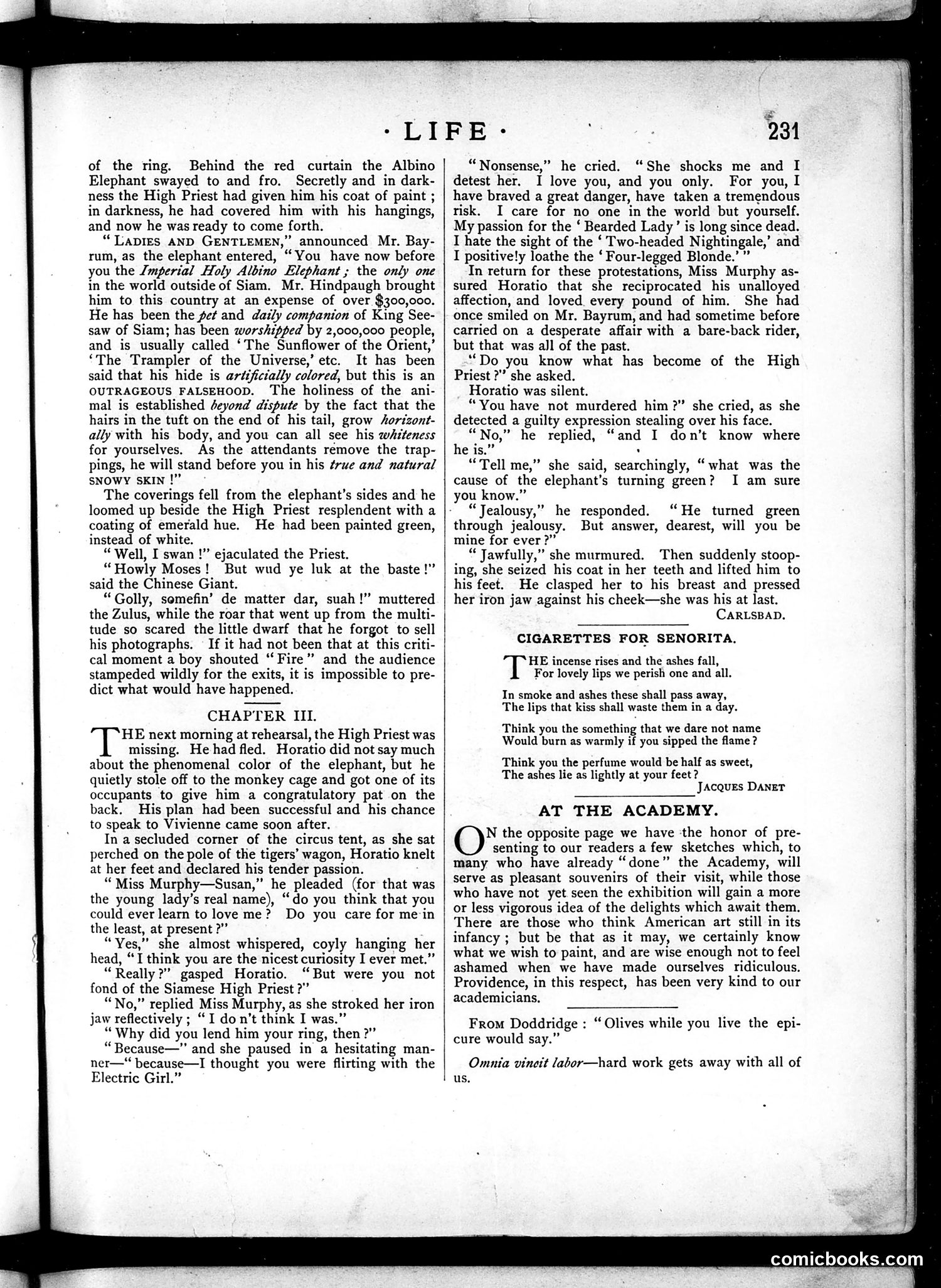
This page contains two distinct sections: **Main Content**: A serialized story ("Chapter III") about a circus performance featuring a High Priest character and an elephant that has been painted green. The narrative involves romantic tension between characters named Horatio and Miss Murphy regarding the elephant's unusual coloring. This appears to be fiction rather than satire. **"Cigarettes for Senorita"**: A short poem by Jacques Danet about cigarette smoke and lips, followed by a section titled "At the Academy" discussing American art and artists, with brief quotes including one from Doddridge ("Olives while you live the epicure would say"). The page lacks evident political satire or social commentary. It reads primarily as entertainment content—serialized fiction and light literary pieces—typical of Life magazine's mixed editorial approach during this era.
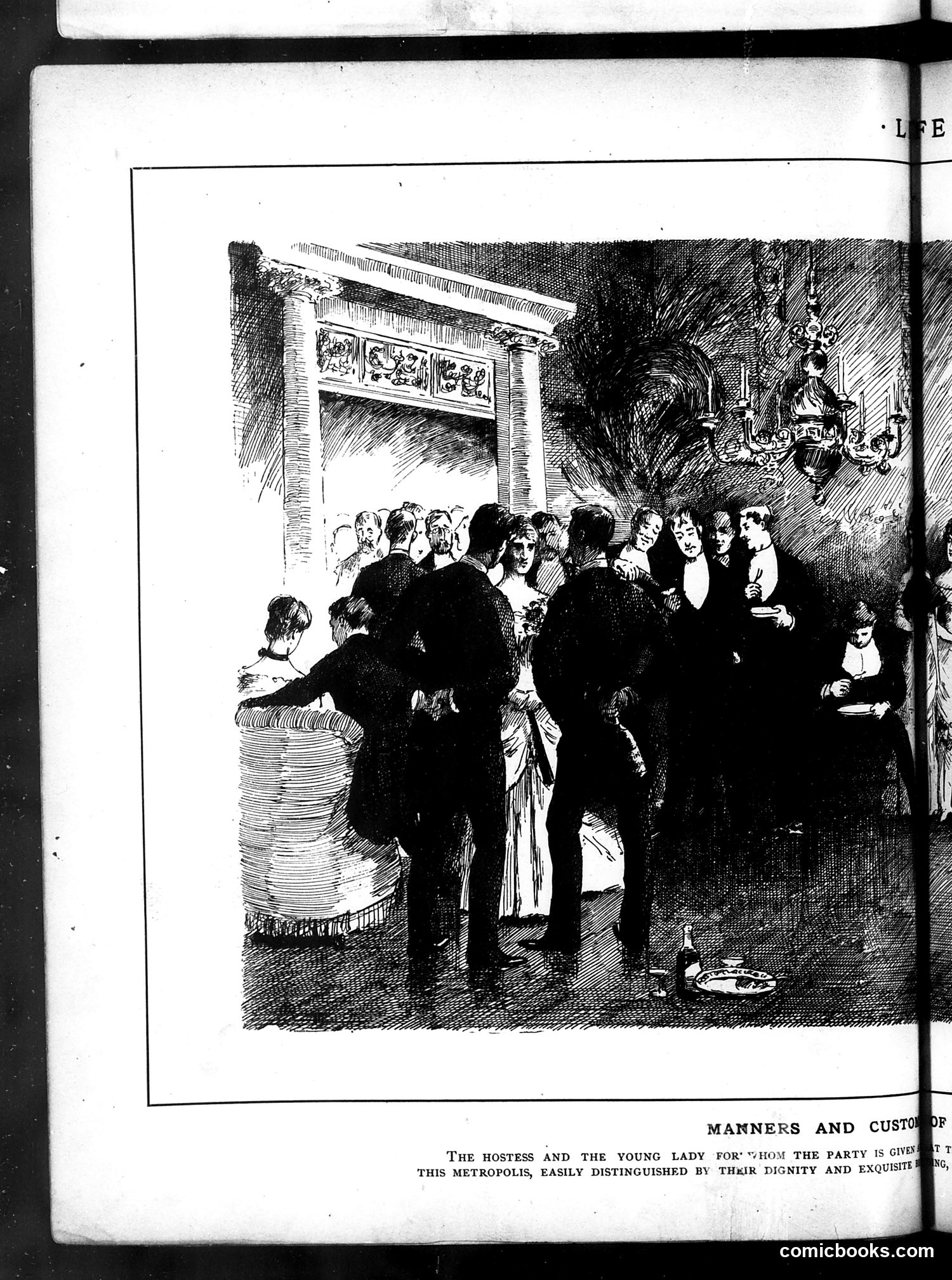
This engraving illustrates a scene titled "The Hostess and the Young Lady" from a section on "Manners and Custom." The caption indicates the hostess and a young woman are "easily distinguished by their dignity and exquisite" behavior at what appears to be a formal social gathering. The image depicts a crowded indoor reception or salon, with formally dressed figures in 19th-century attire. The satirical point seems to concern social class distinctions—specifically, how wealthy or well-bred hosts and guests could be identified by their comportment and bearing, even in crowded settings. This reflects *Life* magazine's frequent commentary on American social pretensions and the performative nature of upper-class etiquette during the Gilded Age. The satire likely mocks the exaggerated importance placed on such visible markers of "refinement."
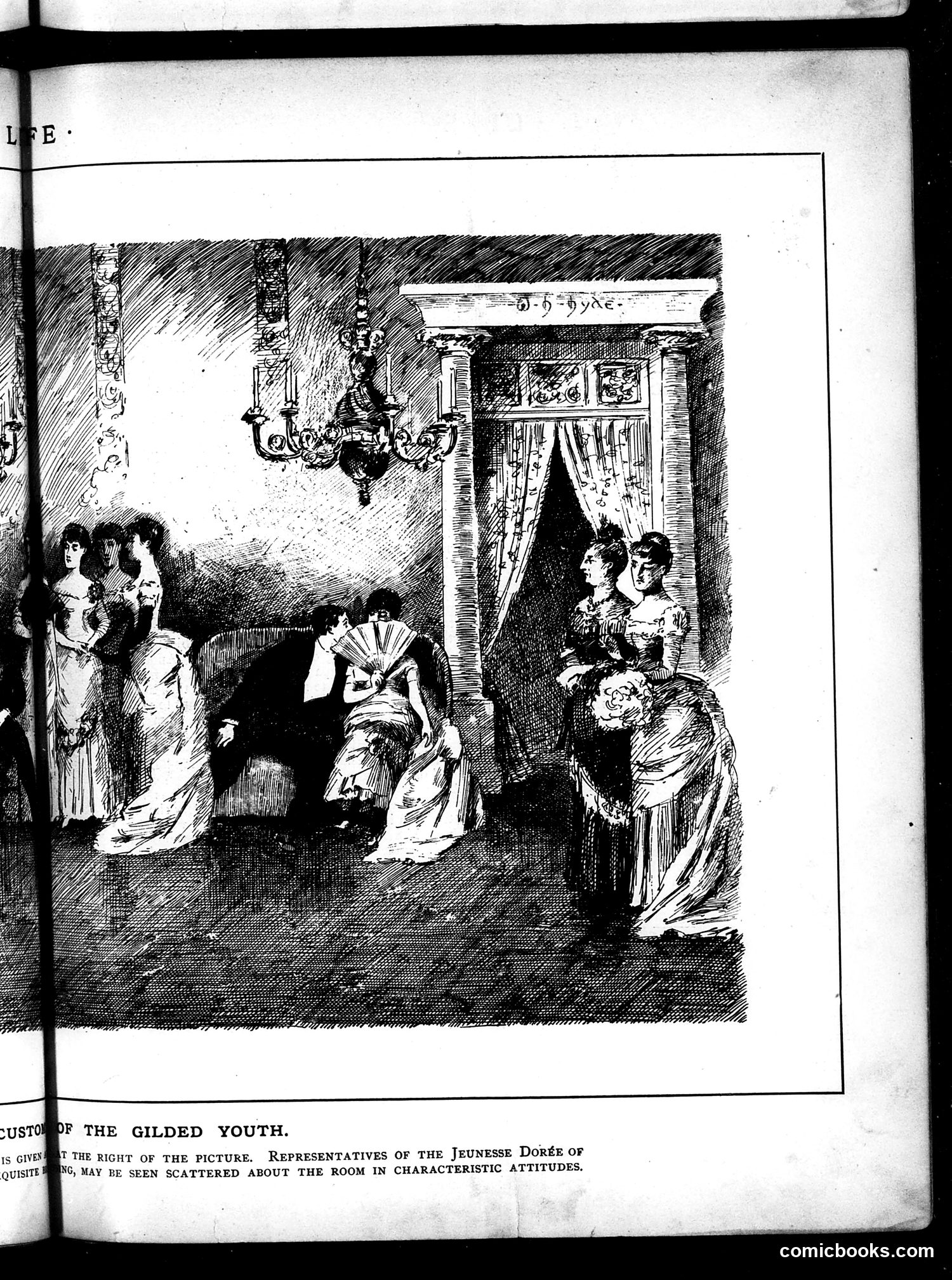
This illustration, titled "Custom of the Gilded Youth," depicts members of the *Jeunesse Dorée* (literally "gilded youth")—a French term for wealthy, fashionable young aristocrats or upper-class socialites. The caption indicates these figures are shown "scattered about the room in characteristic attitudes," suggesting the satire mocks their affected poses and mannerisms. The scene shows an elegant interior with a chandelier and doorway, populated by elegantly dressed women in evening gowns and men in formal wear. The satire appears to ridicule the pretentious, idle behavior and exaggerated refinement of this wealthy social class, portraying them as superficial and self-absorbed. The engraving style suggests this is 19th-century social commentary on class and fashion.
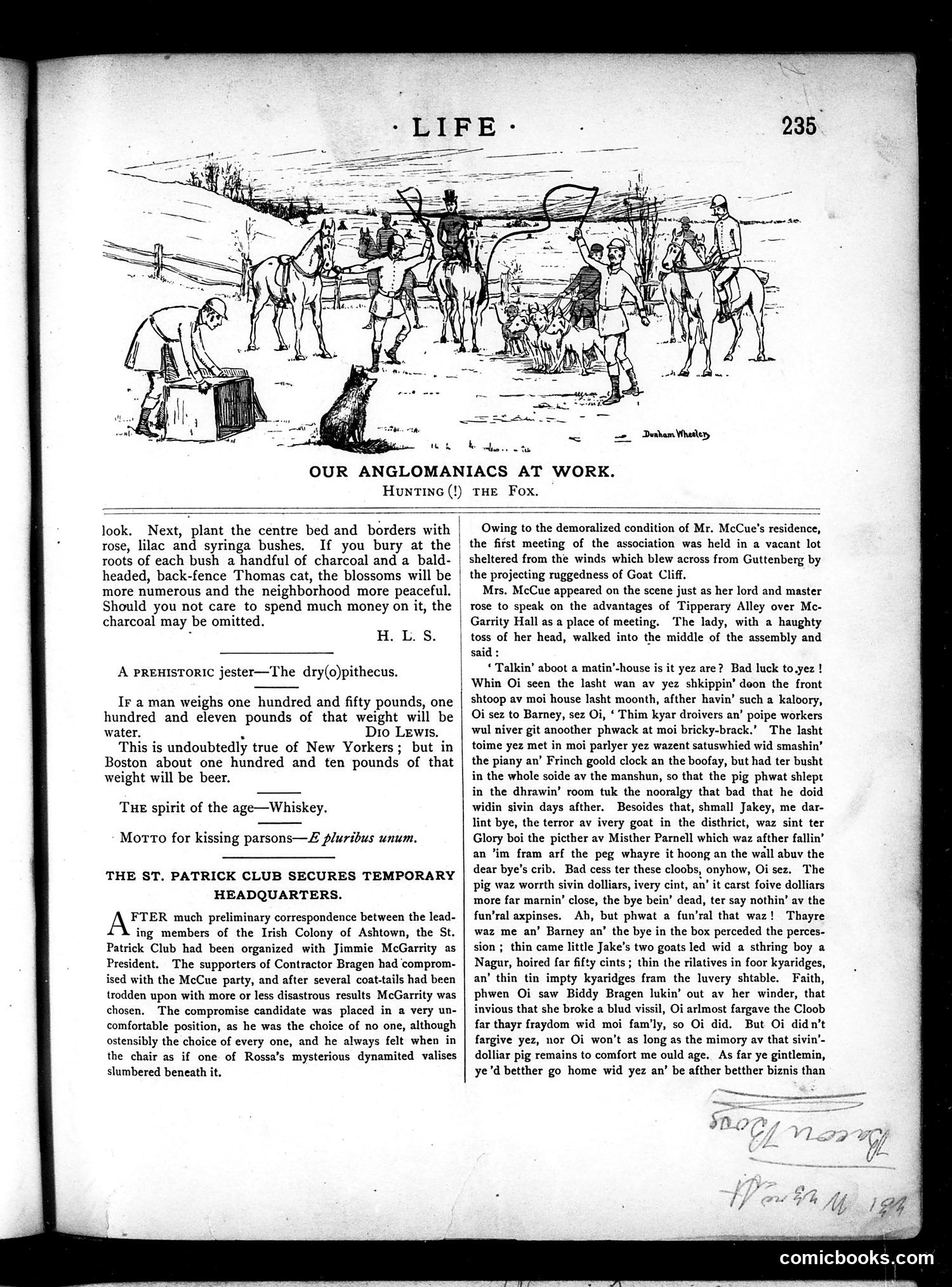
This page satirizes Irish-American social climbing and pretentiousness through two pieces: **The main cartoon** ("Our Anglomaniacs at Work: Hunting (!) the Fox") mocks wealthy Americans imitating British fox-hunting traditions. The exclamation mark suggests the artificiality—these are not authentic hunters but status-conscious "anglomaniacs" (Anglophiles) adopting European aristocratic leisure activities. **The story below** describes an Irish-American social club (St. Patrick Club) meeting disrupted by Mrs. McCue, who angrily recounts how club members damaged her home during previous gatherings. Her thick Irish dialect and complaint about the pig's death (caused by a falling Parnell portrait) creates darkly comic contrast: she's protective of her property and dignity despite humble circumstances, while the club members carelessly destroy what little she has while seeking respectability. The satire targets both working-class Irish aspirations toward middle-class respectability and the chaos that results from their attempts at formal organization.
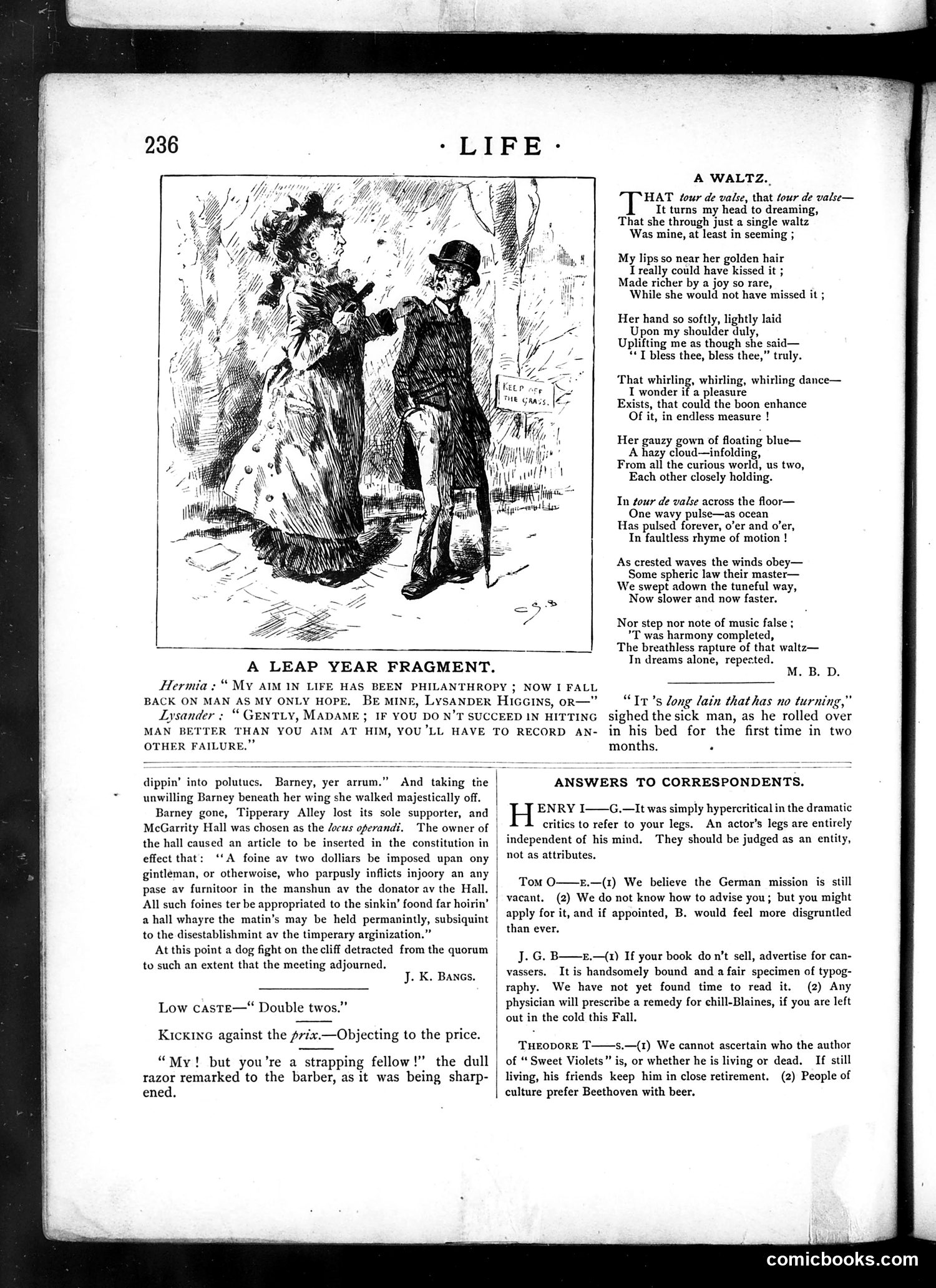
This page contains two romantic/comedic pieces. The main illustration shows a couple waltzing—a sentimental poem about the pleasure of dancing with a woman, emphasizing the closeness and harmony of the moment. It's romantic Victorian-era verse celebrating the waltz as an intimate social dance. Below is "A Leap Year Fragment," a comic dialogue referencing the custom (appearing periodically) that women could propose to men during leap years. Here, a philanthropic woman named Hermia attempts to propose to Lysander Higgins, but her aggressive approach at "hitting" her target is humorously compared to her general lack of success. The joke plays on the awkwardness of role-reversal courtship. The page also includes reader responses and humorous mock-advice addressing queries about acting, German diplomacy, book publishing, and musical taste—typical of *Life* magazine's satirical "Answers to Correspondents" feature mocking contemporary concerns.
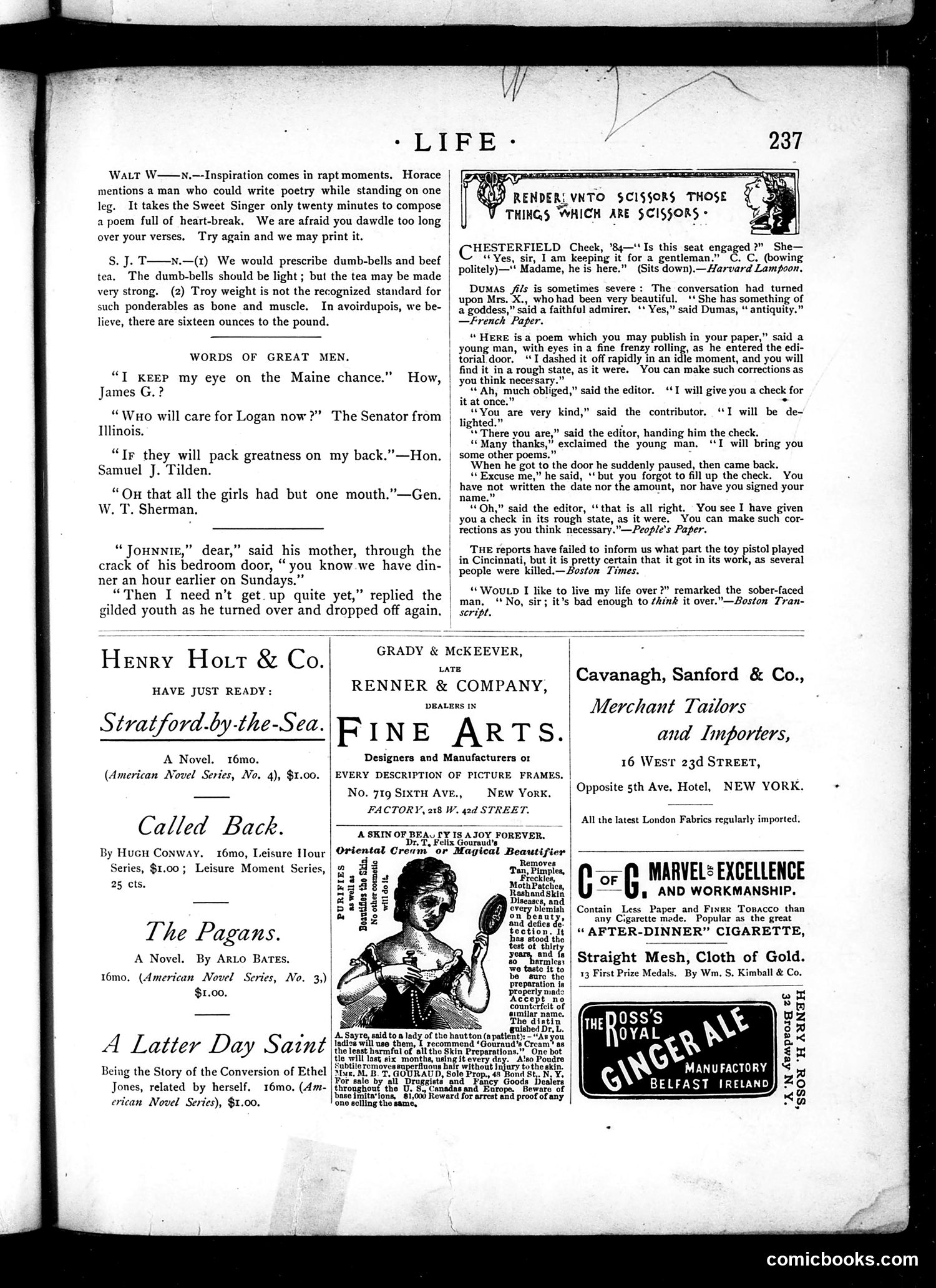
This page is primarily **advertising and miscellaneous editorial content** rather than political cartoons. The small cartoon at top shows a **scissors pun**: "Render unto scissors those things which are scissors"—a mock-biblical joke playing on the phrase "render unto Caesar." The page includes: - **Reader advice column** with humorous tips (dumb-bells for health, etc.) - **"Words of Great Men"** section quoting political figures like James G. Blaine ("Maine chance"), suggesting their statements are either clichéd or self-serving - A joke about a "gilded youth" avoiding Sunday dinner - **Book advertisements** (novels by Hugh Conway, Arlo Bates) - **Product ads** for cosmetics and ginger ale The editorial humor targets **lazy poets, social pretension, and editorial gullibility** (the final anecdote about a poet receiving a blank check). Overall, this is a typical Life magazine page mixing light satire with commercial content.
This is primarily a **page of advertisements** for the 1883 Life magazine, with minimal visual content—mostly text-based classified ads for various businesses and products (clothing, candy, corsets, furniture, wallpaper, hotels). The page includes brief **satirical anecdotes** in the center—short humorous observations typical of Life's style. One jokes about a man drinking kerosene instead of whiskey; another mocks a minister whose loud voice prevents congregants from gossiping during sermons. These are gentle, everyday jokes about human foolishness rather than political commentary. Without visible original cartoons or illustrations on this particular page, the satire operates purely through witty written observations about social behavior and human nature—the magazine's standard formula for a middle-class audience.
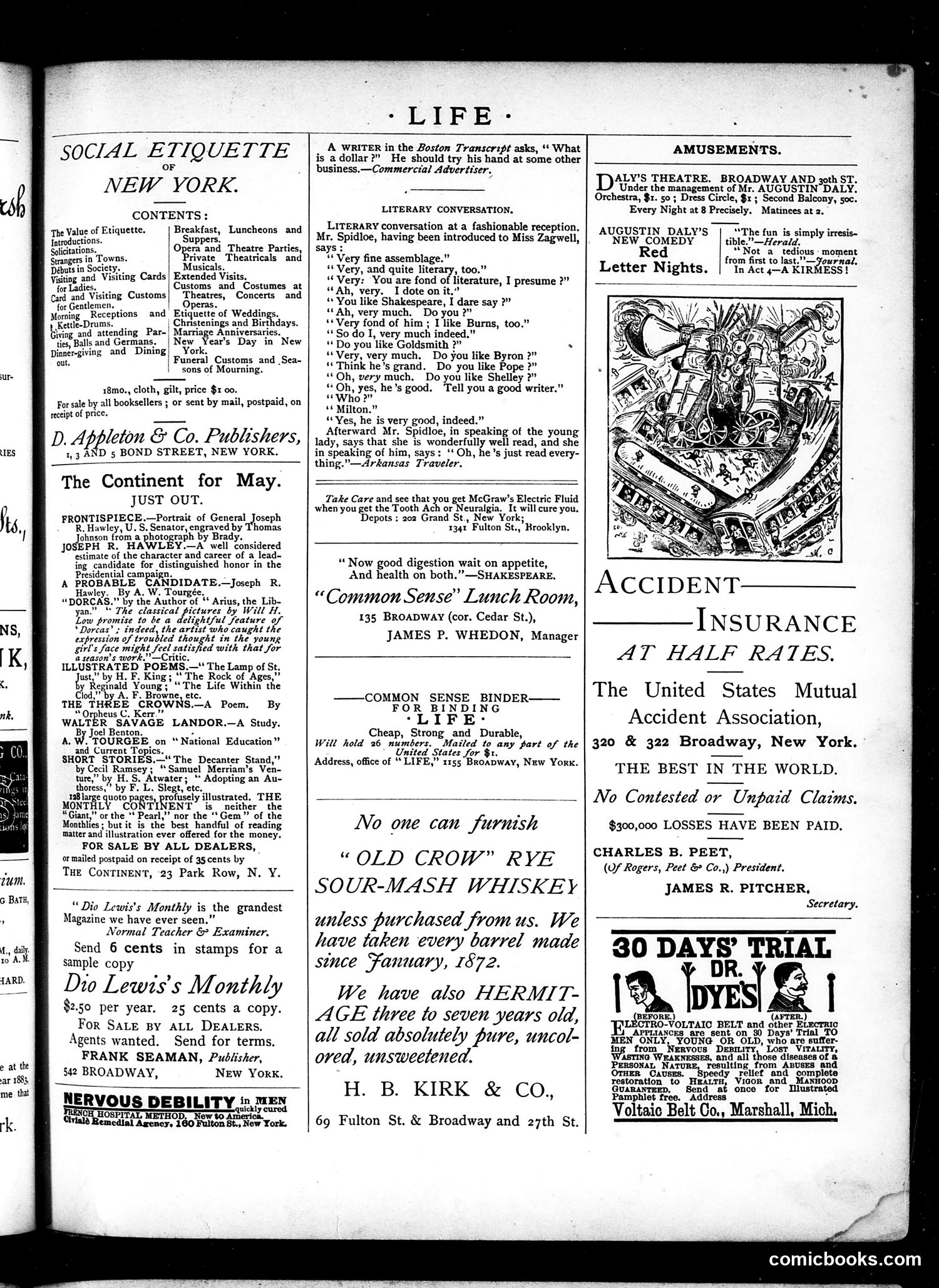
This page is primarily **advertising and announcements** rather than satirical political cartoons. The main visual element is an illustration advertising Daly's Theatre production of "Red Letter Nights." The page includes a satirical **"Literary Conversation"** piece (a common format in Life magazine) that mocks pretentious dinner-party small talk. When a fashionable guest named Mr. Spidioe meets Miss Zagwell, they engage in vapid name-dropping about famous authors—Shakespeare, Burns, Goldsmith, Byron, Pope, Shelley. Their exchange is deliberately superficial; each agrees enthusiastically with whatever the other mentions. The punchline reveals Spidioe later claims Miss Zagwell is "wonderfully well read" when actually she's "just read everything"—satirizing people who appear cultured through mere memorization rather than genuine understanding. The remainder consists of book advertisements, theatre announcements, and product endorsements typical of the era's Life magazine format.
This is primarily an **advertising page** from an American satirical magazine, likely from the 1880s based on references (Centennial 1876, Montreal awards 1881-82). The only cartoon visible depicts two figures in a comedic dispute about **silverware/housewares**. One says "I will never buy any but HARTSHORNE'S ROLLERS" while the other counters "And I will never sell any but HARTSHORNS!" This appears to be a humorous advertisement playing on consumer brand loyalty—the joke being that both merchant and customer are stubbornly committed to the same brand, creating an absurd standoff rather than a transaction. The remainder of the page consists of patent medicine and consumer goods advertisements typical of the era: Crosby's Phosphites (marketed as brain food), Cuticura remedies (for skin conditions), Marvin's safes, and various jewelry and silverware offerings. These reflect 19th-century advertising conventions mixing pseudo-scientific health claims with luxury goods. The cartoon's humor relies on exaggerated brand devotion—a satire of consumer culture emerging in the industrial era.