
Life, 1884-04-24 · page 4 of 16
Life — April 24, 1884 — page 4: what you’re looking at
What you’re looking at
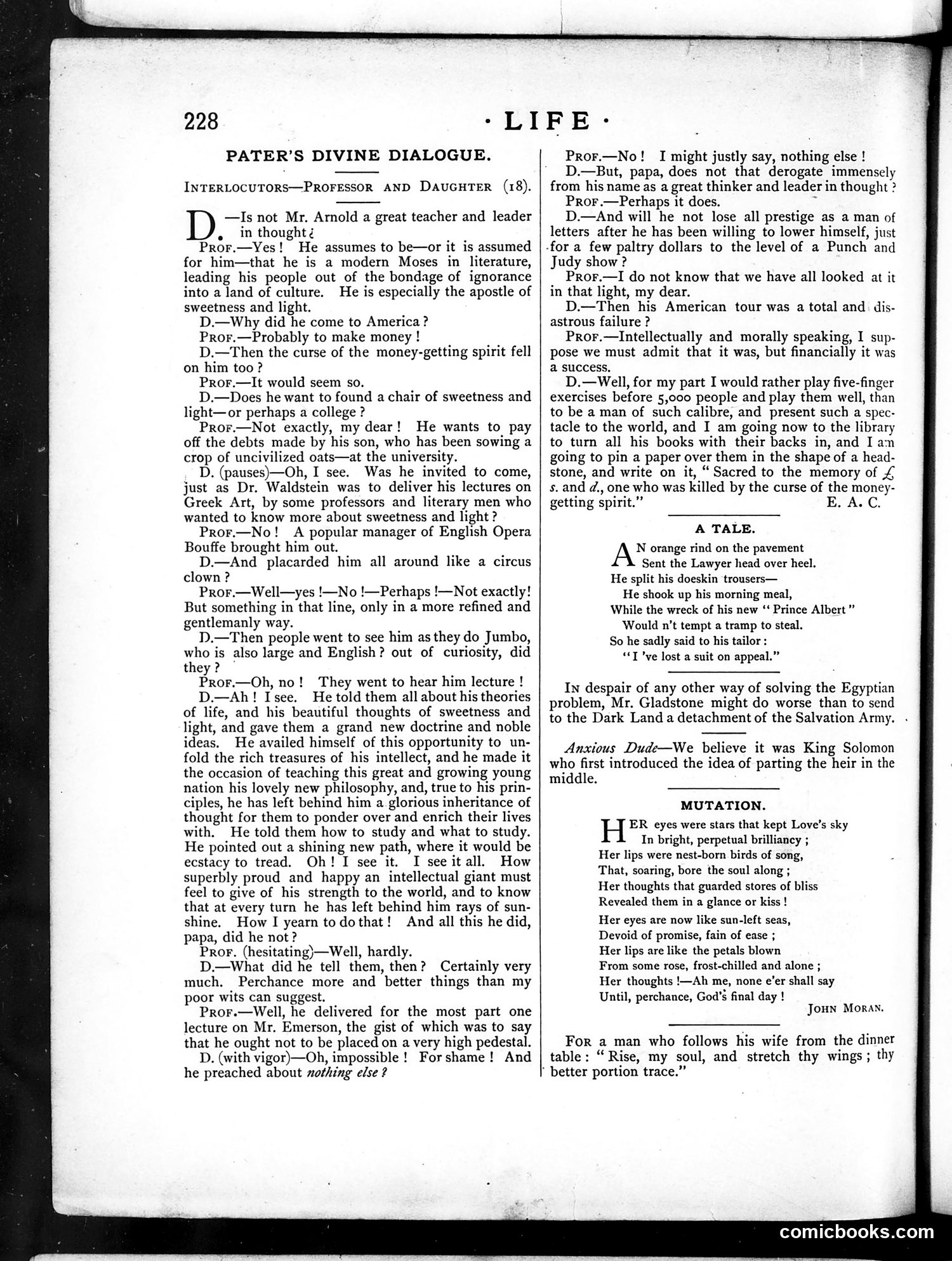
This page contains **no political cartoons**. Instead, it features: 1. **"Pater's Divine Dialogue"** — A satirical dialogue between a Professor and Daughter (18) mocking Matthew Arnold, a prominent 19th-century literary figure. The dialogue ridicules Arnold's American lecture tour as a financial failure and his pretentious intellectualism. The daughter sarcastically notes his "great thoughts" don't translate to popular success, while the Professor defends Arnold's cultural contributions despite his lack of commercial appeal. 2. **Poetry and miscellaneous pieces** including "A Tale" (humorous verse about a lawyer) and "Mutation" (romantic poetry by John Moran). The satire targets Arnold's gap between intellectual prestige and actual influence—a common theme in Life's literary criticism.
📄 Transcribed text from this page (OCR, searchable)
Machine-transcribed from the original scan — historical spelling and the odd misread are preserved.
228 PATER’S DIVINE DIALOGUE. INTERLOCUTORS—PROFESSOR AND DAUGHTER (18). D. in thought é Pror.—Yes! He assumes to be—or it is assumed for him—that he is a modern Moses in literature, leading his people out of the bondage of ignorance into a land of culture. He is especially the apostle of sweetness and light. D.—Why did he come to America ? Pror.—Probably to make money ! D.—Then the curse of the money-getting spirit fell on him too ? Pror.—It would seem so. D.—Does he want to found a chair of sweetness and light—or perhaps a college ? Pror.—Not exactly, my dear! He wants to pay off the debts made by his son, who has been sowing a crop of uncivilized oats—at the university. D. (pauses)—Oh, I see. Was he invited to come, just as Dr. Waldstein was to deliver his lectures on Greek Art, by some professors and literary men who wanted to know more about sweetness and light ? Pror.—No! A popular manager of English Opera Bouffe brought him out. D.—And placarded him all around like a circus clown? Pror.—Well—yes !—No !—Perhaps !—Not exactly! But something in that line, only in a more refined and gentlemanly way. D.—Then people went to see him as they do Jumbo, who is also large and English? out of curiosity, did they ? Pror.—Oh, no! They went to hear him lecture ! D.—Ah! Isee. He told them all about his theories of life, and his beautiful thoughts of sweetness and light, and gave them a grand new doctrine and noble ideas. He availed himself of this opportunity to un- fold the rich treasures of his intellect, and he made it the occasion of teaching this great and growing young nation his lovely new philosophy, and, true to his prin- ciples, he has left behind him a glorious inheritance of thought for them to ponder over and enrich their lives with. He told them how to study and what to study. He pointed out a shining new path, where it would be ecstacy to tread. Oh! I see it. I see it all. How superbly proud and happy an intellectual giant must feel to give of his strength to the world, and to know that at every turn he has left behind him rays of sun- shine. How I yearn todothat! And all this he did, papa, did he not? Pror. (hesitating)—Well, hardly. D.—What did he tell them, then? Certainly very much. Perchance more and better things than my poor wits can suggest. Pror.—Well, he delivered for the most part one lecture on Mr. Emerson, the gist of which was to say that he ought not to be placed on a very high pedestal. D. (with vigor)—Oh, impossible! For shame! And he preached about nothing else ? —Is not Mr. Amold a great teacher and leader - LIFE: Pror.—No! I might justly say, nothing else ! D.—But, papa, does not that derogate immensely from his name as a great thinker and leader in thought ? Pror.—Perhaps it does. D.—And will he not lose all prestige as a man of letters after he has been willing to lower himself, just -for a few paltry dollars to the level of a Punch and Judy show? Pror.—I do not know that we have all looked at it in that light, my dear. D.—Then his American tour was a total and. dis- astrous failure ? Pror.—Intellectually and morally speaking, I sup- pose we must admit that it was, but financially it was a success. D.—Well, for my part I would rather play five-finger exercises before 5,000 people and play them well, than to be a man of such calibre, and present such a spec- tacle to the world, and I am going now to the library to turn all his books with their backs in, and I an going to pin a paper over them in the shape of a head- stone, and write on it, “ Sacred to the memory of £ s. and d,, one who was killed by the curse of the money- getting spirit.” E. A.C. A TALE. N orange rind on the pavement Sent the Lawyer head over heel. He split his doeskin trousers— He shook up his morning meal, While the wreck of his new ‘‘ Prince Albert” Would n’t tempt a tramp to steal. So he sadly said to his tailor : “*T ’ve lost a suit on appeal.” In despair of any other way of solving the Egyptian problem, Mr. Gladstone might do worse than to send to the Dark Land a detachment of the Salvation Army. - Anxious Dude—We believe it was King Solomon who first introduced the idea of parting the heir in the middle. MUTATION. ER eyes were stars that kept Love's sky In bright, perpetual brilliancy ; Her lips were nest-born birds of song, That, soaring, bore the soul along ; Her thoughts that guarded stores of bliss Revealed them in a glance or kiss ! Her eyes are now like sun-left seas, Devoid of promise, fain of ease ; Her lips are like the petals blown From some rose, frost-chilled and alone ; Her thoughts !—Ah me, none e’er shall say Until, perchance, God’s final day ! Joun Moran. For a man who follows his wife from the dinner table: “Rise, my soul, and stretch thy wings; thy ! better portion trace.” comicbooks.com