
A complete issue · 16 pages · 1884
Life — March 27, 1884
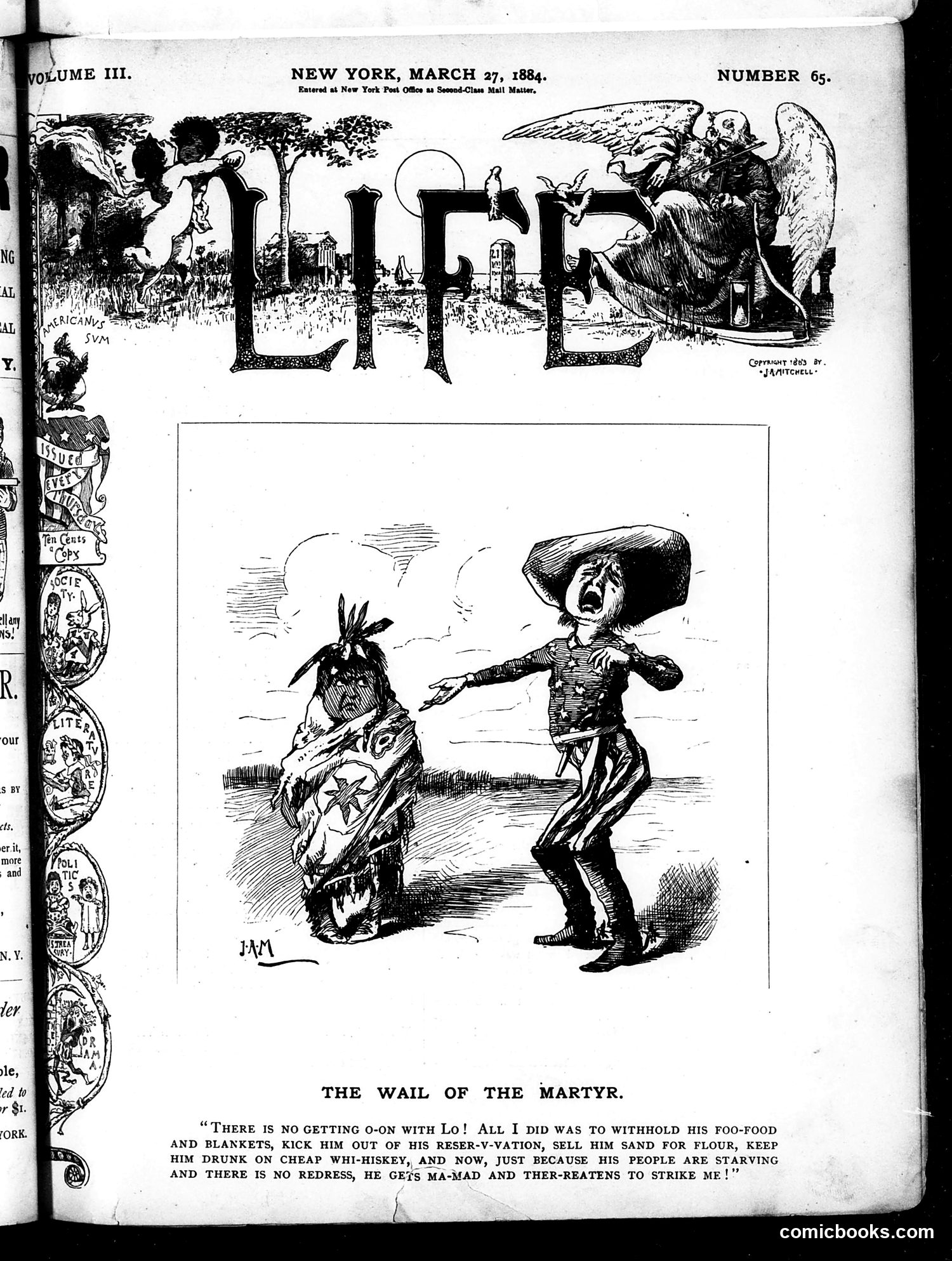
This cartoon depicts a conflict over Native American treatment and food rations. A figure (appearing to be a Native American man with feathered headdress) complains to a uniformed official about withholding food, selling sand mixed with flour for rations, and providing cheap whiskey instead of proper provisions. The Native American claims his people are starving and suffering, demanding redress. The satire critiques corruption in U.S. Indian reservation management—specifically the exploitation and underfunding of Native American communities through fraudulent ration distribution and forced alcohol provision. The "martyr" label sarcastically frames the Native American's suffering as self-inflicted or exaggerated, reflecting the dismissive attitudes toward indigenous grievances common in 1880s American journalism.
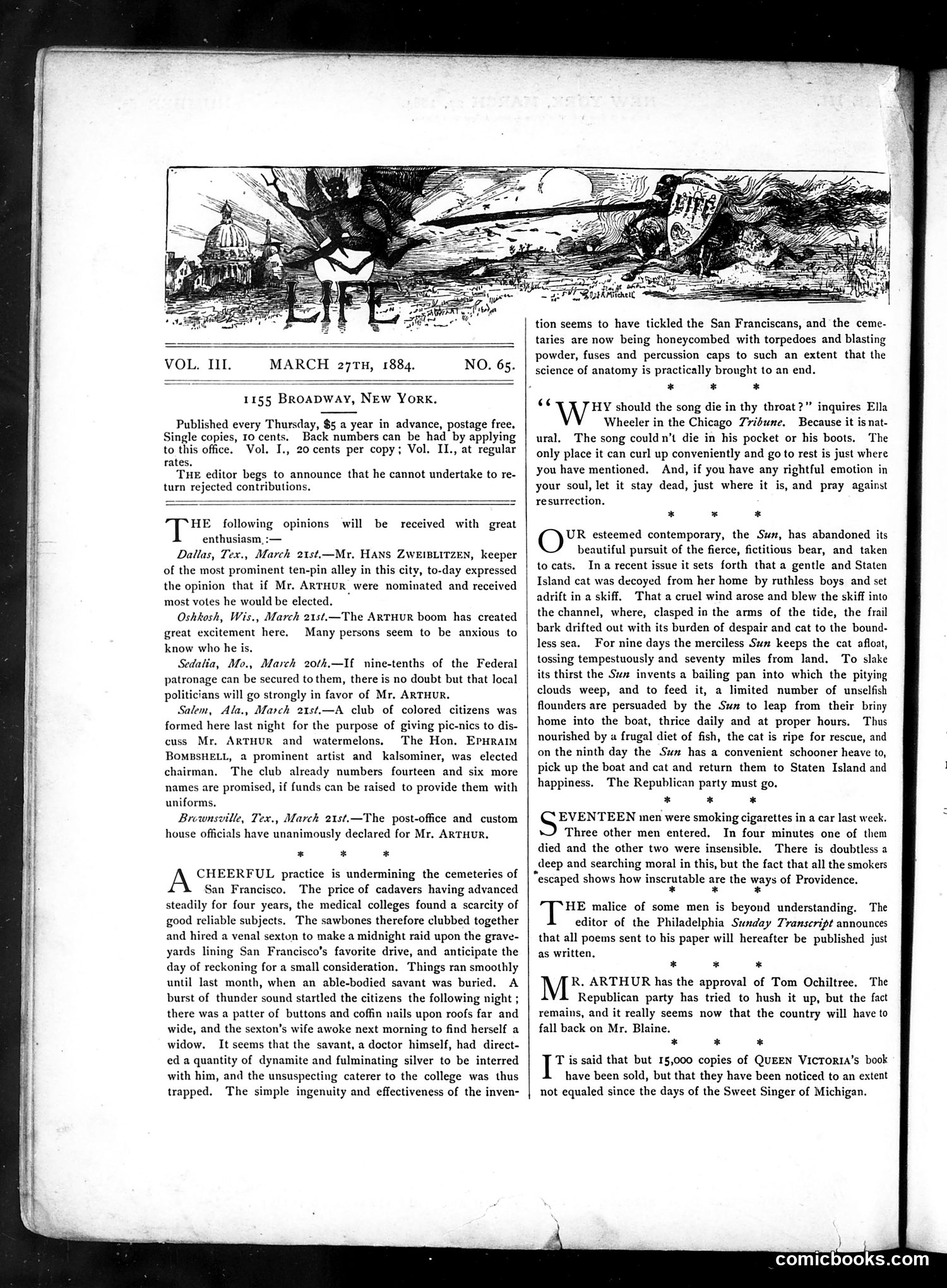
The masthead illustration depicts "LIFE" as a classical female figure seated amid classical ruins and landscape, establishing the magazine's identity as a satirical commentary publication. The text page contains multiple brief satirical items about contemporary figures and events. Key references include: - **Mr. Arthur**: appears to be a political figure receiving both praise and criticism regarding patronage and party politics - **Mr. Blaine**: mentioned in connection with Republican party leadership concerns - **Queen Victoria's book**: a contemporary bestseller referenced for comparison The satire focuses on political appointments, party loyalty, and social absurdities of the era. Without clearer identification of specific 1884 political contexts in the visible text, precise figure identification is uncertain, though "Arthur" likely refers to President Chester Arthur, who served 1881-1885.
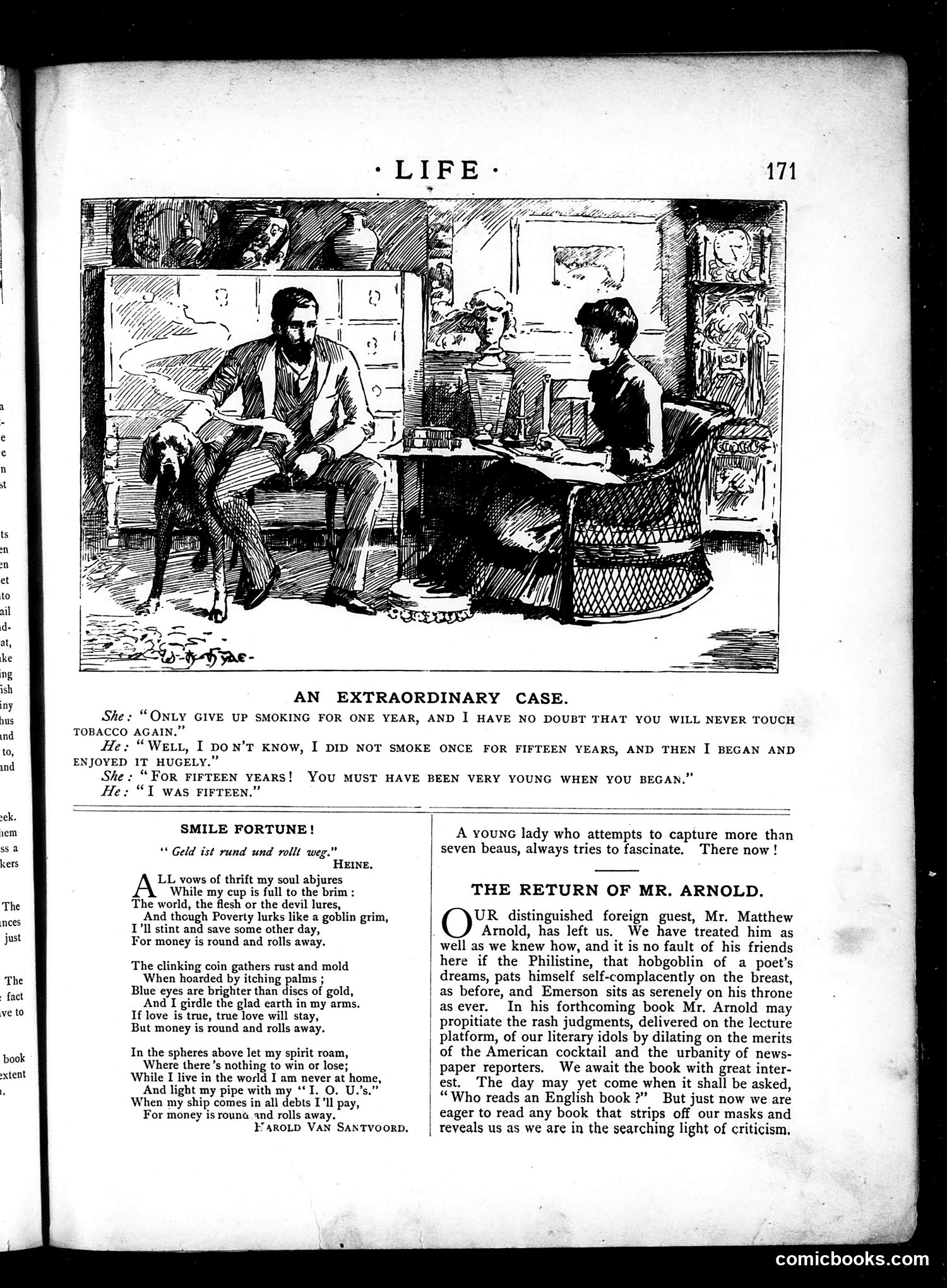
**The Cartoon "An Extraordinary Case"** depicts a domestic scene where a man with a dog sits opposite a woman at a desk, apparently during a serious conversation. The dialogue reveals the joke: she demands he quit smoking for one year, promising he'll never touch tobacco again. His response—that he didn't smoke for fifteen years, then started at age fifteen and enjoyed it—undermines her ultimatum with absurdist logic. The satire targets naive moral persuasion and the futility of addiction-cessation demands. The "extraordinary case" is the man's contradictory reasoning, not his smoking habit. Below are unrelated pieces: a poem about thrift by Arnold Van Stavoord and commentary on departing foreign guest Matthew Arnold, the famous Victorian critic.
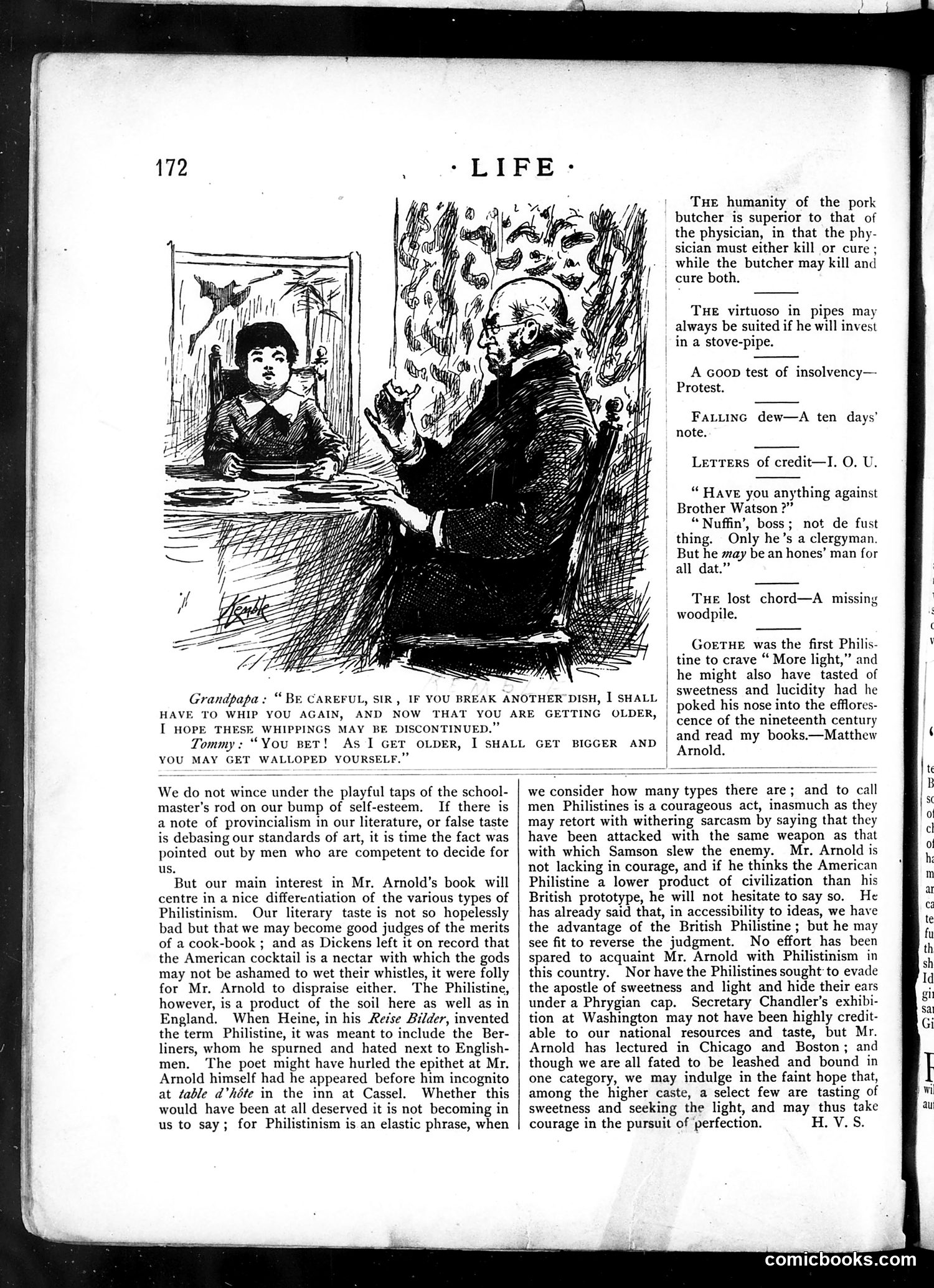
The cartoon depicts a domestic confrontation between an older man (labeled "Grandpapa") and a young woman at a dining table. The grandfather threatens to discontinue her allowance and warns of physical punishment if she breaks another dish, while she dismisses his authority with "You bet!" The satire targets generational conflict and changing social dynamics, likely from the early 20th century. The young woman's defiant attitude challenges Victorian-era patriarchal authority—a common theme in Life's satirical commentary on modernizing American society. The surrounding text discusses various social types and references Matthew Arnold and European intellectualism, but focuses primarily on critiquing American "Philistinism" and cultural pretension. The specific historical context remains unclear without additional dating information.
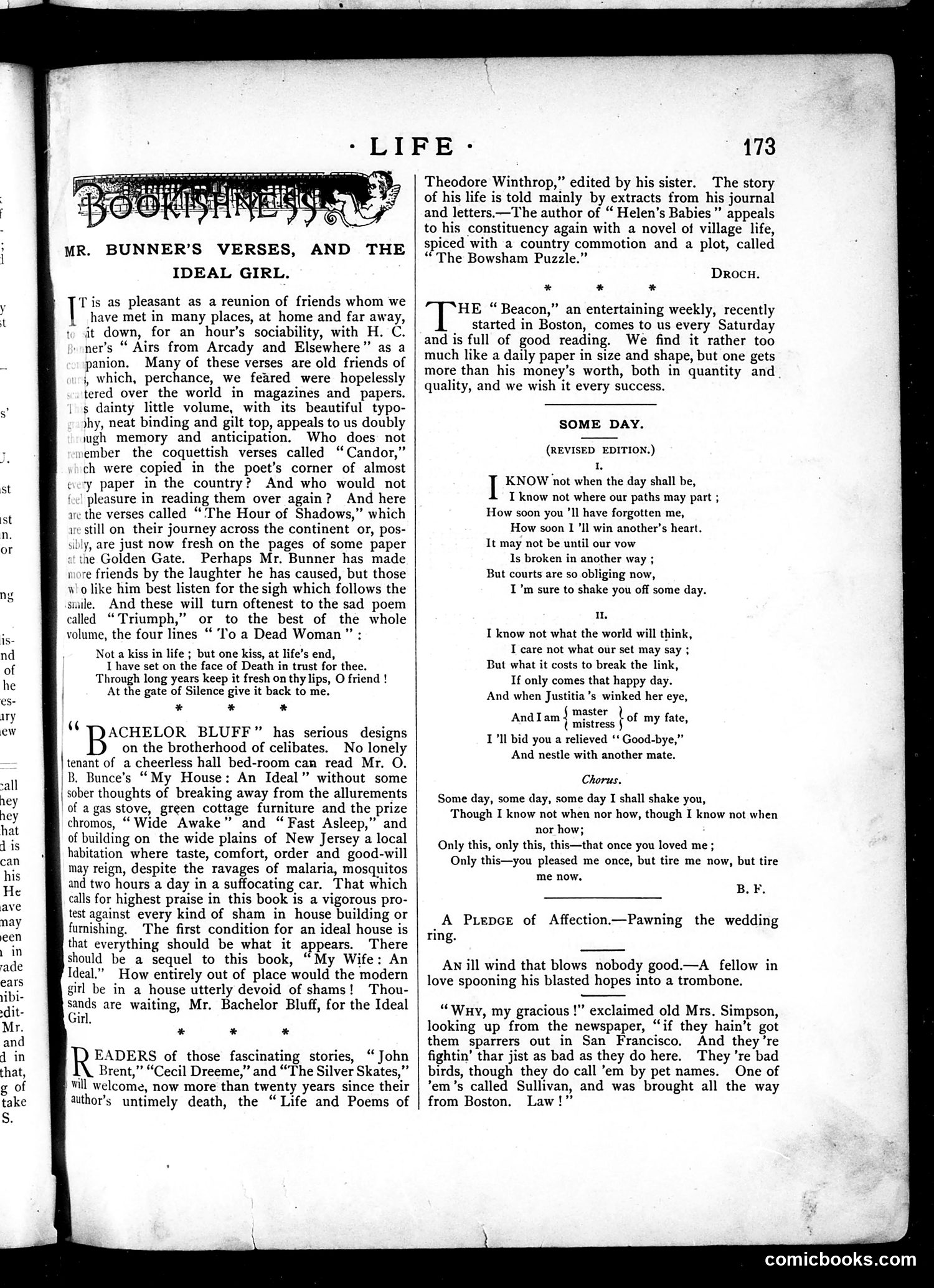
This page primarily contains **literary reviews and poetry**, not political cartoons. The content includes: - A review of "Mr. Bunner's Verses, and the Ideal Girl" — discussing H.C. Bunner's poetry collection and his themes about ideal domesticity and house-building - Reviews of other literary works including "Bachelor Bluff" and references to authors like John Brent and Cecil Dreeme - A poem titled "Some Day" (revised edition) about lost love and separation - Several brief satirical observations on marriage, romance, and social matters — including a joke about sparrows in San Francisco being "bad birds" brought from Boston The page functions as a **literary and humor magazine section** rather than featuring political cartoons. The satire is gentle and domestic in nature, focused on relationships and social customs of the era.
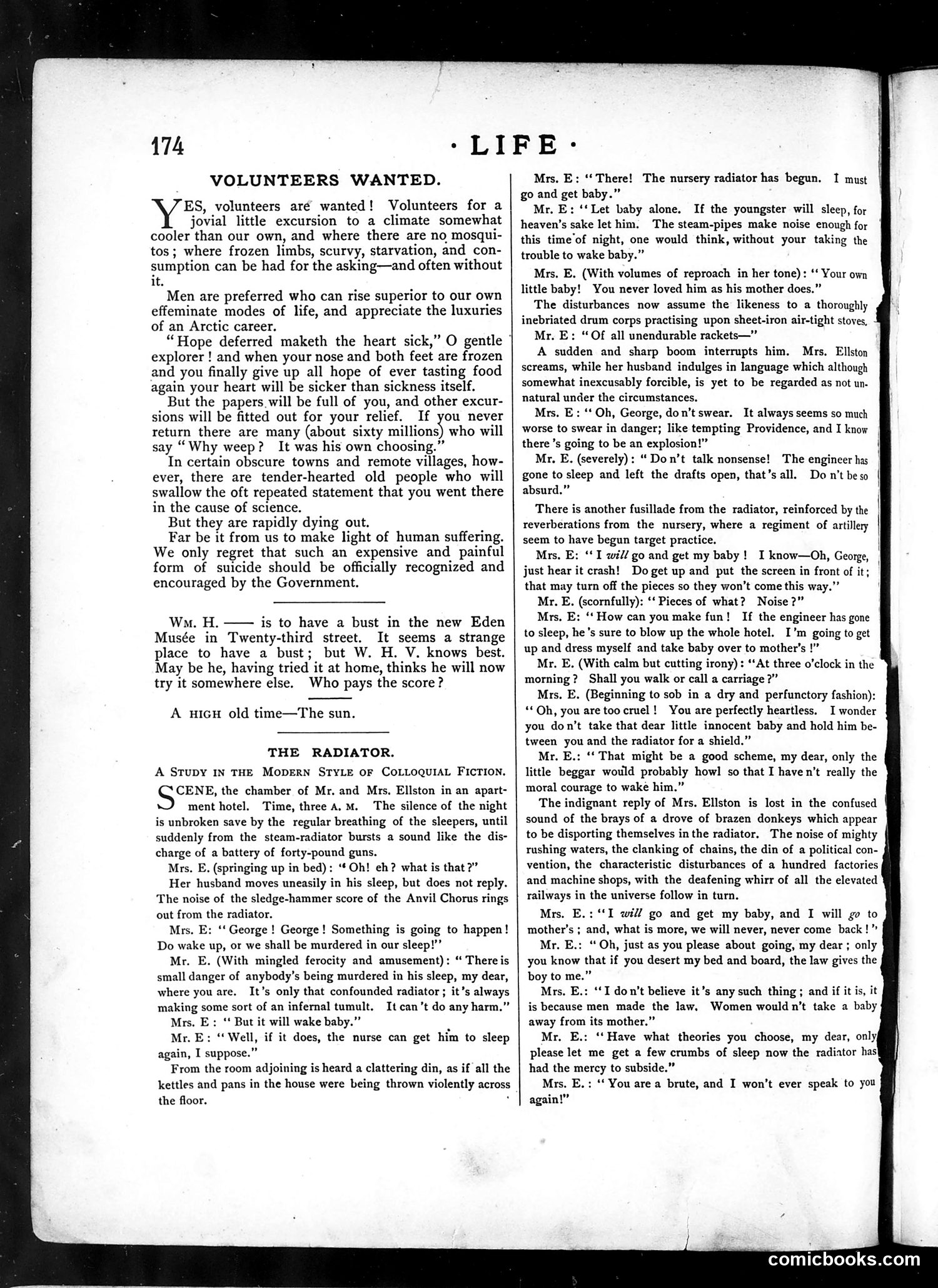
This page contains two distinct pieces: **"Volunteers Wanted"** is a brief satirical item mocking a proposal to recruit volunteers for Arctic expeditions. The satire targets the romantic notion of Arctic exploration as "luxury" while acknowledging the actual horrors (frozen limbs, starvation). The concluding comment about a bust in Eden Musée suggests this was prompted by a specific contemporary proposal, though the reference is now unclear. **"The Radiator"** is a comedic domestic sketch between Mr. and Mrs. Ellston. The humor centers on a malfunctioning steam radiator in their apartment causing nighttime disturbances to their baby. Mrs. Ellston blames her husband's negligence; he dismisses her concerns. The sketch satirizes marital conflict over domestic comfort and parental responsibilities, with the radiator serving as a catalyst for broader accusations and frustration.
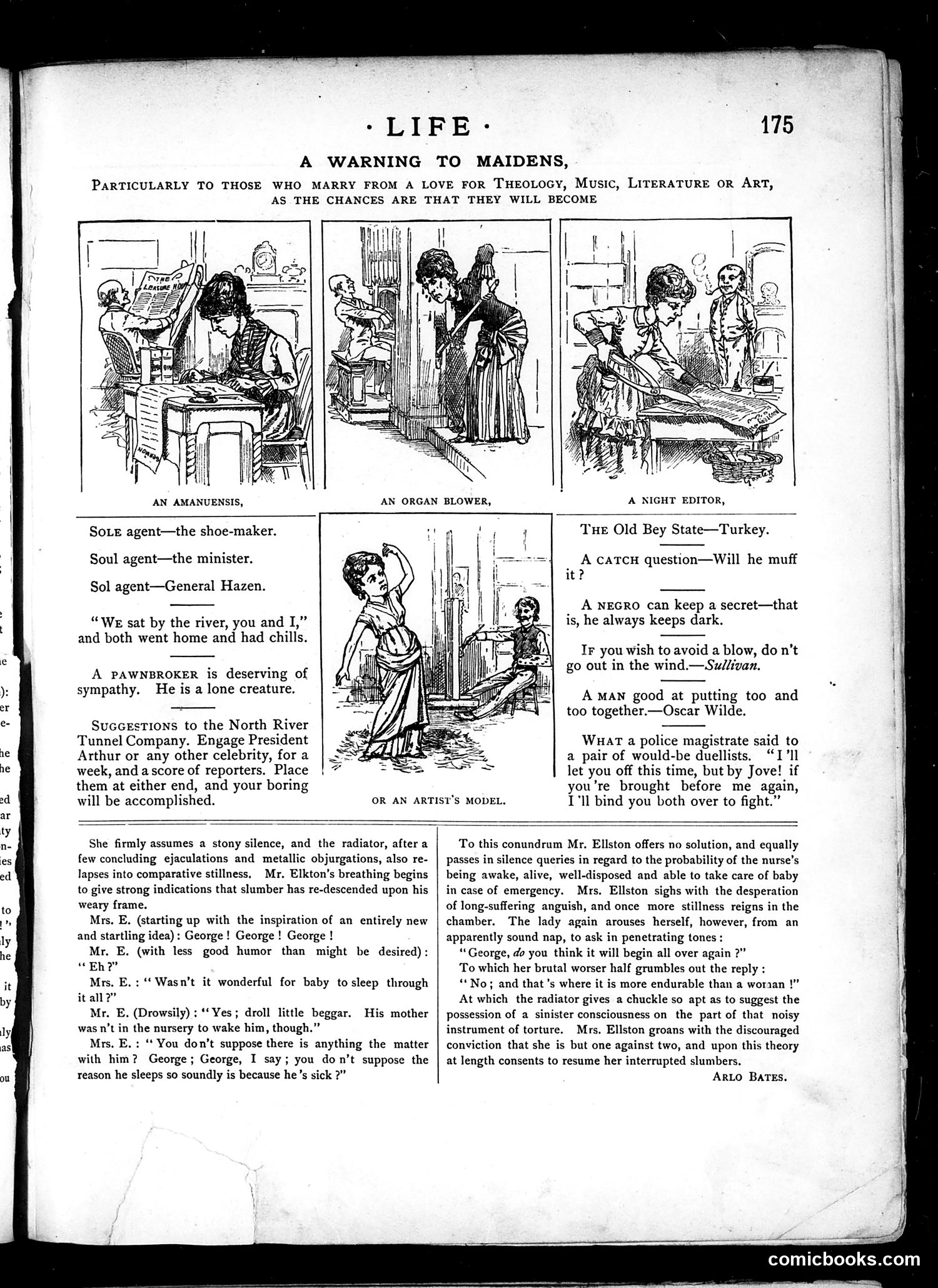
This satirical page mocks women who marry men passionate about intellectual pursuits—theology, music, literature, or art. Four cartoon scenarios illustrate the consequences: 1. **"An Amanuensis"**: A woman serves as her husband's secretary/assistant 2. **"An Organ Blower"**: She's relegated to manually operating his organ 3. **"A Night Editor"**: She works as his editorial assistant 4. **"An Artist's Model"**: She poses for his artwork The accompanying text and jokes reinforce that such marriages doom women to servitude, losing their independence and identity. The satirical "agent" definitions equate wives with shoe-makers and ministers—items owned rather than partners. The commentary critiques both idealistic male intellectuals who exploit wives' unpaid labor and women who marry for romantic love to such men, discovering too late they've become household servants rather than equals.
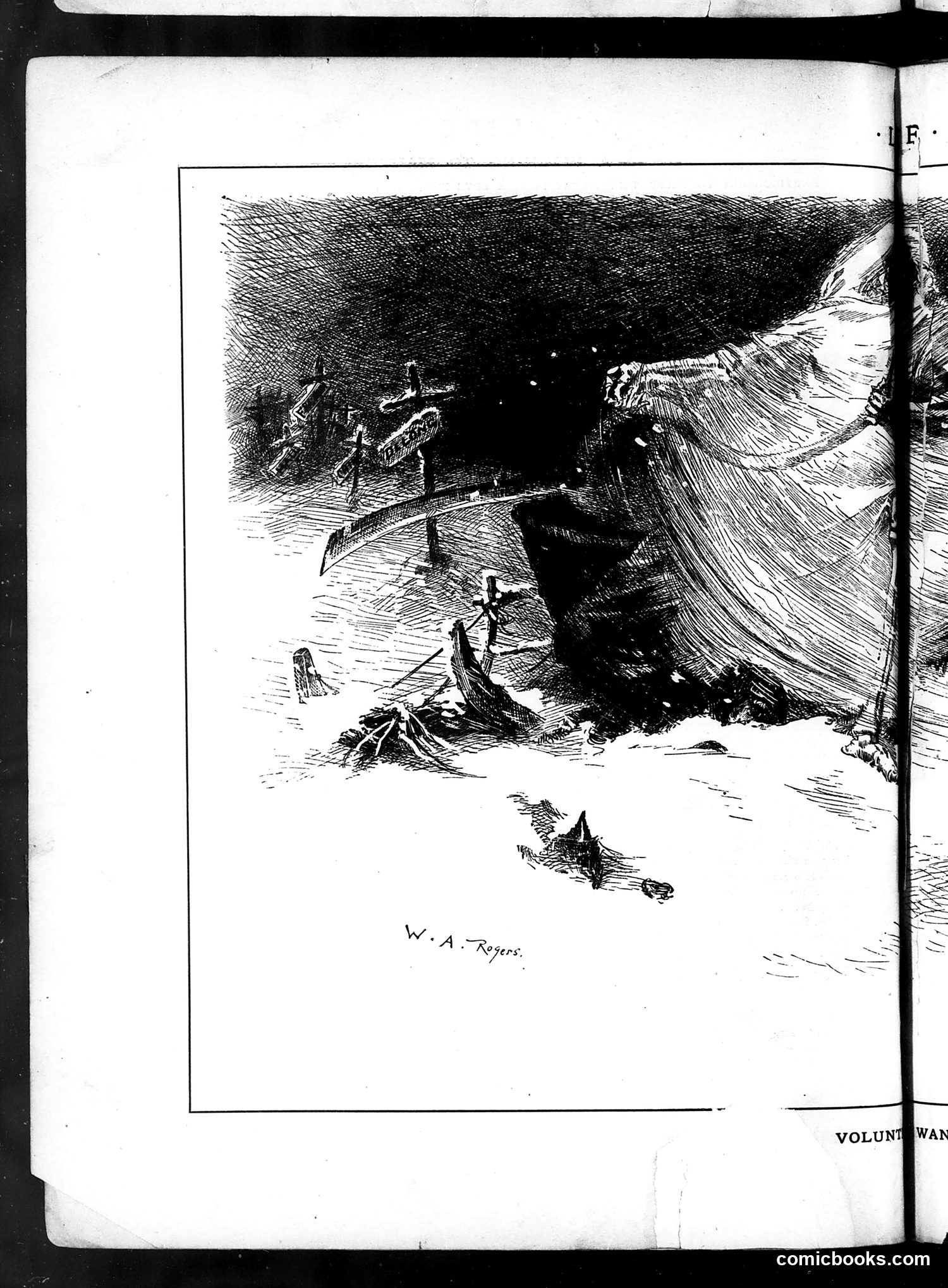
This is an illustration by W.A. Rogers depicting a beach or shoreline scene with what appears to be a cave or large dark rock formation. The image shows figures near the water's edge with some debris or wreckage scattered on the beach. Without additional context from the magazine page (title, caption, or surrounding articles), I cannot definitively identify the specific political or social reference this cartoon makes. The style and technique suggest early-to-mid 20th century Life magazine satire, but the illustration alone doesn't reveal the intended subject or satirical point to a modern viewer unfamiliar with the original publication's context and date. To properly explain the cartoon's meaning, I would need accompanying text identifying the event, figures, or issue being commented upon.
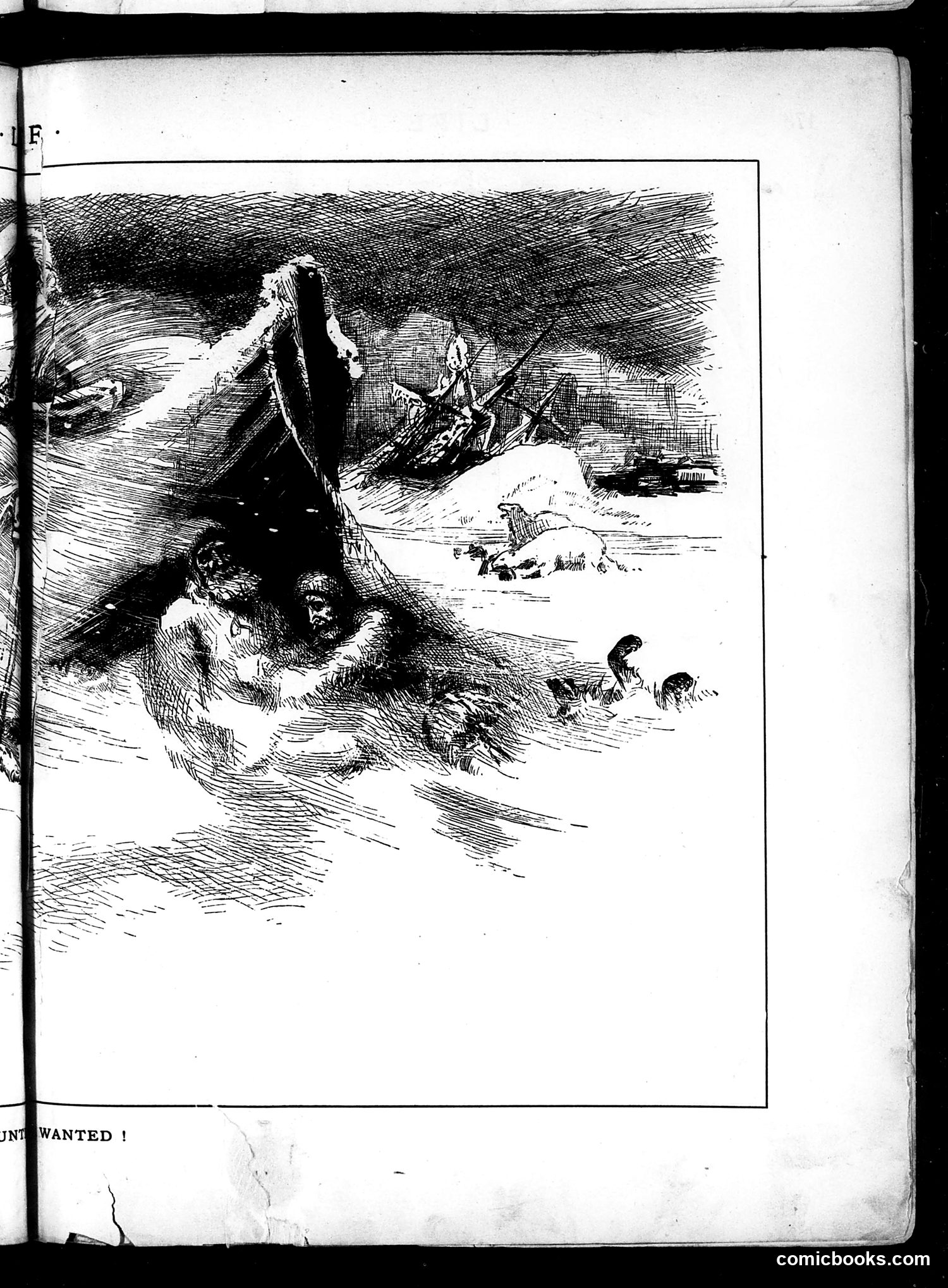
This appears to be an illustration from Life magazine showing a maritime disaster scene. The image depicts multiple figures in and around water near a wrecked or damaged vessel. In the foreground, people are struggling in the water, while in the background, additional figures can be seen near the broken ship and what appear to be other boats. The partial text visible at the bottom reads "WANTED!" but is cut off, making the specific satirical point unclear. Without additional context or complete text, I cannot definitively identify which historical maritime incident this references or what political/social commentary it intends. The style suggests late 19th or early 20th-century American satire, but the exact target of the satire remains uncertain from this page alone.
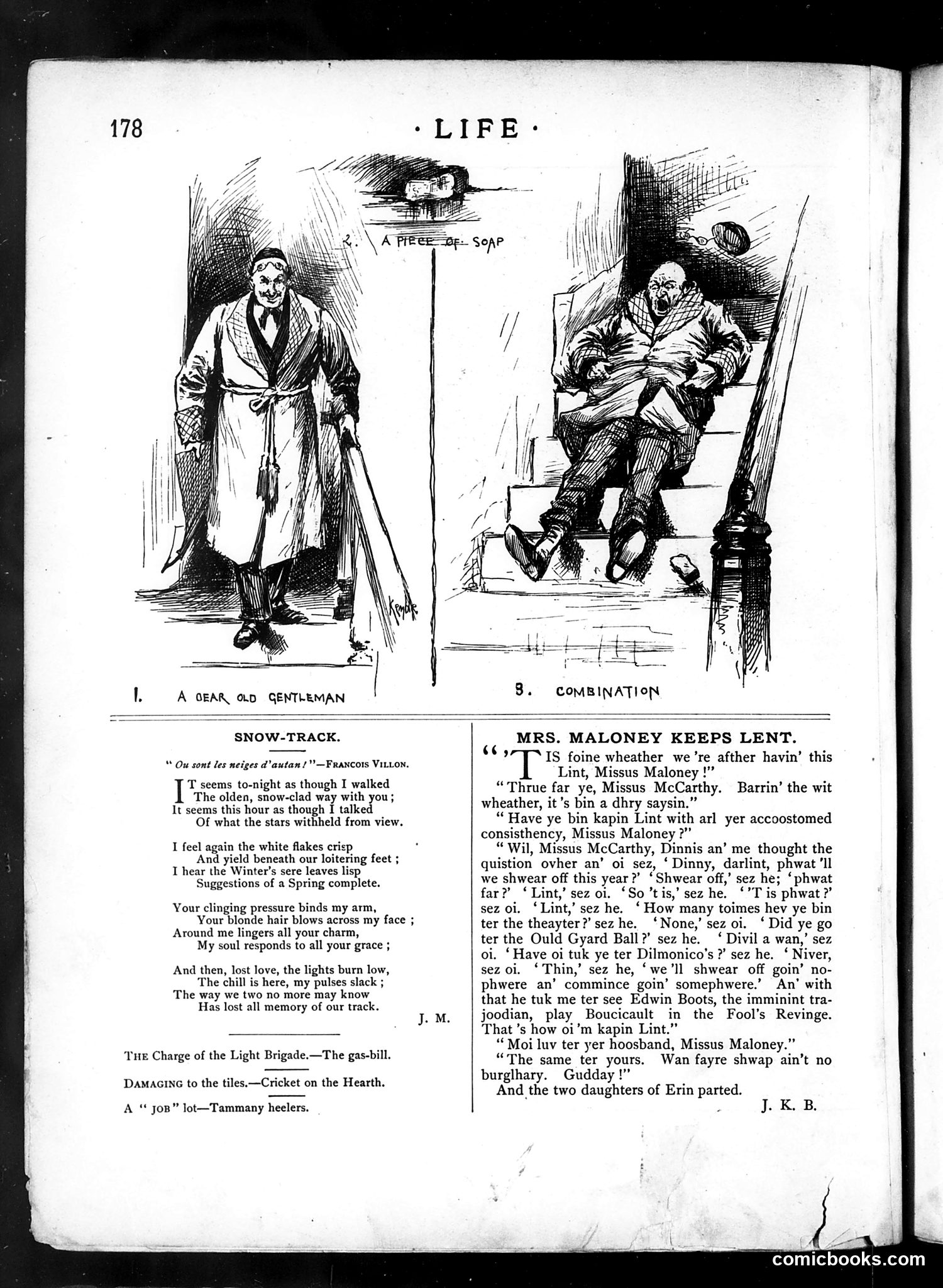
This page contains two distinct pieces of satirical content: **The Cartoons (top):** Sketch 1 shows "A Dear Old Gentleman" standing alone; Sketch 8 depicts "Combination"—a man sitting on stairs. These appear to be visual jokes with minimal accompanying text, their meanings unclear from the image alone. **"Mrs. Maloney Keeps Lent" (main text):** A dialogue between two Irish-American women discussing Lenten sacrifice. The satire mocks how Mrs. Maloney's family interprets religious fasting: they claim to "swear off" going to theaters and entertainment, yet immediately break this vow by attending a play starring Edwin Booth. The phonetic Irish dialect ("foine wheather," "phwat") was typical of period ethnic humor, depicting Irish immigrants as hypocritical about religious observance while maintaining good humor about their contradictions. The piece satirizes both casual Catholicism and Irish-American cultural stereotypes prevalent in late 19th/early 20th-century American magazines.
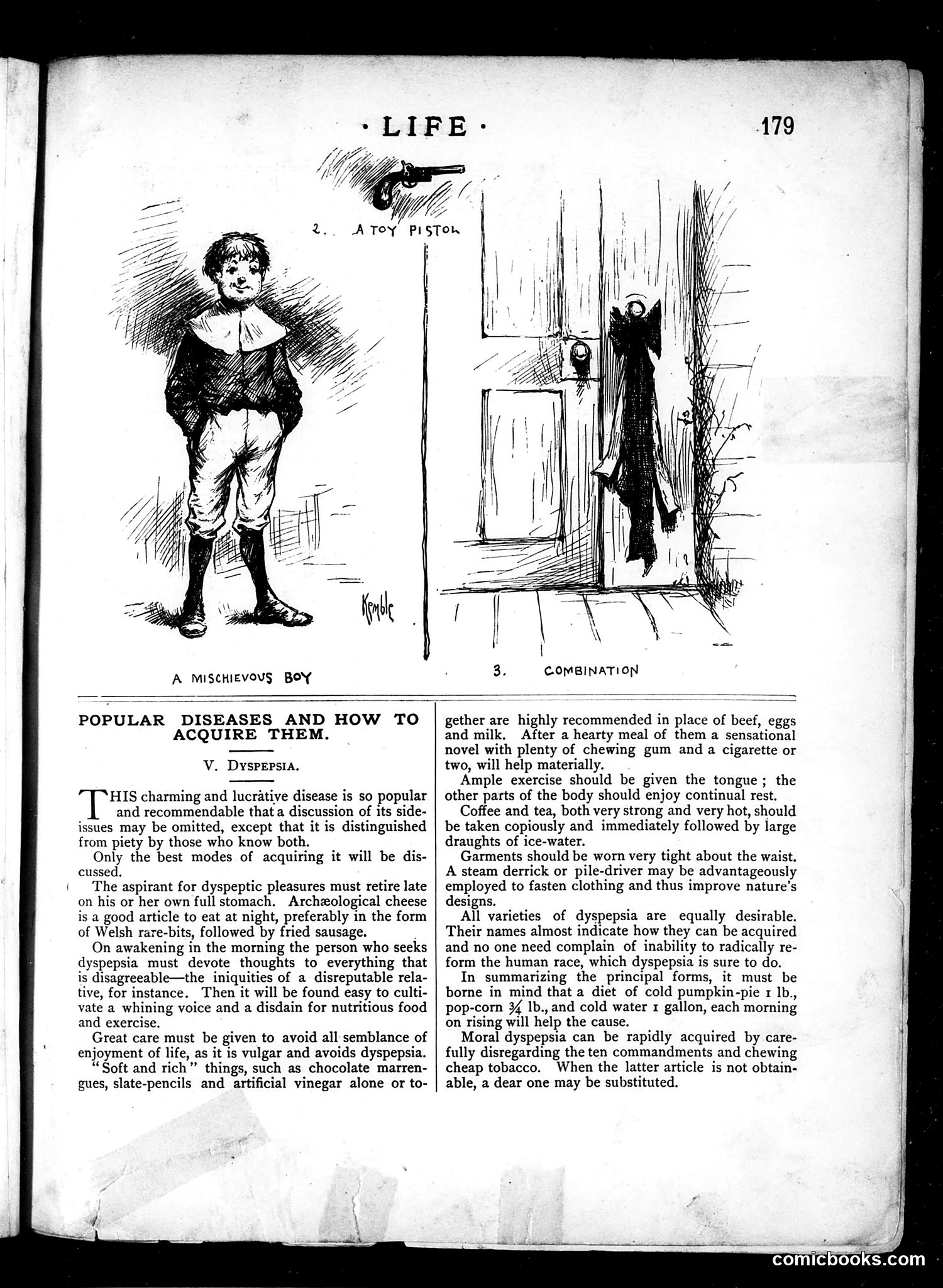
This page satirizes dyspepsia (indigestion/digestive upset) as an fashionable "disease" of the era. The three cartoon vignettes mock common causes: "A Mischievous Boy" (left) depicts a troublemaker who likely suffered stomach problems from misbehavior; "A Toy Pistol" (top) shows a child with a toy gun; "Combination" (right) illustrates domestic chaos. The main text employs heavy irony, providing absurd "instructions" for acquiring dyspepsia—eating Welsh rarebit and fried sausage before bed, wearing tight corsets, consuming contradictory foods (hot coffee followed by ice water), and dwelling on unpleasant thoughts. The satire mocks Victorian hypochondria and the tendency to romanticize illness as a sign of sensitivity. The final paragraph on "Moral dyspepsia" extends the joke: one acquires it by breaking the Ten Commandments and chewing cheap tobacco—suggesting indigestion was considered a moral failing reflecting poor character or habits.
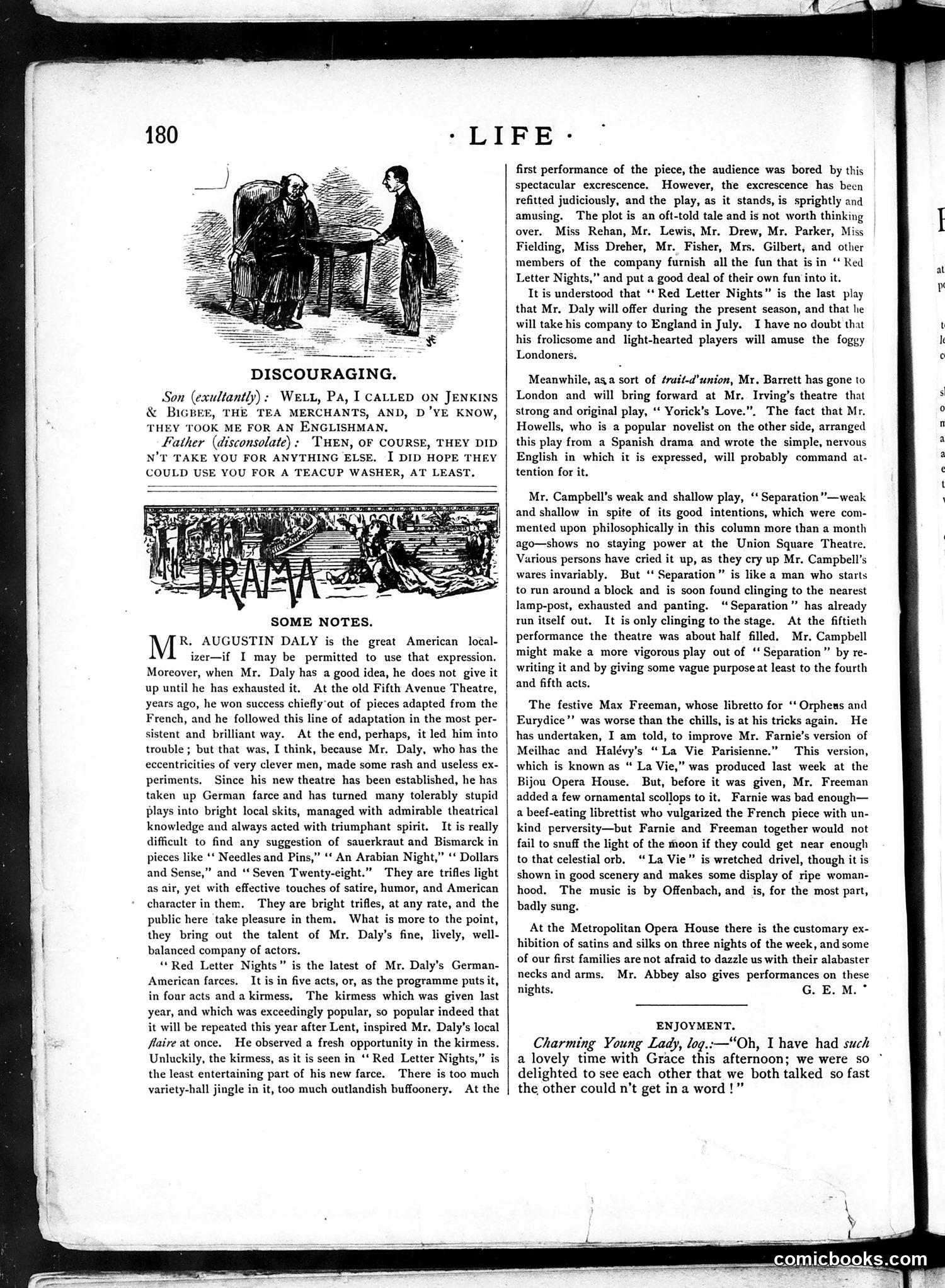
This cartoon satirizes American social pretensions and class anxiety. A son excitedly tells his father that tea merchants mistook him for an Englishman—a compliment in the 19th-century American context, where English identity carried prestige. The father's crushing response—that if they thought him English, they'd never hire him for any useful work, not even washing teacups—inverts the expected hierarchy. The joke targets American insecurity about English superiority while simultaneously mocking Americans who worship English status. It suggests that being "English" in American eyes means being useless and unemployable, yet desirable nonetheless. This reflects mid-19th-century tensions between American independence and lingering anglophilia among certain social classes.
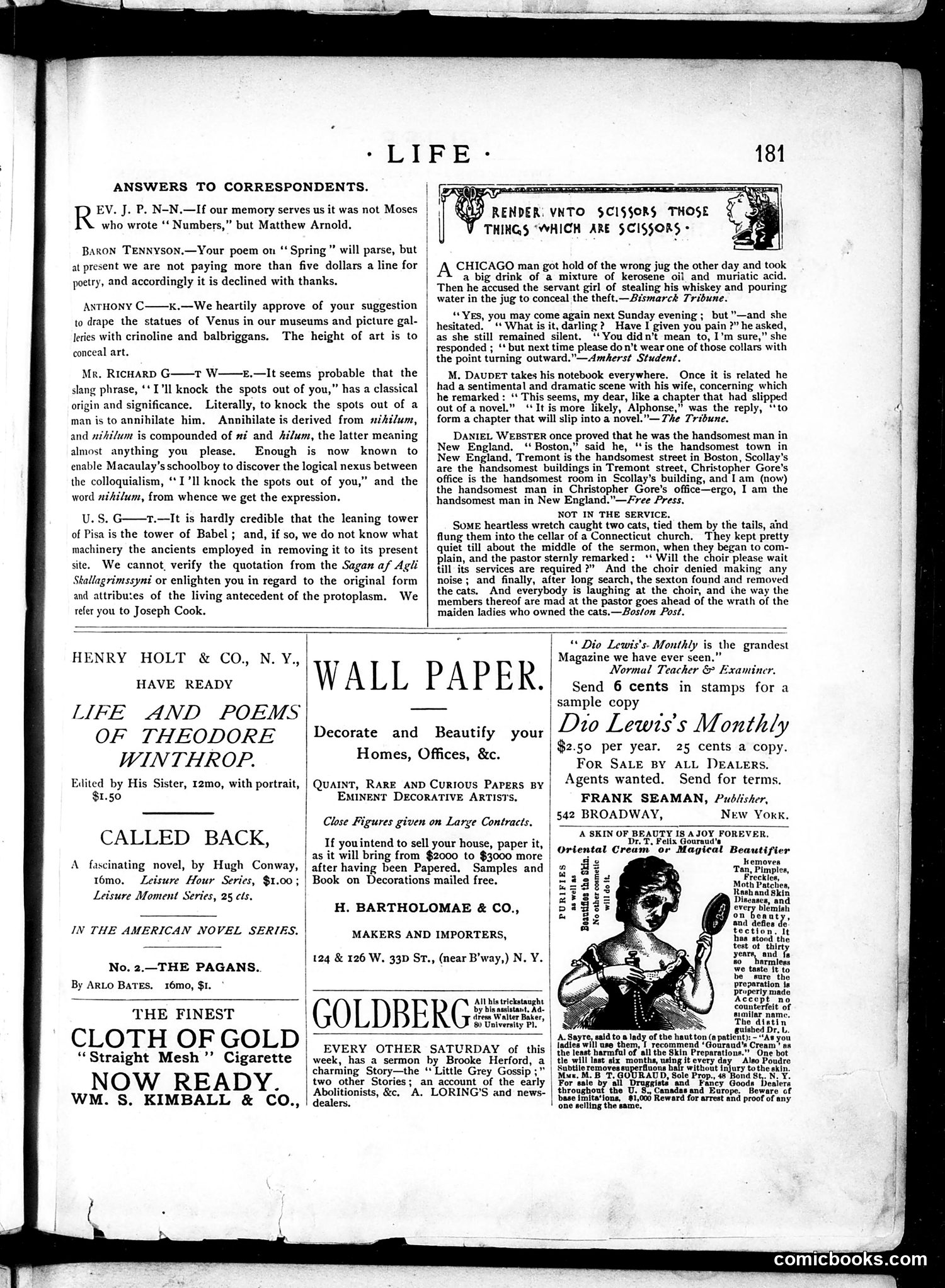
This page is primarily an "Answers to Correspondents" section—a satirical reader-response column typical of *Life* magazine's humor. The cartoon at top depicts a Biblical reference ("Render unto scissors those things which are scissors"), likely mocking pedantic or absurd reader questions. The column itself satirizes various submitted inquiries through mock-serious responses: - A fake attribution of "Numbers" to Matthew Arnold (not Moses) - Rejection of Tennyson's poetry for payment reasons - Approval of draping classical statues in period undergarments (crinoline) as artistic concealment - An absurdly elaborate etymological "explanation" tracing slang to Latin origins - Humorous anecdotes about mishaps (wrong jug, shirt collars, notebooks, church cats) The humor relies on *Life's* trademark approach: deadpan, erudite responses to what are presented as ridiculous questions, treating the absurd with mock-scholarly gravity. The page also contains period advertisements for books, wallpaper, and cosmetics. This is vintage late-19th-century American magazine satire, not political commentary.
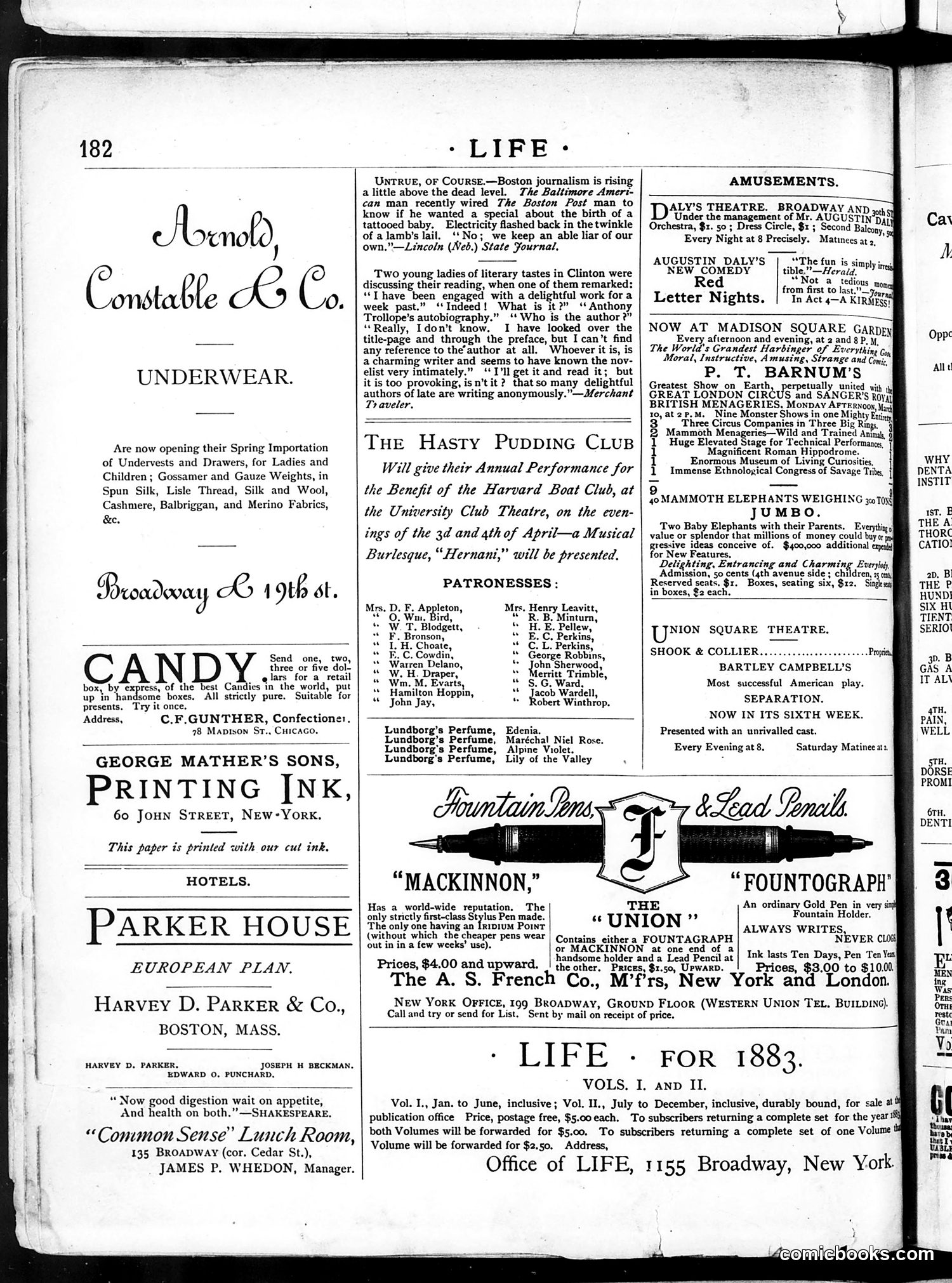
This page is primarily **advertising and announcements**, not political cartoons. However, it contains several humorous anecdotes typical of Life's satirical style: **The "Untrue, of Course" item** mocks Boston journalism's pretensions by reporting a cynical exchange: when asked if he wanted a story about a tattooed baby, a Boston Post editor supposedly wired back that he keeps "an able liar of our own"—satirizing newspapers' willingness to fabricate sensational stories. **The Clinton ladies' anecdote** jokes about Anthony Trollope's autobiography, where readers can't identify the author despite reading the title-page and preface. The humor lies in the absurdity of not recognizing an author's name in his own work. Both items exemplify Life's 1880s humor: commentary on contemporary culture through brief, witty observations rather than visual cartoons. The page otherwise consists of theater advertisements (Daly's Theatre, Barnum's circus), hotel promotions, and luxury goods (underwear, candy, perfume, fountain pens).
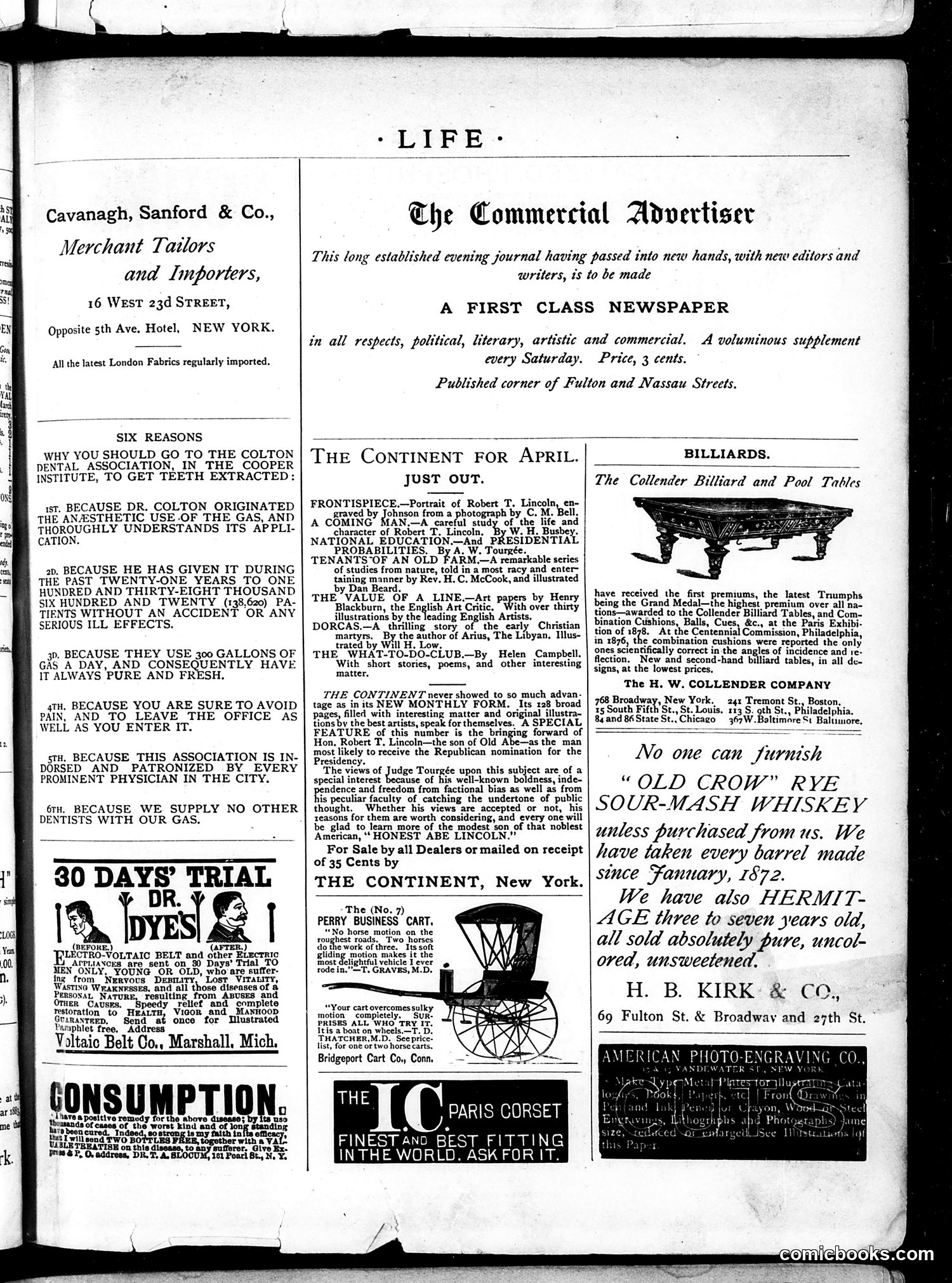
This page is primarily **advertisements and announcements** rather than satirical cartoons. The layout features: **Main Content:** - An announcement for *The Commercial Advertiser*, a newly acquired evening newspaper promising first-class journalism - Advertisement for *The Continent* magazine's April issue, featuring Robert T. Lincoln (son of Abraham Lincoln) as a potential Republican presidential nominee - Various commercial ads: a tailor shop, dental services using anesthetic gas, an electro-voltaic belt for treating "nervous debility," and a corset maker **Historical Context for Modern Readers:** The ads reveal period concerns: tooth extraction was routine (anesthesia still novel), "personal weakness" treatments were advertised discreetly, and corsets were marketed as medical/fashion essentials. The Robert T. Lincoln mention reflects post-Civil War American politics, with his name carrying symbolic weight. This page demonstrates how 19th-century magazines blended editorial content with commercial pitches—no clear separation between advertising and news.
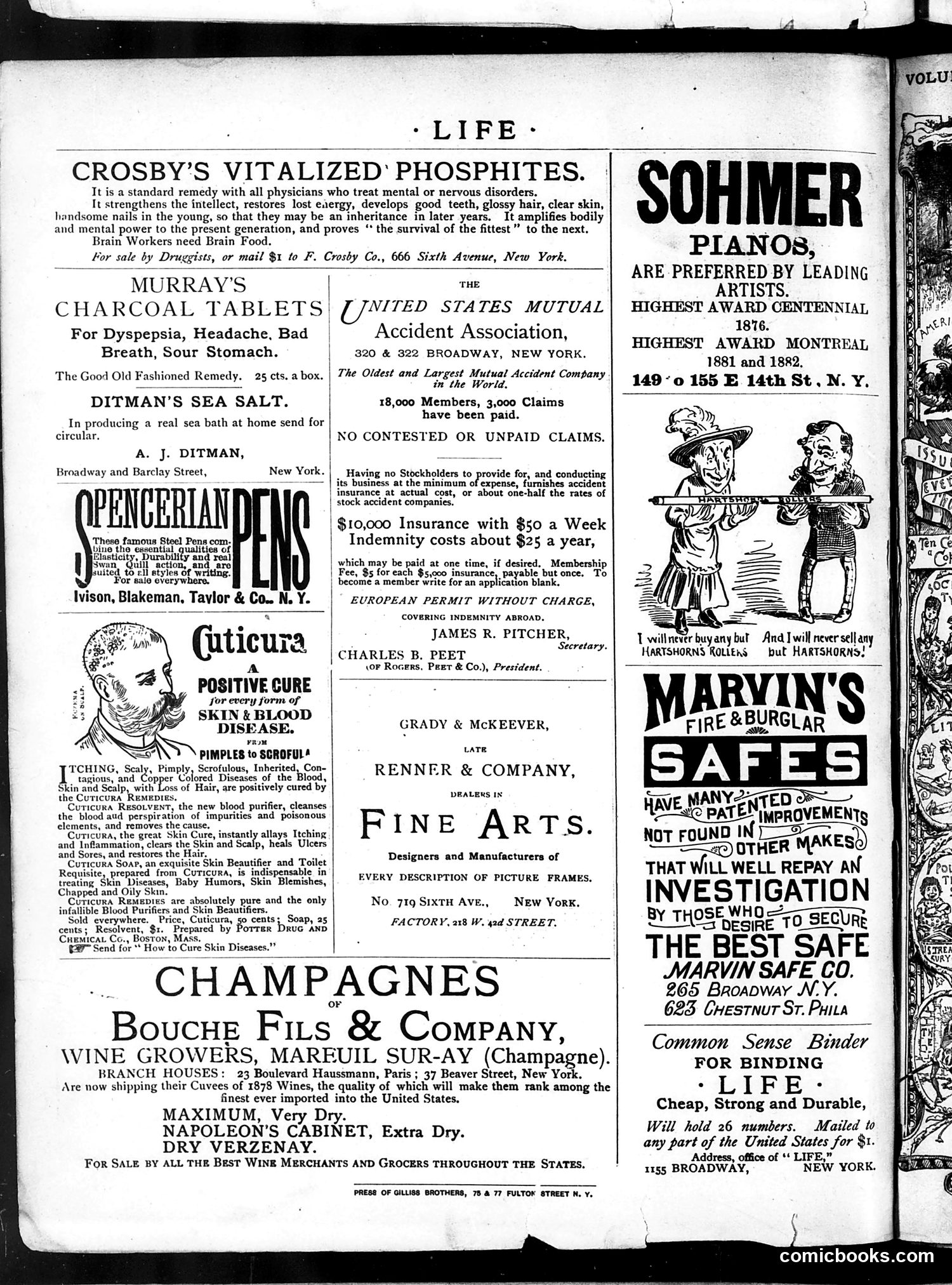
This is primarily an **advertising page** from Life magazine (likely 1870s-1880s based on the 1878 champagne reference). The page contains no political cartoons—only commercial advertisements and one small illustration. The only cartoon element is a **small Sohmer Pianos advertisement** featuring two caricatured figures (a woman and man) with exaggerated features, engaged in dialogue about hartshorn (smelling salts). The joke appears to be a mild domestic humor scenario: the woman declares she'll buy only Sohmer pianos, while the man claims he'll never sell anything but Sohmer products—likely a play on brand loyalty and marital banter. The remainder consists of medical remedy ads (Crosby's Phosphites, Cuticura treatments), insurance promotions, and luxury goods (champagne, pianos, safes). These advertisements reflect 19th-century consumer culture and patent medicine marketing before modern FDA regulations. No significant political satire or social commentary is present on this page.