
Life, 1884-03-27 · page 4 of 16
Life — March 27, 1884 — page 4: what you’re looking at
What you’re looking at
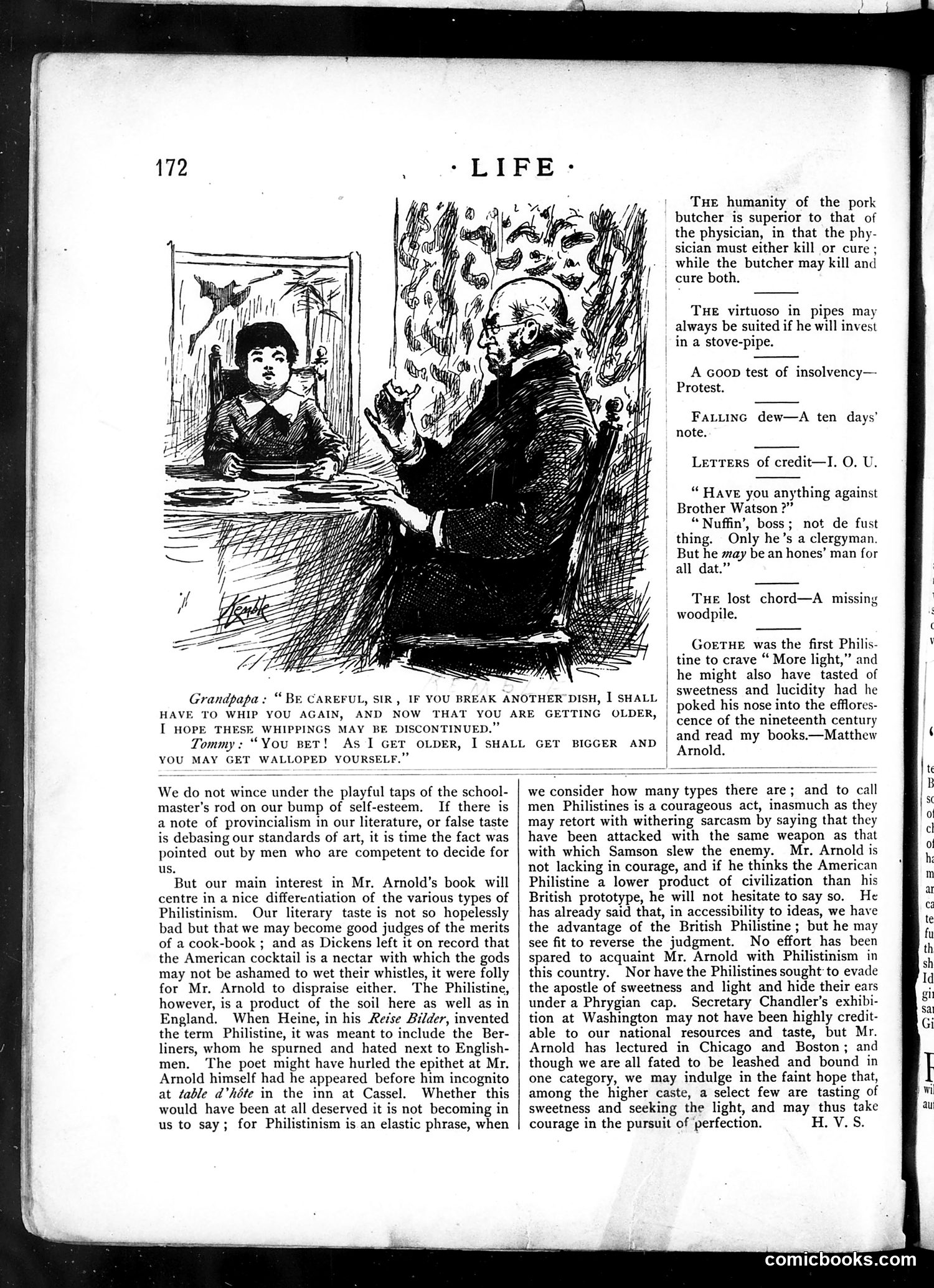
The cartoon depicts a domestic confrontation between an older man (labeled "Grandpapa") and a young woman at a dining table. The grandfather threatens to discontinue her allowance and warns of physical punishment if she breaks another dish, while she dismisses his authority with "You bet!" The satire targets generational conflict and changing social dynamics, likely from the early 20th century. The young woman's defiant attitude challenges Victorian-era patriarchal authority—a common theme in Life's satirical commentary on modernizing American society. The surrounding text discusses various social types and references Matthew Arnold and European intellectualism, but focuses primarily on critiquing American "Philistinism" and cultural pretension. The specific historical context remains unclear without additional dating information.
📄 Transcribed text from this page (OCR, searchable)
Machine-transcribed from the original scan — historical spelling and the odd misread are preserved.
- LIFE: Tue humanity of the pork butcher is superior to that of the physician, in that the phy- sician must either kill or cure ; while the butcher may kill and cure both. THE virtuoso in pipes may always be suited if he will invest in a stove-pipe. A coop test of insolvency— Protest. Faiiuinc dew—A ten days’ note. Lerrers of credit—I. O. U. “ Have you anything against Brother Watson ?” “Nuffin’, boss; not de fust thing. Only he’s a clergyman. But he may be an hones’ man for all dat.” TuE lost chord—A missing woodpile. GOETHE was the first Philis- tine to crave “ More light,” and | he might also have tasted of sweetness and lucidity had he Grandpapa : “BE CAREFUL, SIR, IF YOU BREAK ANOTHER’DISH, I SHALL | HAVE TO WHIP YOU AGAIN, AND NOW THAT YOU ARE GETTING OLDER, I HOPE THESE WHIPPINGS MAY BE DISCONTINUED.” Tommy: “You set! As I GET OLDER, I SHALL GET BIGGER AND poked his nose into the efflores- | cence of the nineteenth century | and read my books.—Matthew YOU MAY GET WALLOPED YOURSELF.” We do not wince under the playful taps of the school- master’s rod on our bump of self-esteem. If there is a note of provincialism in our literature, or false taste is debasing our standards of art, it is time the fact was pointed out by men who are competent to decide for us. But our main interest in Mr. Arnold’s book will centre in a nice differentiation of the various types of Philistinism. Our literary taste is not so hopelessly bad but that we may become good judges of the merits of a cook-book ; and as Dickens left it on record that the American cocktail is a nectar with which the gods may not be ashamed to wet their whistles, it were folly for Mr. Arnold to dispraise either. The Philistine, however, is a product of the soil here as well as in England. When Heine, in his Rerse Bilder, invented the term Philistine, it was meant to include the Ber- liners, whom he spurned and hated next to English- men. The poet might have hurled the epithet at Mr. Arnold himself had he appeared before him incognito at able d’hdte in the inn at Cassel. Whether this would have been at all deserved it is not becoming in us to say; for Philistinism is an elastic phrase, when | Arnold. we consider how many types there are; and to call men Philistines is a courageous act, inasmuch as they may retort with withering sarcasm by saying that they have been attacked with the same weapon as that with which Samson slew the enemy. Mr. Arnold is not lacking in courage, and if he thinks the American Philistine a lower product of civilization than his British prototype, he will not hesitate to say so. He has already said that, in accessibility to ideas, we have the advantage of the British Philistine ; but he may see fit to reverse the judgment. No effort has been spared to acquaint Mr. Arnold with Philistinism in this country. Nor have the Philistines sought to evade the apostle of sweetness and light and hide their ears under a Phrygian cap. Secretary Chandler’s exhibi- tion at Washington may not have been highly credit- able to our national resources and taste, but Mr. Arnold has lectured in Chicago and Boston; and though we are all fated to be leashed and bound in one category, we may indulge in the faint hope that, among the higher caste, a select few are tasting of sweetness and seeking the light, and may thus take courage in the pursuit of ‘perfection. H. V. S. comicbooks.com