
Life, 1884-03-27 · page 5 of 16
Life — March 27, 1884 — page 5: what you’re looking at
What you’re looking at
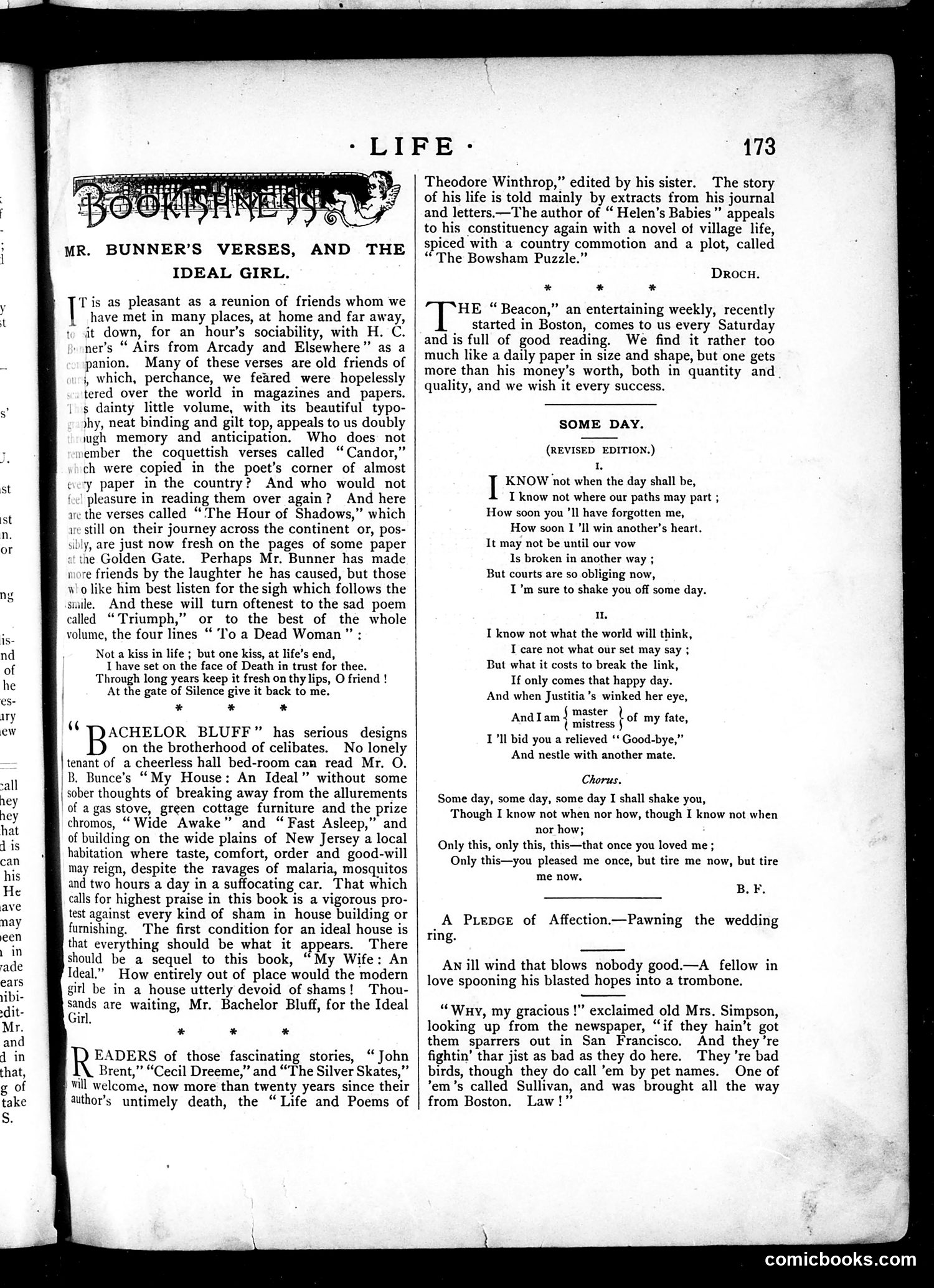
This page primarily contains **literary reviews and poetry**, not political cartoons. The content includes: - A review of "Mr. Bunner's Verses, and the Ideal Girl" — discussing H.C. Bunner's poetry collection and his themes about ideal domesticity and house-building - Reviews of other literary works including "Bachelor Bluff" and references to authors like John Brent and Cecil Dreeme - A poem titled "Some Day" (revised edition) about lost love and separation - Several brief satirical observations on marriage, romance, and social matters — including a joke about sparrows in San Francisco being "bad birds" brought from Boston The page functions as a **literary and humor magazine section** rather than featuring political cartoons. The satire is gentle and domestic in nature, focused on relationships and social customs of the era.
📄 Transcribed text from this page (OCR, searchable)
Machine-transcribed from the original scan — historical spelling and the odd misread are preserved.
rade ears 1ibi- sdit- Mr. and d in that, g of take Ss. - EITFE - MR. BUNNER’S VERSES, AND THE IDEAL GIRL. Tis as pleasant as a reunion of friends whom we have met in many places, at home and far away, it down, for an hour’s sociability, with H. C. ner’s “ Airs from Arcady and Elsewhere” as a panion. Many of these verses are old friends of i, which, perchance, we feared were hopelessly tered over the world in magazines and papers. s dainty little volume, with its beautiful typo- dhy, neat binding and gilt top, appeals to us doubly ugh memory and anticipation. Who does not ember the coquettish verses called “Candor,” ch were copied in the poet’s corner of almost ‘y paper in the country? And who would not pleasure in reading them over again? And here «the verses called “‘The Hour of Shadows,” which still on their journey across the continent or, pos- silly, are just now fresh on the pages of some paper atthe Golden Gate. Perhaps Mr. Bunner has made more friends by the laughter he has caused, but those wio like him best listen for the sigh which follows the suile, And these will turn oftenest to the sad poem called “Triumph,” or to the best of the whole volume, the four lines “ ‘'o a Dead Woman” : Not a kiss in life ; but one kiss, at life’s end, I have set on the face of Death in trust for thee. Through long years keep it fresh on thy lips, O friend ! At the gate of Silence give it back to me. * * * ‘(7 ACHELOR BLUFF” has serious designs on the brotherhood of celibates. No lonely | tenant of acheerless hall bed-room can read Mr. O. B. Bunce’s “My House: An Ideal” without some | sober thoughts of breaking away from the allurements of a gas stove, green cottage furniture and the prize chromos, “Wide Awake” and “ Fast Asleep,” and of building on the wide plains of New Jersey a local habitation where taste, comfort, order and good-will may reign, despite the ravages of malaria, mosquitos and two hours a day in a suffocating car. That which calls for highest praise in this book is a vigorous pro- test against every kind of sham in house building or furnishing. The first condition for an ideal house is that everything should be what it appears. There should be a sequel to this book, “My Wife: An Ideal.” How entirely out of place would the modern girl be in a house utterly devoid of shams! Thou- oats are waiting, Mr. Bachelor Bluff, for the Ideal irl, ‘ * * * EADERS of those fascinating stories, “John L\. Brent,” “Cecil Dreeme,” and “The Silver Skates,” will welcome, now more than twenty years since their author’s untimely death, the “Life and Poems of 173 Theodore Winthrop,” edited by his sister. The story of his life is told mainly by extracts from his journal and letters.—The author of “ Helen's Babies” appeals to his constituency again with a novel of village life, spiced with a country commotion and a plot, called “The Bowsham Puzzle.” Drocu. * * * HE “Beacon,” an entertaining weekly, recently started in Boston, comes to us every Saturday and is full of good reading. We find it rather too much like a daily paper in size and shape, but one gets more than his money’s worth, both in quantity and quality, and we wish it every success. SOME DAY. (REVISED EDITION.) 1 KNOW not when the day shall be, I know not where our paths may part ; How soon you Il have forgotten me, How soon I ’Il win another’s heart. It may not be until our vow Is broken in another way ; But courts are so obliging now, I’m sure to shake you off some day. bh I know not what the world will think, T care not what our set may say ; But what it costs to break the link, If only comes that happy day. And when Justitia’s winked her eye, master AndTam { master lot my fate, I'll bid you a relieved ‘‘ Good-bye,” And nestle with another mate. Chorus. Some day, some day, some day I shall shake you, Though I know not when nor how, though I know not when nor how; Only this, only this, this—that once you loved me ; Only this—you pleased me once, but tire me now, but tire me now. B.F. _A Piepce of Affection—Pawning the wedding ring. An ill wind that blows nobody good.—A fellow in love spooning his blasted hopes into a trombone. “Way, my gracious !” exclaimed old Mrs. Simpson, looking up from the newspaper, “if they hain’t got them sparrers out in San Francisco. And they’re fightin’ thar jist as bad as they do here. They ’re bad birds, though they do call ’em by pet names. One of ’em’s called Sullivan, and was brought all the way from Boston. Law!” comicbooks.com