
Life, 1884-03-27 · page 12 of 16
Life — March 27, 1884 — page 12: what you’re looking at
What you’re looking at
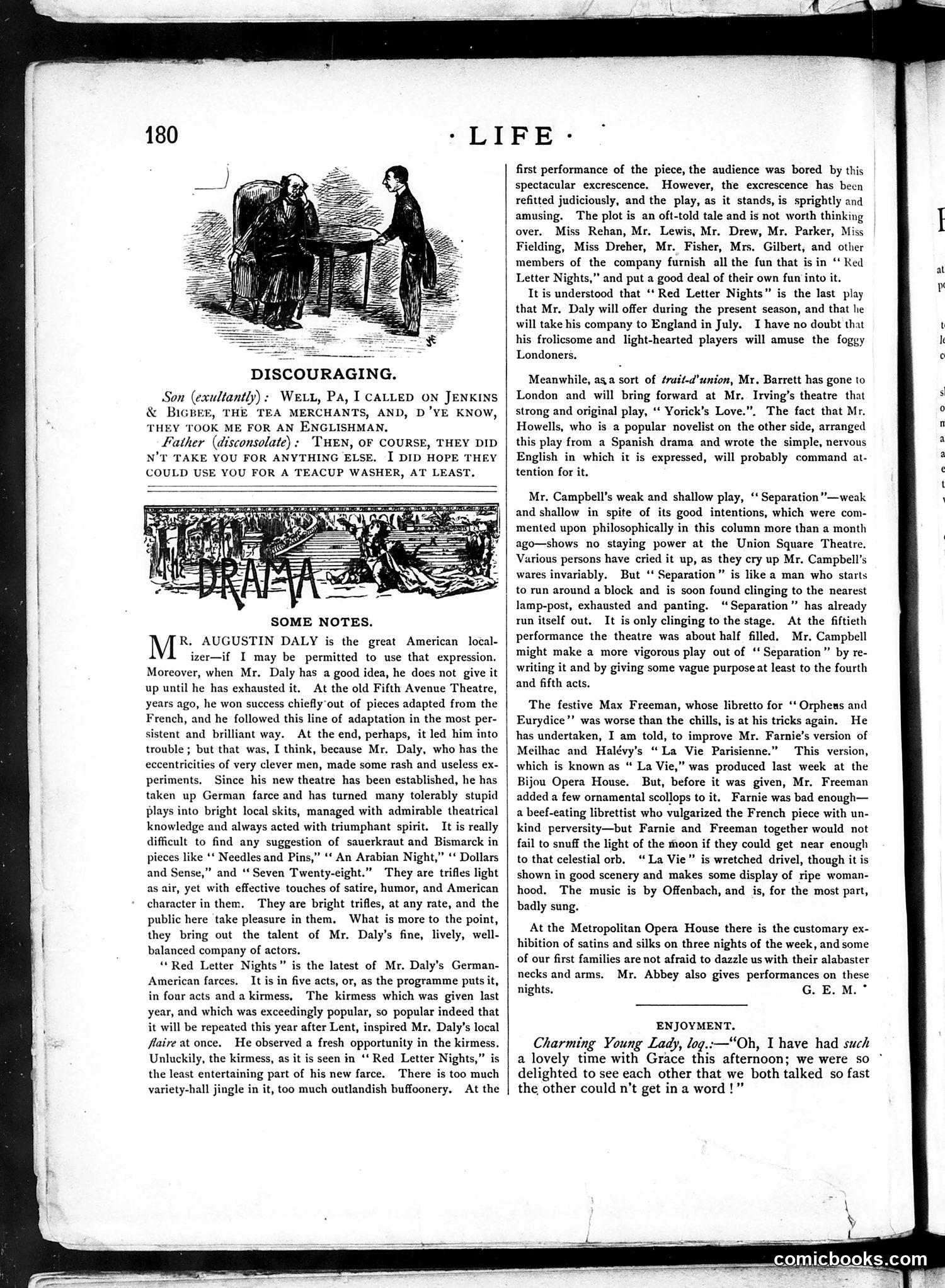
This cartoon satirizes American social pretensions and class anxiety. A son excitedly tells his father that tea merchants mistook him for an Englishman—a compliment in the 19th-century American context, where English identity carried prestige. The father's crushing response—that if they thought him English, they'd never hire him for any useful work, not even washing teacups—inverts the expected hierarchy. The joke targets American insecurity about English superiority while simultaneously mocking Americans who worship English status. It suggests that being "English" in American eyes means being useless and unemployable, yet desirable nonetheless. This reflects mid-19th-century tensions between American independence and lingering anglophilia among certain social classes.
📄 Transcribed text from this page (OCR, searchable)
Machine-transcribed from the original scan — historical spelling and the odd misread are preserved.
DISCOURAGING. Son (exultantly): Wet, Pa, I CALLED ON JENKINS & Bi THE TEA MERCHANTS, AND, D’YE KNOW, THEY TOOK ME FOR AN ENGLISHMAN, Father (disconsolate): THEN, OF COURSE, THEY DID N’T TAKE YOU FOR ANYTHING ELSE. I DID HOPE THEY COULD USE YOU FOR A TEACUP WASHER, AT LEAST. first performance of the piece, the audience was bored by this spectacular excrescence. However, the excrescence has been refitted judiciously, and the play, as it stands, is sprightly and amusing. The plot is an oft-told tale and is not worth thinking over. Miss Rehan, Mr. Lewis, Mr. Drew, Mr. Parker, Miss Fielding, Miss Dreher, Mr. Fisher, Mrs. Gilbert, and other members of the company furnish all the fun that is in ‘ Red Letter Nights,” and put a good deal of their own fun into it. It is understood that ‘‘Red Letter Nights” is the last play that Mr. Daly will offer during the present season, and that he will take his company to England in July. I have no doubt that his frolicsome and light-hearted players will amuse the foggy Londoners. Meanwhile, asa sort of ¢ruit-a’union, Mr. Barrett has gone to London and will bring forward at Mr. Irving’s theatre that strong and original play, ‘‘ Yorick’s Love.”. The fact that Mr. Howells, who is a popular novelist on the other side, arranged this play from a Spanish drama and wrote the simple, nervous English in which it is expressed, will probably command at- tention for it. Mr. Campbell’s weak and shallow play, ‘‘ Separation”—weak and shallow in spite of its good intentions, which were com- mented upon philosophically in this column more than a month SOME NOTES. R, AUGUSTIN DALY is the great American local- izer—if I may be permitted to use that expression. Moreover, when Mr. Daly has a good idea, he does not give it up until he has exhausted it. At the old Fifth Avenue Theatre, years ago, he won success chiefly’out of pieces adapted from the French, and he followed this line of adaptation in the most per- sistent and brilliant way. At the end, perhaps, it led him into trouble ; but that was, I think, because Mr. Daly, who has the eccentricities of very clever men, made some rash and useless ex- periments. Since his new theatre has been established, he has taken up German farce and has turned many tolerably stupid plays into bright local skits, managed with admirable theatrical knowledge and always acted with triumphant spirit. It is really difficult to find any suggestion of sauerkraut and Bismarck in pieces like ‘t Needles and Pins,” ‘‘ An Arabian Night,” ‘‘ Dollars and Sense,” and ‘‘ Seven Twenty-eight.” They are trifles light as air, yet with effective touches of satire, humor, and American character in them. They are bright trifles, at any rate, and the public here take pleasure in them. What is more to the point, they bring out the talent of Mr. Daly’s fine, lively, well- balanced company of actors. ‘*Red Letter Nights” is the latest of Mr. Daly's German- American farces. It is in five acts, or, as the programme puts it, in four acts anda kirmess, The kirmess which was given last year, and which was exceedingly popular, so popular indeed that it will be repeated this year after Lent, inspired Mr. Daly’s local faire at once. He observed a fresh opportunity in the kirmess. Unluckily, the kirmess, as it is seen in ‘‘ Red Letter Nights,” is the least entertaining part of his new farce. There is too much variety-hall jingle in it, too much outlandish buffoonery. At the ago—shows no staying power at the Union Square Theatre. Various persons have cried it up, as they cry up Mr. Campbell’s wares invariably. But ‘“ Separation” is like a man who starts to run around a block and is soon found clinging to the nearest lamp-post, exhausted and panting. “Separation” has already mun itself out. It is only clinging to the stage. At the fiftieth performance the theatre was about half filled. Mr. Campbell might make a more vigorous play out of ‘ Separation” by re- writing it and by giving some vague purpose at least to the fourth and fifth acts. The festive Max Freeman, whose libretto for ‘t Orphens and Eurydice’’ was worse than the chills, is at his tricks again. He has undertaken, I am told, to improve Mr. Farnie’s version of Meilhac and Halévy’s “La Vie Parisienne.” This version, which is known as “ La Vie,” was produced last week at the Bijou Opera House. But, before it was given, Mr. Freeman added a few ornamental scollops to it. Farnie was bad enough— a beef-eating librettist who vulgarized the French piece with un- kind perversity—but Farnie and Freeman together would not fail to snuff the light of the thoon if they could get near enough to that celestial orb, “La Vie” is wretched drivel, though it is shown in good scenery and makes some display of ripe woman- hood. The music is by Offenbach, and is, for the most part, badly sung. At the Metropolitan Opera House there is the customary ex- hibition of satins and silks on three nights of the week, and some of our first families are not afraid to dazzle us with their alabaster necks and arms. Mr. Abbey also gives performances on these nights, G. E. M.° ENJOYMENT. Charming Young Lady, log.:—‘Oh, I have had such a lovely time with Grace this afternoon; we were so delighted to see each other that we both talked so fast the other could n’t get in a word!”