
A complete issue · 16 pages · 1884
Life — March 20, 1884
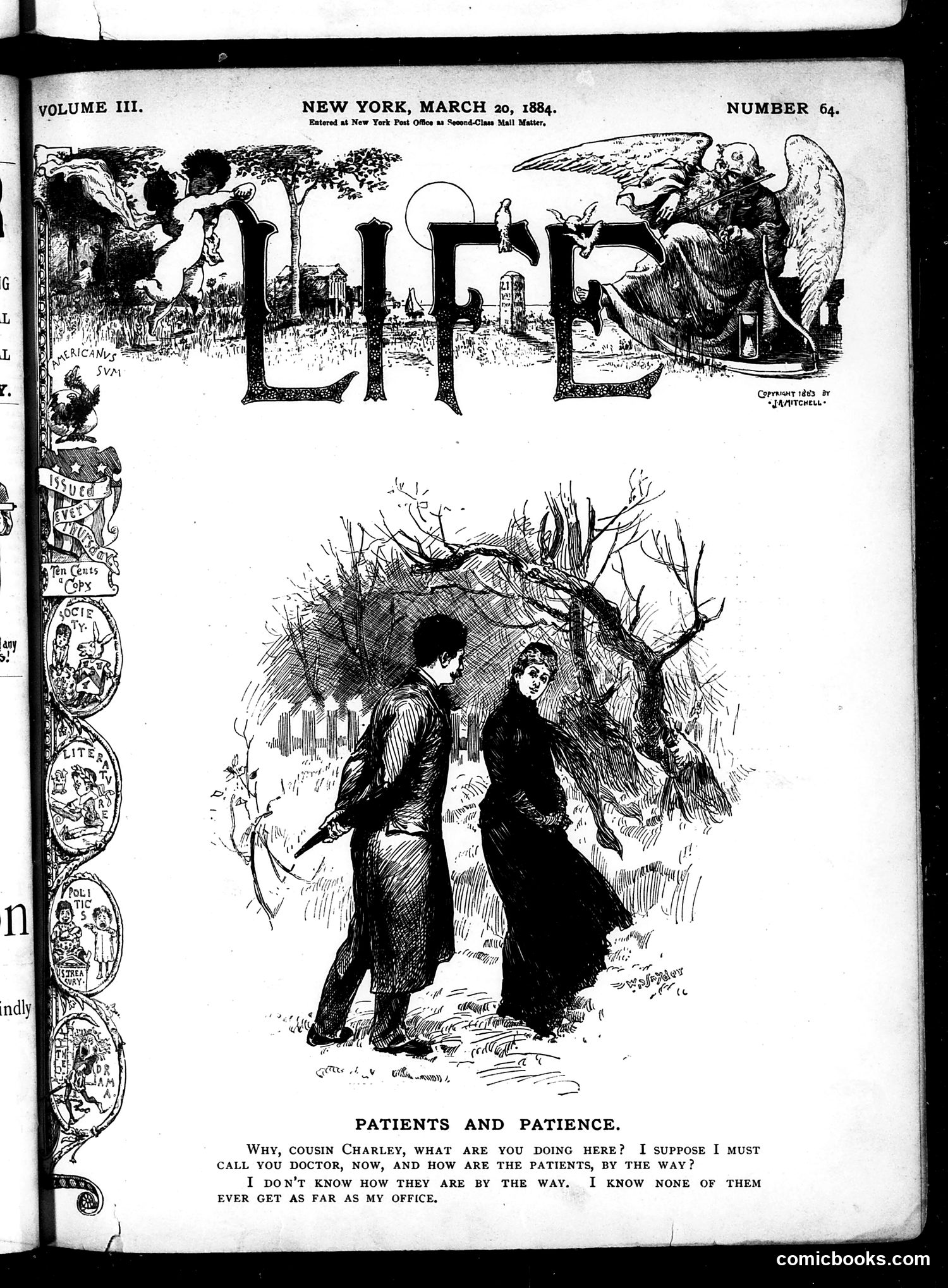
This cartoon satirizes a doctor's poor bedside manner and patient care. Two figures stand outside what appears to be a doctor's office or residence (indicated by the bare tree and simple structure). The dialogue reveals the satirist's point: a doctor complains to his cousin about having to see patients, claiming he doesn't know how they are "by the way" and that patients "never get as far as my office." The satire mocks physicians who are indifferent to their patients' actual conditions and inaccessible to those seeking care. The title plays on "patients" versus "patience"—suggesting the doctor lacks the patience required for his profession. This reflects 19th-century social anxieties about medical professionalism and the quality of healthcare, particularly concerns about doctors prioritizing convenience over patient welfare.
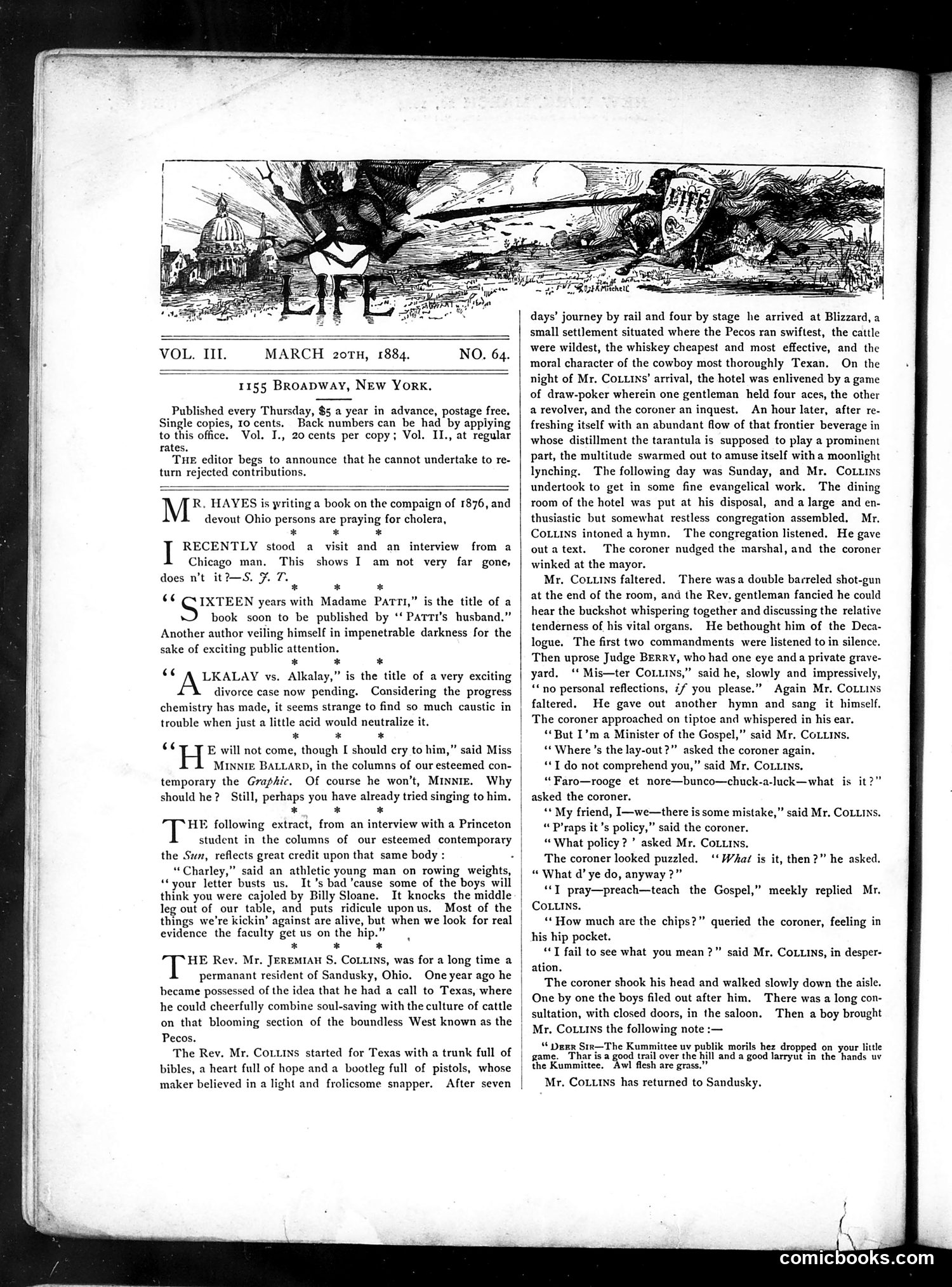
The masthead illustration shows "LIFE" with a winged figure and a banner, typical of the magazine's satirical branding from this era. The page content consists primarily of **editorial notes and brief commentary** rather than political cartoons. Topics include: - A book by Mr. Hayes on the "compaige of 1876" (likely referencing the contested 1876 presidential election) - A mention of "Minnie Ballard" and the *Graphic* publication - A lengthy anecdote about **Rev. Jeremiah S. Collins**, a minister who traveled to Texas. The narrative describes his attempts at evangelical work in a rough frontier setting, with humorous dialogue about frontier slang and his difficulty understanding local customs This appears to be **satirical social commentary** rather than political satire—mocking frontier culture and religious earnestness clashing with rough frontier morality.
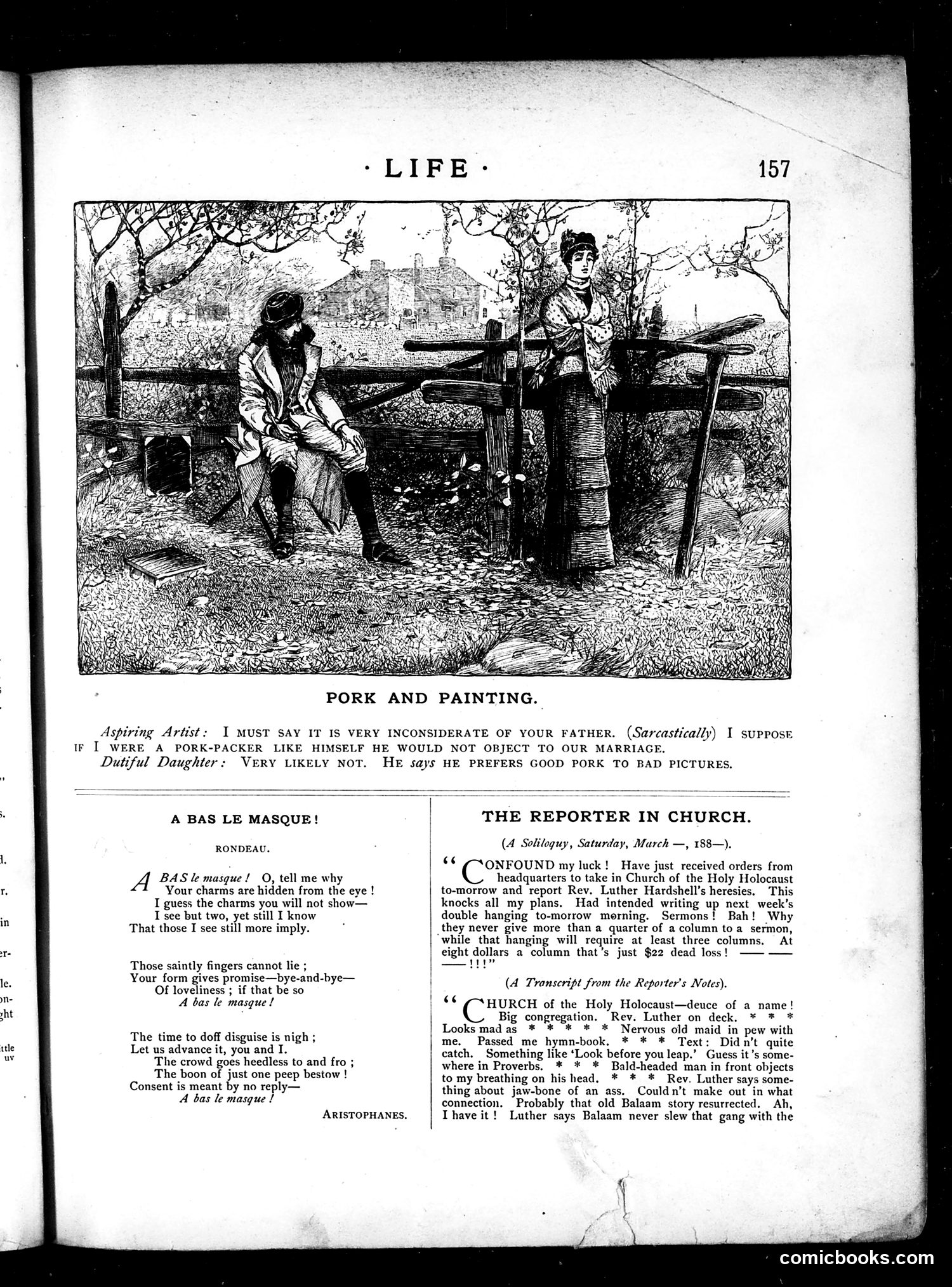
This satirical cartoon depicts a conflict between artistic ambition and practical concerns. An aspiring artist (left) complains that their father won't support their marriage because he prefers "good pork to bad pictures"—suggesting the father views the artist's career as economically unviable compared to more reliable work. The joke plays on class anxieties about professional artists' precarious financial status in the late 19th century. "Pork" represents steady, conventional income (possibly literal pork-packing work), while "painting" symbolizes impractical artistic pursuits. The dutiful daughter agrees the father's skepticism is justified, reinforcing period attitudes that art was a frivolous livelihood unsuitable for supporting a family. The cartoon satirizes both paternal pragmatism and societal dismissal of artists' economic viability.
This page contains no political cartoons. Instead, it features satirical commentary on religious figures and social issues: **Main Content:** - Debate over Reverend Luther Hardshell's fitness as a clergyman, with critics calling him "insane" and noting his public statements contradict Church doctrine - A section titled "Benefit of Crittenden Versus Benefit of Clergy" arguing that murderers of Black victims receive lighter sentences than those who kill white victims, highlighting racial injustice in the legal system - Social commentary questioning how educated men commit crimes, suggesting poverty and ignorance are insufficient excuses **Advertisements:** The page includes book advertisements, including one for "Calcimine for Washington Society"—likely a satirical jab at Washington social circles through a mundane household product ad. The content satirizes religious hypocrisy and racial inequality in the justice system.
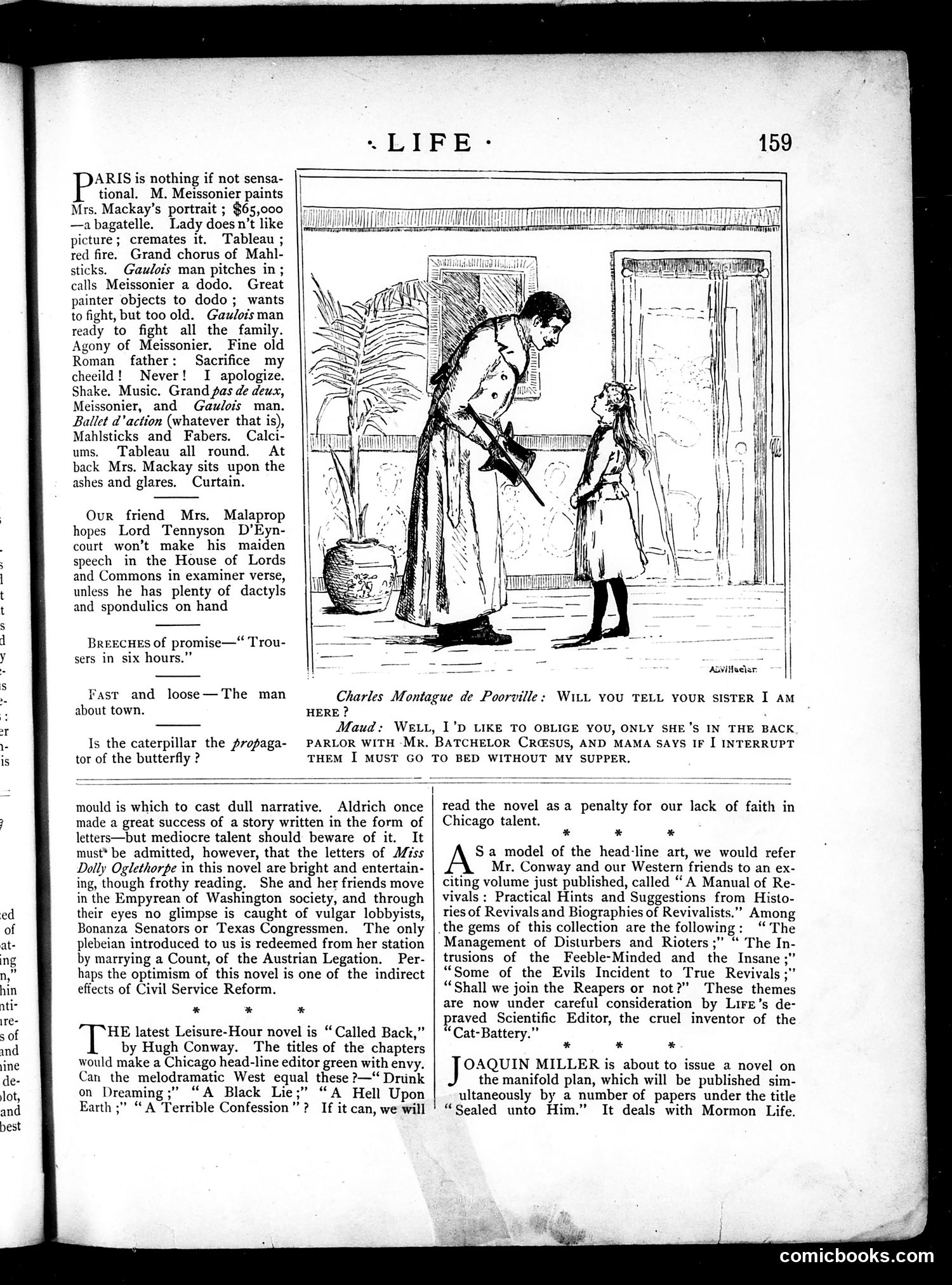
The illustration depicts a scene from a theatrical or literary work: Charles Montague de Poorville confronting a young girl, asking if she'll tell her sister he's present. The girl (Maud) refuses, saying her sister is occupied with "Mr. Batchelor Cruces" and her mother forbids interruptions before bedtime. This appears to be a humorous domestic scene—likely from a contemporary play or serialized story—satirizing social conventions around courtship and family propriety. The exchange plays on the awkwardness of unwanted suitors and parental control over young women's social interactions. The accompanying text discusses contemporary novels and literary criticism, suggesting Life magazine's role in reviewing and satirizing popular entertainment and cultural trends of the era.
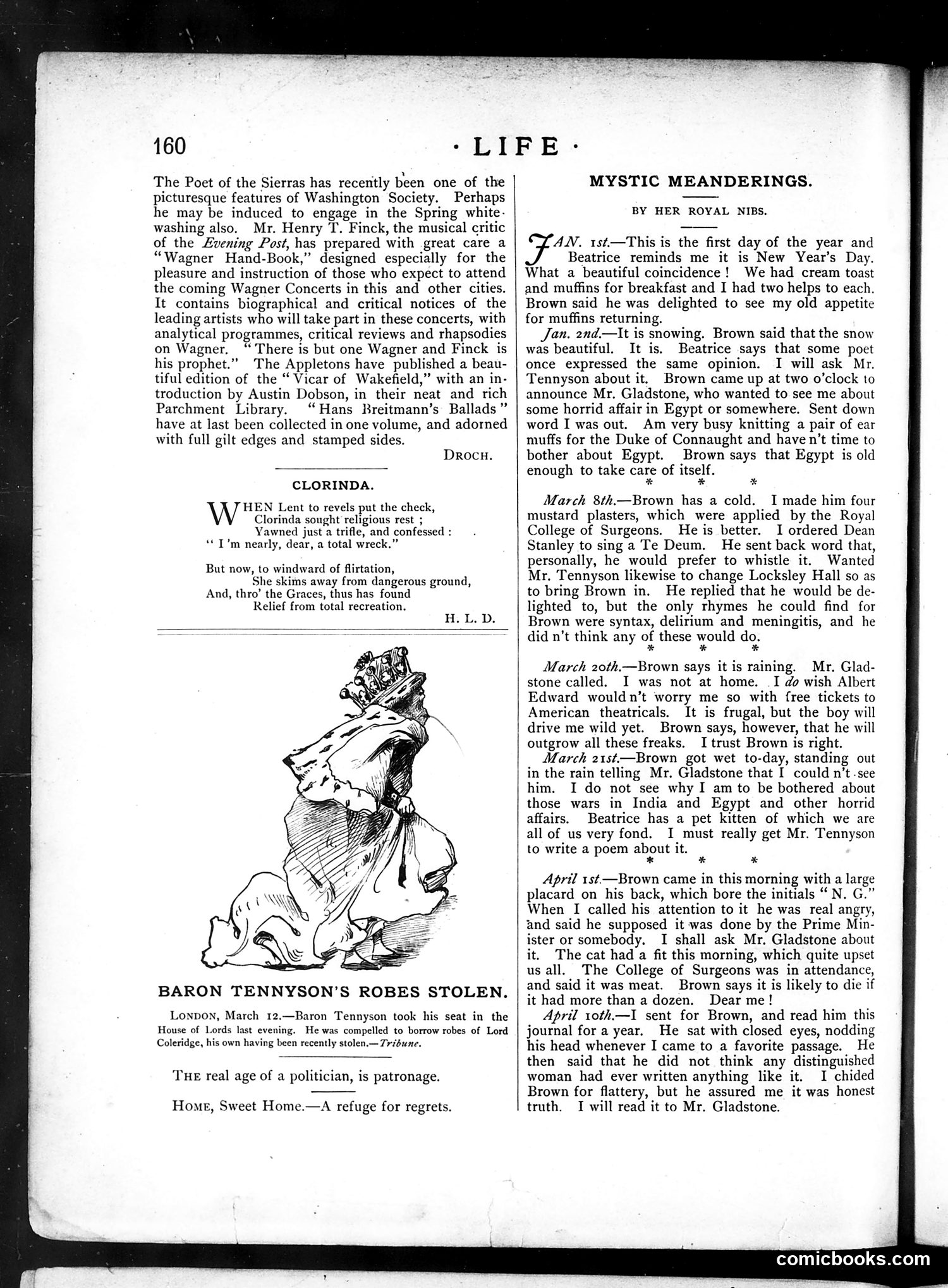
The page contains two main elements: 1. **"Baron Tennyson's Robes Stolen"** — A satirical news item reporting that Baron Tennyson (likely Alfred, Lord Tennyson, the famous poet) had his ceremonial robes stolen while attending the House of Lords. The accompanying cartoon depicts a figure clutching stolen robes, apparently barefoot and disheveled, satirizing the theft of his formal vestments. 2. **"Mystic Meanderings by Her Royal Nibs"** — A diary column by an unnamed society woman recording social observations from January through April, mentioning figures like "Brown" (possibly a servant) and various aristocratic acquaintances and their trivial concerns. The satire mocks both aristocratic pretension (the stolen robes incident) and upper-class gossip columns filled with inconsequential social chitchat.
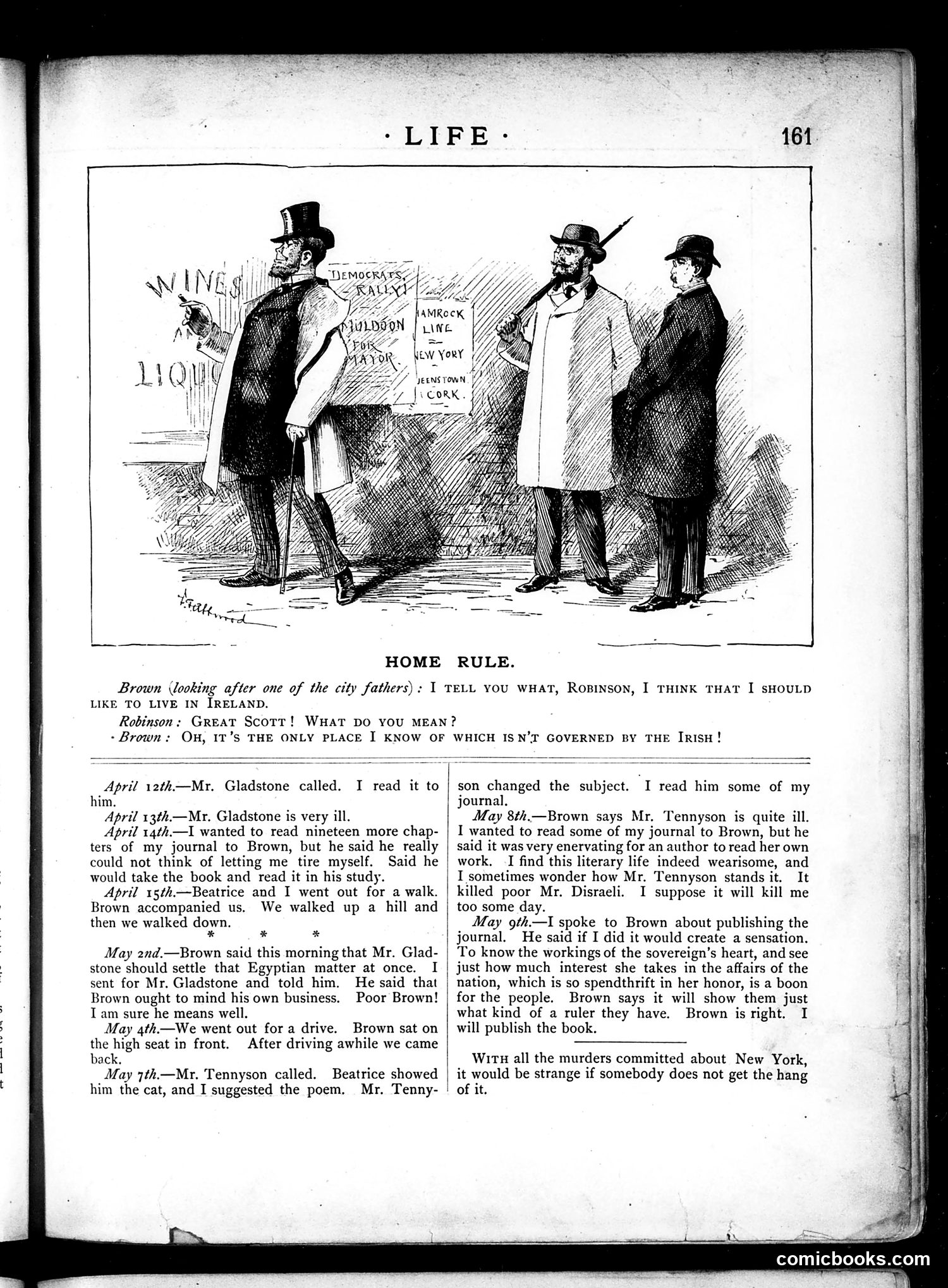
This cartoon satirizes the Irish Home Rule debate of the late 19th century. Three well-dressed men (likely British politicians) discuss Ireland's governance. One man, identified as "Brown," expresses his desire to live in Ireland because it's "the only place I know of which isn't governed by the Irish!" The joke targets British colonialist attitudes: Home Rule would grant Ireland self-governance, which Brown finds objectionable. The satire reveals the contradiction in British rule—they govern Ireland while excluding Irish people from that governance. The diary entries below reference contemporary figures: Gladstone (who championed Home Rule), Tennyson (the poet), and Brown (likely a fictional or generic representative of anti-Home Rule sentiment), showing how this political issue dominated intellectual circles of the period.
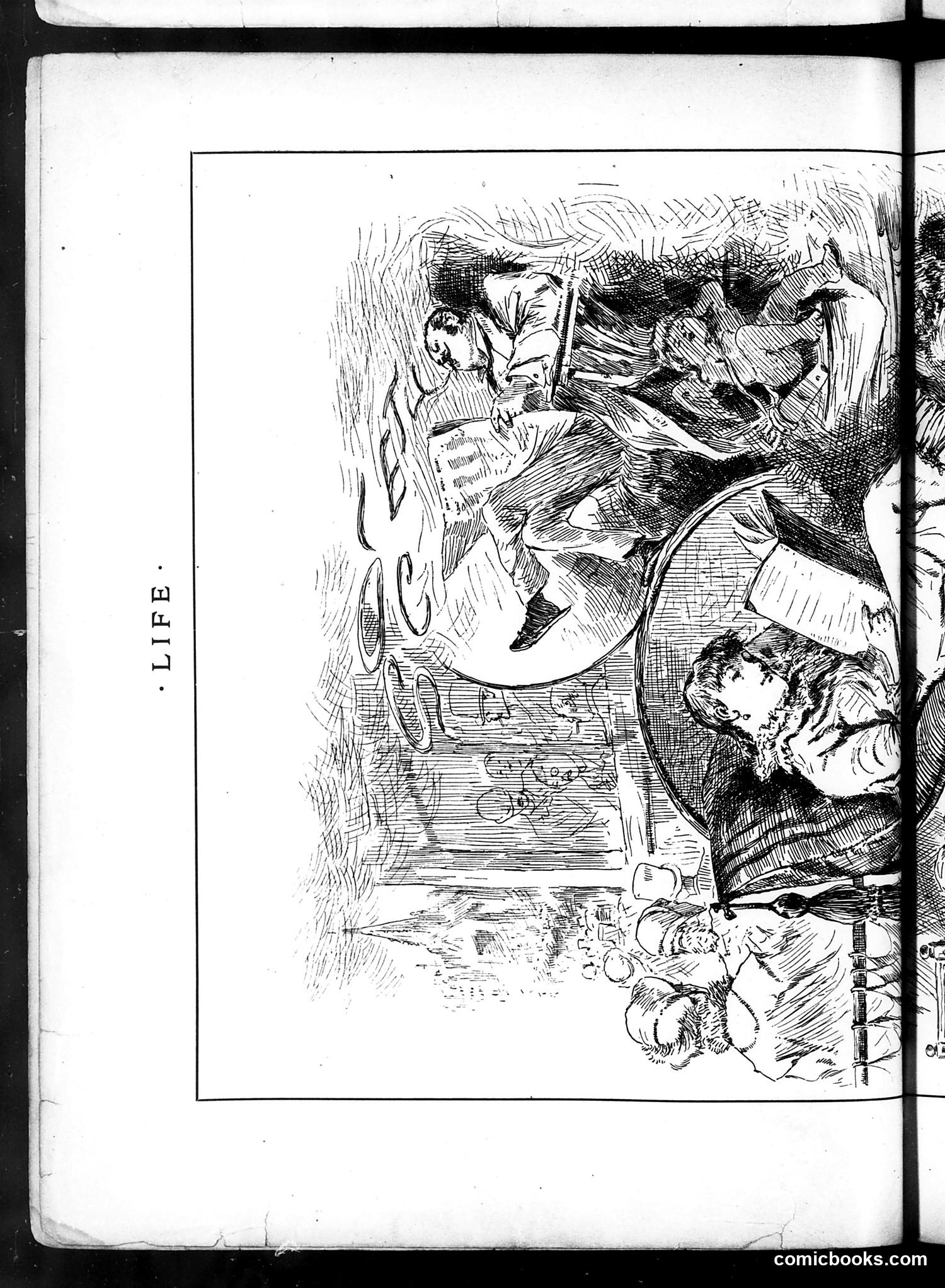
This page from *Life* magazine features a satirical illustration titled "LIFE" (visible on the left margin). The sketch depicts what appears to be a chaotic domestic or social scene rendered in ink with heavy cross-hatching. The drawing shows multiple figures in apparent conflict or struggle—a man appears to be wielding what might be a weapon or tool against others. The style and composition suggest commentary on violence, discord, or social upheaval, though the specific historical event or political situation referenced remains unclear from the image alone. Without additional context about the publication date or accompanying article text, I cannot definitively identify the particular figures or the precise social/political commentary intended. The rough, energetic linework emphasizes drama and chaos rather than clarity.
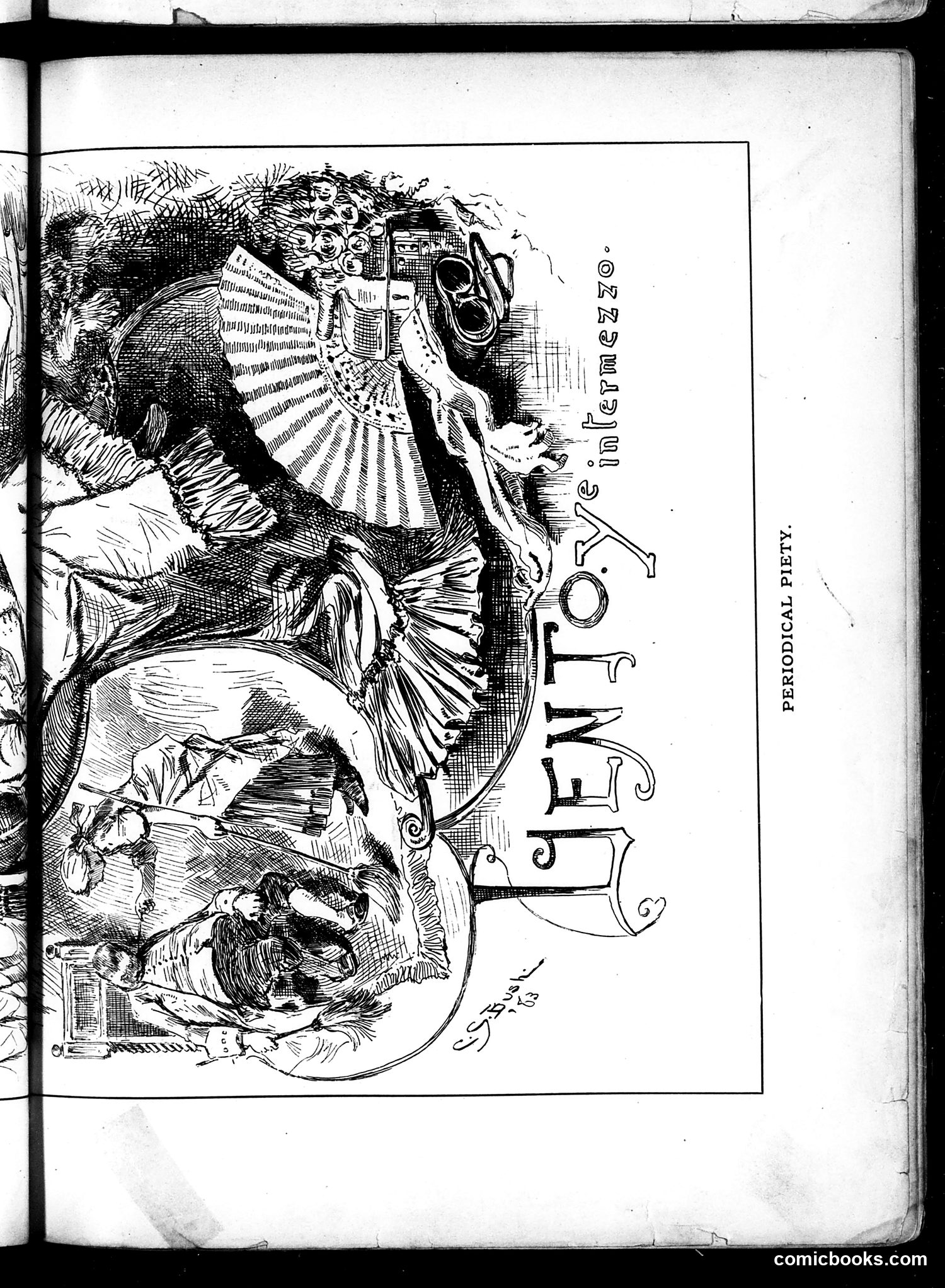
This appears to be a title page or section header for *Life* magazine, a satirical American publication. The illustration shows an elaborately dressed woman in Victorian or Edwardian-era clothing with a large decorative fan, accompanied by smaller figures below—possibly cherubs or putti in classical style. The text reads "LIFE" with "PERIODICAL POETRY" as a subtitle, suggesting this page introduces a poetry or literary section rather than political commentary. The artistic style—detailed pen-and-ink engraving with elaborate cross-hatching—is characteristic of late 19th or early 20th-century American magazine illustration. Without additional context about the specific issue date or accompanying text, I cannot identify the specific figures or pinpoint what social/political references this satire might contain.
This page contains two distinct pieces: **"Breaking the Ice"** is a humorous poem about a romantic ice-skating encounter. A couple falls through the ice while skating, and the narrator is annoyed by his companion's desperate grip and messy appearance during rescue. The satire's point: once they're safe on shore, the previously "timid and shy" woman becomes chatty and confident—they've literally and figuratively "broken the ice" in their relationship. The humor derives from the narrator's complaint about the unromantic reality of near-drowning contrasted with the sentimental outcome. **"It Is Not De Rigeur"** is a satirical etiquette guide listing social behaviors that are supposedly *not* required—though the tongue-in-cheek tone suggests they actually *are* common and expected. Examples include not apologizing for stepping on someone's toe, not asking permission before sitting on a lady's lap in crowded transit, and lying by omission rather than direct falsehood. The satire mocks both Victorian propriety and people's actual disregard for it. Both pieces ridicule social pretense and hypocrisy of the era.
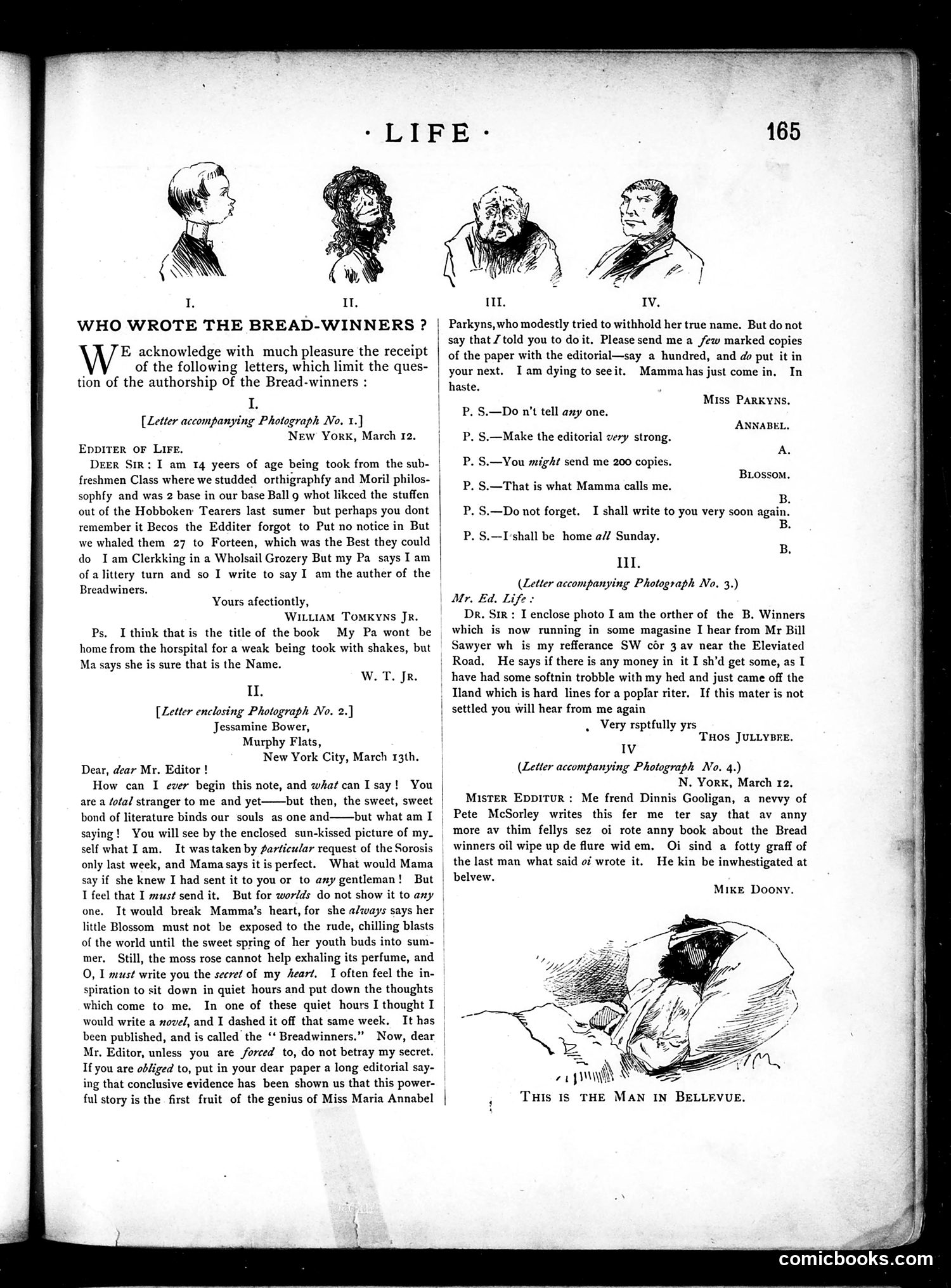
This page satirizes the literary controversy surrounding the anonymously published novel *The Bread-Winners* (1884). Life magazine presents four fake claimants to authorship, each accompanied by a portrait sketch. The satire works through absurd contrasts: a barely-literate 14-year-old boy, a vain society woman (Miss Annabel) who insists on secrecy while demanding publicity, an ex-convict recently released from "the Island" (Blackwell's Island prison), and an unnamed fourth figure. Each letter contains deliberate misspellings and ridiculous contradictions—Miss Annabel requests anonymity while asking for 100 marked copies of the editorial about her authorship. The joke targets both pretentious literary society and public obsession with authorship mysteries. By presenting increasingly implausible authors, Life mocks the actual debate over *The Bread-Winners'* real author (John Hay, which remained disputed). The crude portraits exaggerate each character's absurdity, suggesting that *anyone* could claim authorship, undermining the seriousness of literary attribution itself.
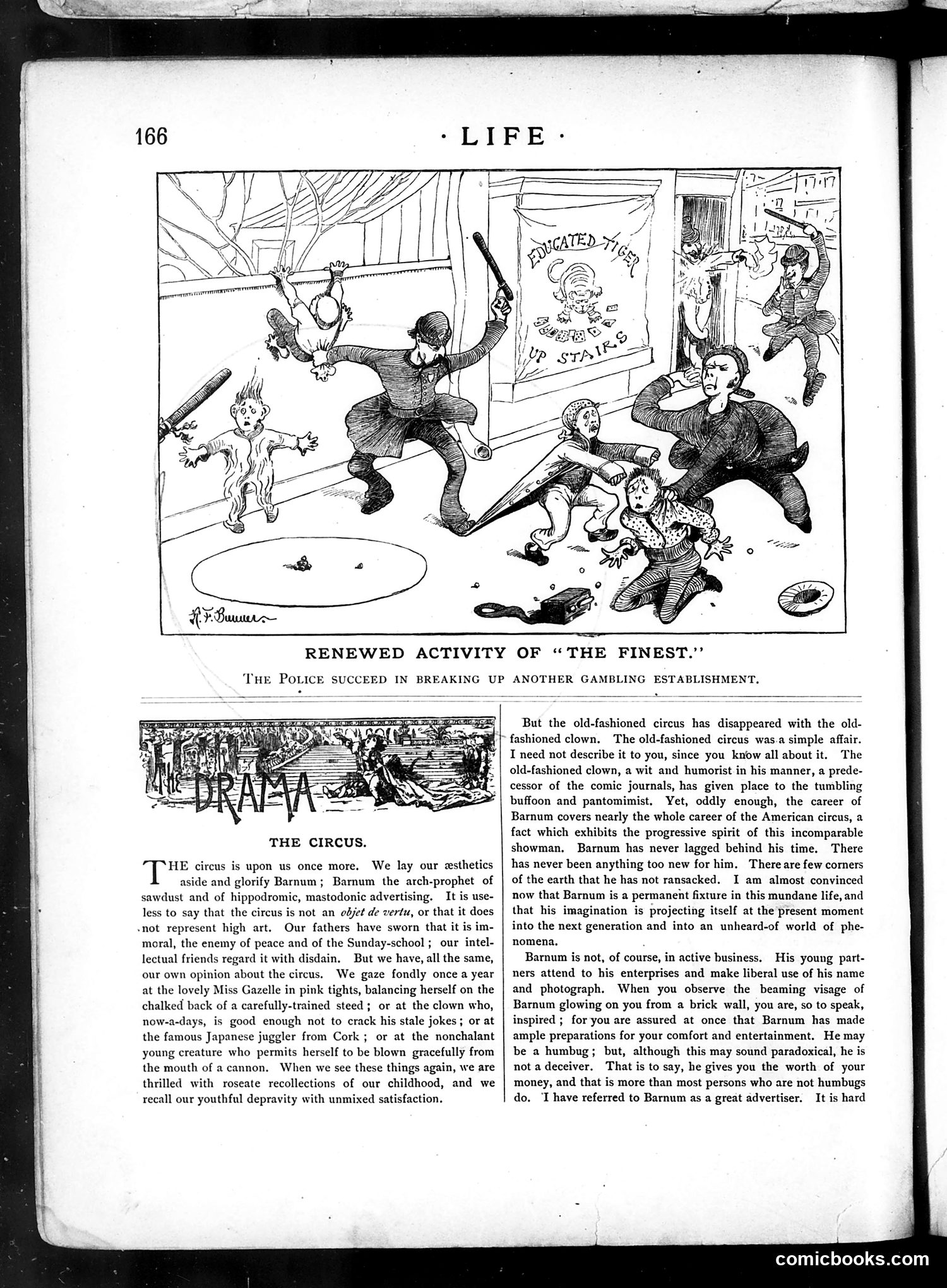
**The Top Cartoon:** Depicts police raiding what appears to be an illegal gambling operation disguised as a circus or entertainment venue. Officers are actively breaking up the establishment while patrons (depicted as small, undignified figures) flee. The sign reads "Educated Fleas" — a common circus attraction used as cover. The satire criticizes "The Finest" (police slang for themselves), suggesting their efforts to stop gambling are chaotic and ineffective theater. **The Article Below:** Praises P.T. Barnum and the circus as wholesome Americana, celebrating his showmanship and innovation. Notably, it defends Barnum as honest despite calling him a "humbug" — meaning he delivers entertainment value even if manipulative. The piece nostalgically contrasts the modern circus with "old-fashioned" versions, mourning lost simplicity while acknowledging progress. **Context:** This reflects Gilded Age attitudes toward entertainment, advertising, and police corruption, presenting gambling raids as performative while celebrating commercial spectacle.
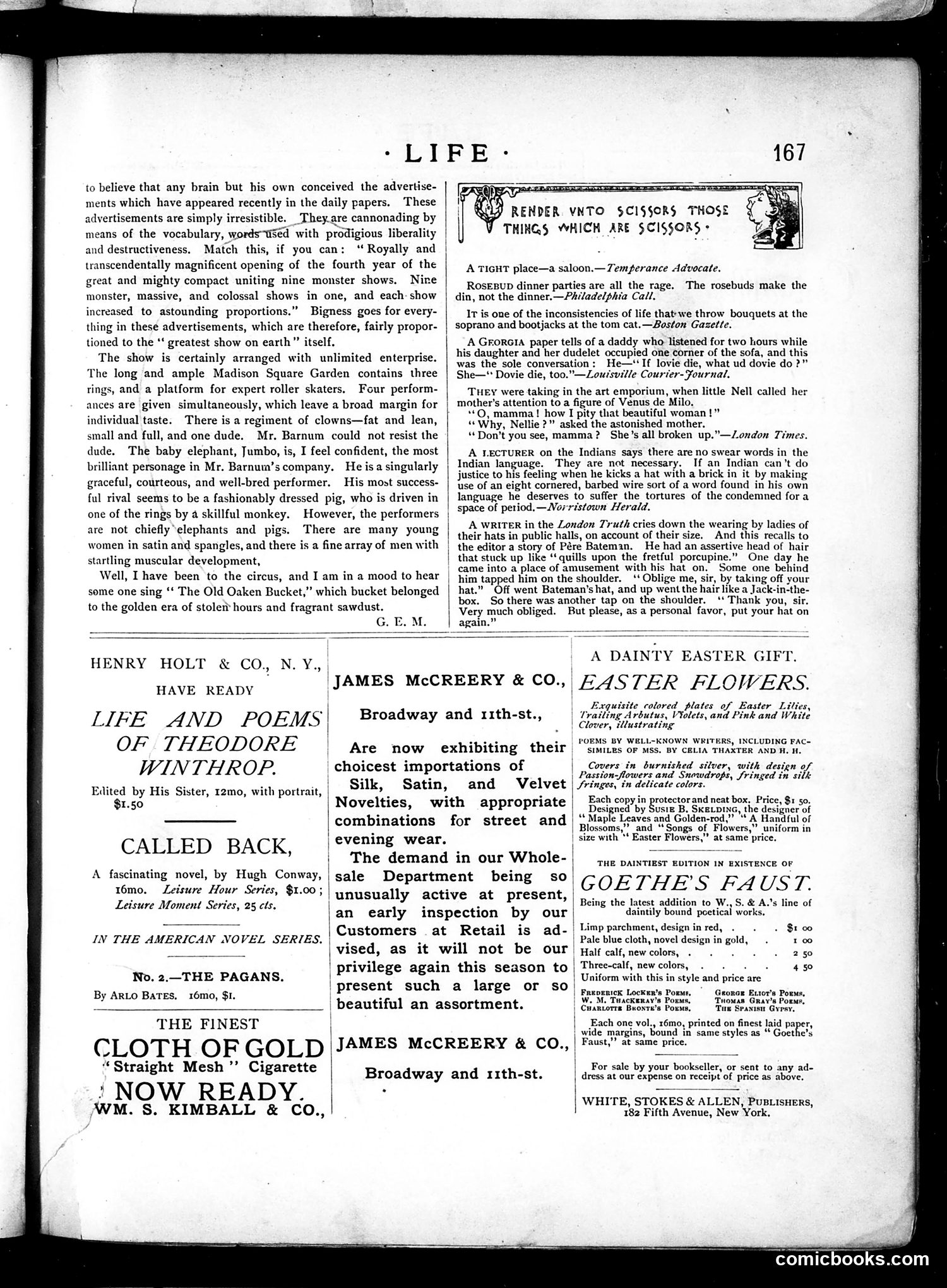
This page is primarily **advertising and miscellaneous content** rather than political satire. The main text discusses a visit to **P.T. Barnum's circus** at Madison Square Garden, praising its scale and performers (elephants, clowns, roller skaters, and acrobats). The author mocks Barnum's notoriously grandiose advertising language, which uses exaggerated vocabulary about "monster shows" and "astounding proportions." The cartoon at top shows scissors with caption "Render unto scissors those things which are scissors"—likely a mild joke about proper tool use or biblical paraphrasing. Below are several humorous anecdotes: a girl pitying Venus de Milo's armlessness, a lecture on Indian expletives, and a story about an assertive hairstyle disrupting a theater audience. The remaining space contains book and product advertisements (Theodore Winthrop's poems, Hugh Conway's novel, James McCreery fabric goods, Goethes Faust, and cigarettes). There is **no significant political content** on this page.
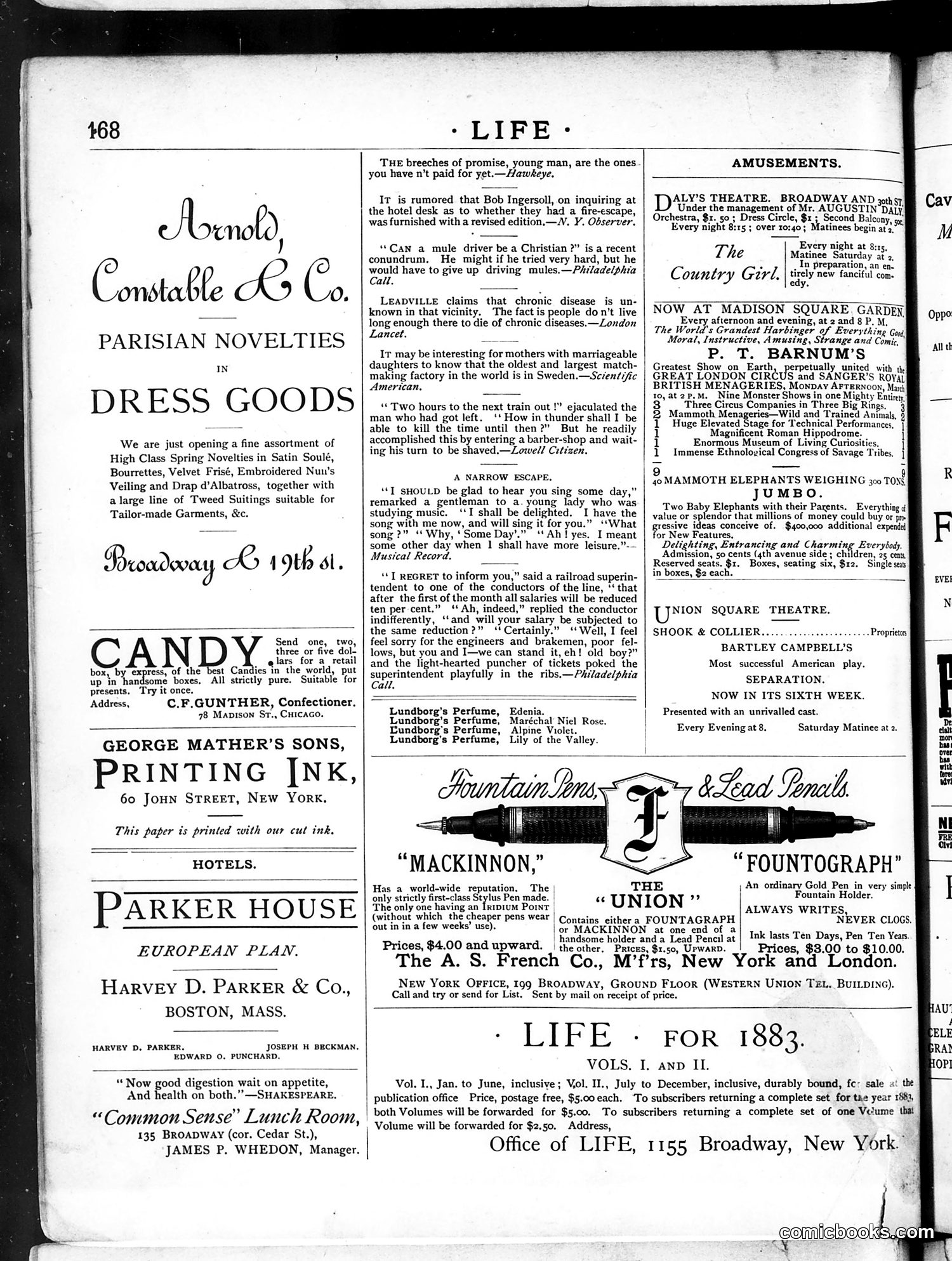
This page is primarily **advertising and announcements**, with minimal political content. The layout features dress goods retailers, candy makers, hotels, and printing companies typical of 1880s commercial notices. The small humor section contains brief, apolitical jokes: - A quip about unpaid marriage promises - A anecdote about Robert Ingersoll (the famous agnostic) asking for a fire-escape and receiving a "revised edition" (wordplay on his religious skepticism) - A conundrum about mule drivers and Christianity - Observations about longevity in Leadville, Colorado The theatrical announcements promote P.T. Barnum's circus and Broadway shows like "The Country Girl." **No identifiable political cartoons appear.** The page reflects the magazine's satirical approach through brief, punchy one-liners rather than visual imagery. The humor targets religion, travel inconveniences, and social situations—safely apolitical for an 1883 audience.
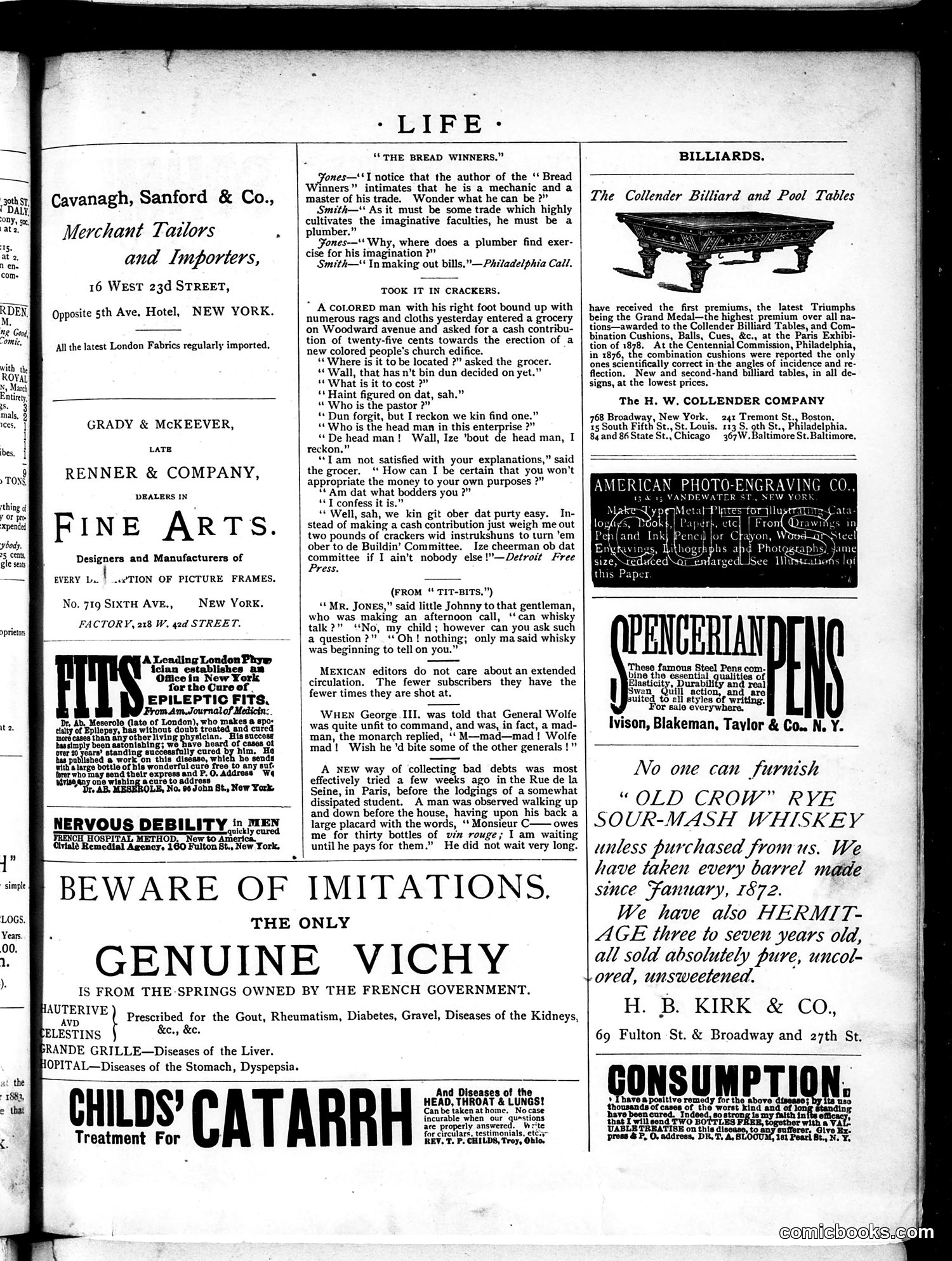
This is primarily an **advertising and humor page** from Life magazine, containing no political cartoons. The content consists of: **Advertisements** for merchant tailors, picture frames, medical treatments (epilepsy, "nervous debility"), Vichy water, and billiard tables—typical late 19th-century pitches, some making dubious health claims. **Humorous anecdotes** mocking: - A plumber's inflated billing practices - A Black man's vague plans to build a church, portrayed through racist dialect and stereotypes suggesting dishonesty and incompetence - A child's innocent observation about alcohol's effects - Mexican editors' supposed indifference to subscriber safety - A creative debt-collection method in Paris The jokes reflect period prejudices and social anxieties. The "bread winners" reference appears to dispute an author's claim to be a working mechanic. Overall, this represents Life's mix of advertising revenue and satirical humor targeting various groups and social types of the era.
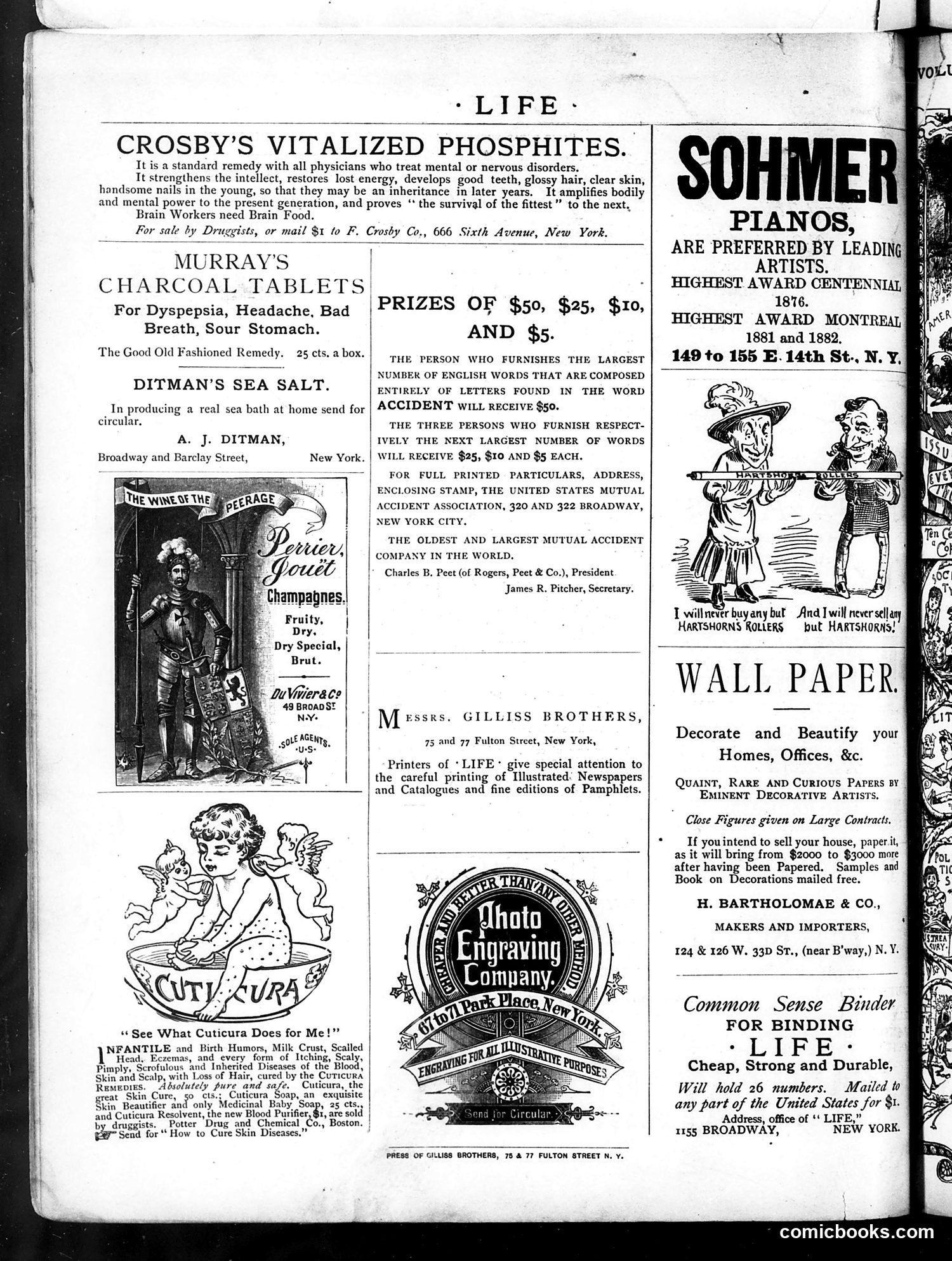
This page is primarily **advertisements** with one small cartoon visible. The main satirical content is a two-panel cartoon (bottom left) showing a couple negotiating over **Hartshorne Rollers** (window shade hardware). The man says "I will never buy any but Hartshorne Rollers" while the woman responds "And I will never sell but Hartshorne's!"—a humorous domestic exchange where both parties stubbornly insist on the same brand, satirizing the absurdity of advertising claims and marital arguments over consumer goods. The page reflects late-19th-century America's emerging consumer culture, with ads for patent medicines (Crosby's Phosphites, Murray's Charcoal Tablets) making pseudoscientific health claims, alongside legitimate products like pianos and wallpaper. The "Accident" word-puzzle contest promoted by an insurance company shows how companies used entertainment to build brand loyalty.