
Life, 1884-03-20 · page 7 of 16
Life — March 20, 1884 — page 7: what you’re looking at
What you’re looking at
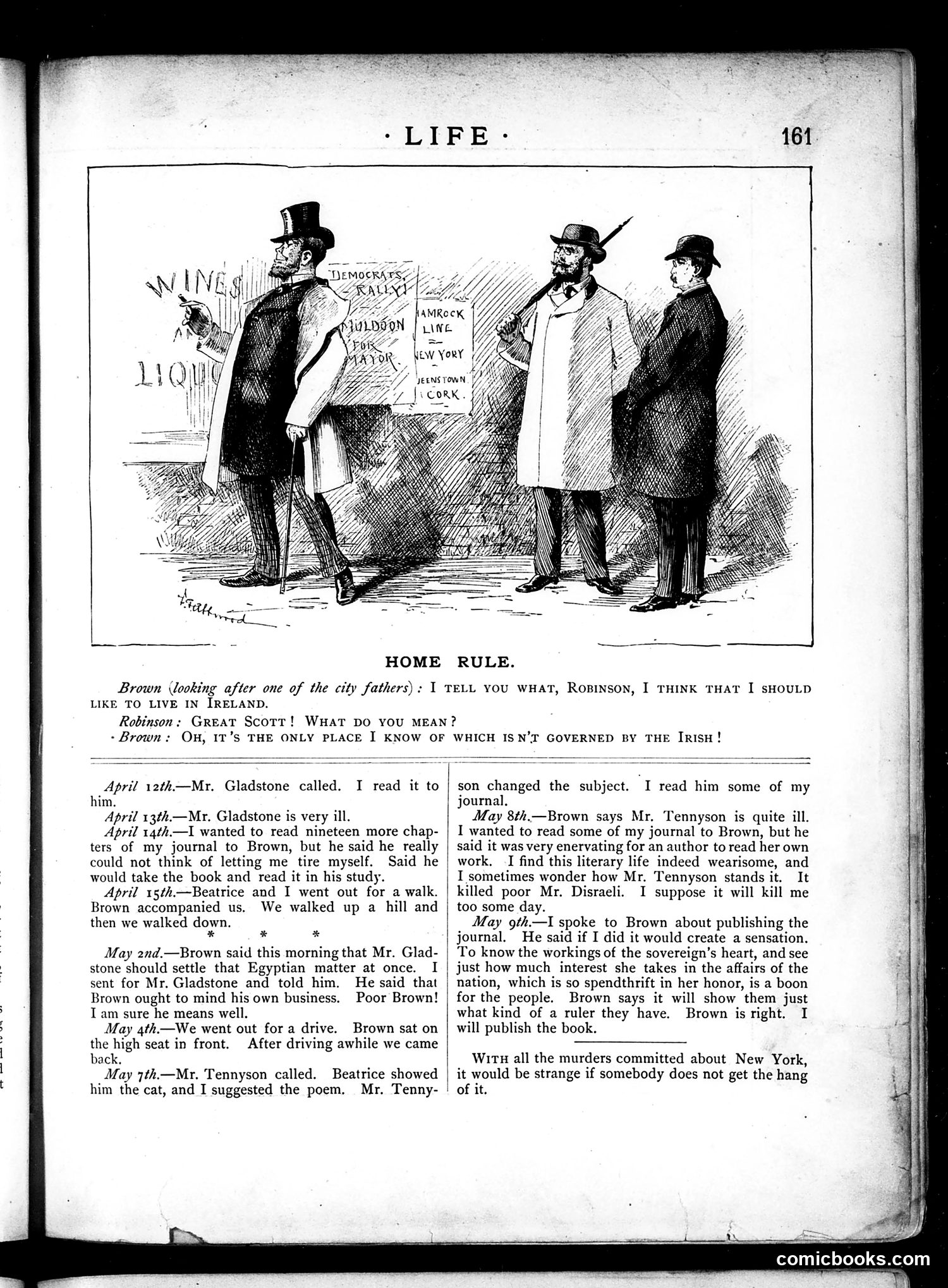
This cartoon satirizes the Irish Home Rule debate of the late 19th century. Three well-dressed men (likely British politicians) discuss Ireland's governance. One man, identified as "Brown," expresses his desire to live in Ireland because it's "the only place I know of which isn't governed by the Irish!" The joke targets British colonialist attitudes: Home Rule would grant Ireland self-governance, which Brown finds objectionable. The satire reveals the contradiction in British rule—they govern Ireland while excluding Irish people from that governance. The diary entries below reference contemporary figures: Gladstone (who championed Home Rule), Tennyson (the poet), and Brown (likely a fictional or generic representative of anti-Home Rule sentiment), showing how this political issue dominated intellectual circles of the period.
📄 Transcribed text from this page (OCR, searchable)
Machine-transcribed from the original scan — historical spelling and the odd misread are preserved.
EMOCRATS, HOME RULE. Brown (looking after one of the city fathers): | TELL you wHat, Rosinson, I THINK THAT I sHOULD LIKE TO LIVE IN IRELAND. Robinson: Great Scott! WHAT DO YOU MEAN? - Brown: OH, IT’S THE ONLY PLACE I KNOW OF WHICH IS N’T GOVERNED BY THE IRISH! April 12th—Mr. Gladstone called. I read it to him. April 13th.—Mr. Gladstone is very ill. April 14th.—I wanted to read nineteen more chap- ters of my journal to Brown, but he said he really could not think of letting me tire myself. Said he would take the book and read it in his study. April 15th.—Beatrice and I went out for a walk. Brown accompanied us. then we walked down. * * * May 2nd.—Brown said this morning that Mr. Glad- | | just how much interest she takes in the affairs of the stone should settle that Egyptian matter at once. I sent for Mr. Gladstone and told him. He said that | Poor Brown! | Brown ought to mind his own business. Tam sure he means well. May 4th—We went out for a drive. Brown sat on the high seat in front. After driving awhile we came back, May 7th.—Mr. Tennyson called. Beatrice showed him the cat, and I suggested the poem. Mr. Tenny- We walked up a hill and | | journal. son changed the subject. I read him some of my journal. May 8¢h.—Brown says Mr. Tennyson is quite ill. I wanted to read some of my journal to Brown, but he said it was very enervating for an author to read her own work. I find this literary life indeed wearisome, and I sometimes wonder how Mr. Tennyson stands it. It killed poor Mr. Disraeli. I suppose it will kill me too some day. May 9th.—I spoke to Brown about publishing the He said if I did it would create a sensation. To know the workings of the sovereign’s heart, and see nation, which is so spendthrift in her honor, is a boon for the people. Brown says it will show them just what kind of a ruler they have. Brown is right. I will publish the book. WitH all the murders committed about New York, it would be strange if somebody does not get the hang of it, comicbooks.com