
Life, 1884-03-20 · page 10 of 16
Life — March 20, 1884 — page 10: what you’re looking at
What you’re looking at
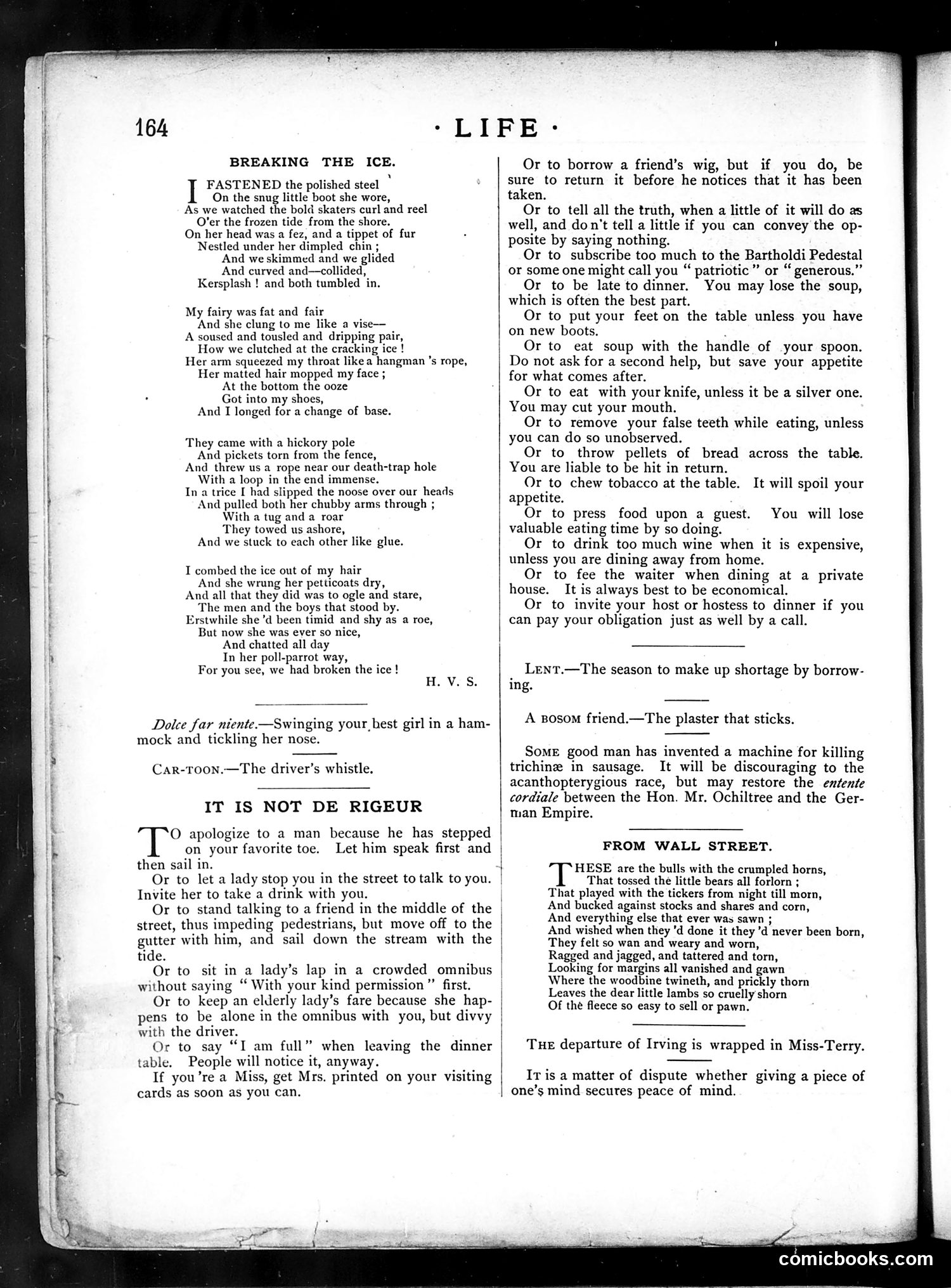
This page contains two distinct pieces: **"Breaking the Ice"** is a humorous poem about a romantic ice-skating encounter. A couple falls through the ice while skating, and the narrator is annoyed by his companion's desperate grip and messy appearance during rescue. The satire's point: once they're safe on shore, the previously "timid and shy" woman becomes chatty and confident—they've literally and figuratively "broken the ice" in their relationship. The humor derives from the narrator's complaint about the unromantic reality of near-drowning contrasted with the sentimental outcome. **"It Is Not De Rigeur"** is a satirical etiquette guide listing social behaviors that are supposedly *not* required—though the tongue-in-cheek tone suggests they actually *are* common and expected. Examples include not apologizing for stepping on someone's toe, not asking permission before sitting on a lady's lap in crowded transit, and lying by omission rather than direct falsehood. The satire mocks both Victorian propriety and people's actual disregard for it. Both pieces ridicule social pretense and hypocrisy of the era.
📄 Transcribed text from this page (OCR, searchable)
Machine-transcribed from the original scan — historical spelling and the odd misread are preserved.
- LPPE BREAKING THE ICE. FASTENED the polished steel On the snug little boot she wore, As we watched the bold skaters curl and reel O’er the frozen tide from the shore. On her head was a fez, and a tippet of fur Nestled under her dimpled chin ; And we skimmed and we glided And curved and—collided, Kersplash ! and both tumbled in. My fairy was fat and fair And she clung to me like a vise— A soused and tousled and dripping pair, How we clutched at the cracking ice ! Her arm squeezed my throat like a hangman's rope, Her matted hair mopped my face ; At the bottom the ooze Got into my shoes, And I longed for a change of base. They came with a hickory pole And pickets torn from the fence, And threw us a rope near our death-trap hole With a loop in the end immense. In a trice [ had slipped the noose over our heads And pulled both her chubby arms through ; With a tug and a roar They towed us ashore, And we stuck to each other like glue. I combed the ice out of my hair ‘And she wrung her petticoats dry, And all that they did was to ogle and stare, The men and the boys that stood by. Erstwhile she ’d been timid and shy as a roe, But now she was ever so nice, And chatted all day In her poll-parrot way, For you see, we had broken the ice ! H. V. S. Dolce far niente—Swinging your, best girl in a ham- mock and tickling her nose. Car-Toon.—The driver’s whistle. IT IS NOT DE RIGEUR O apologize to a man because he has stepped on your favorite toe. Let him speak first and then sail in. Or to let a lady stop you in the street to talk to you. Invite her to take a drink with you. Or to stand talking to a friend in the middle of the | street, thus impeding pedestrians, but move off to the gutter with him, and sail down the stream with the tide. Or to sit in a lady’s lap in a crowded omnibus without saying “ With your kind permission” first. Or to keep an elderly lady’s fare because she hap- pens to be alone in the omnibus with you, but divvy with the driver. Or to say “I am full” when leaving the dinner table. People will notice it, anyway. If you’re a Miss, get Mrs. printed on your visiting cards as soon as you can. Or to borrow a friend’s wig, but if you do, be sure to return it before he notices that it has been taken. Or to tell all the truth, when a little of it will do as well, and don't tell a little if you can convey the op- posite by saying nothing. Or to subscribe too much to the Bartholdi Pedestal or some one might call you “ patriotic” or “ generous.” Or to be late to dinner. You may lose the soup, which is often the best part. Or to put your feet on the table unless you have on new boots. Or to eat soup with the handle of your spoon. Do not ask for a second help, but save your appetite for what comes after. Or to eat with your knife, unless it be a silver one. You may cut your mouth. Or to remove your false teeth while eating, unless you can do so unobserved. Or to throw pellets of bread across the table. You are liable to be hit in return. Or to chew tobacco at the table. It will spoil your appetite. | Or to press food upon a guest. | valuable eating time by so doing. Or to drink too much wine when it is expensive, unless you are dining away from home. Or to fee the waiter when dining at a private house. It is always best to be economical. Or to invite your host or hostess to dinner if you can pay your obligation just as well by a call. You will lose _ Lent.—The season to make up shortage by borrow- ing. A Bosom friend.—The plaster that sticks. Some good man has invented a machine for killing trichine in sausage. It will be discouraging to the acanthopterygious race, but may restore the entente cordiale between the Hon. Mr. Ochiltree and the Ger- man Empire. FROM WALL STREET. | Ts are the bulls with the crumpled horns, That tossed the little bears all forlorn ; That played with the tickers from night till morn, And bucked against stocks and shares and corn, | And everything else that ever was sawn ; | And wished when they 'd done it they ’d never been born, | They felt so wan and weary and worn, | | Ragged and jagged, and tattered and torn, Looking for margins all vanished and gawn Where the woodbine twineth, and prickly thorn | Leaves the dear little lambs so cruelly shorn Of the fleece so easy to sell or pawn. Tue departure of Irving is wrapped in Miss-Terry. Ir is a matter of dispute whether giving a piece of | one’s mind secures peace of mind. comicbooks.com