
A complete issue · 19 pages · 1884
Life — January 3, 1884
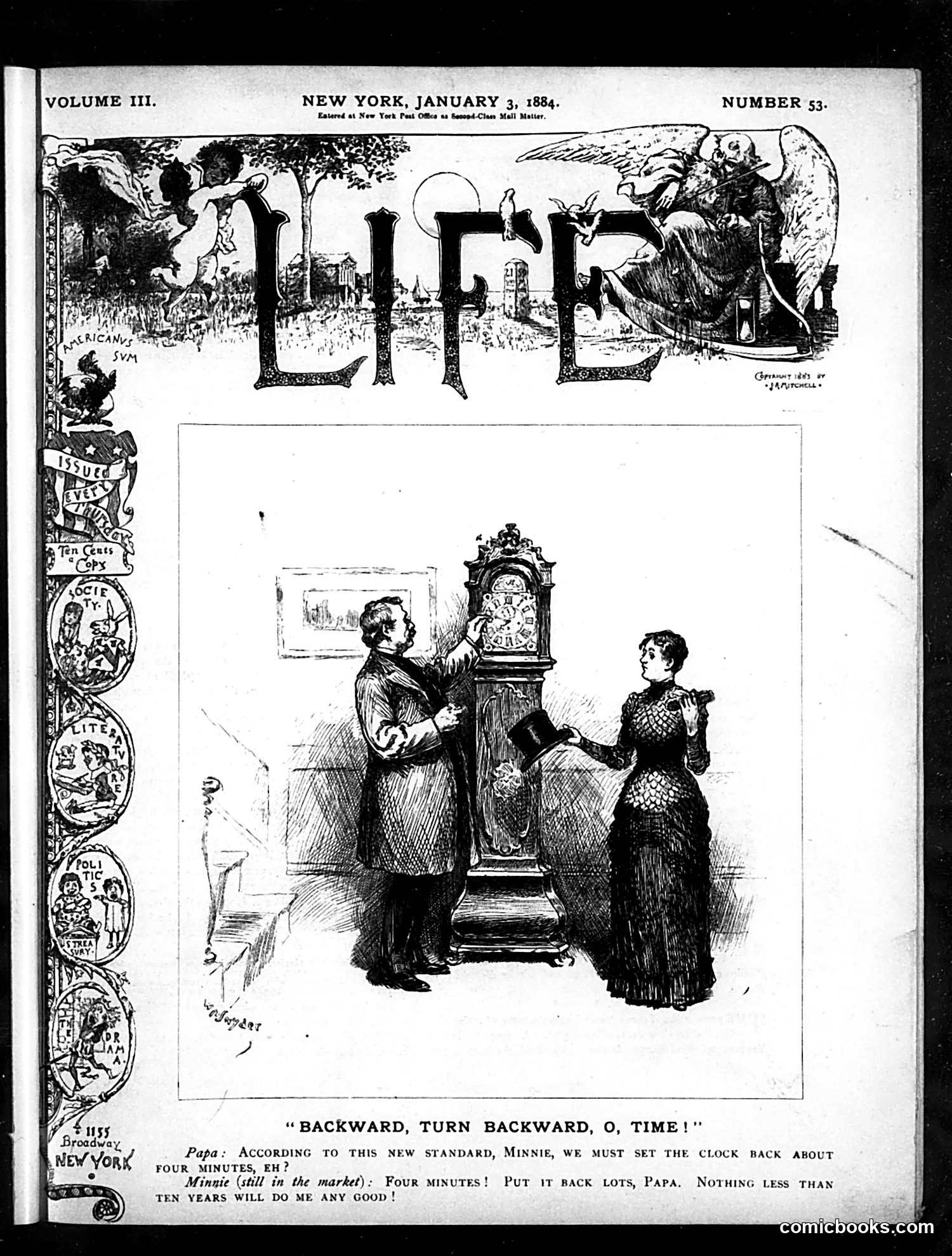
This 1884 *Life* magazine cartoon satirizes marital conflict over timekeeping. A man (labeled "Papa") and woman (labeled "Minnie") argue beside a grandfather clock. According to the caption, Minnie insists the clock be set back four minutes because she believes doing so will extend her youth by ten years—a humorous jab at vanity and magical thinking about aging. The satire mocks both female vanity (the obsession with appearing younger) and the absurdity of believing one can reverse time through clock manipulation. The domestic quarrel setup reflects 1880s anxieties about marriage dynamics and gender relations. The joke's humor depends on the reader recognizing the irrationality of Minnie's demand and the exasperation it causes her husband.
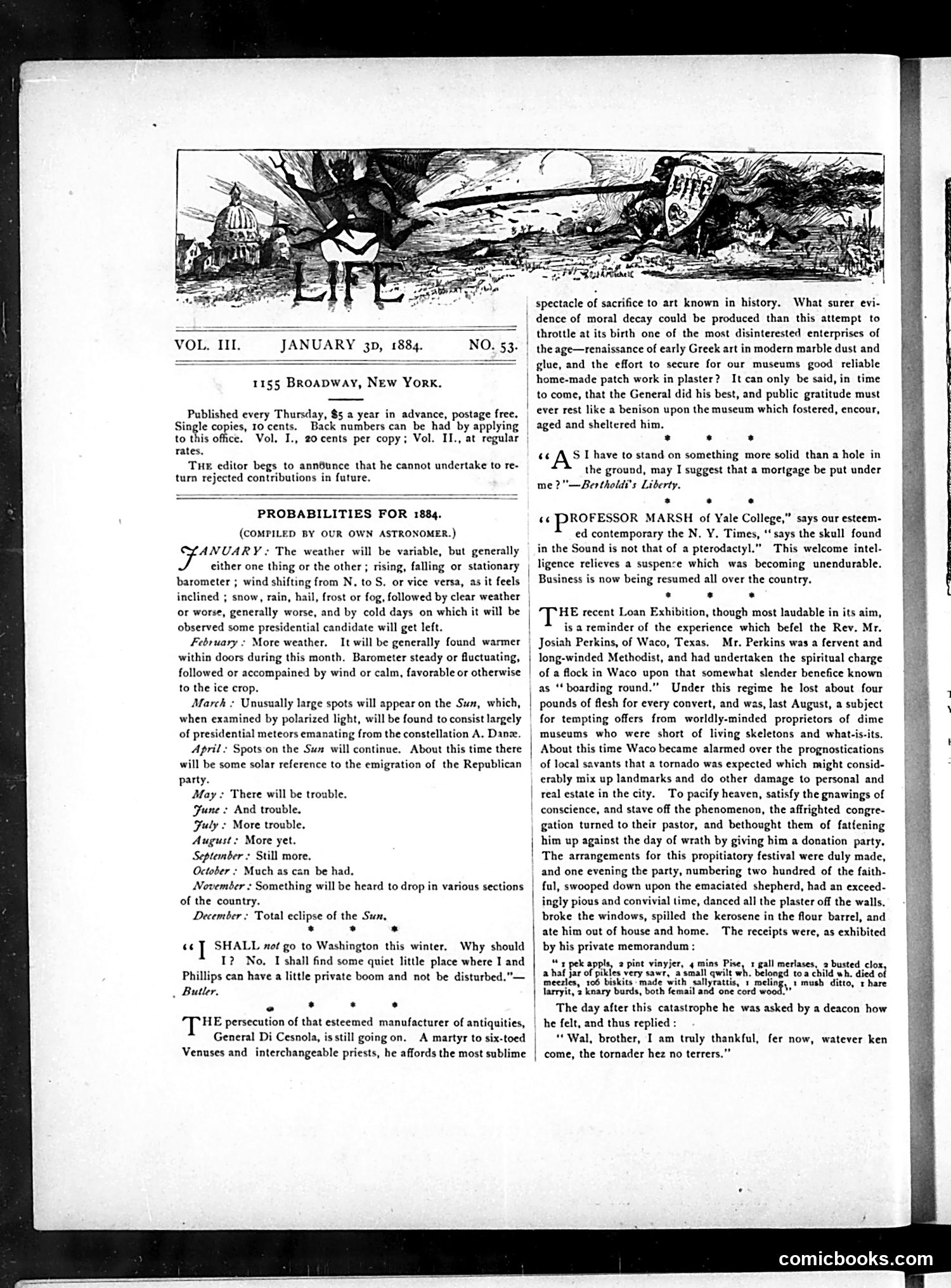
The masthead illustration depicts a skeletal death figure labeled "Life" overlooking a landscape with a dome (likely the Capitol). This appears to be satirical commentary on mortality and politics. The text discusses General Di Cesnola, curator of antiquities being persecuted—likely a contemporary scandal involving the museum official. The passage critiques his prosecution as evidence of "moral decay," comparing it unfavorably to Greek Renaissance values. A separate section mocks a Methodist minister in Waco, Texas, whose congregation donated money to protect him from a tornado's destruction, then celebrated the donation with a party. The satire targets religious hypocrisy—the contrast between pious gratitude and worldly celebration. The "Probabilities for 1884" section is mock-astrological political prediction, suggesting Republican troubles ahead.
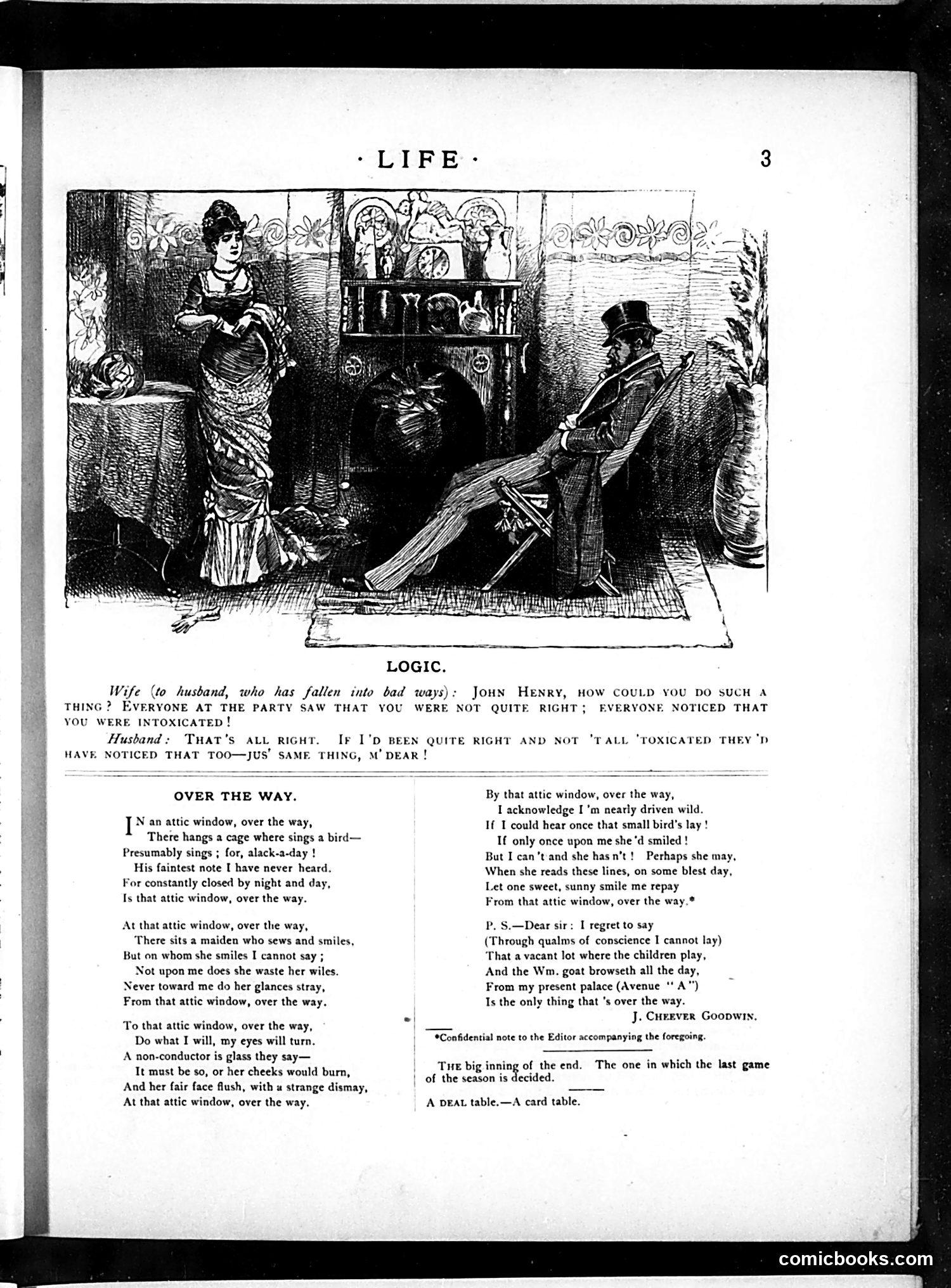
The cartoon titled "LOGIC" depicts a domestic dispute. A wife confronts her husband John Henry about appearing intoxicated at a party, noting everyone noticed his condition. His defense employs circular logic: he claims if he'd been "quite right" and "not 'all 'toxicated," people would have noticed *that* instead—therefore, their noticing his intoxication proves nothing unusual occurred. The satire mocks male drunkenness and the absurd excuses husbands offered to wives. The cartoon presents a common domestic scenario of the period where a husband's heavy drinking was socially tolerated but personally problematic. Below is a poem titled "Over the Way" about lost love and regret, unrelated to the cartoon. The page represents typical early-20th-century Life magazine content: satirical commentary on middle-class social behavior.
This page contains no political cartoon. Instead, it features: 1. **"A Triangular Duel in Three Acts"** — a humorous theatrical sketch by "One of the Actors" about romantic entanglement between Mr. Bowser, Miss Wavering, and Mr. Towser. The dialogue depicts the social awkwardness of Victorian courtship, with men and women performing coded politeness while navigating romantic jealousy. 2. **"First Aid to the Injured"** — practical advice on treating animal bites, presented with tongue-in-cheek humor (remedies include climbing trees and offering cigars). 3. **"My Brierwood Pipe"** — a sentimental poem by Harold Van Santvoord celebrating a beloved smoking pipe. The page is primarily literary/humorous content rather than visual satire, typical of Life's mid-period editorial mix.
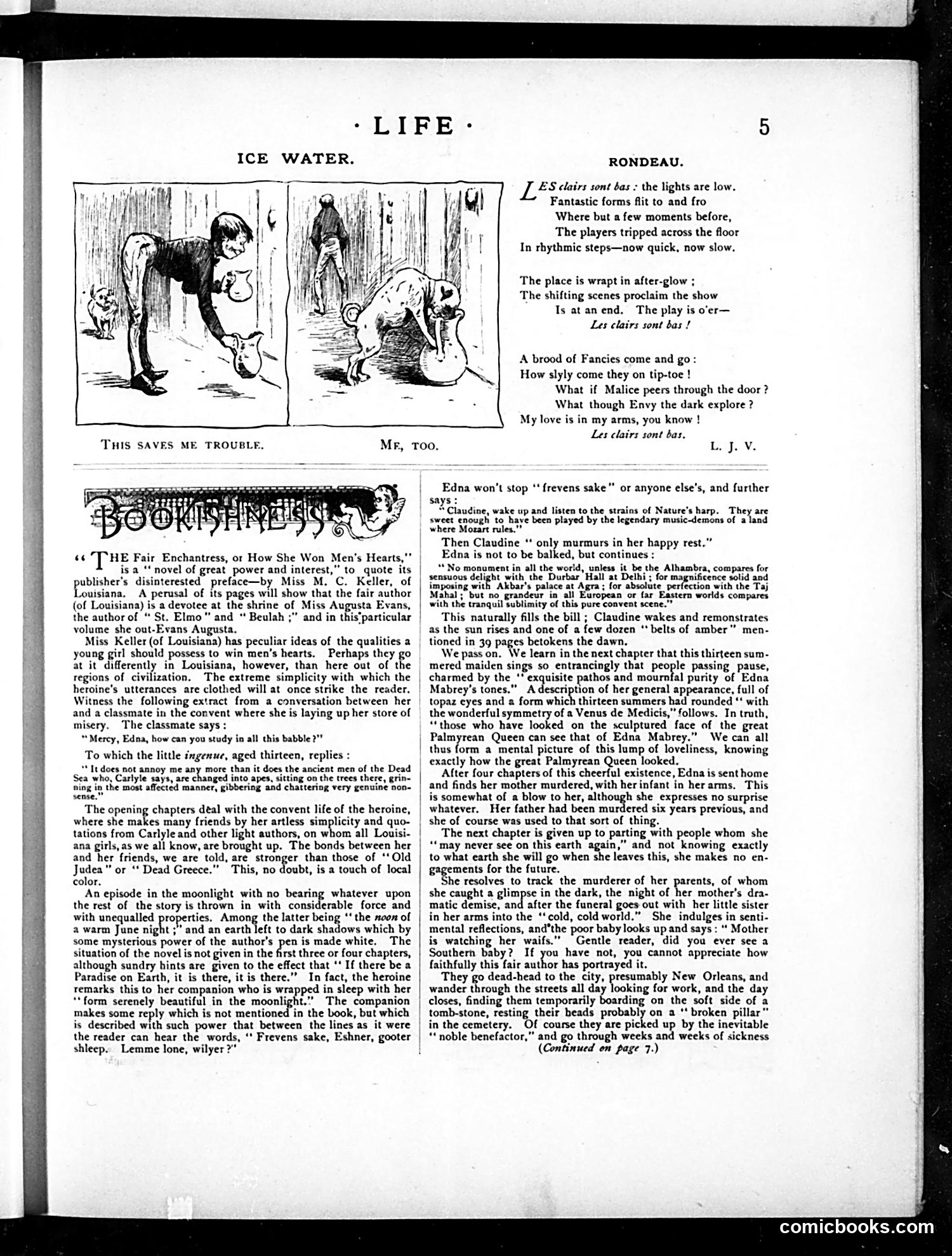
**The Cartoons:** The two panels titled "Ice Water" and "Rondeau" appear to be humorous domestic sketches rather than political satire. They depict Victorian-era social situations with exaggerated characters—likely showing comedic misunderstandings or awkward moments in parlor life. **The Book Review:** The bulk of the page reviews "The Awakening of Helena Richie," praising it as a novel of "great power and interest." The lengthy critique discusses the protagonist Edna's moral journey and character development, comparing her favorably to literary heroines. The reviewer emphasizes the book's psychological depth and emotional authenticity, particularly regarding how the author portrays a woman navigating societal expectations and personal conflict. This appears to be cultural criticism rather than political commentary.
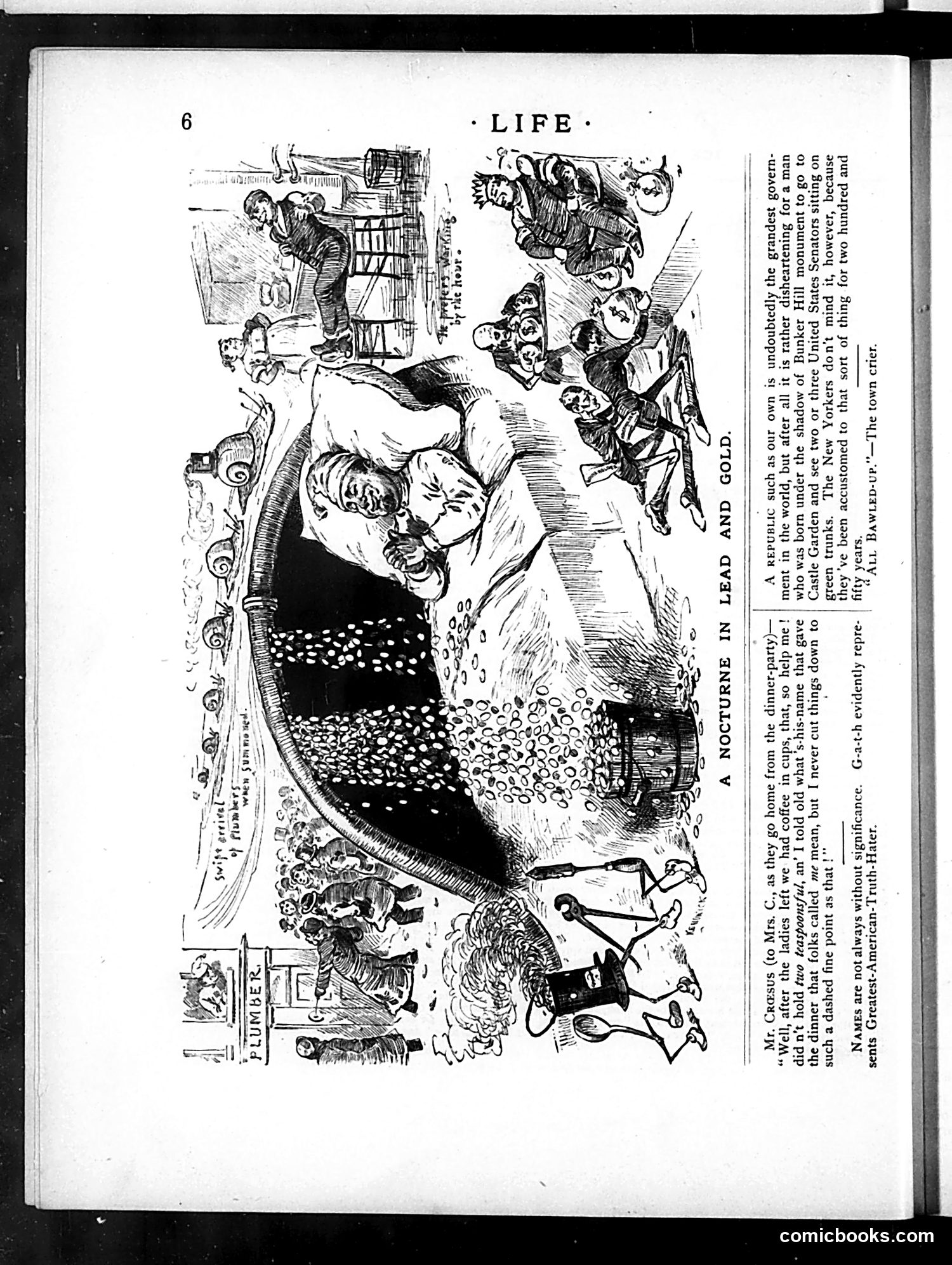
This satirical cartoon depicts a rotund, well-fed figure (appears to be a wealthy industrialist or financier) sleeping contentedly while cradling money bags. The figure is labeled "PLUMBER" at bottom left, suggesting irony about supposedly working-class status masking actual wealth accumulation. Surrounding the sleeping figure are smaller characters engaged in various activities—some appear distressed or laboring. The caption references a "dinner-party" where "ladies left we had office gossip" and mentions "bread" versus "gold," suggesting contrast between working people's basic needs and the wealthy's abundance. The satire critiques economic inequality: how certain individuals become fabulously wealthy while others struggle, possibly during labor disputes or economic hardship. The ironic "plumber" label mocks the pretense of humble origins among the newly rich.
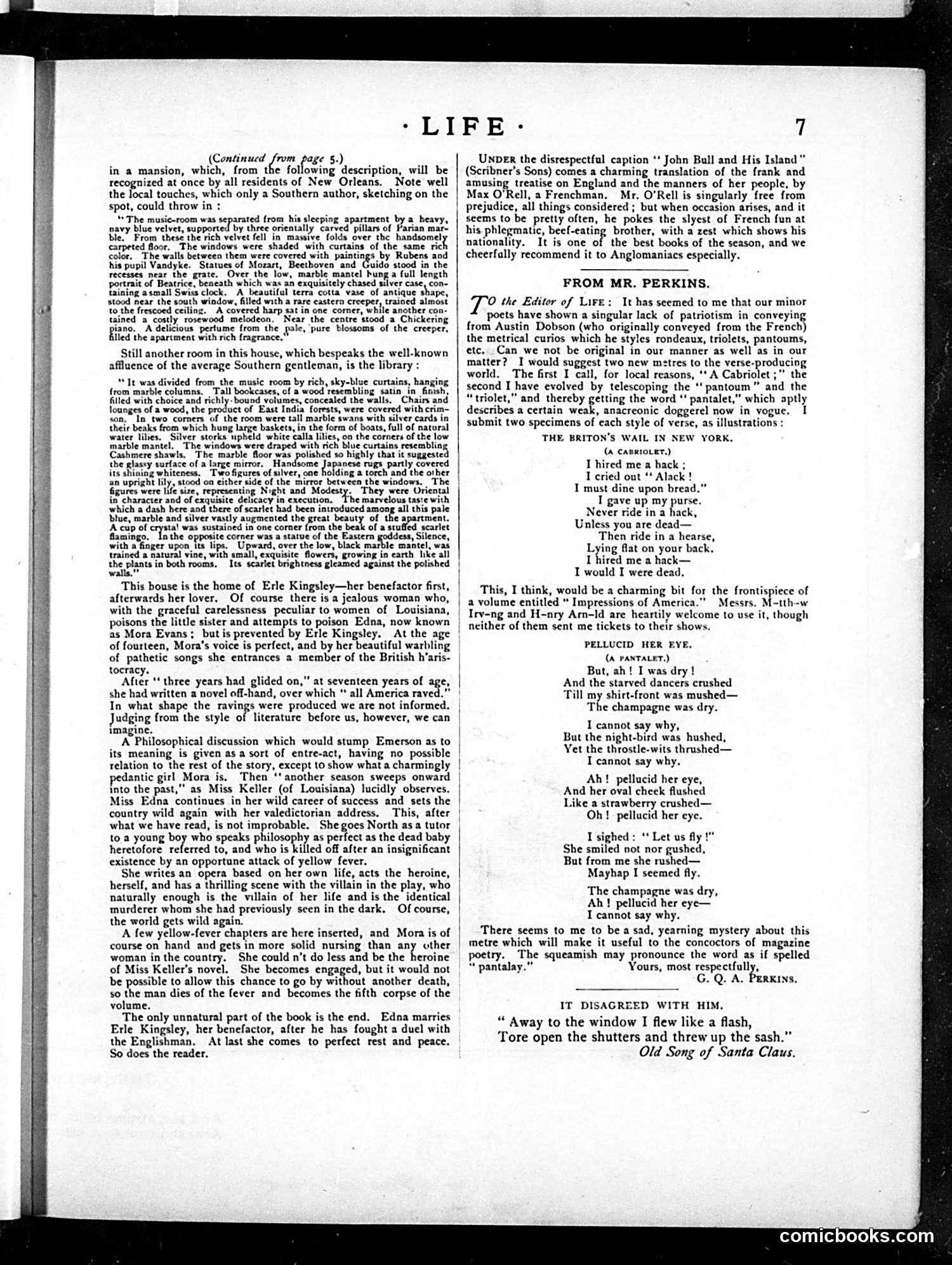
This page from *Life* magazine contains literary criticism and poetry rather than political cartoons. The left column reviews "John Bull and His Island" by Scribner's Sons, praising an English author's treatment of English life and manners. The right side features a letter from Mr. Perkins criticizing American minor poets for lacking patriotism compared to French poets, followed by three specimen poems illustrating different metrical styles—"A Cabriolet," "Pellucid Her Eye," and "I Pellicled Her Eye." At the bottom, there's a brief disagreement about pronouncing "pantalettes" as "pant-aly" versus "pant-allay." The page is primarily focused on literary merit and American cultural criticism rather than political satire or cartooning.
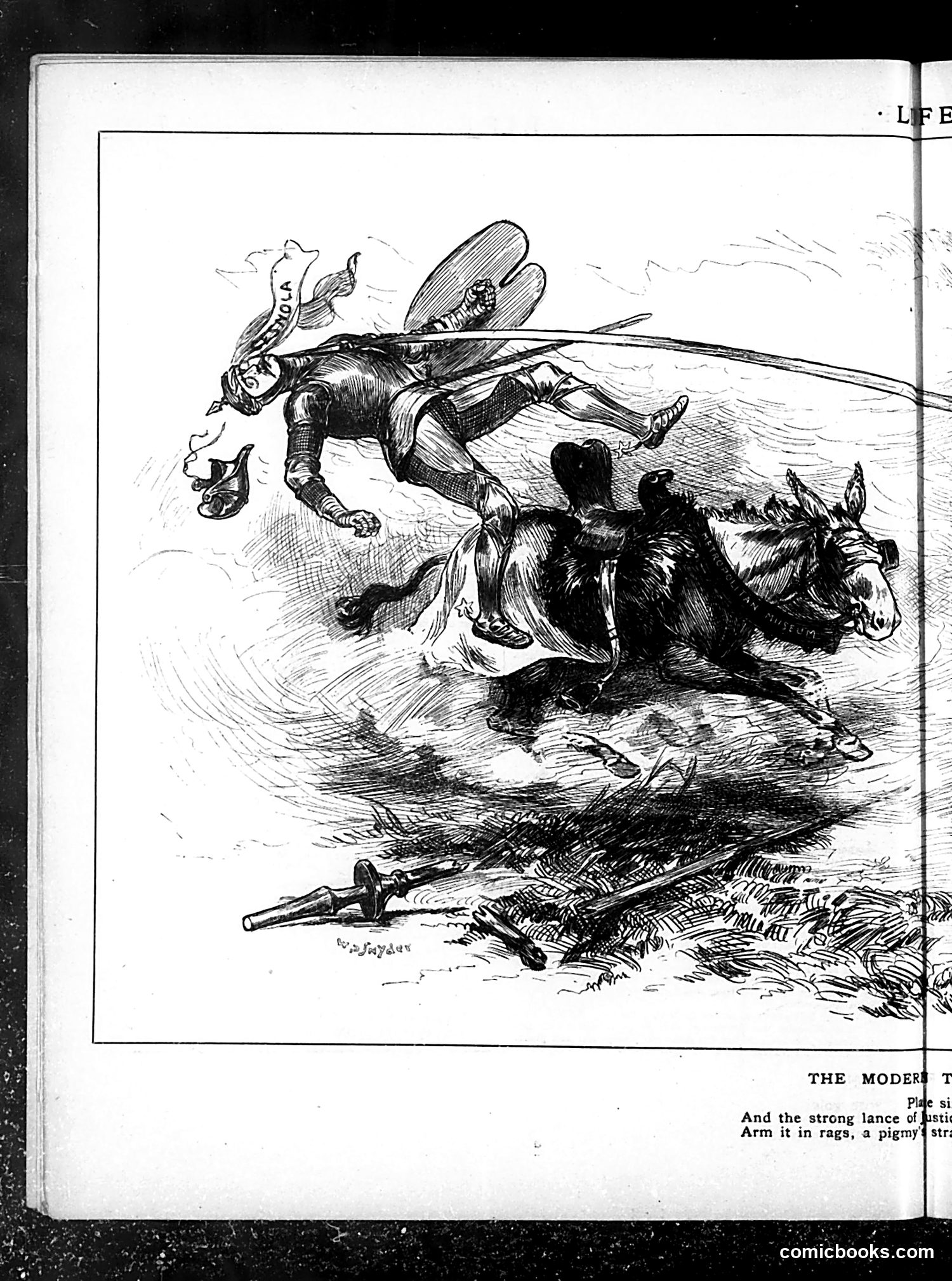
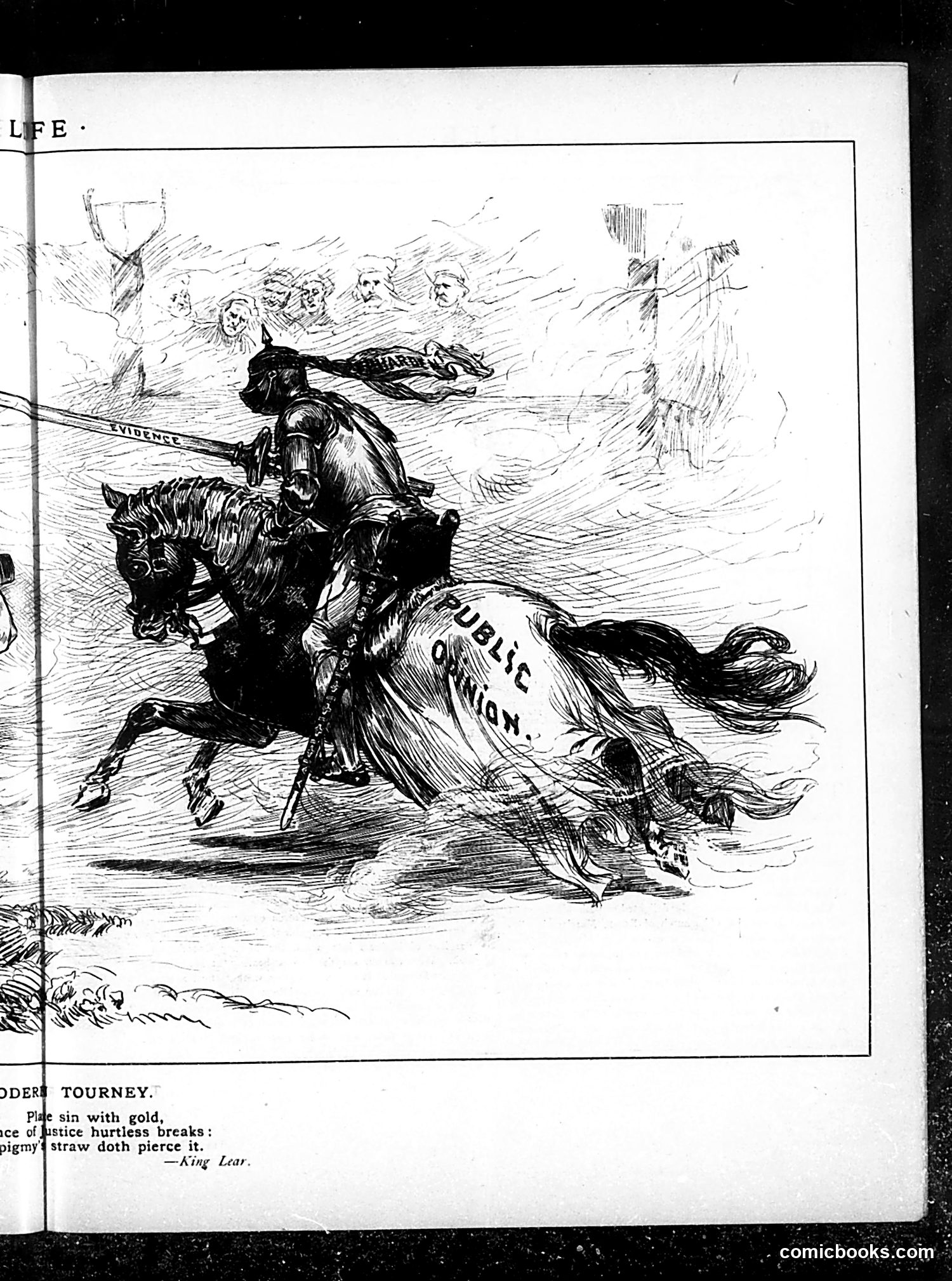
This is a satirical cartoon from *Life* magazine depicting a chaotic scene of a figure being thrown from a galloping horse. The figure flies through the air while losing military equipment—a sword and what appears to be a rifle lie discarded below. The style and composition suggest this is political satire about a military or political leader experiencing a dramatic fall from power. The visible text references "the strong lance of Justice" and mentions "rags" and "a pigmy," suggesting the figure is being judged or overthrown by forces of justice. However, without the complete caption or publication date visible, I cannot definitively identify which specific political event or figure this caricatures. The overall message appears to satirize an authority figure's humiliating defeat or removal from power.
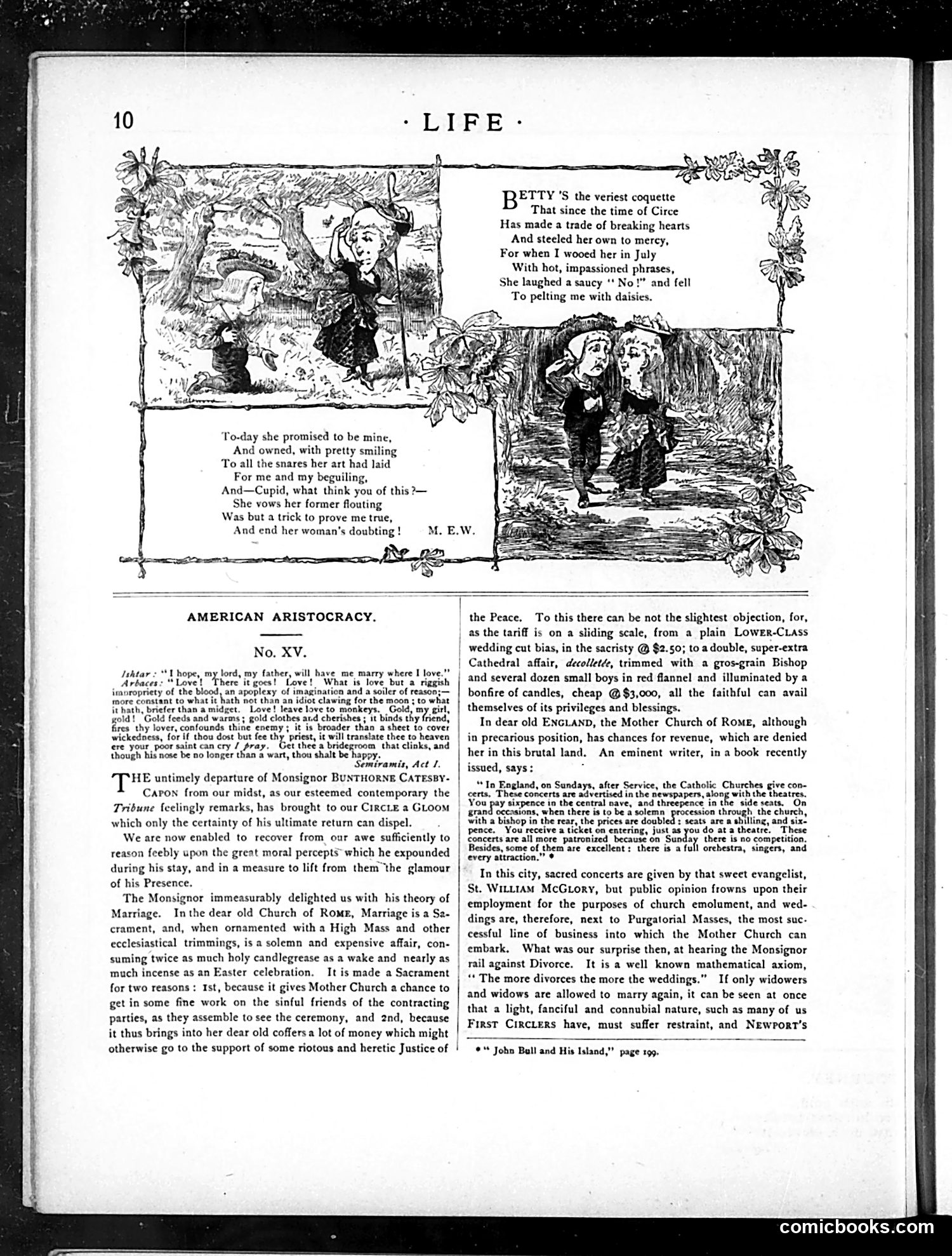
This page contains two distinct pieces: **"Betty" (top):** A romantic poem by M.E.W. about a coquettish woman who rejected the speaker's July courtship by laughing and pelting him with daisies, but now promises to marry him. The joke is that her earlier coldness was supposedly a "trick" to test his devotion—a satirical jab at female romantic game-playing. **"American Aristocracy No. XV" (bottom):** A satirical essay mocking the Catholic Church's commercialization of marriage. It argues the Church makes marriage a sacrament primarily for profit, charging sliding-scale fees from poor ($2.50 sacristy weddings) to wealthy (elaborate Cathedral affairs). The piece cites a Shakespeare quote dismissing romantic love in favor of money, then describes how English Catholic churches monetize even religious concerts. The satire targets clerical greed and the Church's exploitation of life's major events for revenue.
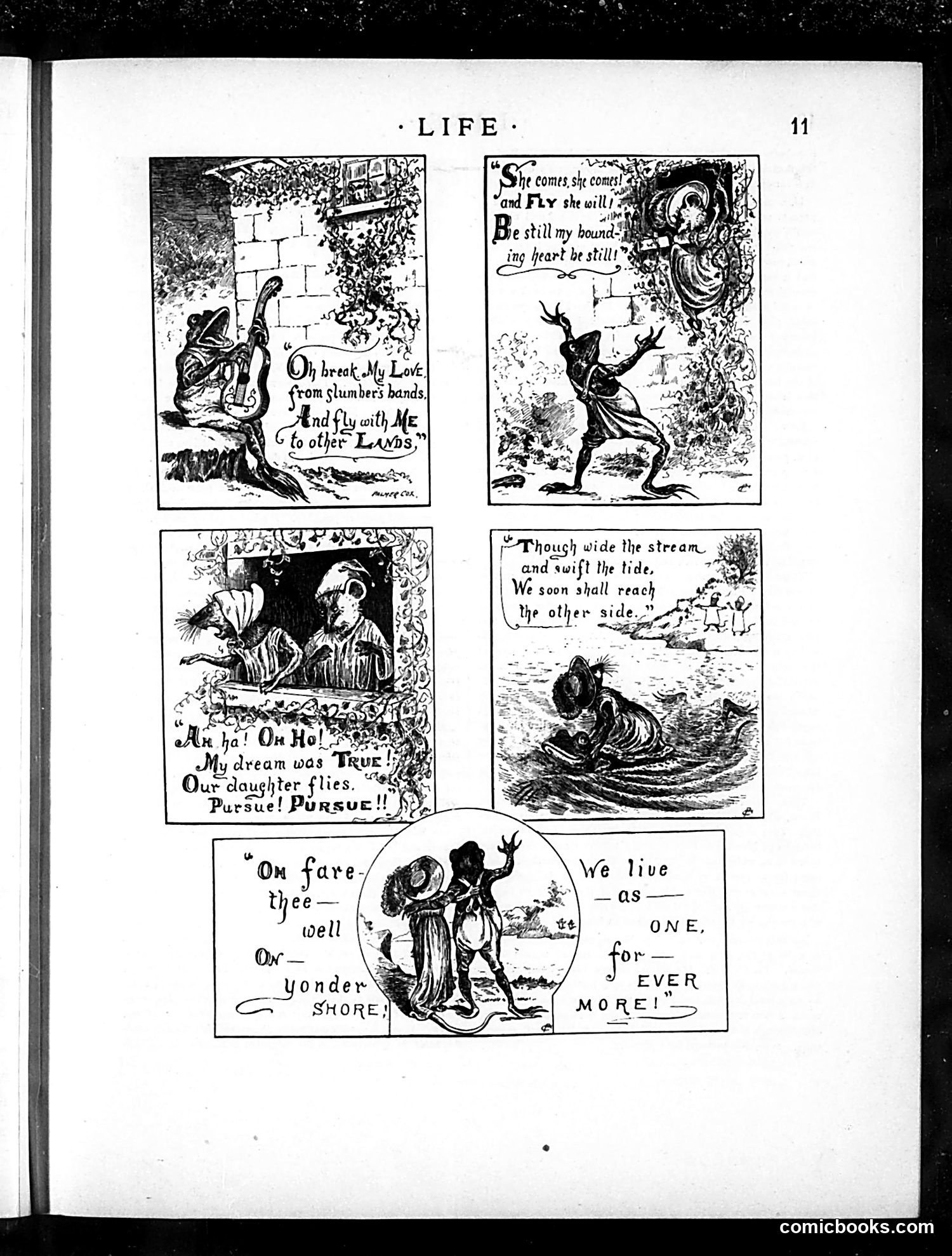
This appears to be a **fairy tale or fantasy narrative** told through sequential comic panels, likely an adaptation of a classic story (possibly "The Mermaid" or similar folklore). The narrative depicts lovers separated by water and circumstance: A musician pleads with his love to "break my Love / from slumbers bands / and fly with Me / to other Lands." Subsequent panels show a female figure in flight, pursuit across a stream, and romantic reunion by the shore, concluding with the promise "We live—as—ONE, for—EVER MORE!" The romantic, whimsical tone and decorative art style are typical of Life magazine's lighter content. **The satire or specific political commentary, if any, is unclear from this page alone**—it may simply be illustrative poetry with accompanying artwork rather than social commentary. The emphasis on escape and eternal love suggests escapist entertainment rather than topical satire.
This page from *Life* magazine contains **satirical commentary on marriage, divorce, and religious hypocrisy**, not a cartoon illustration. The article attacks a Catholic authority figure (identified as "Monsignor Bunthorne Catesby-Capon") who advocates *mariage de convenance*—marriages arranged for financial advantage rather than love. The satire's target is the perceived contradiction: the Church permits mercenary marriages but forbids divorce. The author sarcastically argues that if divorce were as easily obtainable as marriage—even as a "Sacrament" costing "$2.50 to $3,000"—wealthy Americans could repeatedly marry and divorce for profit, treating matrimony as a business transaction. The piece mocks both wealthy parents who treat daughters as commodities and religious authorities who sanction such arrangements while condemning divorce. The satire exposes class anxieties of the wealthy (keeping daughters from marrying "poor men") and critiques institutional religion's enabling of financial exploitation under the guise of moral authority.
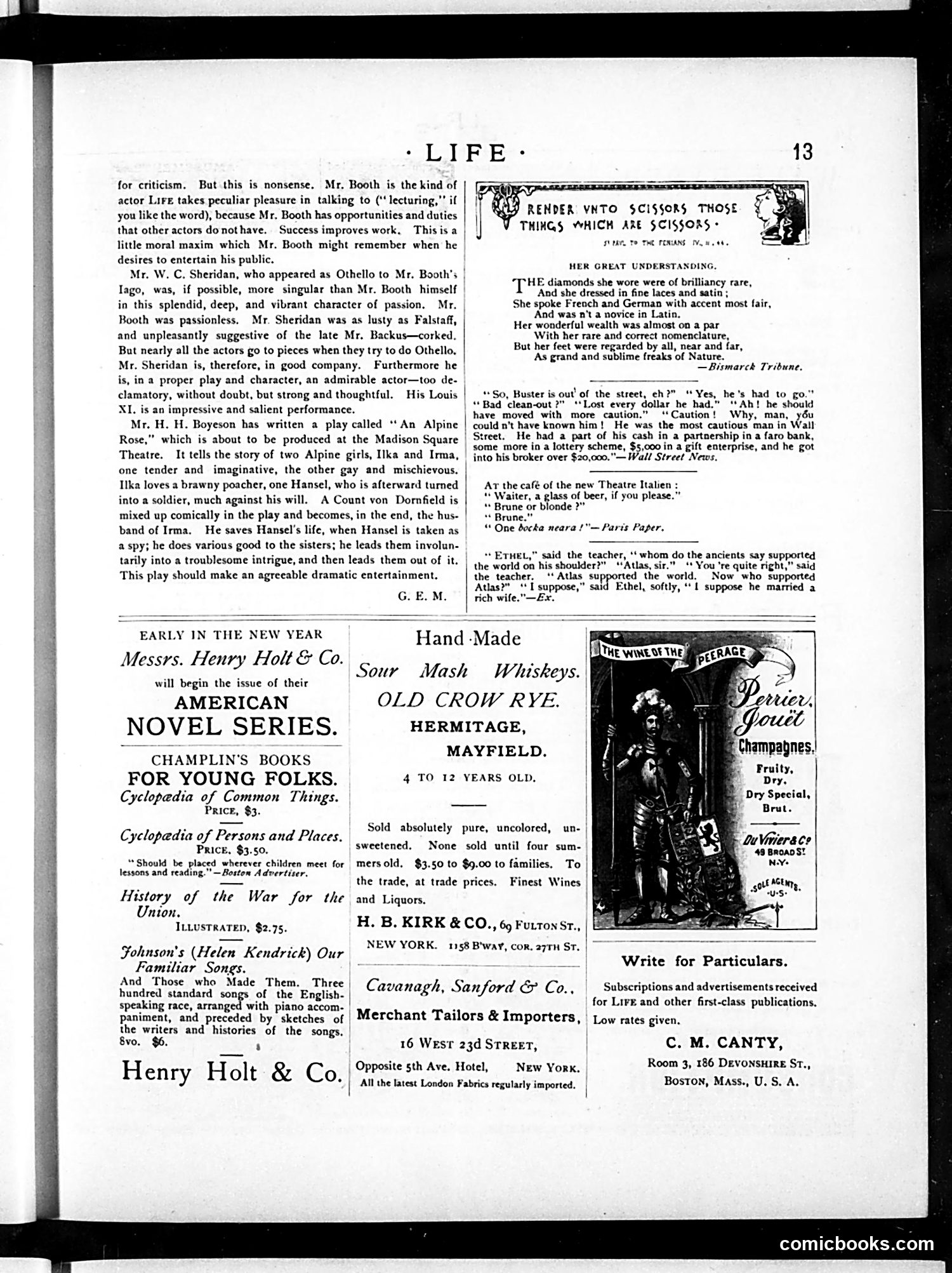
This page contains **theater criticism and humorous anecdotes** rather than political cartoons. The main content criticizes actor Edwin Booth's performance as Iago in *Othello*, arguing he was "passionless" compared to his scene partner W.C. Sheridan, who played Othello with excessive energy. The **cartoon** at top shows scissors with the caption "Render unto scissors those things which are scissors"—a play on the biblical phrase, likely commenting on something contemporary (unclear without more context). Below are **short jokes**: one about a Wall Street man who lost money through various risky schemes despite being "cautious"; another about a Parisian waiter; and a schoolroom joke where a girl cheekily suggests Atlas "married a rich wife" to support himself. The page is **heavily laden with period advertisements** for books, whiskeys, and merchant tailors—typical of 1880s magazine layout.
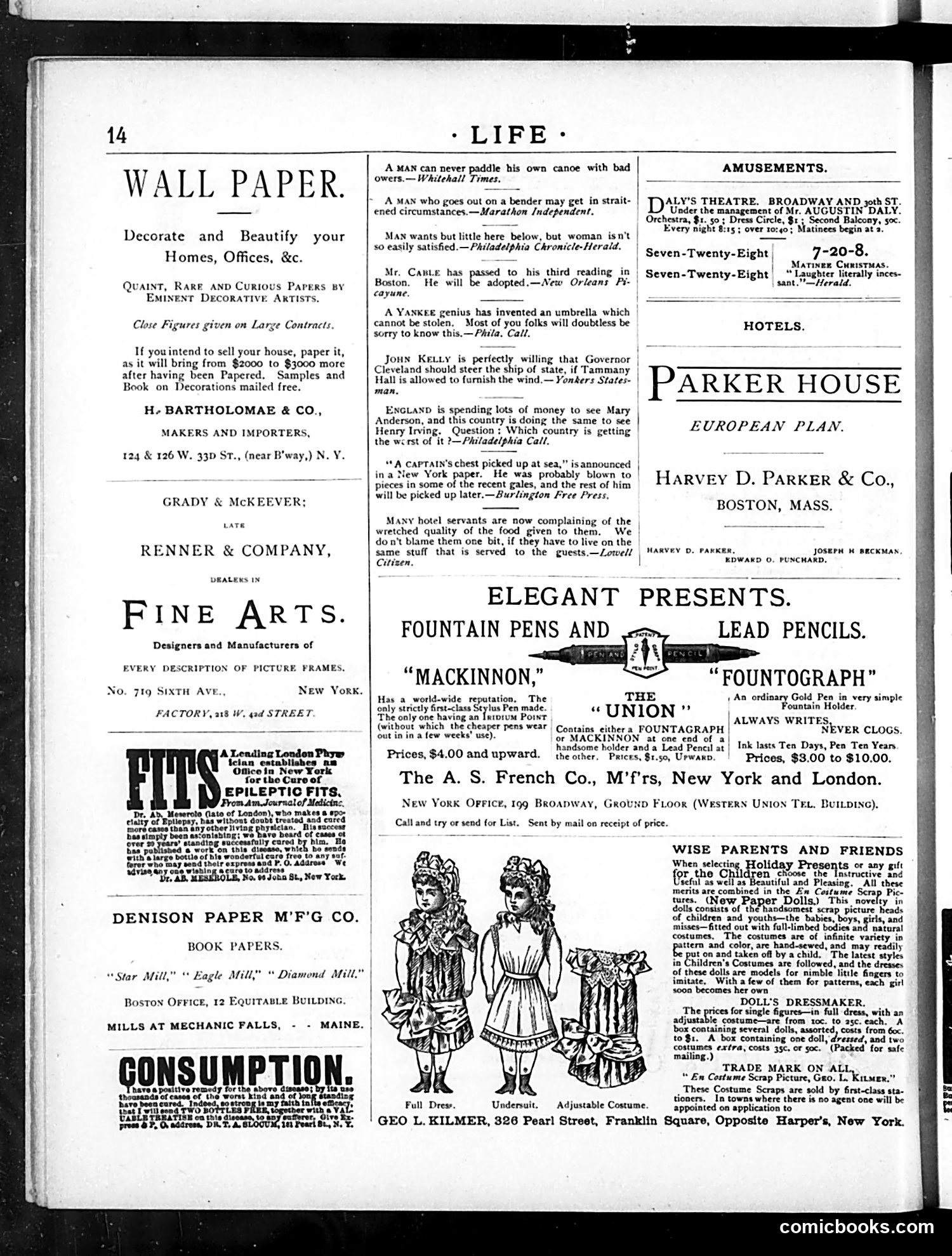
This page is **primarily advertisements** with a small humor section. The main content consists of commercial ads for: wall paper, picture frames, fine arts dealers, medical remedies (epilepsy treatment), book papers, and elegant gifts (fountain pens, pencils). The only satirical material appears in the upper-middle section: **brief quotations from various newspapers** mocking contemporary social observations—particularly gender relations ("A man wants but little... but woman isn't so easily satisfied") and political commentary on New York politics (references to Tammany Hall and Gov. Cleveland). There are no political cartoons on this page. The visual elements are purely commercial illustrations: children's dolls in costumes (advertising Kilmer's paper dolls) and images of fountain pens. The "satire" is minimal—consisting of light, punny observations rather than pointed commentary. This appears to be a standard advertising-heavy page from *Life* magazine's early era, when it functioned primarily as an advertising vehicle with occasional humorous interjections.
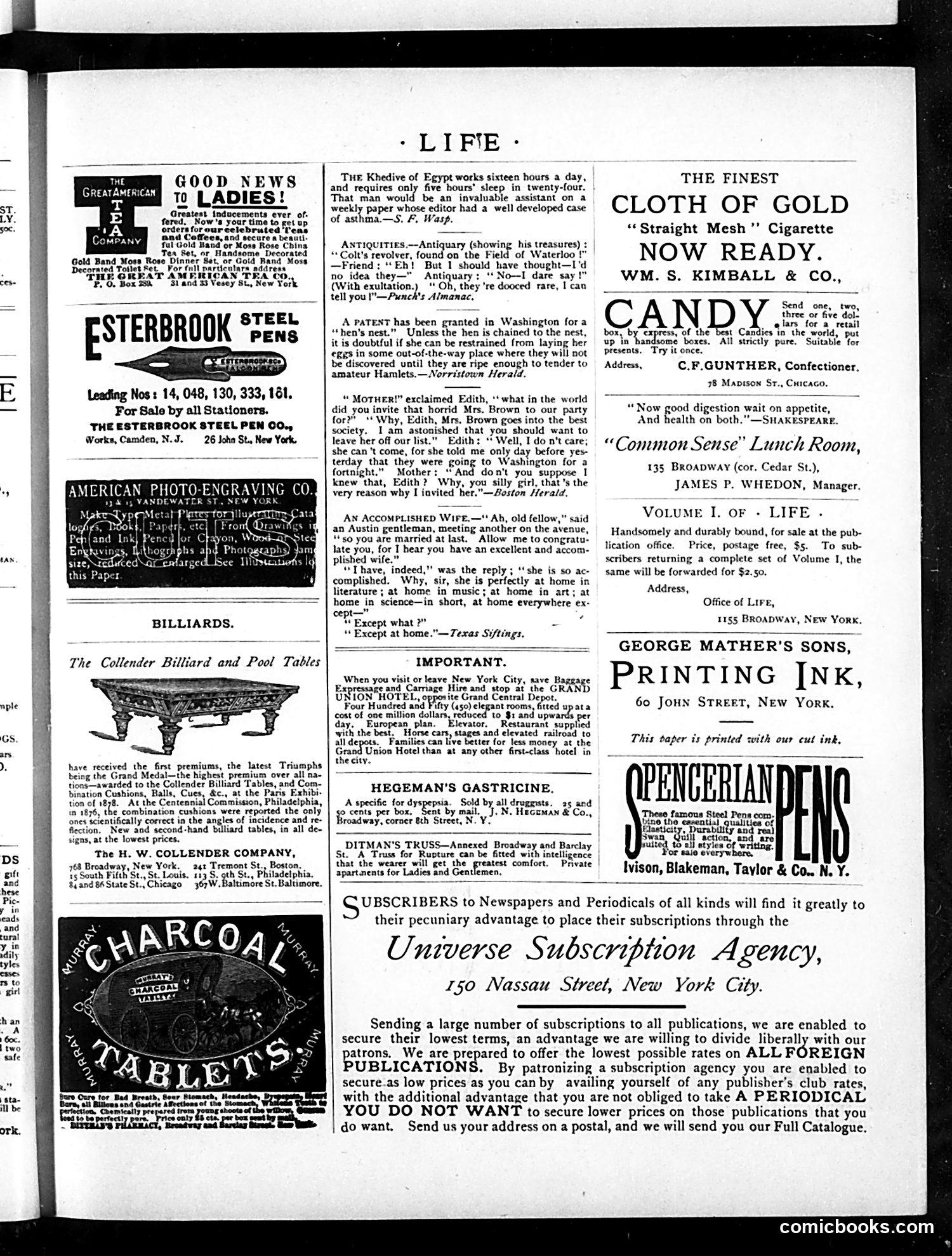
This page consists primarily of **advertisements and short humorous anecdotes**, not political cartoons. There are no illustrated political cartoons visible. The humor is light, domestic satire typical of late-19th-century publications: - A brief sketch about an accomplished wife who excels in literature, music, art, and science—but is never home - An antiquary bragging about a rare Colt revolver supposedly found at Waterloo - A mother inviting an unwanted guest (Mrs. Brown) specifically *because* she'd already left town—calculated social chess - A joke about Egypt's Khedive working excessively long hours The page's main content is **commercial advertisements** for tea sets, steel pens, billiard tables, printing ink, and hotels—typical of 19th-century magazine economics. The satire is gentle observation of Victorian social pretension and marital dynamics, not political commentary. No identified public figures appear.
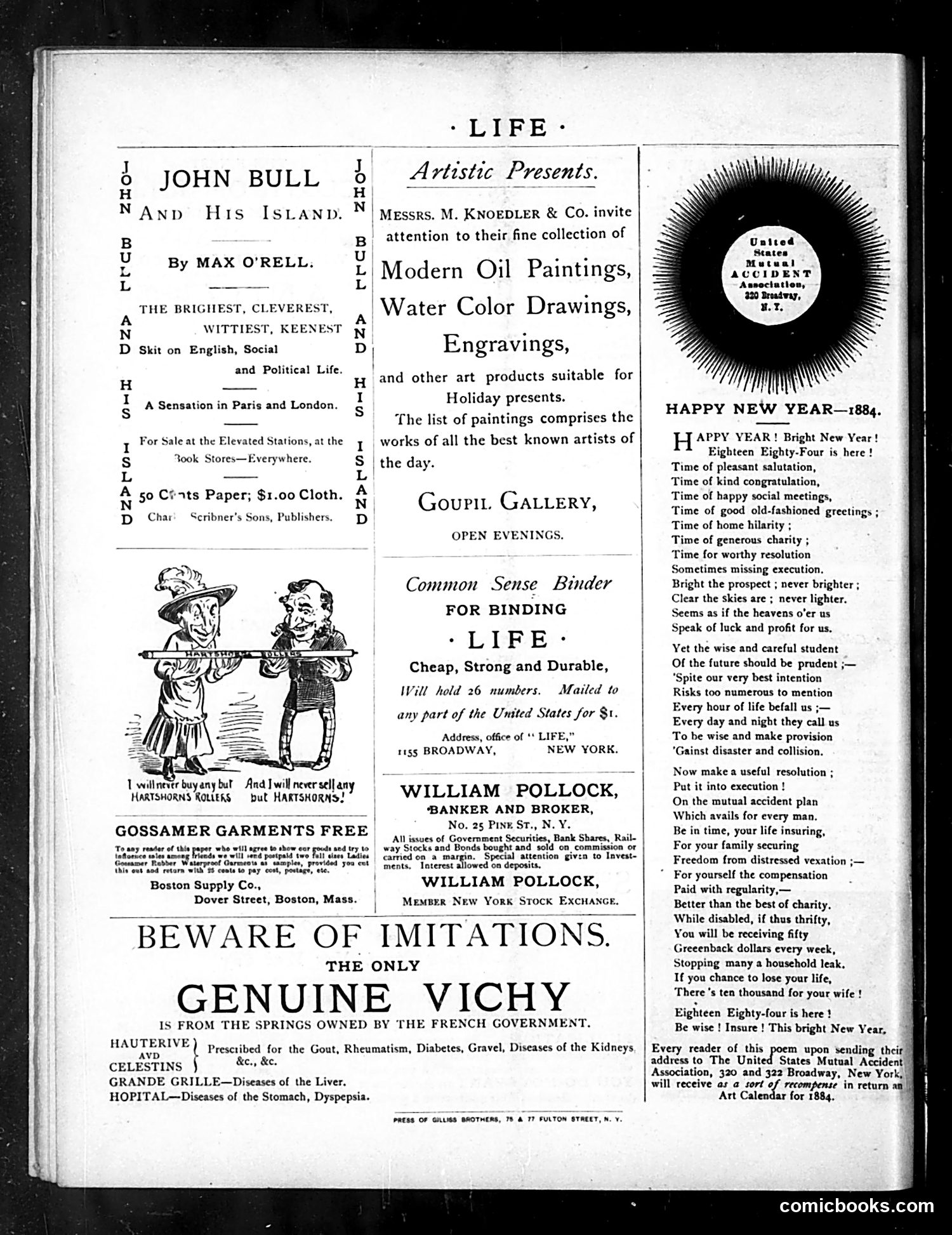
This page is primarily **advertising**, not political satire. The main cartoon depicts two figures in a commercial dispute over **Hartshorn's Rollers** (window shade mechanisms). One figure declares "I will never buy any but HARTSHORN'S ROLLERS," while the other responds "And I will never sell any but HARTSHORN'S!" This is a straightforward **product advertisement using humor**—likely satirizing competitive market claims or brand loyalty debates of the 1880s. The caricatures appear to represent generic merchant/consumer types rather than specific public figures. The page itself is a *Life* magazine issue from January 1884, featuring mostly holiday-themed advertisements and content (New Year resolutions, insurance pitches, art galleries). The "John Bull and His Island" book advertisement and Vichy water warnings occupy smaller sections. No significant political commentary is visible on this particular page.

I can see this is a heavily darkened page from Life magazine with significant image degradation. The page appears to be mostly black with only faint outlines visible, making it extremely difficult to discern specific cartoon content, figures, or text clearly enough to provide accurate analysis. While I can see there are some circular shapes and outlines that might represent caricatures or illustrated content, and there appears to be some text along the left margin, the image quality is too poor to reliably identify specific political figures, social references, or the satirical point being made. To accurately explain this page's meaning to a modern reader, I would need a clearer version of the source material.
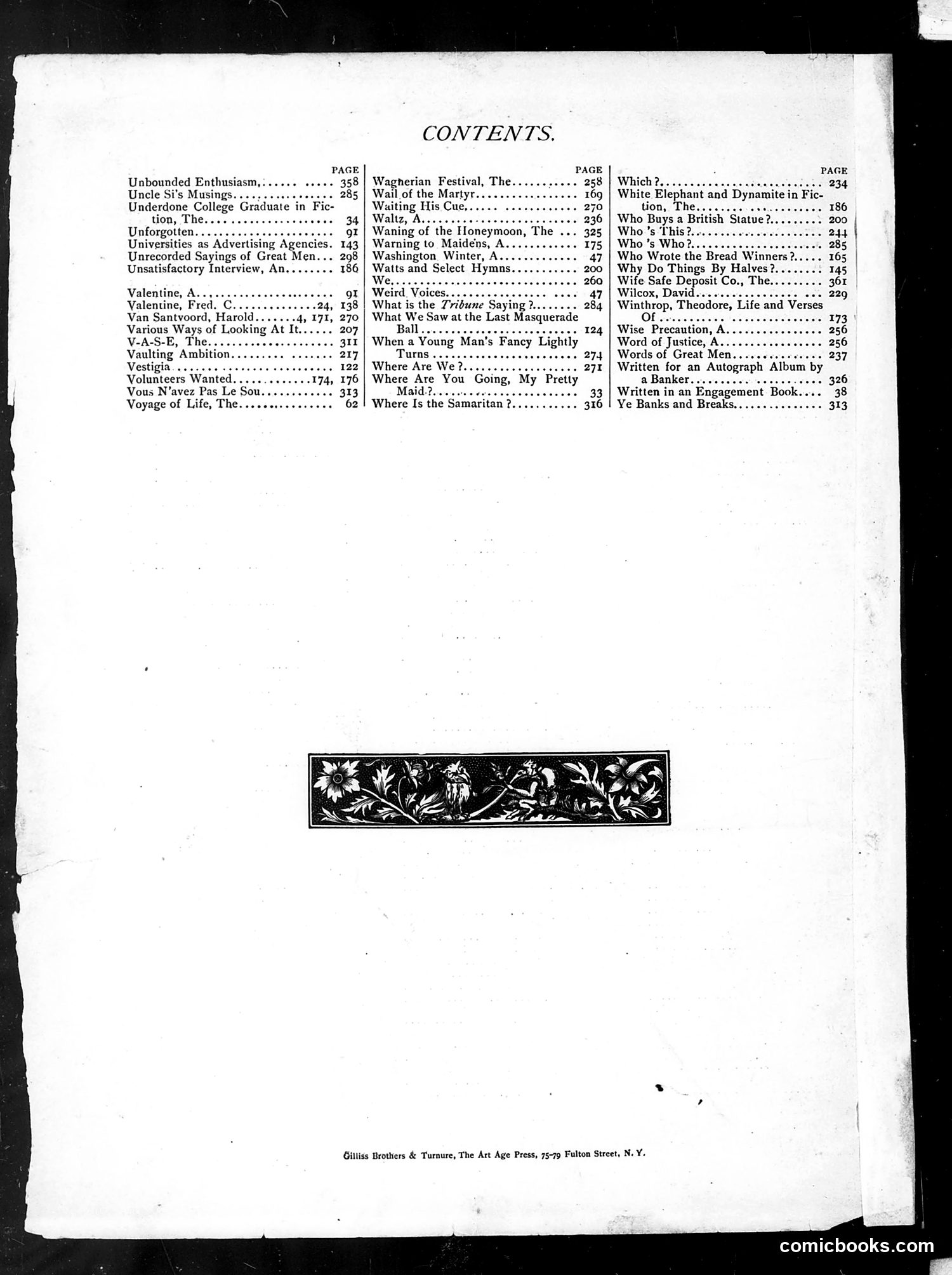
This is a **contents/index page** from Life magazine—not a cartoon page itself. It lists article and illustration titles with their page numbers. The page shows the magazine's typical mix of satirical content from the late 19th century, including: - Social commentary ("Unbounded Enthusiasm," "Unsatisfactory Interview") - Cultural critique ("Universities as Advertising Agencies," "Waning of the Honeymoon") - Political/topical pieces ("Washington Winter," "Wagherian Festival") - Humorous domestic observations ("Wife Safe Deposit Co.") - Literary commentary ("Who Wrote the Bread Winners?"—likely referencing authorship disputes) The decorative floral border at the bottom is typical period design. Without seeing the actual cartoons and articles, we cannot determine specific satirical targets, but the titles suggest Life focused on mocking social pretension, romantic disillusionment, institutional hypocrisy, and contemporary debates—standard fare for American satirical weeklies of this era.

I can see this is a page from Life magazine, but the image quality is too dark and degraded for me to discern specific cartoon content, caricatures, or text details with confidence. The page appears to be predominantly black with some faint circular or organic shapes visible, possibly artwork, but I cannot reliably identify figures, read any accompanying text, or determine what political or social satire is being depicted. To provide an accurate historical analysis as requested, I would need a higher-quality or clearer scan of this page. I cannot responsibly guess at identities, dates, or references without being able to see them clearly.