
Life, 1884-01-03 · page 7 of 19
Life — January 3, 1884 — page 7: what you’re looking at
What you’re looking at
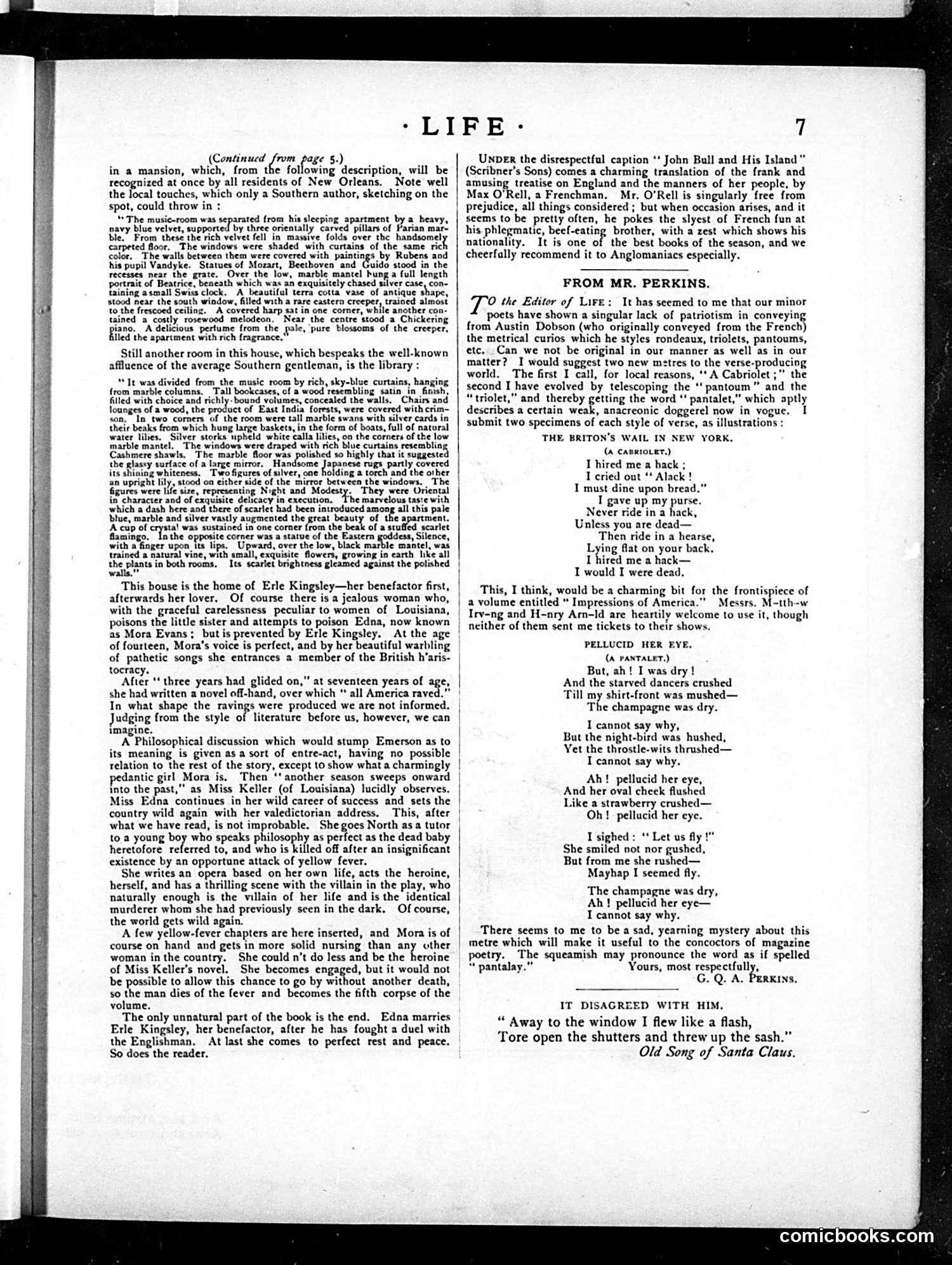
This page from *Life* magazine contains literary criticism and poetry rather than political cartoons. The left column reviews "John Bull and His Island" by Scribner's Sons, praising an English author's treatment of English life and manners. The right side features a letter from Mr. Perkins criticizing American minor poets for lacking patriotism compared to French poets, followed by three specimen poems illustrating different metrical styles—"A Cabriolet," "Pellucid Her Eye," and "I Pellicled Her Eye." At the bottom, there's a brief disagreement about pronouncing "pantalettes" as "pant-aly" versus "pant-allay." The page is primarily focused on literary merit and American cultural criticism rather than political satire or cartooning.
📄 Transcribed text from this page (OCR, searchable)
Machine-transcribed from the original scan — historical spelling and the odd misread are preserved.
Sa TT a *-LIFE: 7 (Continued from pase 5.) in a mansion, which, from the following description, will be r ized at once by all residents of New Orleans. Note well the local touches, which only a Southern author, sketching on the spot, could throw in : The music-room was separated from his sleeping apartment by a heavy, navy blue velvet, supporte: f by three orientally carved pillars of Parian mar- tle.” From these the rich velvet fell in| massive folds over the handsomely carpeted floor. The windows were shaded with curtains of the same ric! color. The walls between them were covered with paintings by Rubens aod his pupil Vandyke. Statues of Mozart, Beethoven and Gaids stood in the recesses near the grate. Over the low, marble mantel hung a full length portrait of Beatrice, beneath which was an exquisitely chased silver case, con- taining asmall Swiss clock. A beautiful terra cotta vase of antique shape, stood near the south window, filled with a rare eastera creeper, trained almost to the frescoed ceiling. A covered harp sat in one corner, while another con- tained a costly rosewood melodeon, Near the centre stood a Chickering ite. A delicious pertume from the pale, pure blossoms of the creeper, lied the apartment with rich fragrance.” Still another room in this house, which bespeaks the well-known affluence of the average Southern gentleman, is the library : “It was divided from the music room by rich, sky-blue curtains, hanging from marble columns. bookcases, of a wood resembling satin in finish, filled with choice and richly-bound volumes, concealed the walls, Chairs and lounges of a wood, the product of East India forests, were covered with crim son, In two corners of the room were tall marble swans with silver cards in their beaks from which hung lange baskets, in the form of boats, full of natural water lilies. Silver storks upheld white calla lilies, on the corners of the low marble mantel. The windows were draped with rich blue curtains resemblin Cashmere shawls, The marble floor was polished so highly that it suggeste the glassy surface of a lange mirror. Handsome Japanese rugs, partly covered its shining whiteness. Two figures of silver, one holdi an upright lily, stood on either side of the mirror between the windows. figures were life size, representing Night and Modesty. They were Oriental in character and of exquisite delicacy in execution. The marvelous taste with which a dash here and there of scarlet had been introduced among all this pale blue, marble and silver vastly augmented the great beauty of the apartment. ‘A cup of crystal was sustained in one corner from the beak of a stuffed scarlet flamingo. Inthe opposite corner was a statue of the Eastern goddess, Silence, with a finger upon its lips. Upward, over the low, black marble mantel, was trained a natural vine, with small, exquisite flowers, growing in earth like all the plants in both rooms, "Its scarlet brightness gleamed against the polished walls.” This bouse is the home of Erle Kingsley—her benefactor first, | afterwards her lover, Of course there is a jealous woman who, with the graceful carelessness peculiar to women of Louisiana, poisons the little sister and attempts to poison Edna, now known as Mora Evans; but is prevented by Erle Kingsley. At the age of fourteen, Mora’s voice is perfect, and by her beautiful warbling of pathetic songs she entrances a member of the British h’aris- tocracy. After ‘* three years had glided on,” at seventeen years of age, she had written a novel off-hand, over which “ all America raved.” In what shape the ravings were produced we are not informed. Judging from the style of literature before us, however, we can imagine. A Philosophical discussion which would stump Emerson as to | its meaning is given as a sort of entre-act, having no possible | relation to the rest of the story, except to show what a charmingly dantic girl Mora is. Then ‘t another season sweeps onward into the past,” as Miss Keller (of Louisiana) lucidly observes. | Miss Edna continues in her wild career of success and sets the country wild again with her valedictorian address. This, after | what we have read, is not improbable. She goes North as a tutor to.a young boy who speaks philosophy as perfect as the dead baby heretofore referred to, and who is killed off after an insignificant existence by an opportune attack of yellow fever. She writes an opera based on her own life, acts the heroine, herself, and has a thrilling scene with the villain in the play, who naturally enough is the villain of her life and is the identical murderer whom she had previously seen in the dark. Of course, the world gets wild again, A few yellow-fever chapters are here inserted, and Mora is of | course on hand and gets in more solid nursing than any other woman in the country. She could n't do less and be the heroine of Miss Keller's novel. She becomes engaged, but it would not be possible to allow this chance to go by without another death, so the man dies of the fever and becomes the fifth corpse of the volume, The only unnatural part of the book is the end. Edna marries Erle Kingsley, her benefactor, after he has fought a duel with the Englishman, At last she comes to perfect rest and peace. So does the reader, jag a torch and the other | UnpeR the disrespectful caption ‘ John Bull and His Island” (Scribner's Sons) comes a charming translation of the frank and amusing treatise on Englund and the manners of her people, by Max O'Rell, a Frenchman. Mr. O'Rell is singularly free from prejudice, all things considered ; but when occasion arises, and it seems to be pretty often, he pokes the slyest of French fun at his phlegmatic, beef-eating brother, with a zest which shows his nationality. It is one of the best books of the season, and we cheerfally recommend it to Anglomaniacs especially. FROM MR. PERKINS. Te the Editor of Lire: It has seemed to me that our minor poets have shown a singular lack of patriotism in conveyin, from Austin Dobson (who originally conveyed from the Preach) the metrical curios which he styles rondeaux, triolets, pantoums, etc, Can we not be original in our manner as well as in our matter? I would suggest two new metres to the verse-producing world. The first I call, for local reasons, ‘* A Cabriolet ;" the second I have evolved by telescoping the ‘ pantoum” and the “triolet,” and thereby getting the word ‘ pantalet,” which aptly describes a certain weak, anacreonic doggerel now in vogue. I submit two specimens of each style of verse, as illustrations : THE BRITON’S WAIL IN NEW YORK. (a caprioter.) I hired me a hack T cried out ‘* Alac I must dine upon bread.” I gave up my purse. Never ride in a hack, Unless you are dead— Then ride in a hearse, Lying flat on your back. I hired me a hack— I would I were dead. This, I think, would be a charming bit for the frontispiece of a volume entitled “ Impressions of America.” Messrs. M-tth-w Irv-ng and H-nry Am-Id are heartily welcome to use it, though neither of them sent me tickets to their shows, PELLUCID HER EYE. (A PANTALET.) But, ah ! I was dry! And the'starved dancers crushed Till my shirt-front was mushed— The champagne was dry. I cannot say why, But the night-bird was hushed, Yet the throstle-wits thrushed— I cannot say why, Ah! pellucid her eye, And her oval cheek flushed Like a strawberry crushed— Oh! pellucid her eye. I sighed : ‘Let us fly !” She smiled not nor gushed, But from me she rushed— Mayhap I seemed fly. The champagne was dry, Ah! pellucid her eye— I cannot say why. There seems to me to bea sad, yearning mystery about this metre which will make it useful to the concoctors of magazine poetry, The squeamish may pronounce the word as “ pantalay.” Yours, most respectful: IT DISAGREED WITH HIM, “ Away to the window I flew like a flash, Tore open the shutters and threw up the sash.” Old Song of Santa Claus. comicbooks.com