
Life, 1884-01-03 · page 5 of 19
Life — January 3, 1884 — page 5: what you’re looking at
What you’re looking at
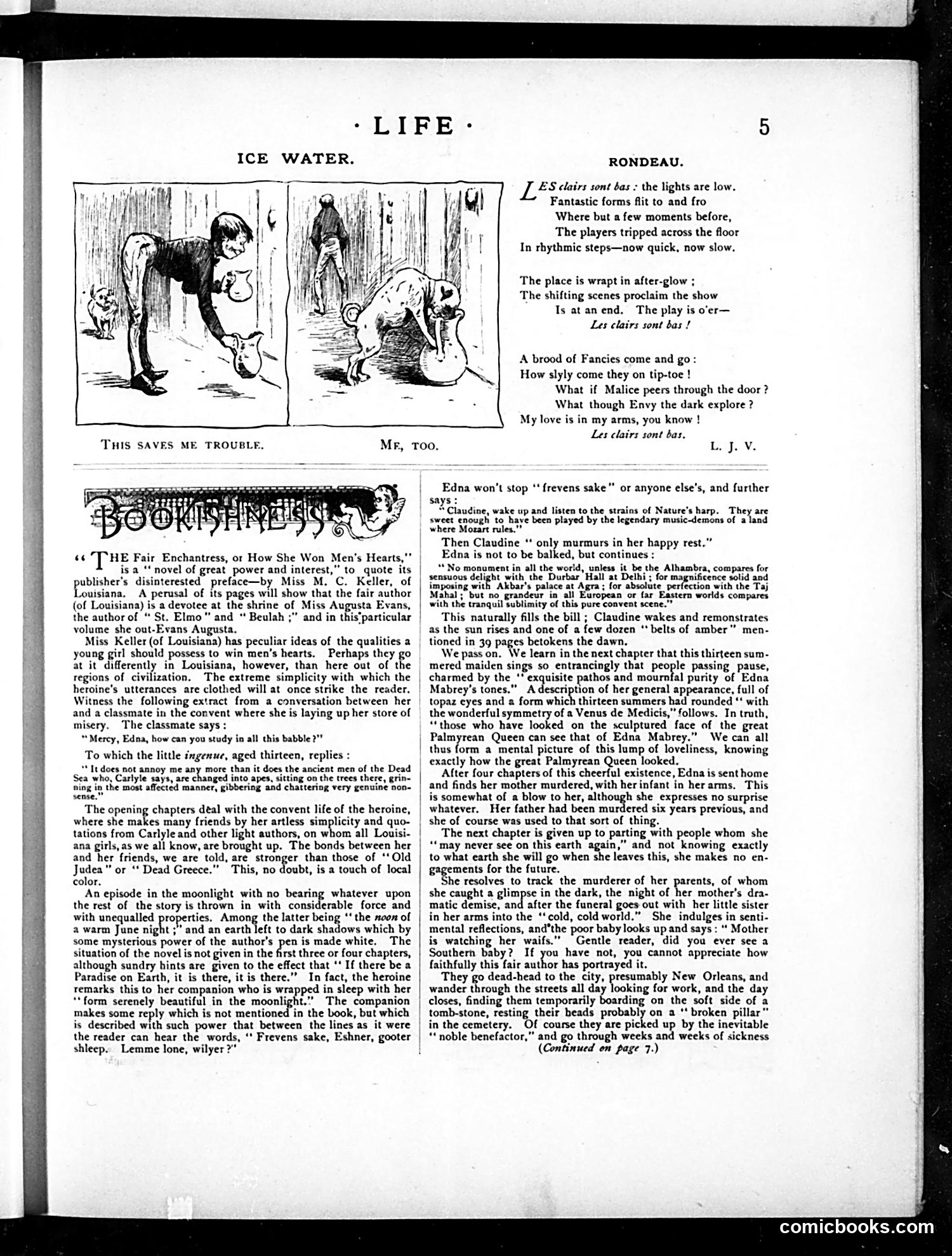
**The Cartoons:** The two panels titled "Ice Water" and "Rondeau" appear to be humorous domestic sketches rather than political satire. They depict Victorian-era social situations with exaggerated characters—likely showing comedic misunderstandings or awkward moments in parlor life. **The Book Review:** The bulk of the page reviews "The Awakening of Helena Richie," praising it as a novel of "great power and interest." The lengthy critique discusses the protagonist Edna's moral journey and character development, comparing her favorably to literary heroines. The reviewer emphasizes the book's psychological depth and emotional authenticity, particularly regarding how the author portrays a woman navigating societal expectations and personal conflict. This appears to be cultural criticism rather than political commentary.
📄 Transcribed text from this page (OCR, searchable)
Machine-transcribed from the original scan — historical spelling and the odd misread are preserved.
6¢ THE Fair Enchantress, or How She Won Men's Hearts,”’ isa ‘* novel of great power and interest,” to quote its ublisher's disinterested preface—by Miss M. C. Keller, of Louisiana, A perusal of its pages will show that the fair author (of Louisiana) is a devotee at the shrine of Miss Augusta Evans, the author of “ St. Elmo” and “ Beulah ;” and in this’particular volume she out-Evans Augusta, iss Keller (of Louisiana) has peculiar ideas of the qualities a young girl should possess to win men’s hearts. Perhaps they go at it differently in Louisiana, however, than here out of the regions of civilization. The extreme simplicity with which the heroine's utterances are clothed will at once strike the reader. Witness the following extract from a conversation between her and a classmate in the convent where she is laying up her store of misery. The classmate says : © Mercy, Edna, how can you study in all this babble ?"" To which the little ingenue, aged thirteen, replies : ** Itdoes not annoy me any more than it does the ancient men of the Dead Sea who, Carlyle says, are changed into apes, sitting on the trees there, grin ning ip the most affected manner, gibbering and chattering very genuine non- sense.’ The opening chapters déal with the convent life of the heroine, where she makes many friends by her artless simplicity and quo- tations from Carlyle and other light authors, on whom all Loui: ana girls,as we all know, are brought up. The bonds between her and her friends, we are told, are stronger than those of ‘Old Judea" or ‘* Dead Greece.” This, no doubt, is a touch of local color, An episode in the moonlight with no bearing whatever upon the rest of the story is thrown in with considerable force and | with unequalled properties. Among the latter being ‘‘ the noon of a warm June night ;” and an earth feft to dark shadows which by some mysterious power of the author's pen is made white. The situation of the novel is not given in the first three or four chapters, although sundry hints are given to the effect that ‘If there be a Paradise on Earth, it is there, it is there.” In fact, the heroine remarks this to her companion who is wrapped in sleep with her ‘*form serenely beautiful in the moonlight." The companion makes some reply which is not mention is described with such power that between the lines as it were | Ee in the book, but which | the reader can hear the words, ‘* Frevens sake, Eshner, gooter | shleep. Lemme lone, wilyer ?" RONDEAU. ES clairs sont bas : the lights are low. Fantastic forms flit to and fro Where but a few moments before, The players tripped across the floor In rhythmic steps—now quick, now slow, The place is wrapt in after-glow ; ‘The shifting scenes proclaim the show Is at anend, The play is o’er— Les clairs sont bas ! A brood of Fancies come and go : How slyly come they on tip-toe ! What if Malice peers through the door ? What though Envy the dark explore ? My love is in my arms, you know ! Les clairs sont bas, L. J. ve Edna won't stop ‘‘ frevens sake" or anyone else's, and further says: * Claudine, wake up and listen to the strains of Nature's harp. They are sweet enough to haye been played by the legendary music-demons of a land where Mozart rules.” Then Claudine “ only murmurs in her happy rest.” Edna is not to be balked, but continues : ** No monument in all the world, unless it be the Alhambra, compares for sensuous delight with, the Durbar Hall at Delhi ; for magnificence solid and imposing with Akbar's palace at Agra; for absolute perfection with the Taj Mahal ; but no grandeur in all European or far Eastern worlds compares with the tranquil sublimity of this pure convent scene.” This naturally fills the bill ; Claudine wakes and remonstrates as the sun rises and one of a few dozen ‘belts of amber” men- tioned in 39 pages betokens the dawn, We pass on. We learn in the next chapter that this thirteen sum- mered maiden sings so entrancingly that people passing pause, charmed by the ‘* athos and mournfal purity of Edna Mabrey’s tones.” tion of her general appearance, full of exqui A deseri topaz eyes and a form which thirteen summers had rounded “ with the wonderful symmetry of a Venus de Medicis,” follows. In truth, “those who have looked on the sculptured face of the great Palmyrean Queen can see that of Edna Mabrey.” We can all thus form a mental picture of this lump of loveliness, knowing exactly how the great Palmyrean Queen looked. After four chapters of this cheerful existence, Edna is sent home and finds her mother murdered, with her infant in her arms. This is somewhat of a blow to her, although she expresses no surprise whatever. Her father had been murdered six years previous, and she of course was used to that sort of thing. The next chapter is given up to parting with people whom she ‘may never see on this earth again,” and not knowing exactly to what earth she will go when she leaves this, she makes no en- gagements for the future. She resolves to track the murderer of her parents, of whom she caught a glimpse in the dark, the night of her mother’s dra- matic demise, and after the funeral goes out with her little sister in her arms into the ‘‘cold, cold world.” She indulges in senti- mental reflections, and’the poor baby looks up and says : “* Mother is watching her waifs.” Gentle reader, did you ever see a Southern baby? If you have not, you cannot appreciate how faithfully this fair author has portrayed it. They go dead-head to the city, presumably New Orleans, and wander through the streets all day looking for work, and the day closes, finding them temporarily boarding on the soft side of a tomb-stone, resting their beads probably, on a ‘‘ broken pillar” in the cemetery. Of course they are picked up by the inevitable “noble benefactor,” and go through weeks and weeks of sickness (Continued on page 7.) comicbooks.com