
Life, 1884-01-03 · page 10 of 19
Life — January 3, 1884 — page 10: what you’re looking at
What you’re looking at
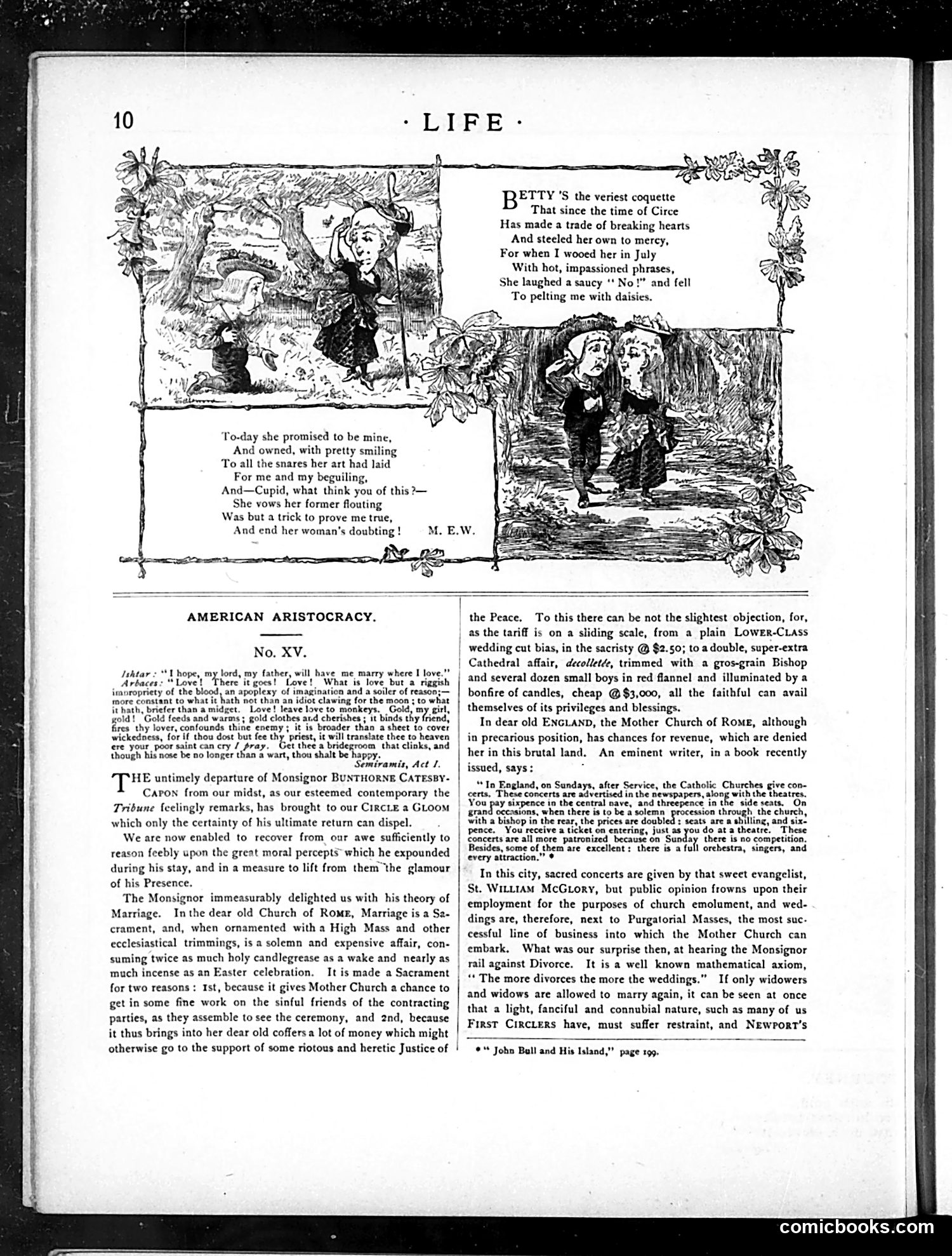
This page contains two distinct pieces: **"Betty" (top):** A romantic poem by M.E.W. about a coquettish woman who rejected the speaker's July courtship by laughing and pelting him with daisies, but now promises to marry him. The joke is that her earlier coldness was supposedly a "trick" to test his devotion—a satirical jab at female romantic game-playing. **"American Aristocracy No. XV" (bottom):** A satirical essay mocking the Catholic Church's commercialization of marriage. It argues the Church makes marriage a sacrament primarily for profit, charging sliding-scale fees from poor ($2.50 sacristy weddings) to wealthy (elaborate Cathedral affairs). The piece cites a Shakespeare quote dismissing romantic love in favor of money, then describes how English Catholic churches monetize even religious concerts. The satire targets clerical greed and the Church's exploitation of life's major events for revenue.
📄 Transcribed text from this page (OCR, searchable)
Machine-transcribed from the original scan — historical spelling and the odd misread are preserved.
To-day she promised to be mine, And owned, with pretty smiling To all the snares her art had laid For me and my beguiling, And—Cupid, what think you of this ?— She vows her former flouting Was but a trick to prove me true, And end her woman's doubting ! ETTY'S the veriest coquette That since the time of Circe Has made a trade of breaking hearts And steeled her own to mercy, For when I wooed her in July With hot, impassioned phrases, She laughed a saucy ‘t No!” and fell To pelting me with daisies. M. E.W. AMERICAN ARISTOCRACY. No. XV. the Peace. To this there can be not the slightest objection, for, as the tariff is on a sliding scale, from a plain Lower-CLass wedding cut bias, in the sacristy @ $2.50; to adouble, super-extra | Cathedral affair, decollete, trimmed with a gros-grain Bishop Ishtar : “hope, my lord, my father, will have me marry where I love.”” Arbaces: “Lovet There’ it goes! Love! What is love but a riggish impropriety of the blood, an apoplexy of imaginatica and a soiler of reason;— more constant to what it hath not than an idiot clawing for the moon ; to what it hath, briefer than a midget. Love! leave love to monkeys. Gold, my girl, gold! ‘Gold feeds and warms ; gold clothes and cherishes ; it binds thy friend, fires thy lover, confounds thine enemy ; it is broader than a sheet to cover wickedness, for if thou dost but fee thy ‘priest, it will translate thee to heaven ere your poor saint can cry / pray. Get thee a bridegroom that clinks, and though his nose be no longer than a wart, thou shalt be happy. Semiramis, Act 1. AyPHE untimely departure of Monsignor BUNTHORNE CATESBY- Capon from our midst, as our esteemed contemporary the Tribune {celingly remarks, has brought to our C1RCLE a GLooM which only the certainty of his ultimate return can dispel. We are now enabled to recover from our awe sufficiently to | reason feebly upon the great moral percepts which he expounded during his stay, and in a measure to lift from them the glamour of his Presence. The Monsignor immeasurably delighted us with his theory of Marriage. Inthe dear old Church of Rome, Marriage is a Sa- crament, and, when ornamented with a High Mass and other ecclesiastical trimmings, is a solemn and expensive affair, con- suming twice as much holy candlegrease as a wake and nearly as much incense as an Easter celebration. It is made a Sacrament for two reasons : Ist, because it gives Mother Church a chance to get in some fine work on the sinful friends of the contracting | with a bishop in the rear, the prices are doub! parties, as they assemble to see the ceremony, and 2nd, because it thus brings into her dear old coffers lot of money which might otherwise go to the support of some riotous and heretic Justice of | | and several dozen small boys in red flannel and illuminated by a bonfire of candles, cheap @$3,000, all the faithful can avail themselves of its privileges and blessings. In dear old ENGLAND, the Mother Church of Rome, although | in precarious position, has chances for revenue, which are denied her in this brutal land. An eminent writer, in a book recently issued, says: “In England, on Sundays, after Service, the Catholic Churches give con- certs, These concerts are advertised in the newspapers, along with the theatres, You pay sixpence in the central nave, and threepence in the side seats. On Erand occasions, when there isto be a solemn procession through. the church, : seats are a sbilling, and six pence. You receive a ticket on entering, just as you do at a theatre. concerts are all more patronized because on Sunday there is no competition, Besides, some of them are excellent there is a full orebestra, singers, and every attraction.” © In this city, sacred concerts are given by that swect evangelist, St. WiLLtAM McGtory, but public opinion frowns upon their employment for the purposes of church emolument, and wed- dings are, therefore, next to Purgatorial Masses, the most suc- | cessful line of business into which the Mother Church can | embark. What was our surprise then, at hearing the Monsignor | rail against Divorce. It is a well known mathematical axiom, ‘* The more divorces the more the weddings.” If only widowers and widows are allowed to marry again, it can be seen at once that a light, fanciful and connubial nature, such as many of us First CircLers have, must suffer restraint, and Newport's * John Ball and His Island,” page 199. comicbooks.com