
A complete issue · 24 pages · 1883
Life — December 20, 1883
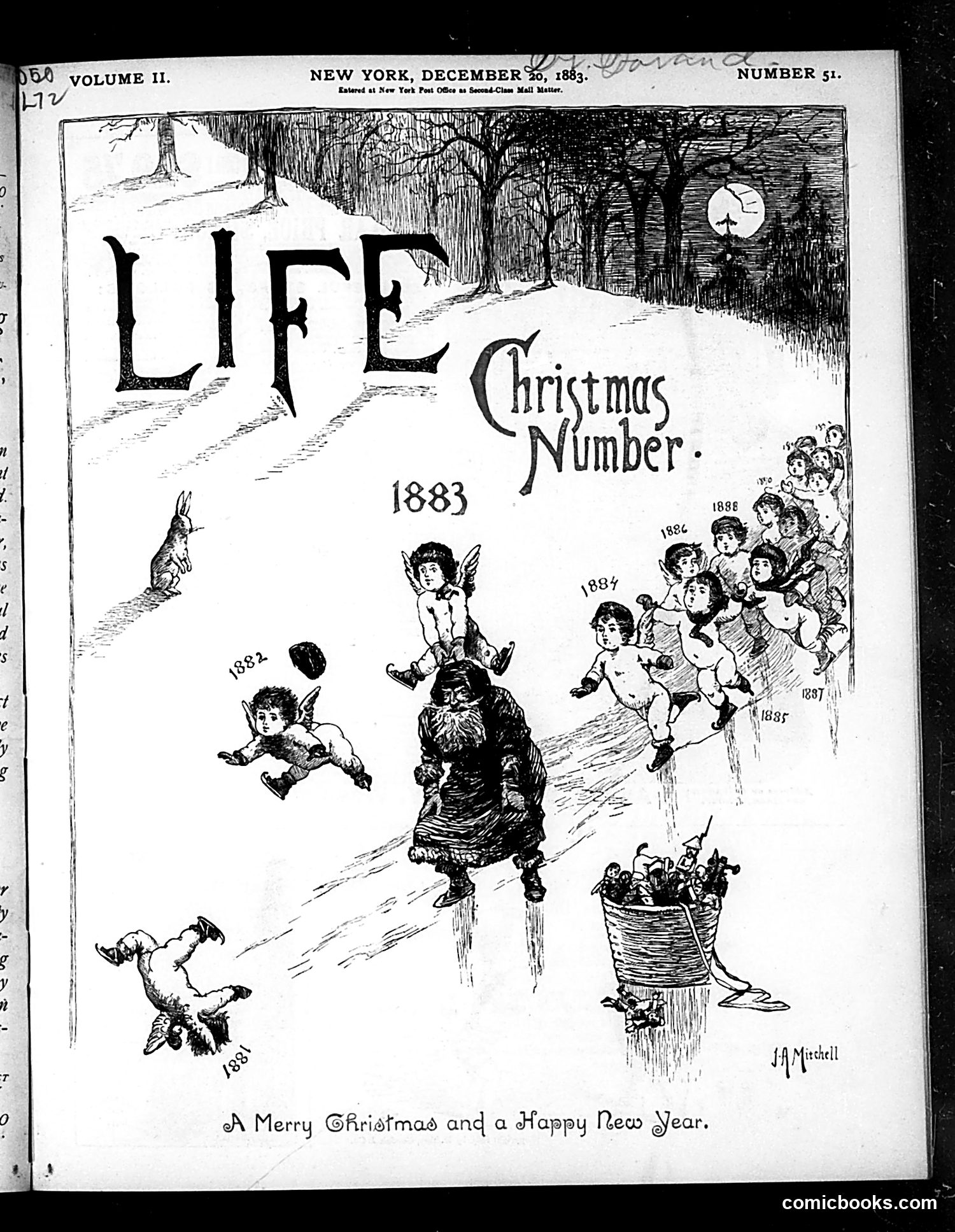
This is a festive cover illustration rather than political satire. The central figure is Santa Claus surrounded by cherubs dated from 1882-1888, presumably representing past and future Christmas issues of *Life* magazine. The numbered cherubs (1882, 1883, 1884, 1887, 1888) appear to document the magazine's Christmas editions across these years. A rabbit in the snow and a basket of toys complete the winter holiday scene. The illustration celebrates *Life's* editorial tradition of special Christmas issues, presenting them as an ongoing festive legacy. The cherubs function as decorative emblems of the magazine's seasonal output rather than as satirical commentary. The greeting "A Merry Christmas and a Happy New Year" confirms this is purely celebratory rather than satirical content.
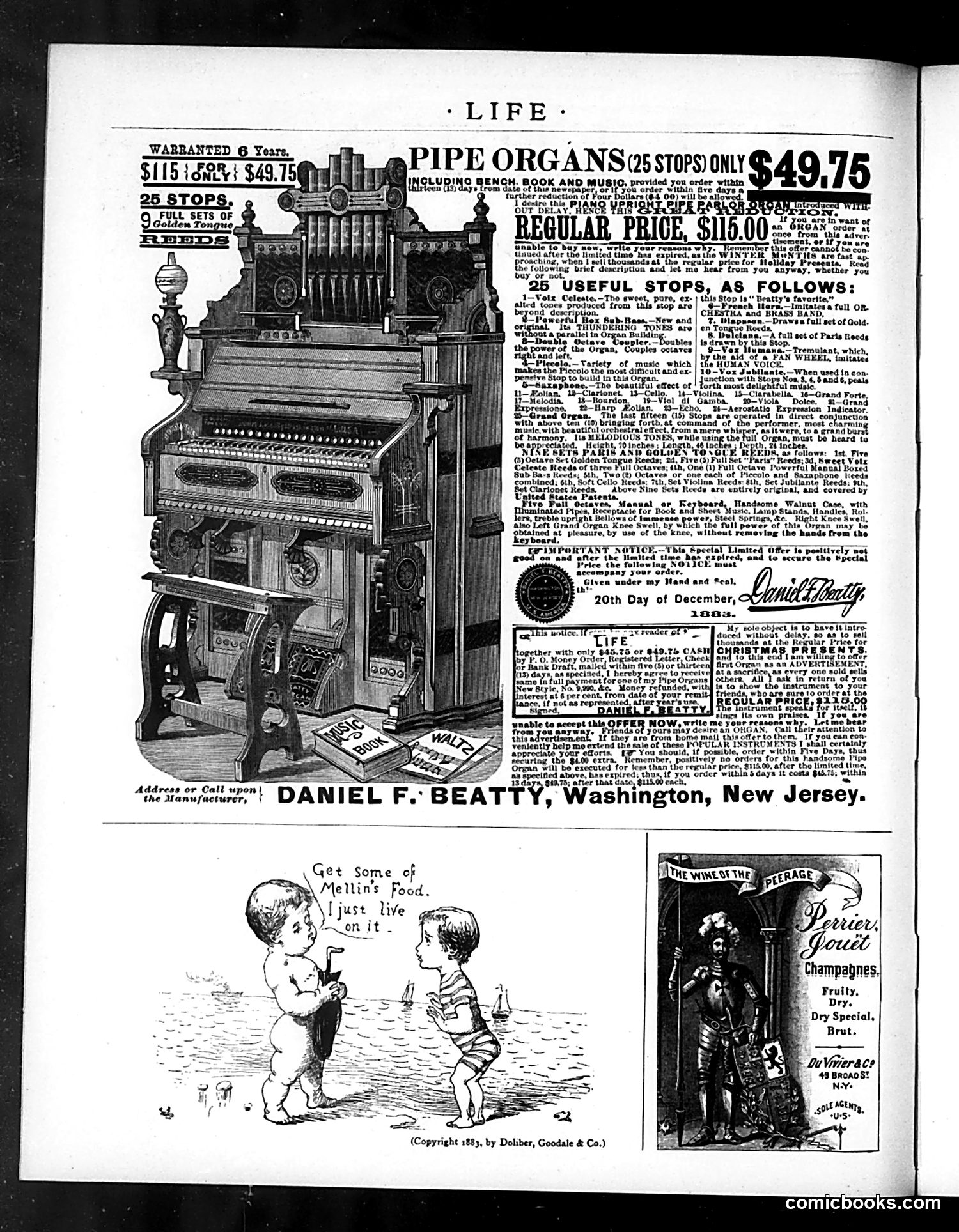
This page is primarily **advertising**, not political satire. The dominant content is a large advertisement for a pipe organ manufactured by Daniel F. Beatty of Washington, New Jersey, priced at $49.75 (warranted 6 years, regular price $116). Below the organ ad is a small cartoon showing two babies at a beach. One says to the other: "Get some of Mellin's Food, I just live on it." This is a **product endorsement cartoon** advertising Mellin's baby food, using children as testimonial figures. The humor relies on the babies' apparent contentment with the product. The page also includes an advertisement for Perrier-Jouët Champagne (bottom right). This reflects late-19th-century magazine advertising practices, where humor and cartoons were employed to sell consumer goods.
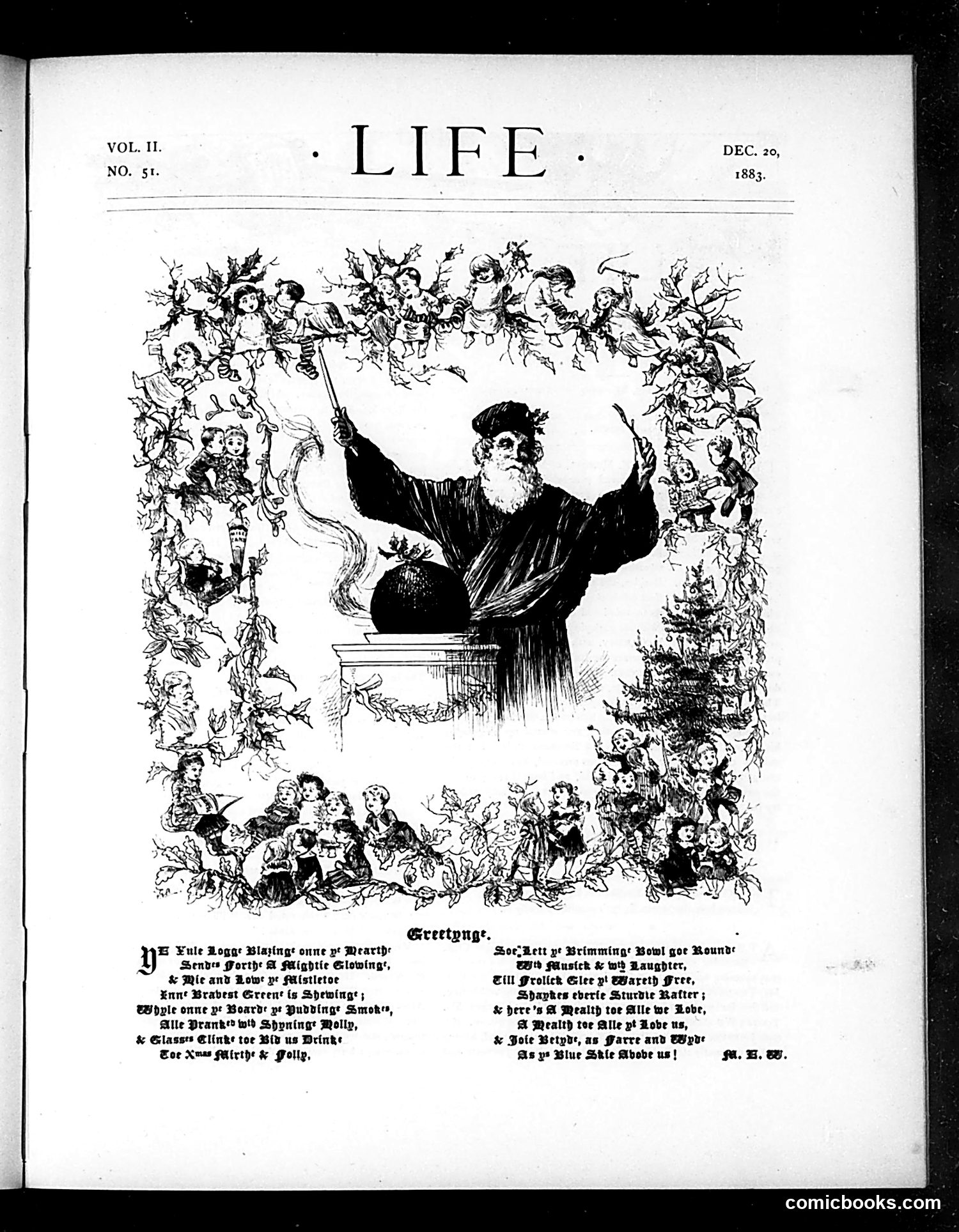
This is a Christmas greeting from *Life* magazine (December 20, 1883). The central illustration depicts a wizardly figure—likely representing Father Christmas or a similar magical holiday figure—conjuring cherubs and festive imagery from a cauldron. He's surrounded by an ornate border of children, holly, and seasonal decorations. The text below contains two Christmas carol excerpts or greeting verses written in Old English style lettering, celebrating traditional holiday themes: wassailing, feasting, good cheer, and winter merriment. Rather than political satire, this appears to be purely **seasonal festive content**—a holiday greeting page typical of 19th-century magazine special issues. The "wizard" imagery suggests the magical, transformative spirit of Christmas itself, conjuring joy and childhood wonder from the holiday season.
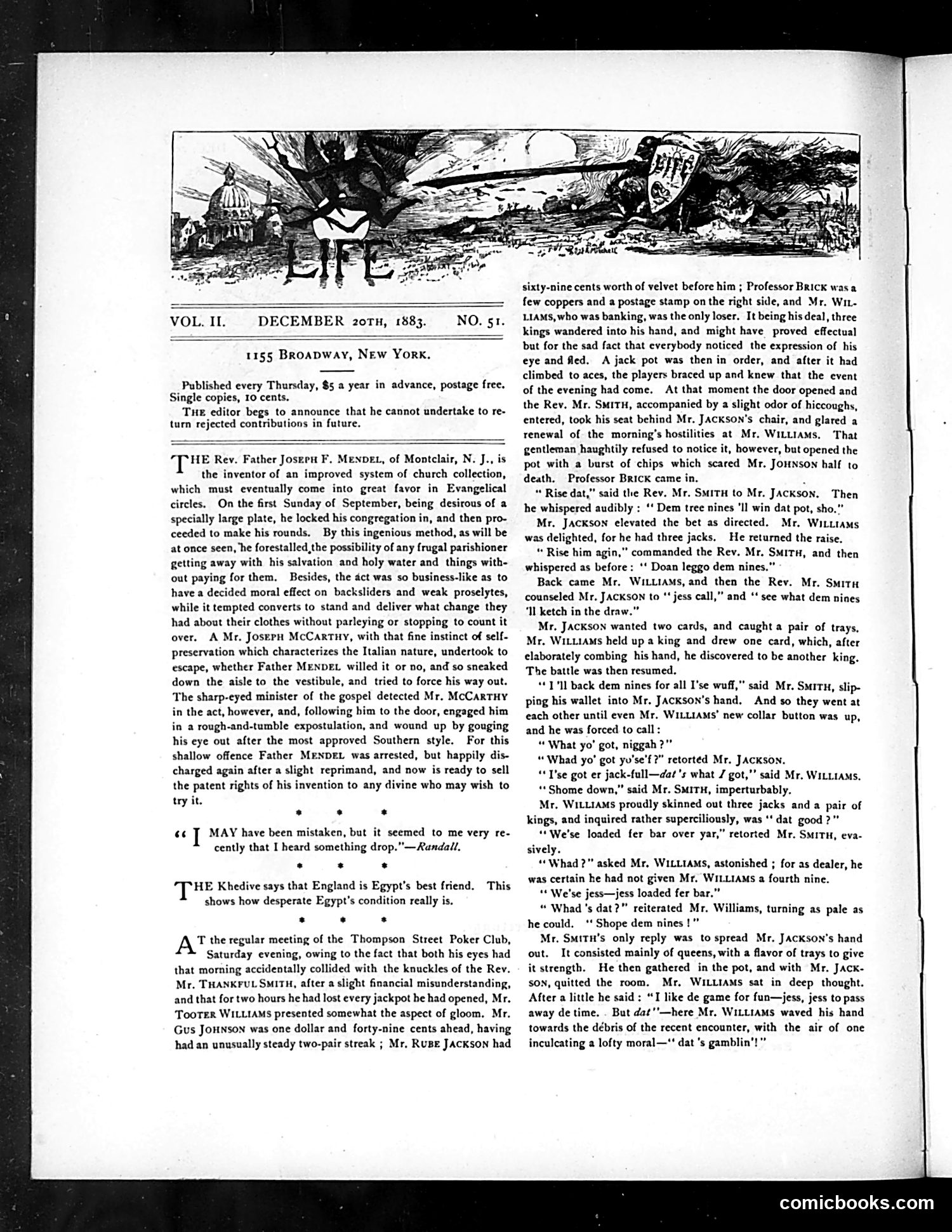
The page contains a satirical story about a poker game rather than political cartoons. The narrative describes a dispute among players—including characters named Mr. Williams, Mr. Jackson, Professor Brick, and Rev. Mr. Smith—over card game outcomes and winnings. The satirical humor targets the pretense of respectable gentlemen engaged in gambling. Notably, a clergyman (Rev. Mr. Smith) participates in the poker game, which is ironic given religious opposition to gambling in the era. The story mocks their attempts to maintain dignity while quarreling over cards and money, suggesting hypocrisy among supposedly moral citizens. The page also includes brief satirical commentary on other topics, including a jab at Egypt's political situation and an anecdote about church fundraising methods—typical content for Life's satirical social commentary.
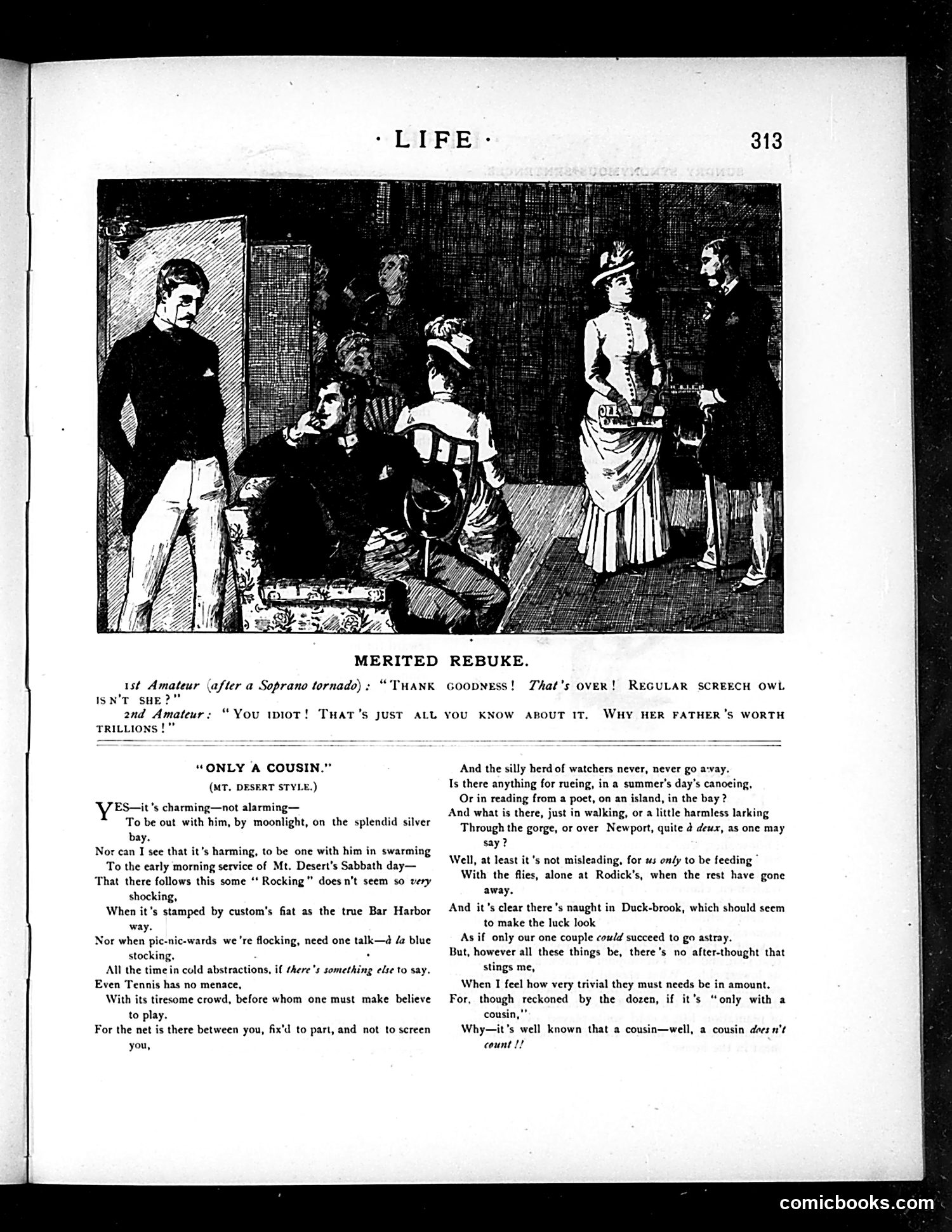
This page contains two pieces of social satire targeting upper-class leisure activities of the early 20th century. The top cartoon, "Merited Rebuke," mocks amateur opera singers. An inexperienced soprano performs while her wealthy father (implied by the second amateur's comment about his "trillions") attends. The joke is that incompetent singers rely on family money and status rather than actual talent. The poem "Only a Cousin" (Mt. Desert style) satirizes summer leisure culture among the wealthy—boating, poetry reading, and idle walks. The speaker defends these trivial pursuits as harmless, acknowledging they're socially meaningless ("a cousin doesn't count!!"). This appears to mock the self-aware shallowness of the leisure class at exclusive coastal resorts like Mt. Desert. Both pieces target genteel upper-class pretensions and empty social pursuits.
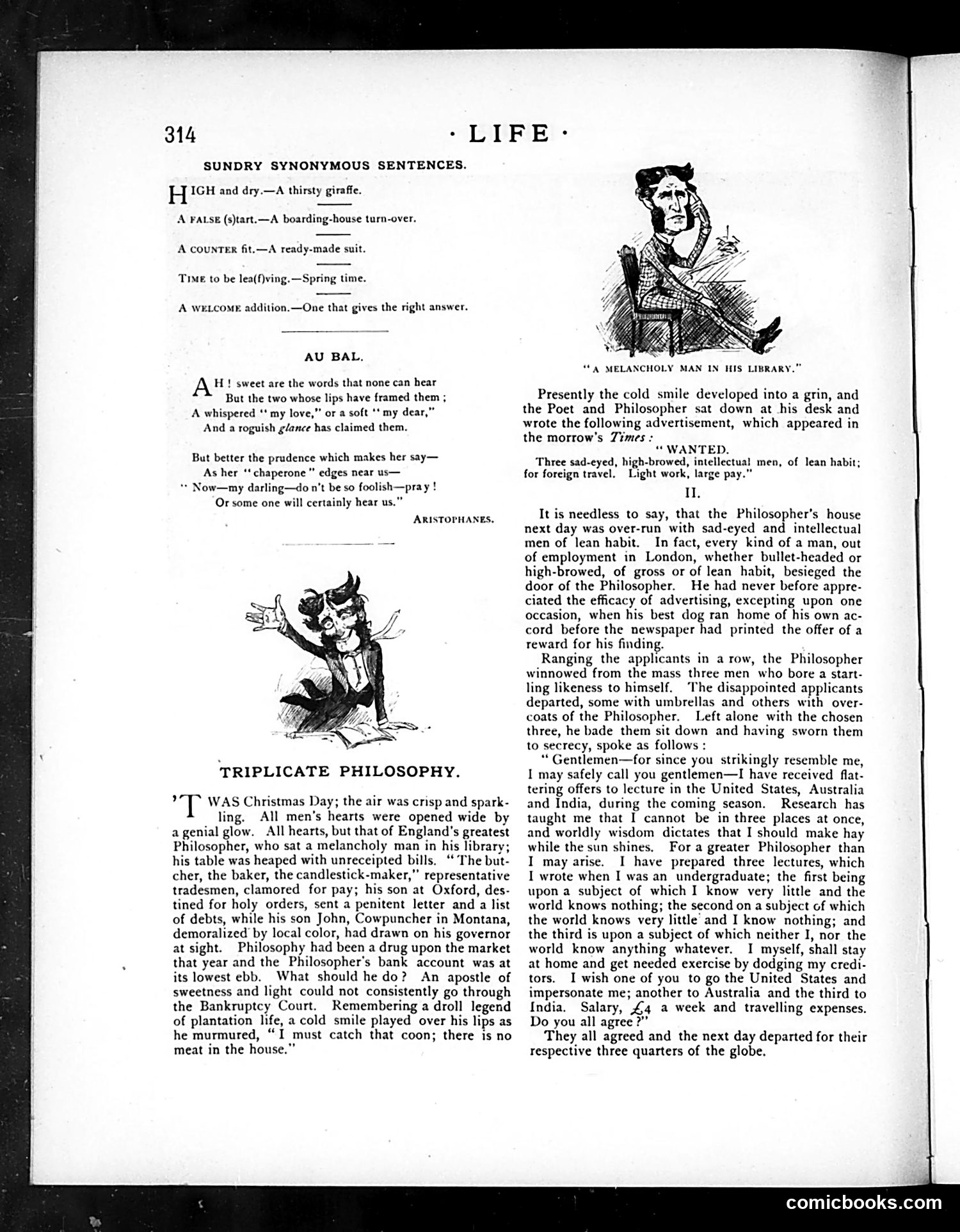
This page contains literary humor and social satire rather than political cartoons. The main piece, "Triplicate Philosophy," satirizes intellectual pretension through a story about a melancholy philosopher advertising for lecturers. The humor derives from the contradiction between the philosopher's claims of erudition and his actual financial desperation—his house is overrun with sad-eyed, intellectual men of "lean habit," and he's been forced to advertise for employment after bankruptcy. The satire mocks Victorian-era academic culture and the oversupply of intellectuals competing for scarce academic positions. The phrase "melancholy man in his library" (illustrated) represents the stereotypical impoverished scholar. The advertisement promising £4 weekly salary for global lecture tours parodies the era's optimistic travel-lecture circuit while exposing the philosopher's financial straits. The cartoons are simple character sketches supporting the literary humor.
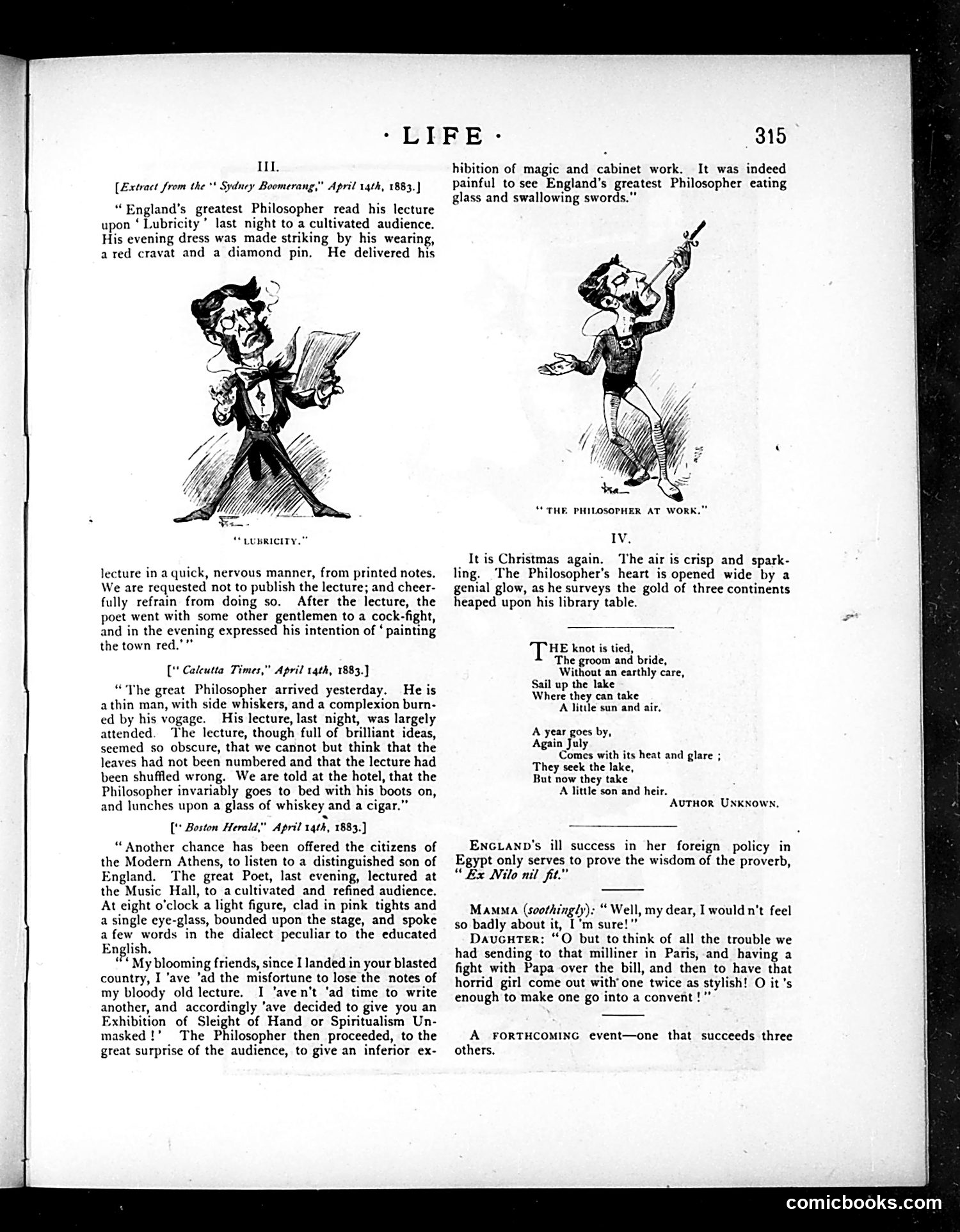
This page mocks a prominent English philosopher (identity unclear from text alone) who recently lectured on "Lubricity." The cartoons ridicule both his pretentious presentation and eccentric behavior. The left cartoon, titled "Lubricity," shows him reading notes in formal evening dress with a red cravat and diamond pin—the text notes he delivered lectures "in a quick, nervous manner" from printed notes rather than extemporaneously. The right cartoon, "The Philosopher at Work," depicts him performing a sword-swallowing stunt, mocking the lecture's apparent descent into vulgar demonstration. The accompanying newspaper excerpts describe his oddities: thin build, side whiskers, and the chaotic nature of his presentation. The satire targets Victorian pretension about serious philosophy mixed with public spectacle.
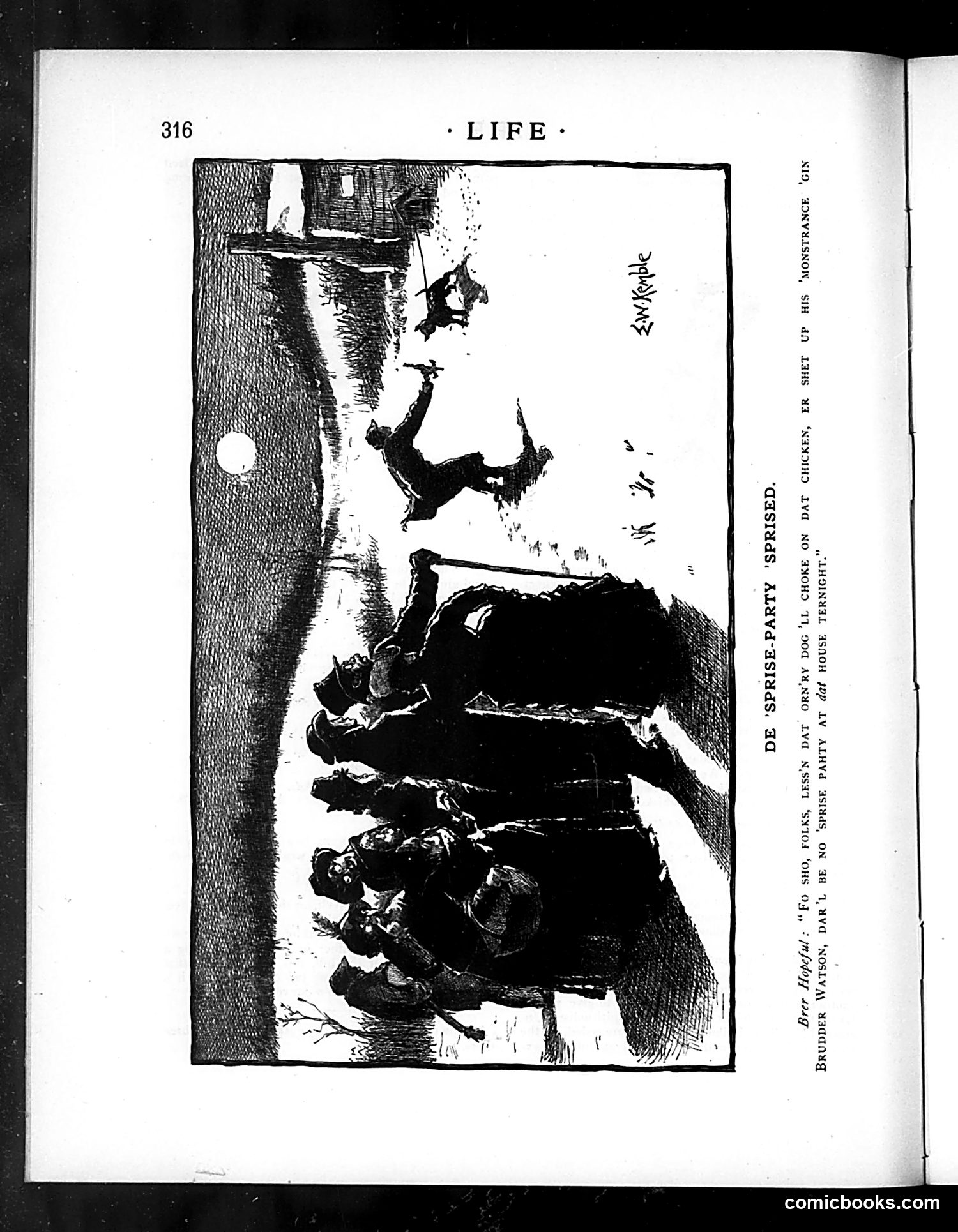
This cartoon depicts a surprise party scene that has gone awry. The caption reads: "By Jiggold: 'Fi shy folks, less is pay on Di churches, Er shut up his moustache tip'" The image shows several figures in what appears to be an interior space with a tree. The composition suggests guests have startled the host or an unexpected guest has arrived, disrupting the gathering. The title "A Surprise Party Sprised" plays on the word "surprised," indicating the joke involves the surprise backfiring or an ironic reversal—the would-be-surprised party-goer instead surprising the party planners. Without clearer text or additional context, the specific satirical or social commentary target remains unclear, though the cartoon's humor appears to rely on the disruption of domestic social conventions.
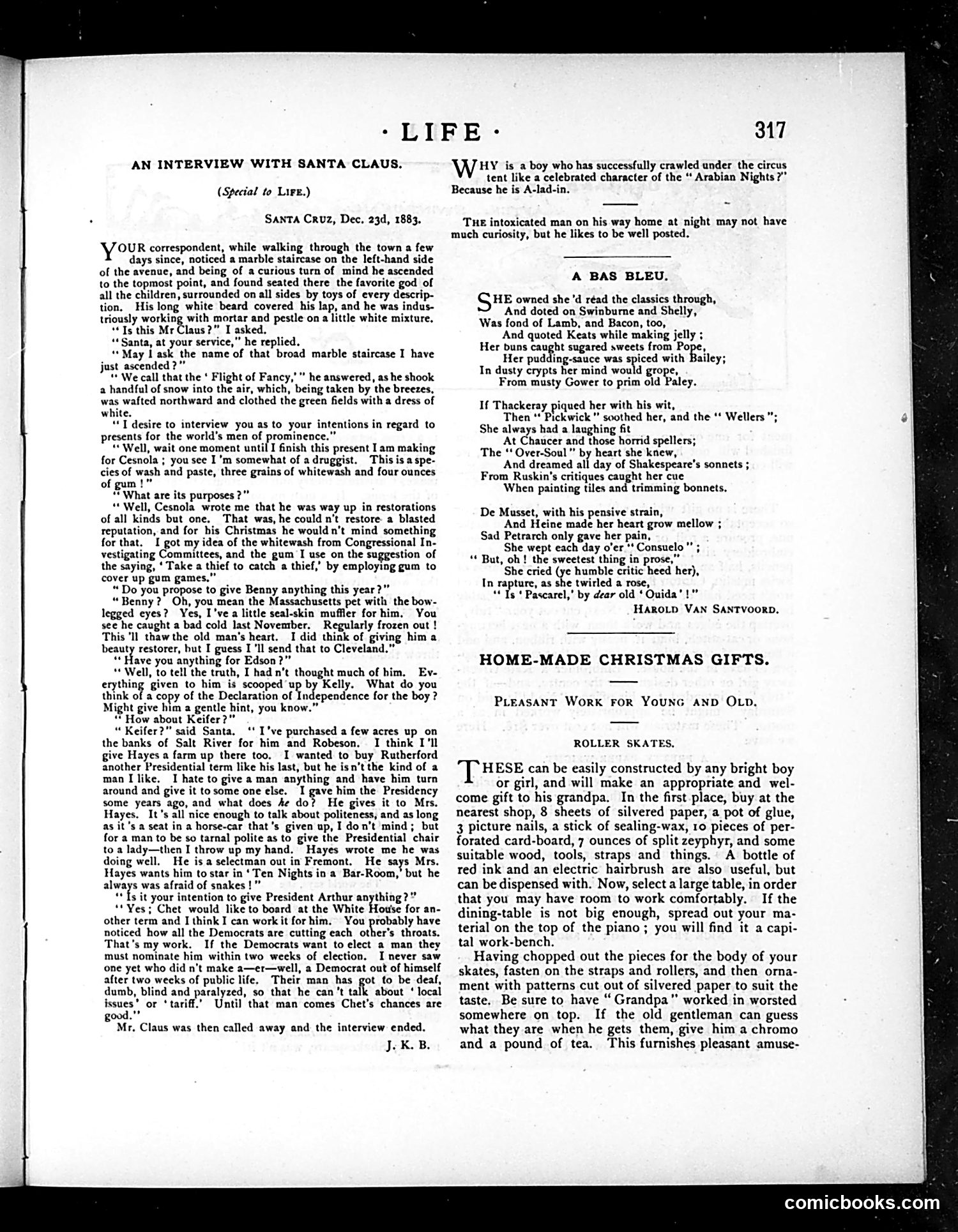
This page contains three distinct sections: 1. **"An Interview with Santa Claus"** — A humorous dialogue where a correspondent questions Santa about gift-giving and politics. Santa discusses various recipients (Benny Hayes, President Arthur) and makes political commentary about Democrats "cutting each other's throats" and election disputes. The satire targets contemporary political divisions. 2. **"A Bas Bleu"** — A poem mocking an intellectual woman who reads classics and aspires to literary sophistication. The title (French for "blue stocking," a period insult for educated women) indicates satirical criticism of women's intellectual pretensions. 3. **"Home-Made Christmas Gifts"** — Practical instructions for constructing roller skates, targeting young readers. This appears instructional rather than satirical. The page reflects 1883 political commentary and gender attitudes typical of the era.
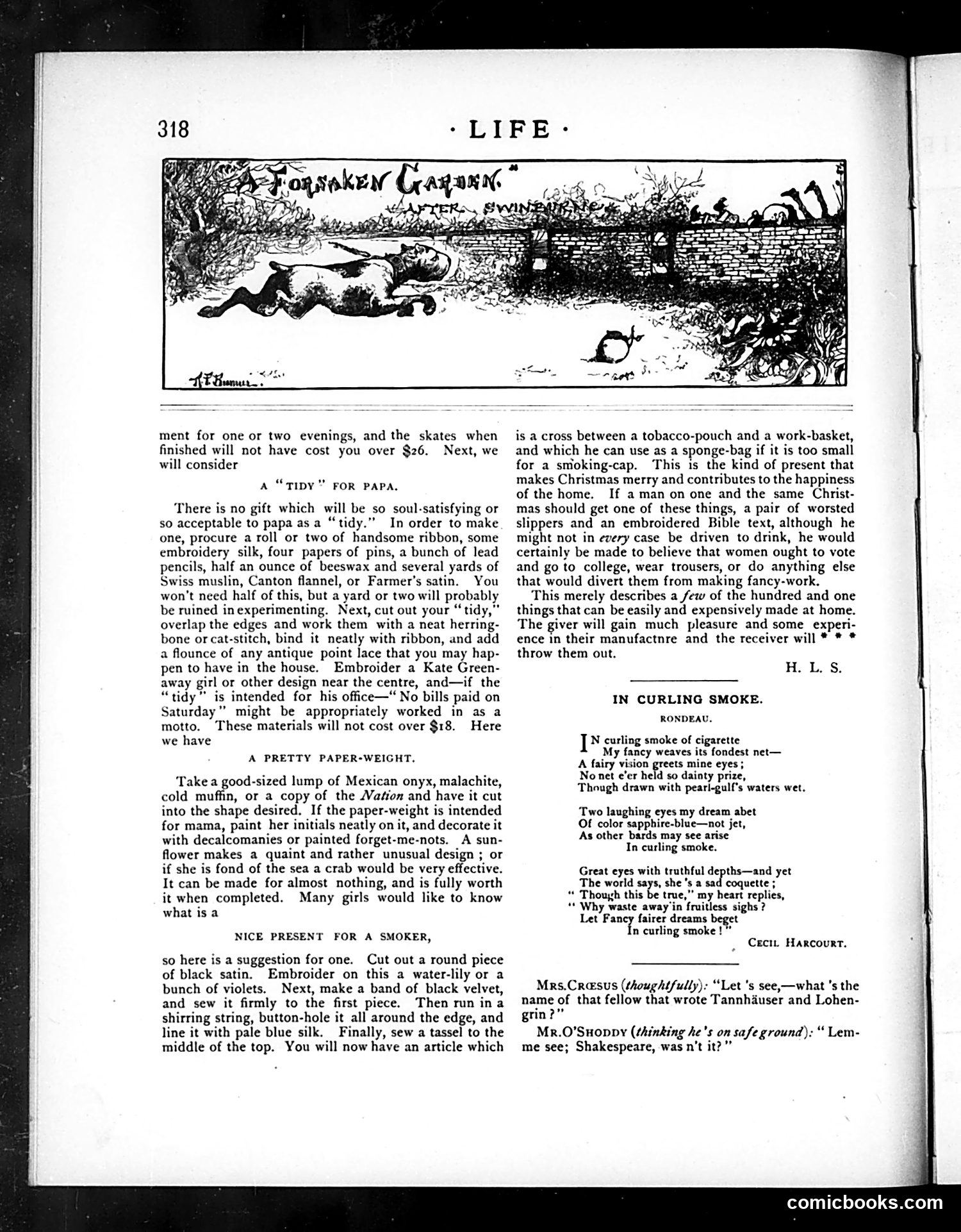
## Cartoon The top illustration titled "Forsaken Cabaret" depicts a man lying prone on the ground near a brick wall, appearing distressed or defeated. The crude sketch style and title suggest this is satirizing romantic disappointment or the aftermath of a failed romantic encounter—likely mocking melodramatic responses to rejection. ## Text Content The page consists primarily of **gift-giving advice**, not political satire. It suggests Christmas presents for family members: ice skates for children, decorative "tidies" (furniture doilies) for fathers, paperweights for mothers, and smoking accessories for men. ## Social Commentary The final paragraph contains the actual satire: it mocks the impracticality of handmade gifts by noting that men receiving such items might be driven to "believe that women ought to vote and go to college, wear trousers"—satirizing anxieties about women's rights and independence. The humor assumes readers find such prospects absurd. The dialogue snippets mock social pretension: a wealthy woman confuses Wagner with Shakespeare.

I can see this is a page from Life magazine, but the image quality is too degraded for me to make out specific cartoon content, figures, caricatures, or text with confidence. The page appears mostly blank or very faded, with only faint marks visible. Without being able to read the OCR text clearly or discern distinct satirical imagery, I cannot reliably identify the political/social references, figures depicted, or the intended joke or point of the satire. To provide an accurate historical analysis as requested, I would need a clearer image where the cartoon details and text are legible. I cannot responsibly invent or guess at specifics that aren't clearly visible.
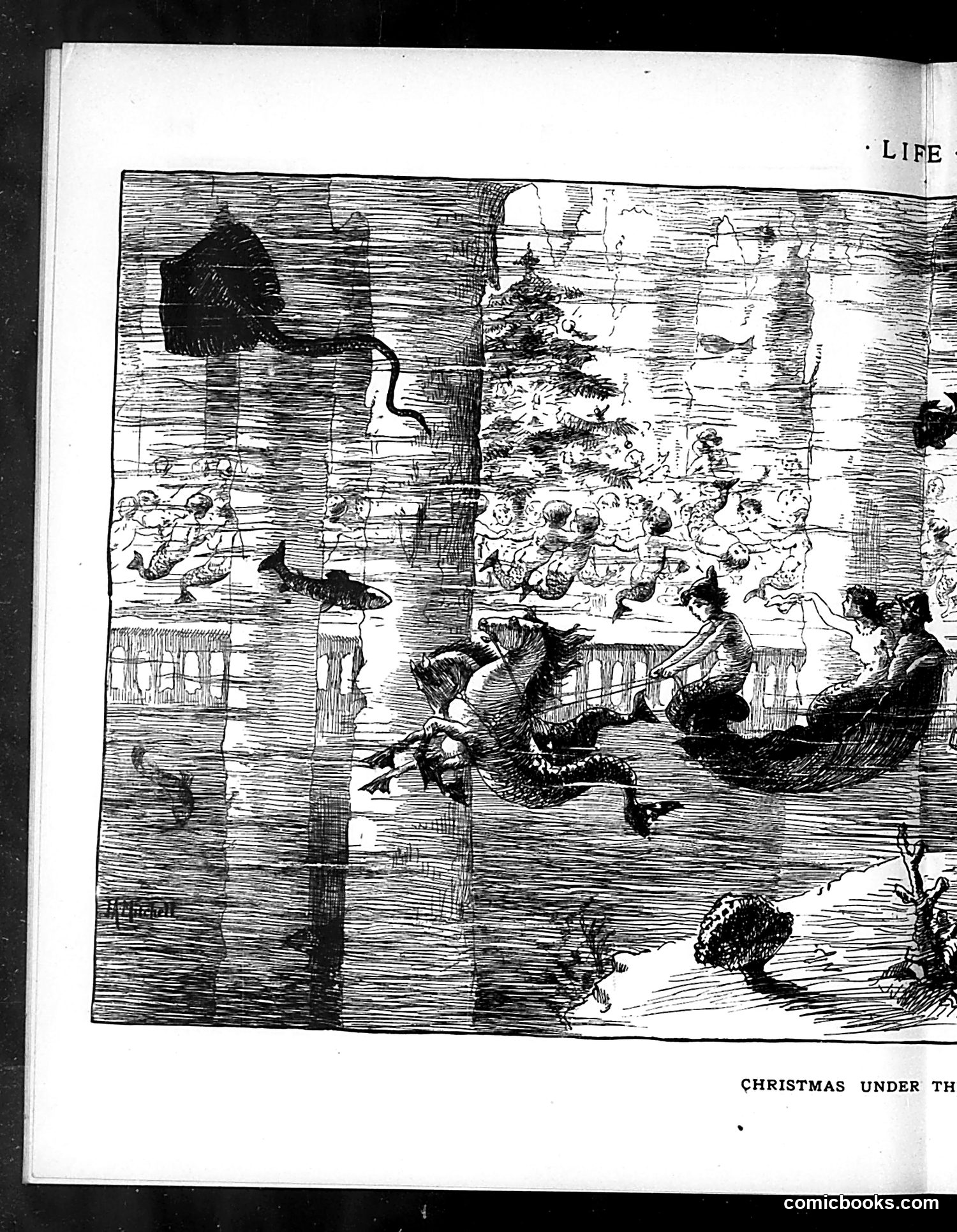
This is an engraving-style illustration titled "Christmas Under Th[e]" (text cut off). The scene depicts an underwater Christmas celebration with merpeople and human figures in water. A decorated Christmas tree stands in the center, surrounded by numerous cherubs or children-like figures swimming and celebrating. There are fish, sea creatures, and what appears to be festive decorations adapted for an aquatic setting. The satire likely plays on the incongruity of celebrating a traditional Christian holiday (Christmas) in an impossible, fantastical underwater realm. This may mock either Victorian sentimentality about the holiday or serve as whimsical social commentary. Without the complete caption or date, the specific political or social target remains unclear, though Life magazine typically satirized contemporary culture and society.
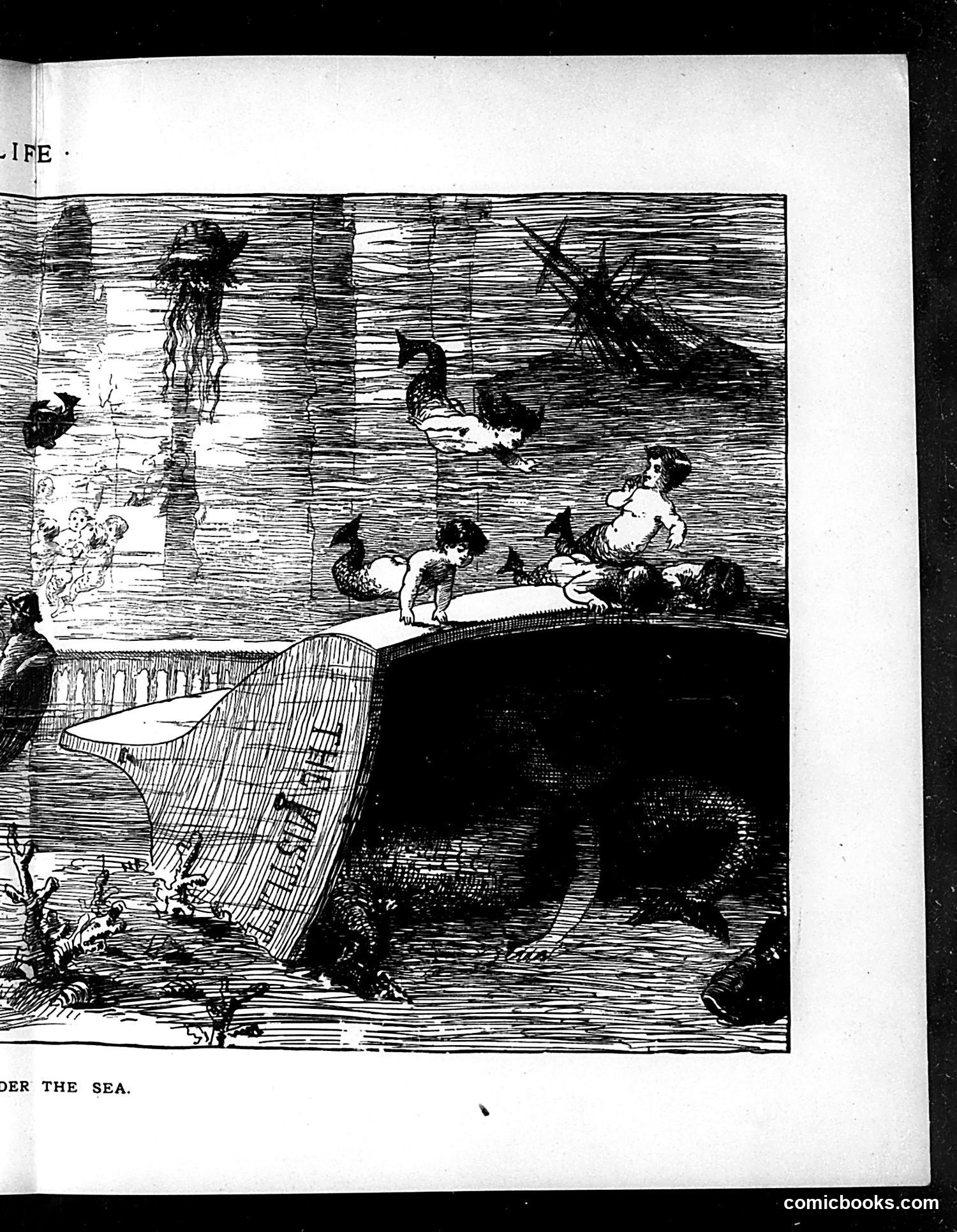
This appears to be a fantastical underwater scene rather than a political cartoon. The etching shows mermaids and mythological sea creatures on the ocean floor, with human figures (appearing to be well-dressed observers, possibly in period costume) viewing them from above—possibly from a ship or platform indicated by the wooden structure on the left. The title fragment "DER THE SEA" (likely "UNDER THE SEA") and the artistic style suggest this is illustrative rather than satirical. Without the full page context or complete OCR text, I cannot identify specific political references or social satire. The work appears to be a fantastical or imaginative illustration, possibly from a story or serial feature in *Life* magazine, rather than editorial commentary.

I can see this is a blank or nearly blank page from Life magazine, with only a "comicbooks.com" watermark visible at the bottom. There is no discernible cartoon, illustration, text content, or satirical material present on the page itself that I can analyze. The page appears to be either: - A blank interior page from the original publication - A title page or section divider - Improperly scanned or reproduced Without visible cartoon content, political figures, social commentary, or satirical material, I cannot identify specific references, caricatures, or the intended message. To provide meaningful analysis, I would need a page with actual visible content.
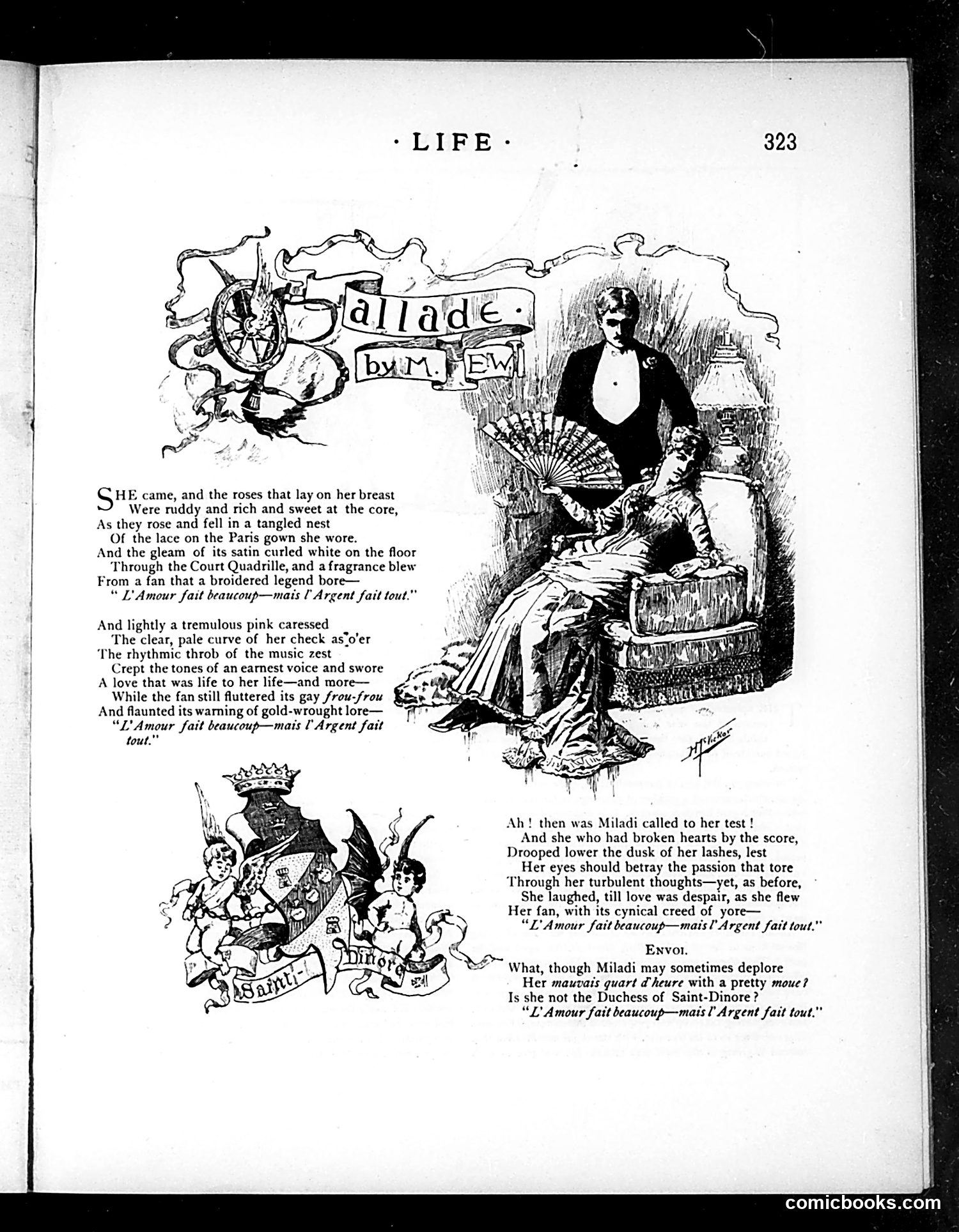
This is a romantic poem illustrated with satirical artwork, not a political cartoon. The piece mocks a wealthy aristocratic woman ("Miladi," the Duchess of Saint-Dinore) through the recurring French refrain: "Love accomplishes much—but money accomplishes everything." The narrative depicts her receiving a passionate declaration of love while her ornate fan cynically reminds her (and readers) that financial security matters more than romance. The accompanying illustrations—showing her in elegant Paris gown, attended by admirers—emphasize her wealth and status. The satire targets the superficiality of aristocratic romance: despite being "called to her test" emotionally, she ultimately prioritizes her titled position and fortune over genuine feeling. The final "Envol" (closing stanza) confirms this, suggesting she accepts her loveless marriage as the acceptable trade-off for being a duchess.
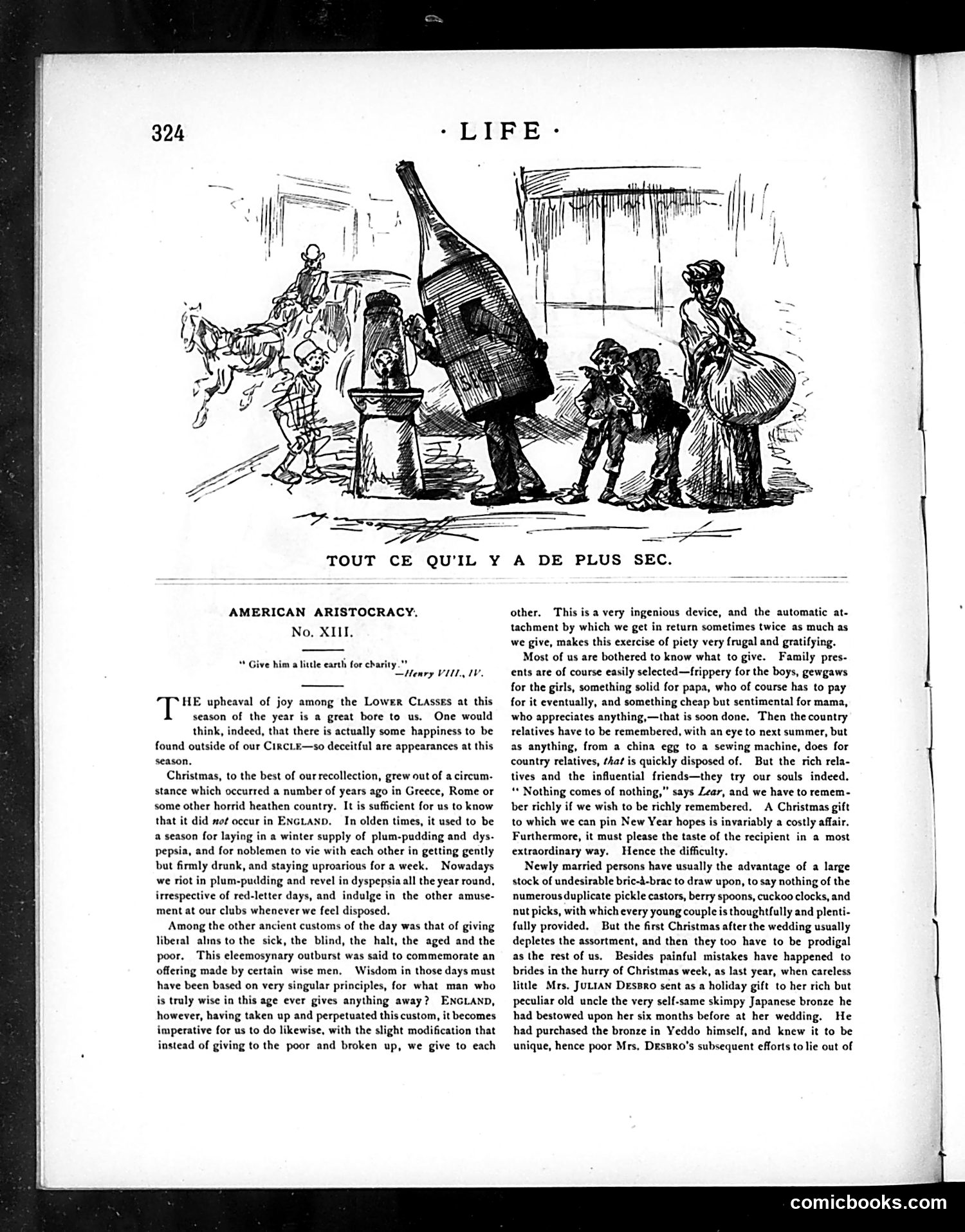
This satirical piece mocks wealthy English aristocrats' hypocritical approach to Christmas charity. The text presents the voice of a snobbish upper-class narrator who dismisses the poor's joy at Christmas as a "bore" and reveals how the rich have corrupted the holiday's charitable spirit. The cartoon illustration shows wealthy figures distributing gifts—but the satire lies in the accompanying essay, which explains that instead of genuinely helping the poor, the rich merely exchange expensive gifts *among themselves*, calculating to receive "twice as much as we give." The piece ridicules this as false charity: gifts to country relatives are perfunctory; gifts to wealthy, influential friends must be costly and perfectly tailored. The anecdote about Mrs. Julian Desaro accidentally regifting her uncle a Japanese bronze he'd already given her exemplifies the absurd, self-serving nature of aristocratic "generosity." The satire targets class pretension and the hollowness of charity performed for social obligation rather than genuine benevolence.
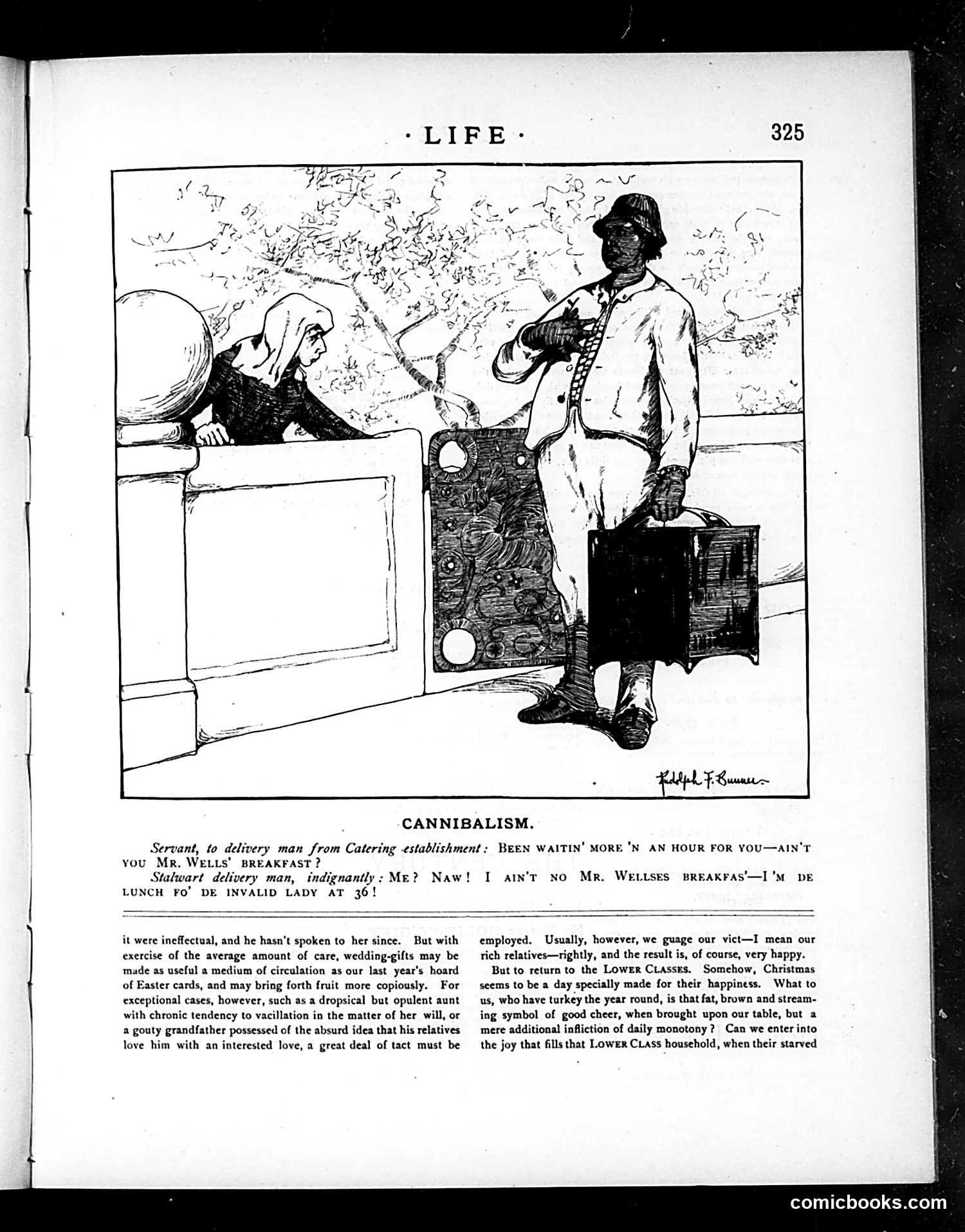
This satirical cartoon jokes about class disparities in food access. A delivery man from a catering establishment arrives with a meal, and a servant mistakenly asks if it's Mr. Wells' breakfast. The delivery man indignantly corrects her: it's actually lunch for "the invalid lady at 36"—implying the wealthy Wells family eats so much that their servants assume every delivery must be for them. The accompanying text discusses wedding gifts and "Lower Classes," contrasting wealthy households who enjoy turkey year-round with poor families for whom Christmas turkey is a rare luxury. The title "Cannibalism" darkly suggests the wealthy metaphorically consume the labor and resources of the poor. The cartoon satirizes turn-of-the-century class inequality—mocking the obliviousness of the rich to their own excess while the working poor struggle with scarcity.
This page contains a satirical essay ("M.E.R.") paired with a humorous poem ("M.H.G.") mocking a Frenchman's impressions of New York's elevated railway. The essay criticizes wealth inequality at Christmas: while wealthy families give expensive toys that bring little joy, poor families' inexpensive gifts (a 50-cent Christmas tree) bring genuine delight. The author argues that the wealthy have power to meaningfully help the impoverished—yet a trinket costing less than a poor family's annual rent remains unspent. The poem presents a French visitor astounded by the elevated train ("rabbit transit") that runs on air alone, moving so fast it leaves passengers behind. He marvels at American engineering while simultaneously expressing relief to return to solid ground—gentle mockery of both the technology and foreign bewilderment at American innovation. The page otherwise contains book advertisements from publishers like Champlin's Books and D. Appleton & Co., typical of *Life* magazine's format.
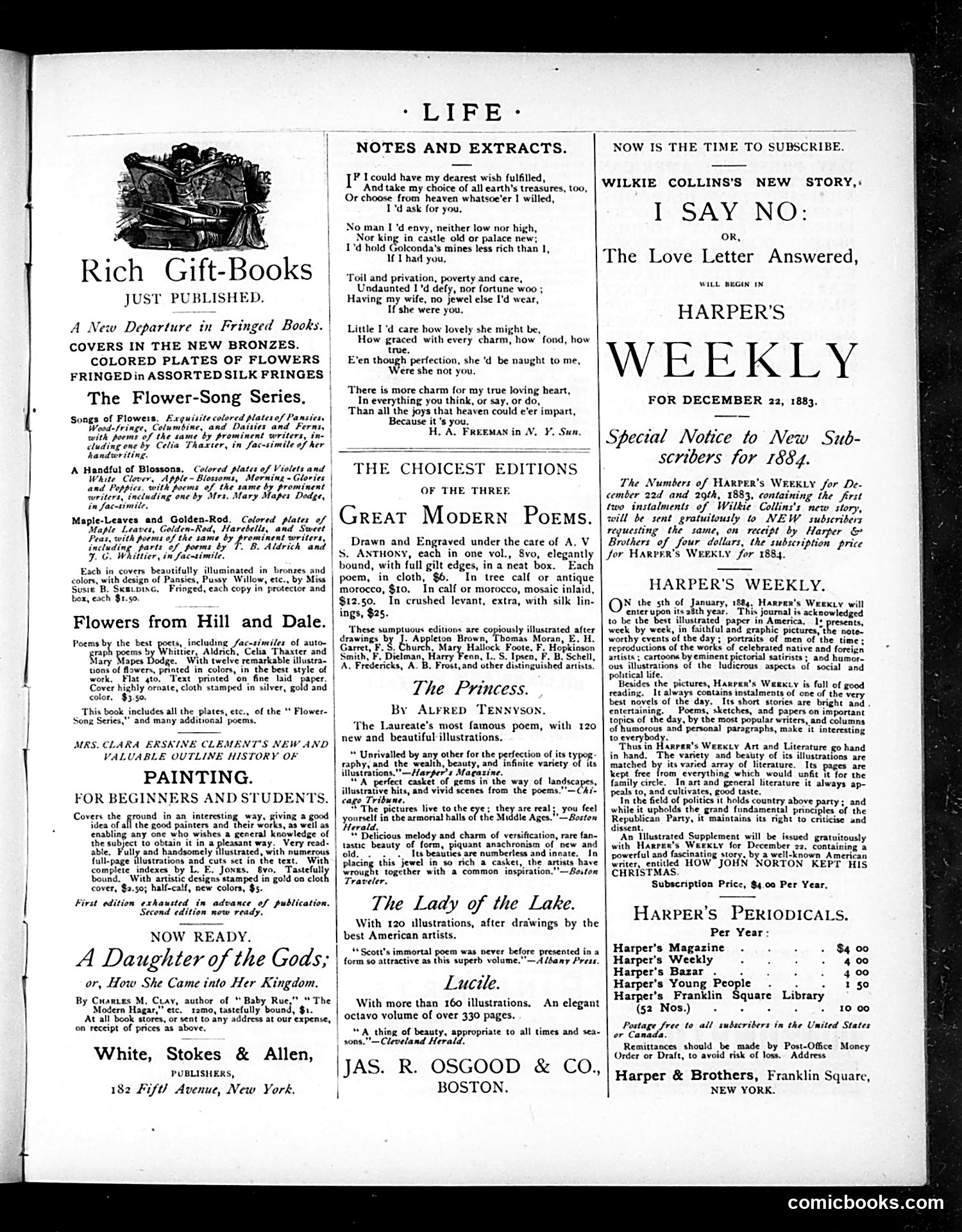
This is a book advertisement section from *Life* magazine (December 22, 1883). The page showcases luxury gift books newly published by White, Stokes & Allen: ornate volumes of poetry and illustrated flower collections with autographed poems by prominent writers like Whittier and Aldrich. Also advertised are editions of classic poems (appears to reference Tennyson works based on visible titles like "The Princess" and "The Lady of the Lake") and a history of painting for students. The right column promotes *Harper's Weekly* and other Harper publications, offering subscription information for 1884. There is no political cartoon visible—this is purely commercial publishing promotion typical of late 19th-century magazine advertising.
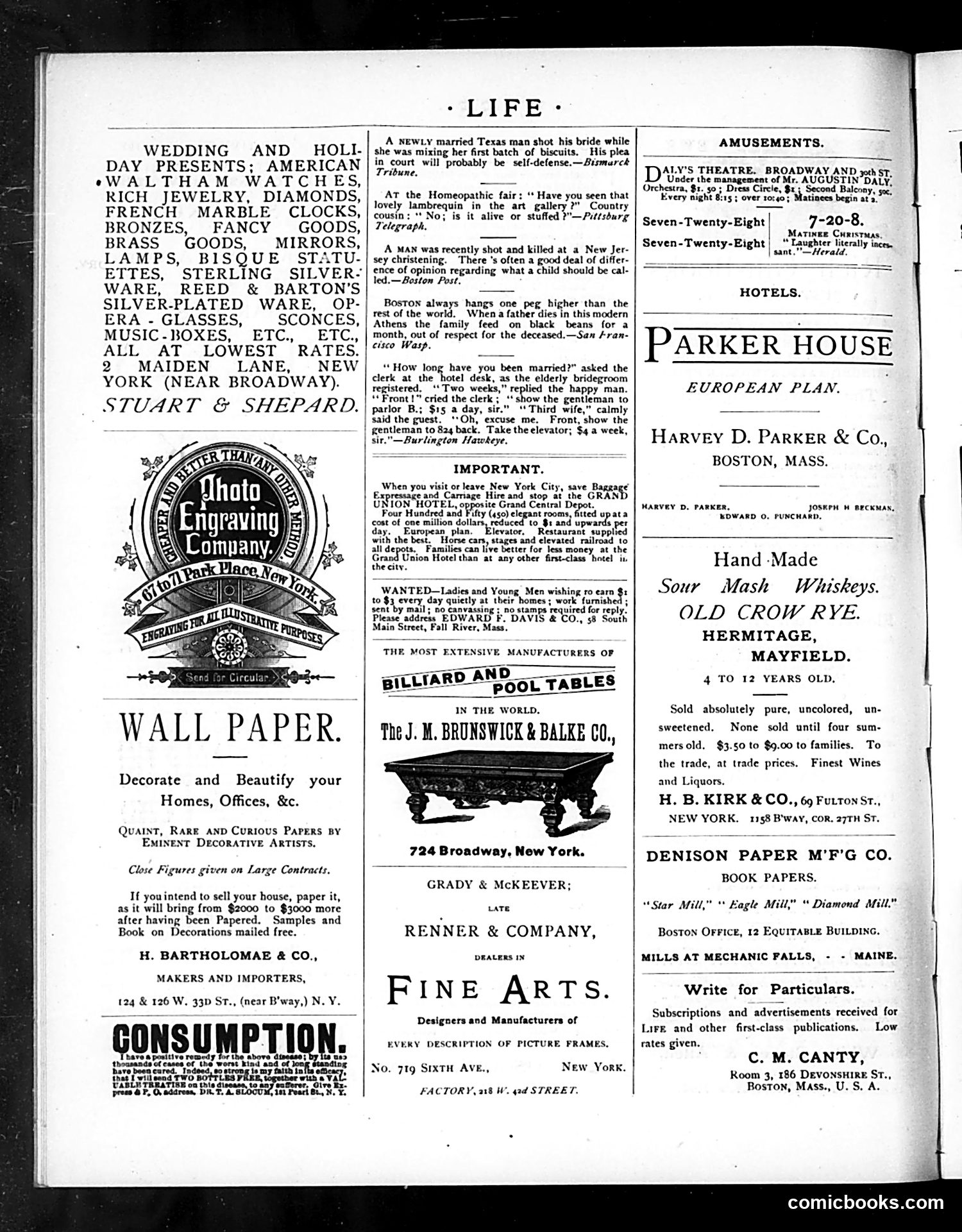
This page is primarily advertising, but includes a "Amusements and Humor" section featuring brief satirical anecdotes. The jokes target absurd or darkly comic scenarios: a Texas man shooting his newly married wife as "self-defense" while she makes biscuits; confusion at a homeopathic fair; a shooting at a New Jersey christening over naming disputes; Bostonians' austere mourning customs; and a widower remarrying repeatedly, receiving progressively cheaper hotel rates. These represent typical late 19th-century Life magazine humor—relying on regional stereotypes (Texas, Boston, San Francisco), dark violence treated as comedy, and social commentary through exaggeration. The jokes assume reader familiarity with regional characteristics and contemporary anxieties about modern life. The humor would be considered offensive today, particularly regarding domestic violence. The rest of the page consists of classified advertisements for jewelry, wallpaper, hotels, and manufactured goods.
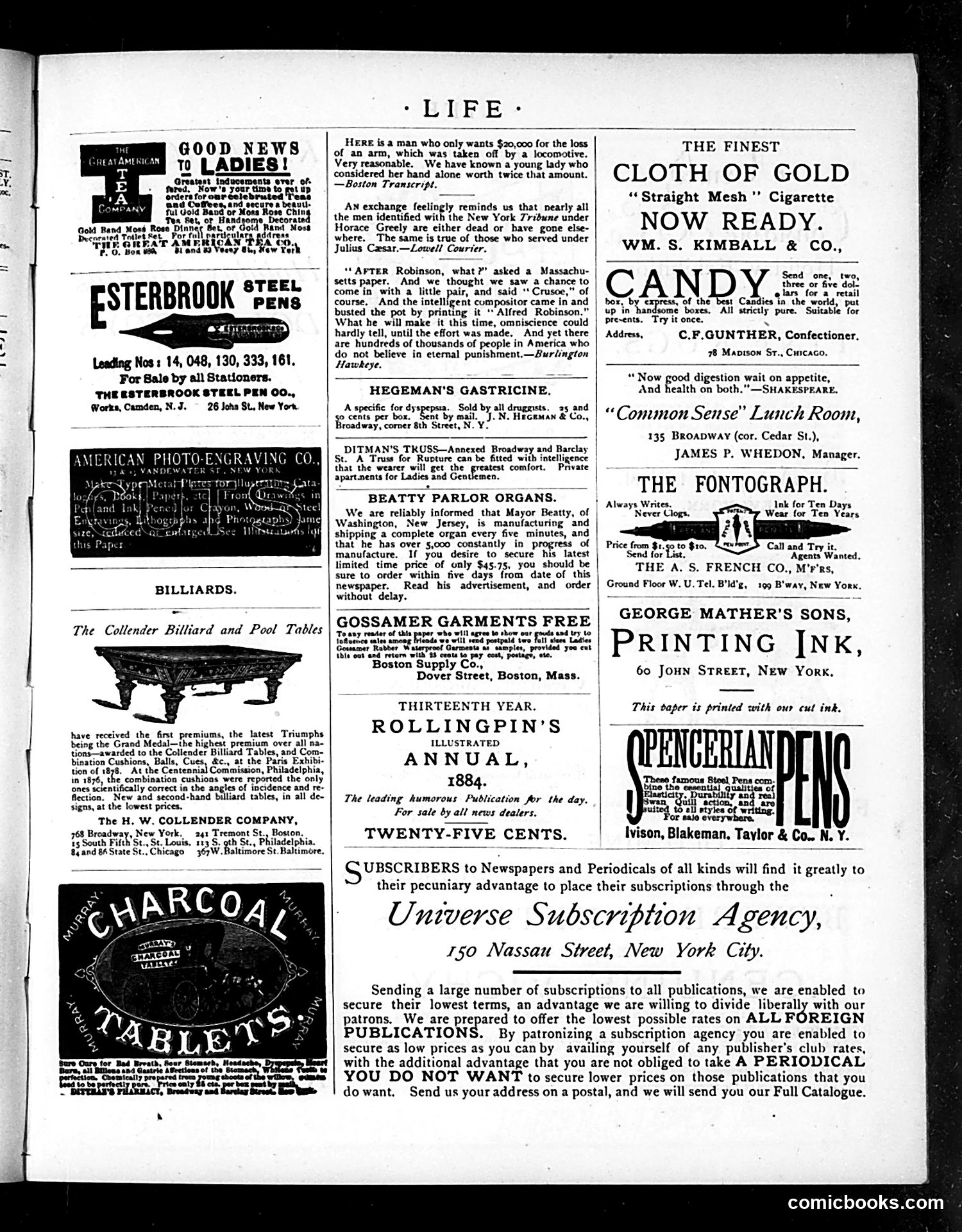
This is primarily an **advertising page** from Life magazine (appears to be 1880s based on references). The page contains mostly commercial advertisements with a few brief humorous editorial snippets interspersed. The humor pieces are short satirical jabs typical of 19th-century Life: - A joke about a man seeking $20,000 compensation for losing an arm, criticized as too modest - A quip about the New York *Tribune* under Horace Greeley, sarcastically comparing staff turnover to Julius Caesar's era - A typographical error joke where "Robinson" was misset as "Alfred Robinson," mocking the compositor's incompetence - A dig at religious hypocrisy, suggesting people disbelieve in eternal punishment despite constant proof of human error The advertisements promote period products: steel pens, billiard tables, medical devices (trusses), organs, and cigarettes. **No political cartoons appear on this page**—it's essentially a commercial sheet with scattered one-liner jokes, representative of Life's lighter satirical style.
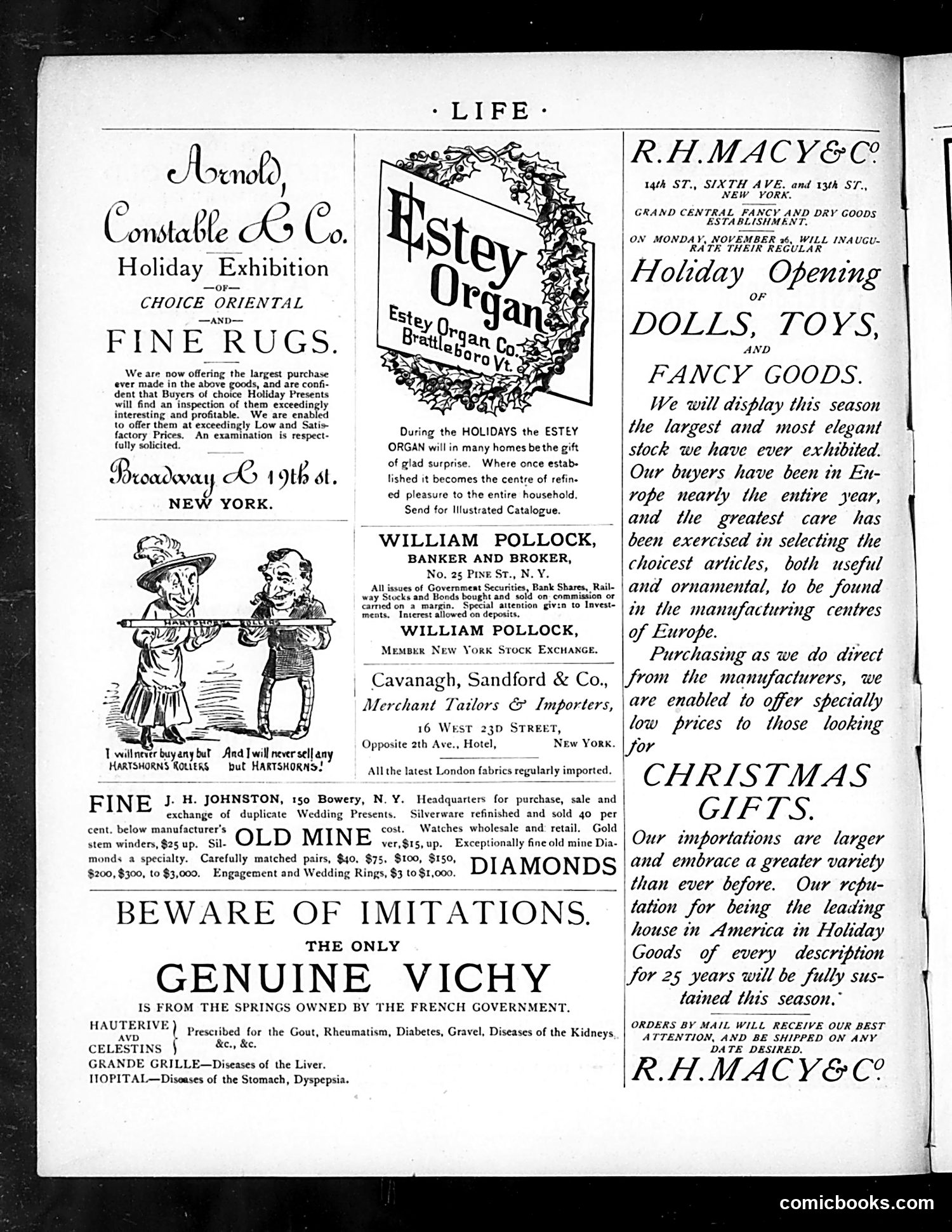
This is primarily a **Victorian-era advertisement page** from Life magazine, not a political cartoon. The page contains no satire or social commentary—it's a collection of holiday shopping advertisements from late 19th-century New York merchants. The only visual element is a **small cartoon** (bottom left) showing two figures with a humorous caption about "Hartshorns Rollers," a window shade product. The joke appears to be a play on brand loyalty: "I will buy any but Hartshorns Rollers" / "And I will never sell any but Hartshorns!"—suggesting the product's reliability and market dominance. The rest of the page advertises luxury goods targeting wealthy consumers: oriental rugs, organs, diamonds, fine tailors, and R.H. Macy's holiday opening for dolls and imported European fancy goods. This reflects the consumer culture and European imports fashionable among the American upper classes during this period.
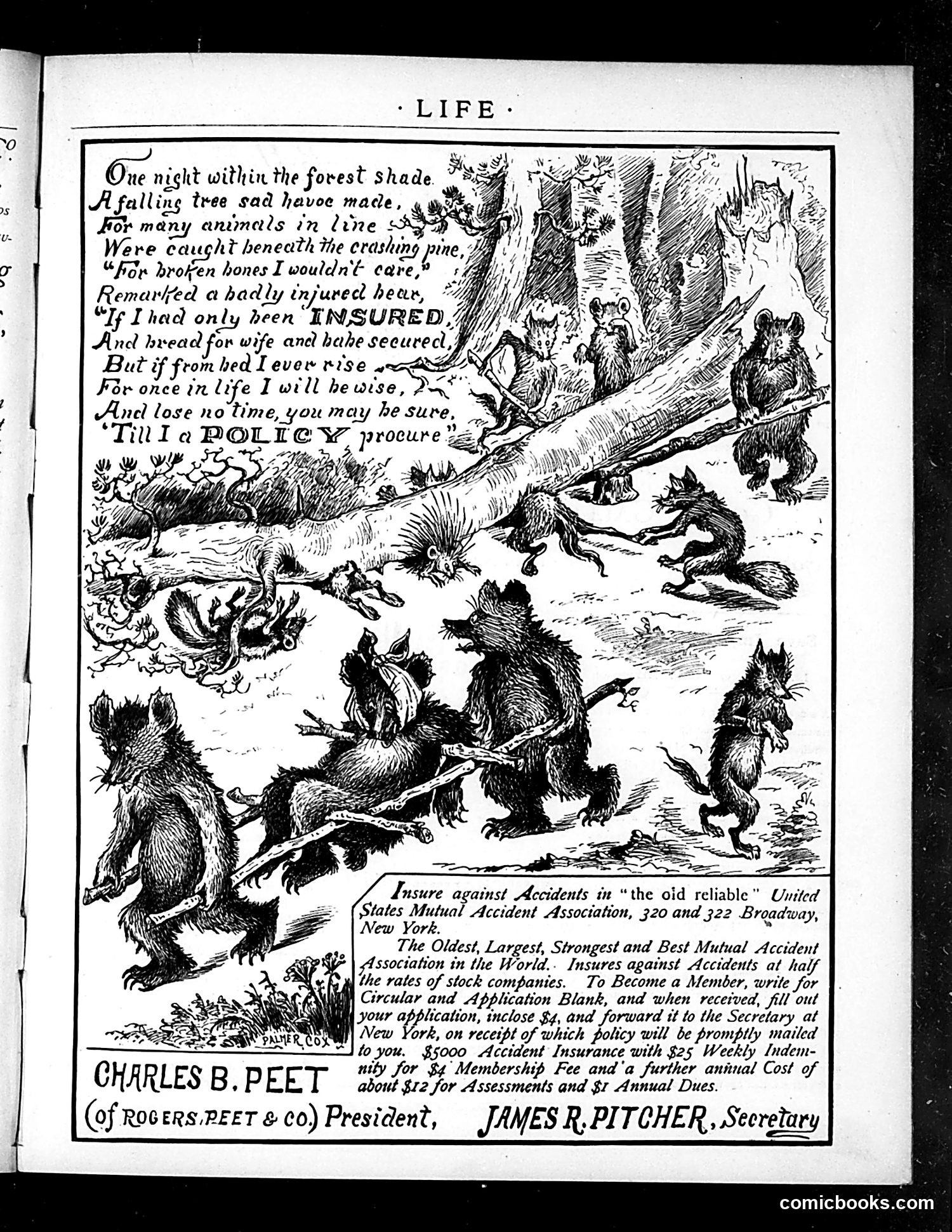
This is primarily an **advertisement disguised as entertainment** for the United States Mutual Accident Association, an insurance company. The cartoon shows forest animals injured by a falling tree. A badly hurt bear, trapped beneath the pine, reflects on his misfortune—he wouldn't mind broken bones if only he had **accident insurance** to protect his wife and child. The moral is heavy-handed: once recovered, he'll immediately purchase a policy. This is **satirical advertising**: the fable uses an anthropomorphized animal's regret to pitch insurance as essential protection. The joke operates on two levels—the absurdity of animals discussing insurance policies, and the implicit commentary on human vulnerability and financial insecurity. For modern readers, it illustrates how insurance companies marketed protection against industrial-era dangers (workplace accidents, injuries) by exploiting public anxiety. The advertisement emphasizes the association's age, size, and low rates compared to "stock companies," standard competitive claims of the period.
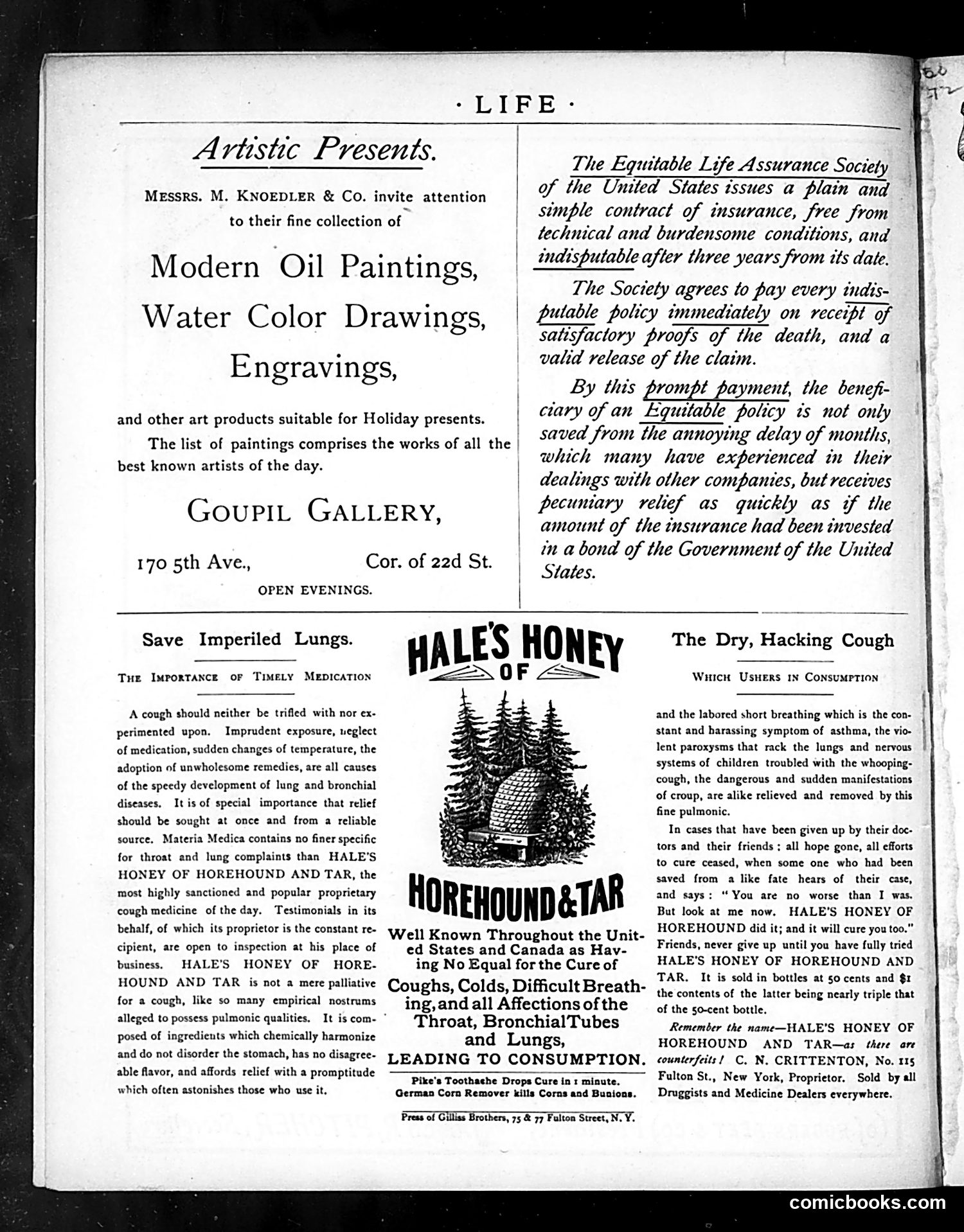
This page is primarily **advertising**, not satire or political commentary. It contains three main advertisements from what appears to be a 19th-century issue of Life magazine: 1. **Goupil Gallery** (top left): An art dealer announces holiday gift paintings and engravings by "best known artists of the day." 2. **Equitable Life Assurance Society** (top right): Insurance company emphasizing quick claim payouts, contrasting favorably with competitors' delays. 3. **Hale's Honey of Horehound and Tar** (center/bottom): Patent medicine advertisement claiming to cure coughs, colds, bronchitis, asthma, croup, and consumption. It includes testimonials from patients allegedly given up by doctors but saved by this remedy. The medical advertising reflects the era's unregulated patent medicine industry, making dramatic curative claims without scientific substantiation. The page exemplifies Life's commercial content rather than its famous satirical illustrations.