
Life, 1883-12-20 · page 16 of 24
Life — December 20, 1883 — page 16: what you’re looking at
What you’re looking at
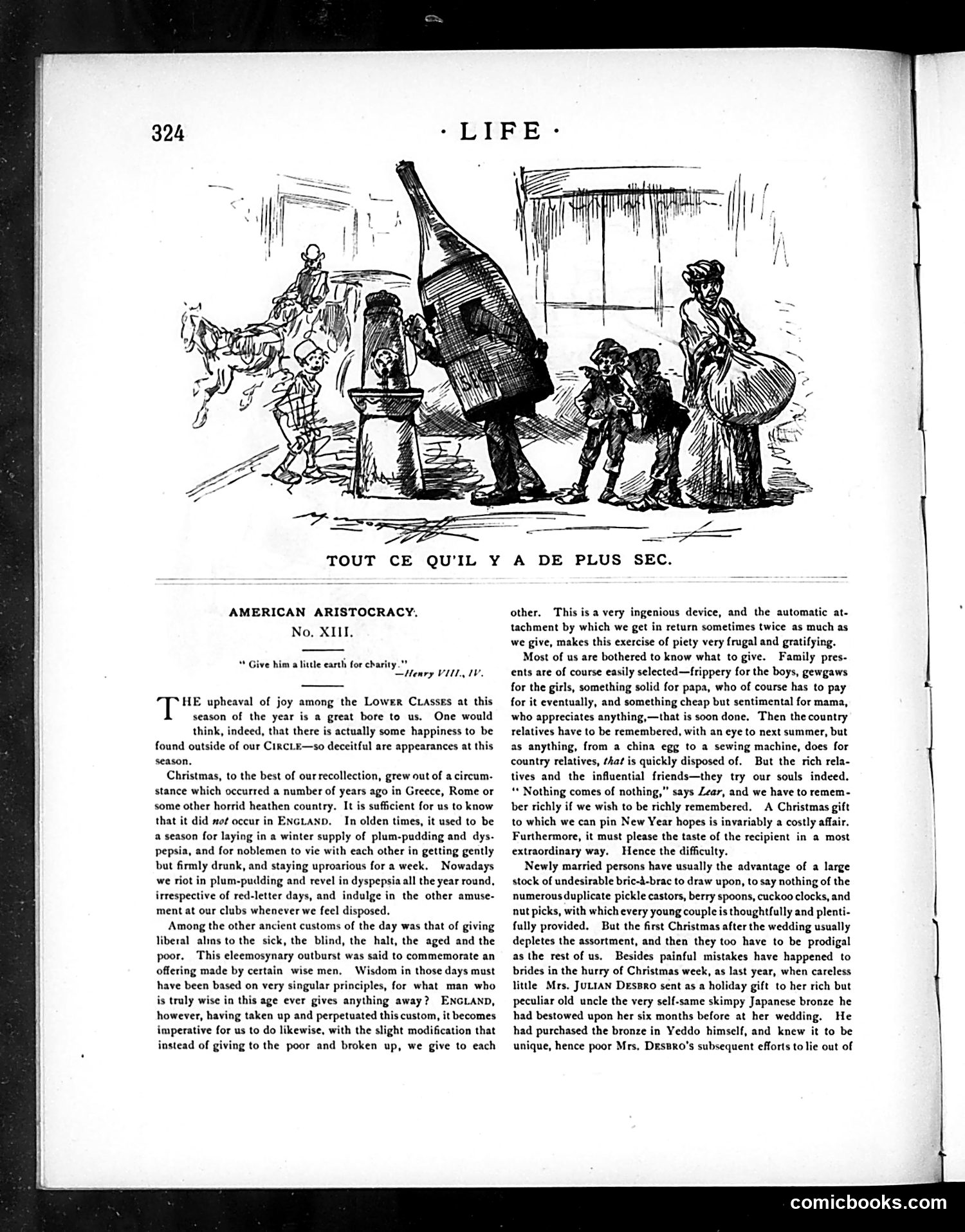
This satirical piece mocks wealthy English aristocrats' hypocritical approach to Christmas charity. The text presents the voice of a snobbish upper-class narrator who dismisses the poor's joy at Christmas as a "bore" and reveals how the rich have corrupted the holiday's charitable spirit. The cartoon illustration shows wealthy figures distributing gifts—but the satire lies in the accompanying essay, which explains that instead of genuinely helping the poor, the rich merely exchange expensive gifts *among themselves*, calculating to receive "twice as much as we give." The piece ridicules this as false charity: gifts to country relatives are perfunctory; gifts to wealthy, influential friends must be costly and perfectly tailored. The anecdote about Mrs. Julian Desaro accidentally regifting her uncle a Japanese bronze he'd already given her exemplifies the absurd, self-serving nature of aristocratic "generosity." The satire targets class pretension and the hollowness of charity performed for social obligation rather than genuine benevolence.
📄 Transcribed text from this page (OCR, searchable)
Machine-transcribed from the original scan — historical spelling and the odd misread are preserved.
AMERICAN ARISTOCRACY. No, XIII. “ Give him a little earth for charity."” —Henry VIL IV. HE upheaval of joy among the Lower Ctasses at this season of the year is a great bore to us. One would think, indeed, that there is actually some happiness to be found outside of our CincLE—so deceitful are appearances at this season. Christmas, to the best of ourrecollection, grew out of a circum- stance which occurred a number of years ago in Greece, Rome or some other horrid heathen country. It is sufficient for us to know that it did mof occur in ENGLAND. In olden times, it used to be a season for laying in a winter supply of plum-pudding and dys- pepsia, and for noblemen to vie with each other in getting gently but firmly drunk, and staying uproarious for a week. Nowadays we riot in plum-pudding and revel in dyspepsiaall the year round, irrespective of red-letter days, and indulge in the other amuse- ment at our clubs whenever we feel disposed. Among the other ancient customs of the day was that of giving liberal alins to the sick, the blind, the halt, the aged and the poor, This eleemosynary outburst was said to commemorate an offering made by certain wise men. Wisdom in those days must have been based on very singular principles, for what man who is truly wise in this age ever gives anything away? ENGLAND, however, having taken up and perpetuated this custom, it becomes imperative for us to do likewise, with the slight modification that instead of giving to the poor and broken up, we give to each TOUT CE QU’IL Y A DE PLUS SEC. other, This is a very ingenious device, and the automatic at- tachment by which we get in return sometimes twice as much as we give, makes this exercise of piety very frugal and gratifying. Most of us are bothered to know what to give. Family pres- ents are of course easily selected—frippery for the boys, gewgaws for the girls, something solid for papa, who of course has to pay for it eventually, and something cheap but sentimental for mama, who appreciates anything,—that is soon done, Then thecountry relatives have to be remembered, with an eye to next summer, but as anything, from a china egg to a sewing machine, does for country relatives, that is quickly disposed of. But the rich rela- tives and the influential friends—they try our souls indeed. ‘* Nothing comes of nothing,” says Lear, and we have to remem- ber richly if we wish to be richly remembered. A Christmas gift to which we can pin New Year hopes is invariably a costly affair. Furthermore, it must please the taste of the recipient in a most extraordinary way. Hence the difficulty. Newly married persons have usually the advantage of a large stock of undesirable bric-4-brac to draw upon, to say nothing of the numerous duplicate pickle castors, berry spoons, cuckoo clocks, and nut picks, with which every young couple is thoughtfully and plenti- fully provided, But the first Christmas after the wedding usually depletes the assortment, and then they too have to be prodigal as the rest of us. Besides painful mistakes have happened to brides in the hurry of Christmas week, as last year, when careless little Mrs. JULIAN Dessro sent as a holiday gift to her rich but peculiar old uncle the very self-same skimpy Japanese bronze he had bestowed upon her six months before at her wedding. He had purchased the bronze in Yeddo himself, and knew it to be unique, hence poor Mrs, Desaro's subsequent efforts to lie out of comicbooks.com