
A complete issue · 16 pages · 1883
Life — December 6, 1883
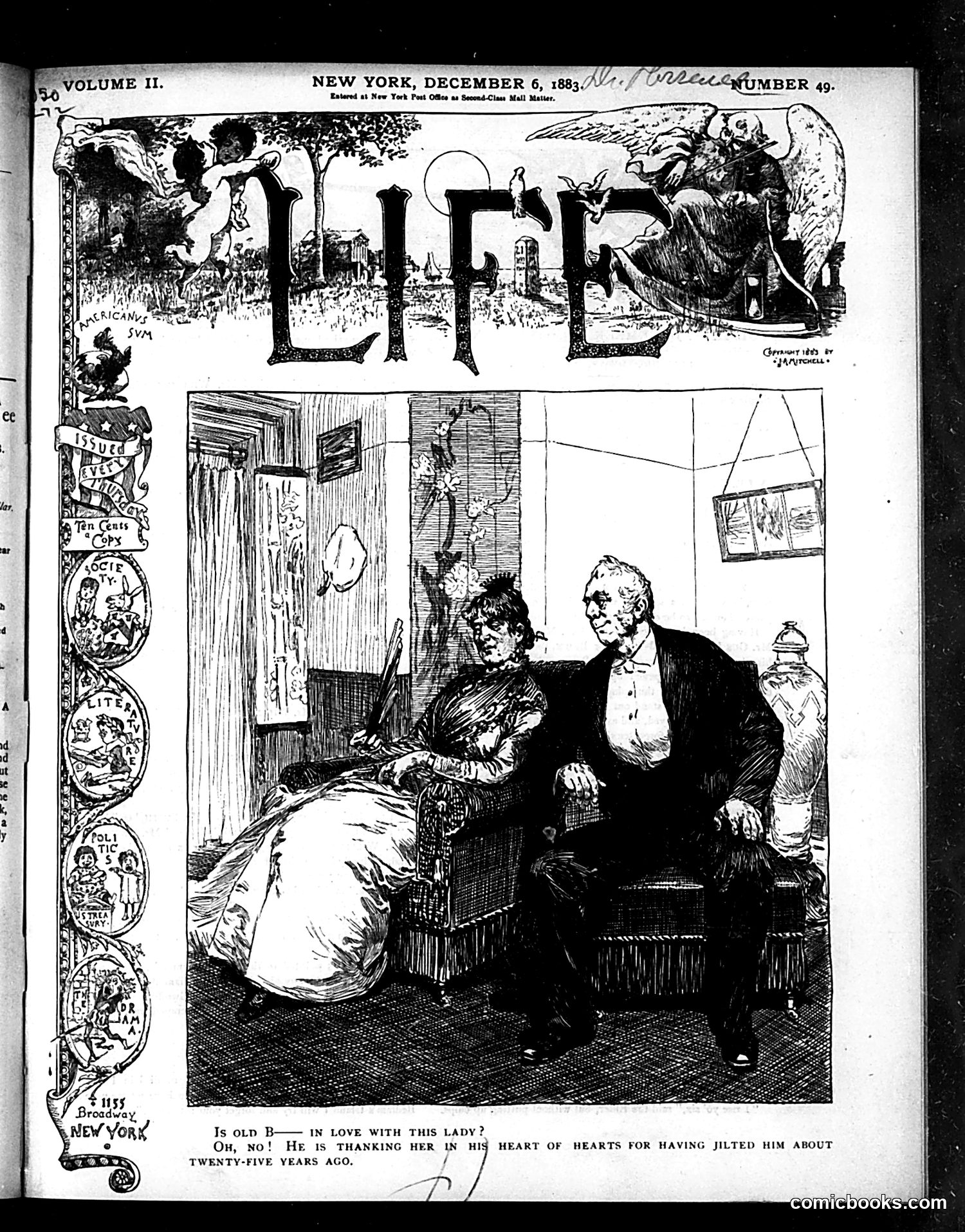
**The Main Illustration:** The cartoon depicts a scene of romantic regret. According to the caption, an elderly man ("old B____") sits with a woman, reflecting that he is "thanking her in his heart of hearts for having jilted him about twenty-five years ago." **The Satire:** The joke targets the common Victorian trope of romantic disappointment. Rather than portraying the jilted suitor as heartbroken, Life presents him as grateful—suggesting that being abandoned 25 years prior was actually a blessing. This reverses typical sentimental expectations, humorously implying the woman's rejection saved him from an unwanted marriage. The ornate decorative border on the left appears typical of the era's magazine design.
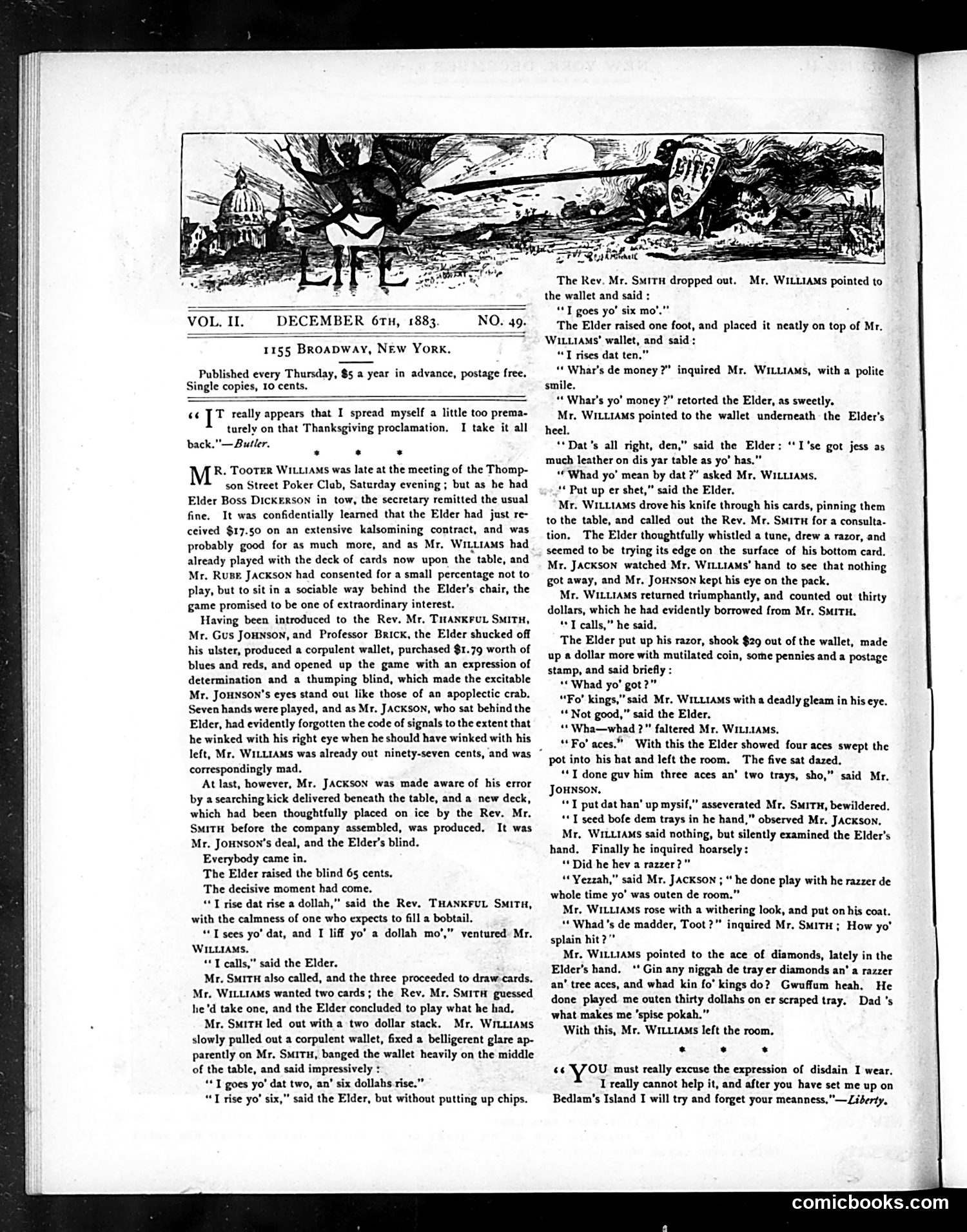
This page contains a short story with illustrations about a poker game, not a political cartoon. The narrative describes a con game where Mr. Williams uses sleight-of-hand tricks during card play—making money appear and disappear, substituting coins for cards, and ultimately stealing from the other players. The story satirizes cheating at cards and the gullibility of the players involved (the Rev. Smith, Mr. Jackson, and an Elder). It's social satire about deception and dishonesty in gambling rather than political commentary. The woodcut illustration at the top shows a rural scene, likely setting context for the story. This appears to be humorous fiction rather than political or social commentary on contemporary events.
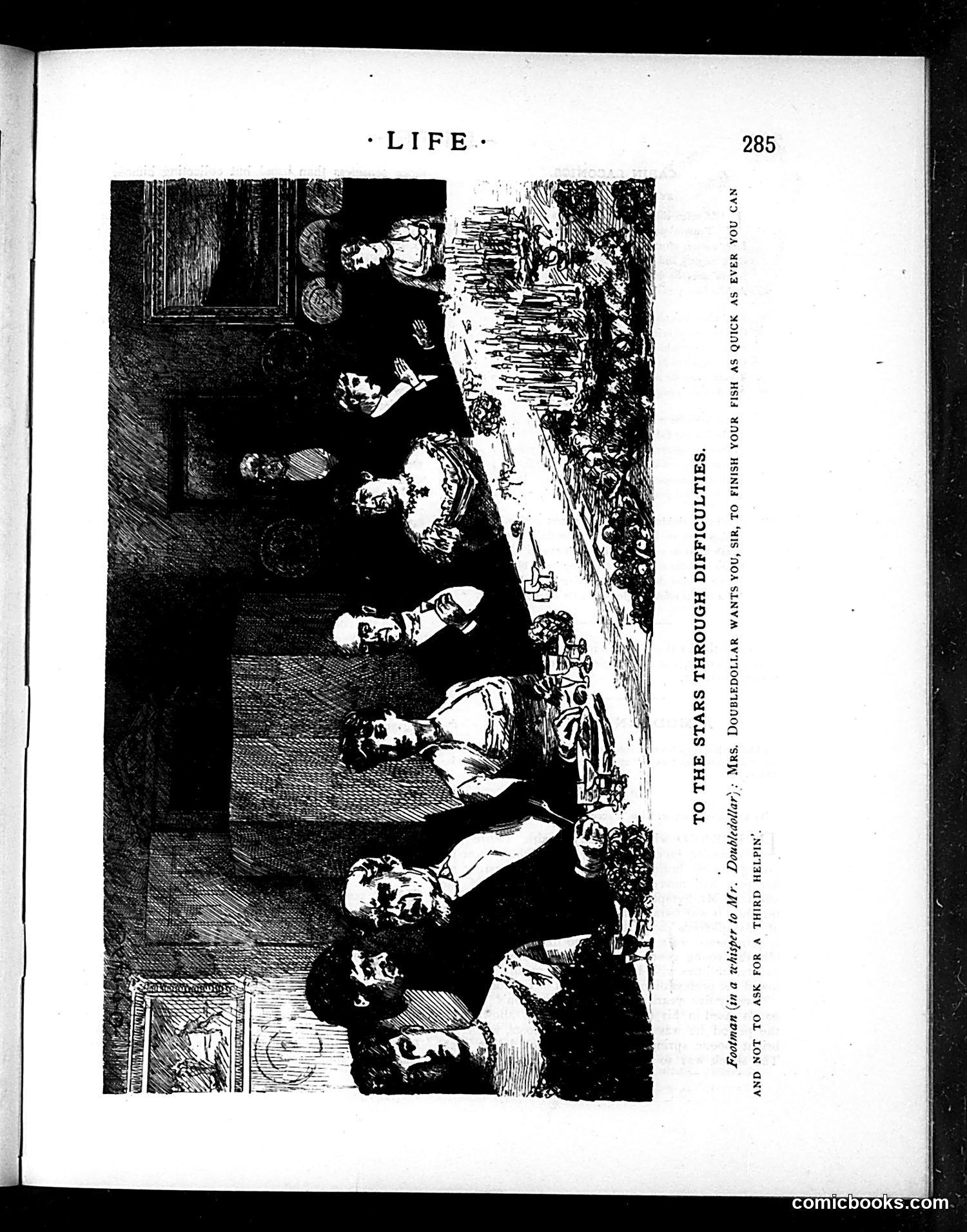
This page from *Life* magazine (page 285) presents an illustration titled "TO THE STARS THROUGH DIFFICULTIES." The etching-style image depicts several figures in what appears to be a domestic interior scene, shown sideways/rotated on the page. The caption indicates this is "Foreword [by] a dither Mrs. Dinkelspieler" and references "Mrs. Dinkelspieler wants you sir, to finish your fish as quick as ever you can and not to ask for a third helping." The satire appears to target domestic economy and wartime rationing—a common *Life* magazine subject. The joke seems to mock overly-frugal household management or suggest tension between maintaining proper dining etiquette and material scarcity. However, without clearer visual details or additional context, the specific historical moment referenced remains uncertain.
This page contains no political cartoon. Instead, it features literary content: "Cabin Laconics" (a section of dialect verse), followed by "A Modern Instance" — the beginning of a serialized short story by an unnamed author about Jack Sympleton, a wealthy but intellectually modest gentleman who falls in love with a cook named Diana Bluestock. The humor is social satire rather than political: it mocks the gentleman's pretensions, his pursuit of a working-class woman, and the class incongruities involved. References to "silken purse" and domestic virtue suggest commentary on courtship and marriage conventions of the era, though the specific historical moment remains unclear from this excerpt alone.
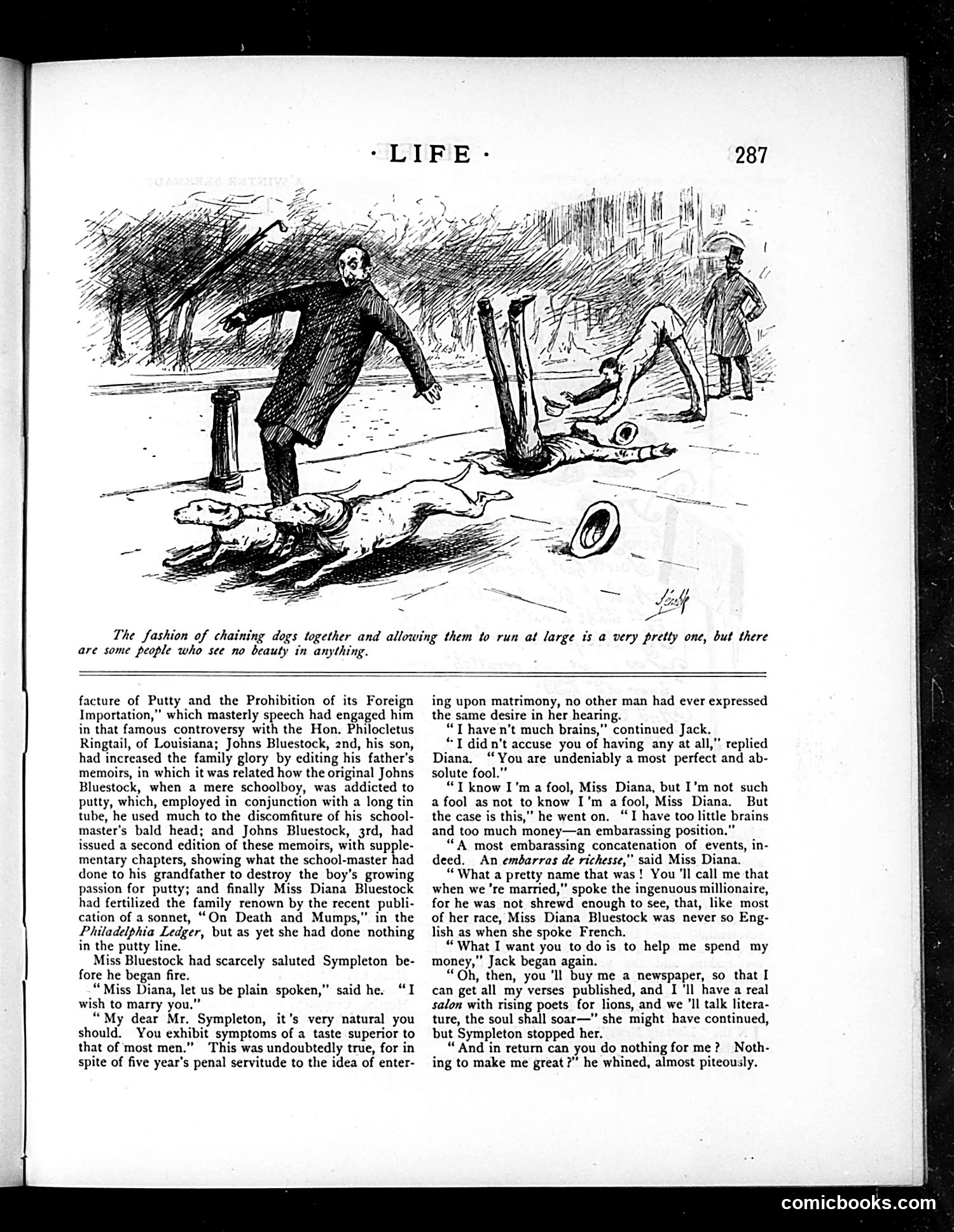
The illustration depicts a man stepping over a prostrate dog while others observe. The caption states: "The fashion of chaining dogs together and allowing them to run at large is a very pretty one, but there are some people who see no beauty in anything." This is **social satire about class attitudes**. The cartoon mocks wealthy people who adopt fashionable practices (here, allowing chained dogs to run loose in public spaces) without regard for practical consequences or public safety. The "people who see no beauty" represents working-class citizens annoyed by the nuisance. The accompanying text involves a dialogue between Jack Sympleton and Miss Diana Bluestock, satirizing courtship rituals among the upper classes—her pretensions, his social climbing, and their mutual absurdity. The satire targets **fashionable foolishness** among the wealthy elite.
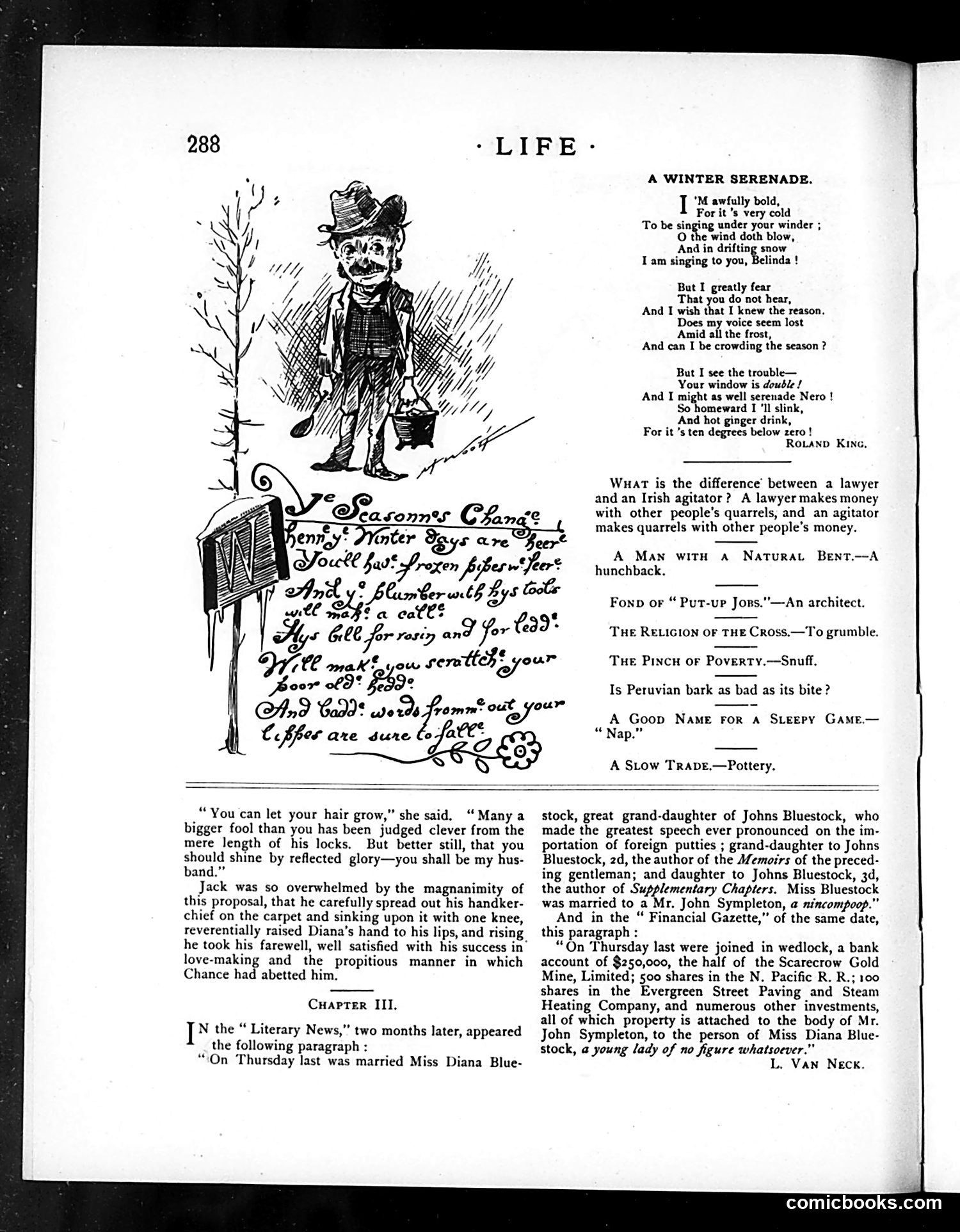
The main cartoon depicts a ragged figure in winter clothing standing in snow beside a bare tree. The handwritten caption beneath references "Sasonnes Change" and winter hardship—the figure appears to be a destitute person enduring harsh weather. The accompanying poem "A Winter Serenade" by Roland King sardonically describes singing beneath someone's window during freezing conditions, establishing a contrast between romantic tradition and poverty's grim reality. Below this, the page contains satirical definitions and jibes typical of Life's humor format, including wordplay on legal professions, religion, and trade. The dominant satirical point: the irony of performing romantic gestures while suffering deprivation—mocking both sentimental traditions and the social invisibility of poverty during harsh seasons.
This page contains literary reviews rather than political cartoons. The content discusses several books: 1. **"Poems in Prose" by Ivan Turhnimoff** - Reviews of short literary pieces, including "The Blockhead" (about a man who becomes a music critic) and "The Sphinx" (describing a mysterious plaster sculpture). 2. **"Stray Chords" by Julia R. Anagnos** - Praised for verses on classical subjects like Hawthorne and Greek vases. 3. **Works by Mrs. James T. Fields and a translation of Horace's Odes** by Henry Hubbard Pierce. The page also includes a substantial poem about lost youth and love, seemingly melancholic in tone. The small decorative illustration near the poem is ornamental rather than satirical. This appears to be a genuine literary review section, not political satire.
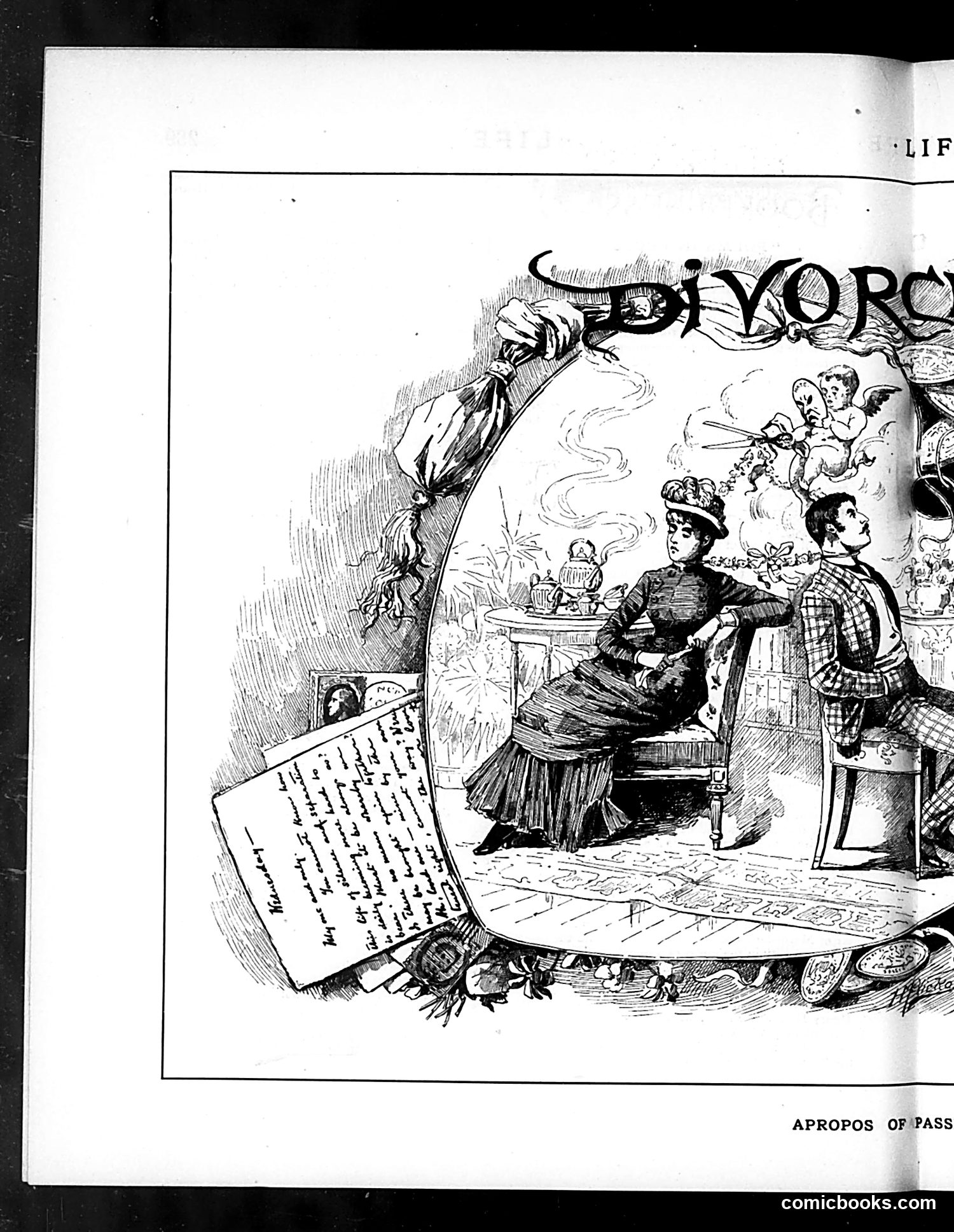
This illustration appears to be a satirical vignette titled "APROPOS OF PASS" (visible at bottom). The image shows a Victorian-era domestic scene with a woman seated at a table with two male figures, while cherubs float overhead. A document with text is prominently displayed in the foreground (left side). The satire likely concerns **passes** — likely theatrical or social admission passes — given the elaborate framing and the woman's central position. The cherubs and romantic staging suggest commentary on courtship or social access. The document's prominence indicates the "pass" itself is the satirical target. Without clearer text visibility, the specific political or social reference remains unclear, though the ornate, somewhat absurd theatrical composition suggests mockery of either social pretension or the commodification of access to events or social occasions during the Victorian period.
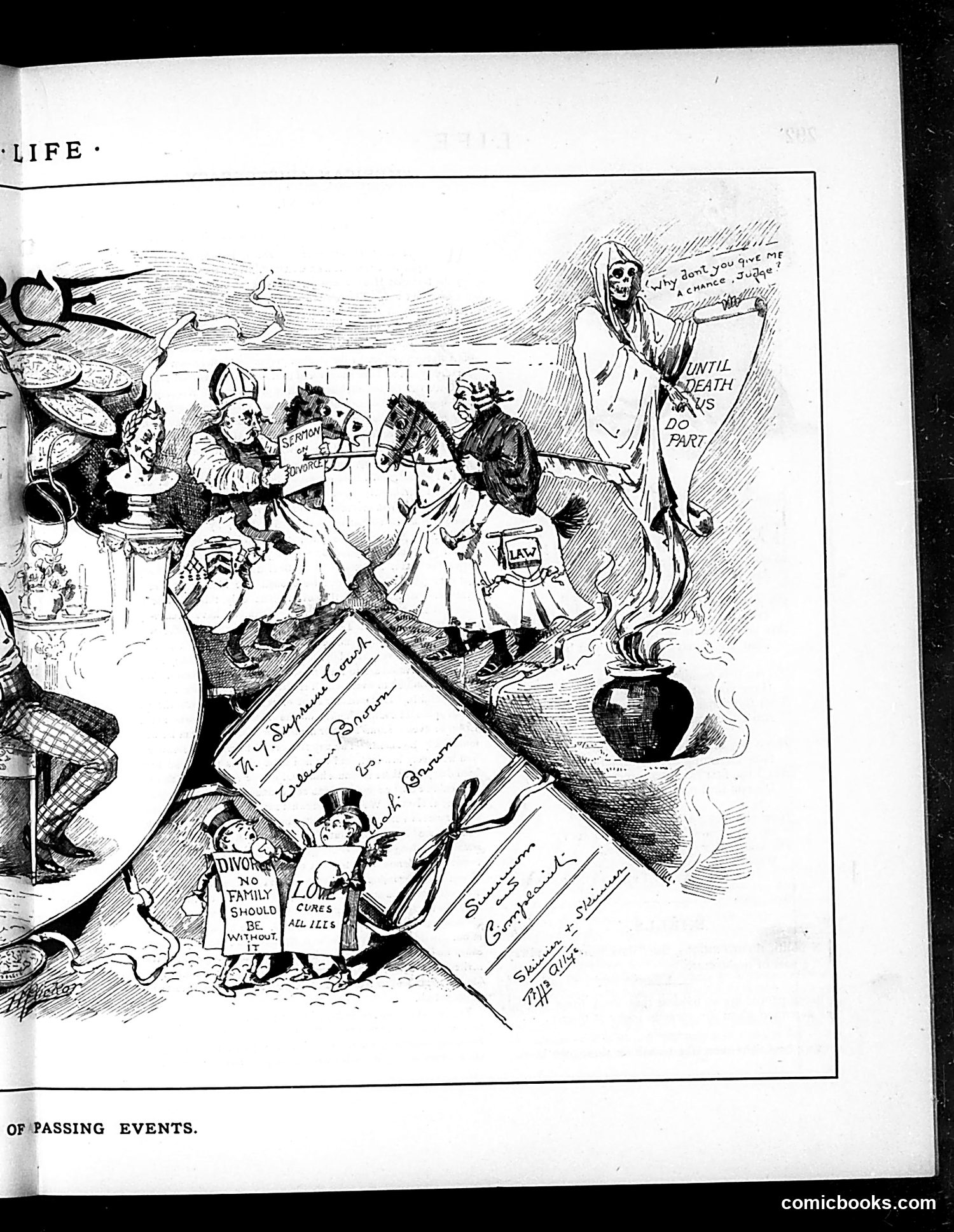
This is a political cartoon titled "Of Passing Events" depicting Death (skeletal figure, upper right) offering various historical figures a chance to avoid their fate. The central scene shows what appear to be military or political leaders on horseback gathered around documents labeled with names—likely references to prominent figures or nations of the era. The lower left shows small figures examining what appears to be a family tree or genealogical document marked "Dinosaur Family" with text about extinction "without" something (text unclear). The overall satirical message appears to comment on the mortality of political powers and institutions, suggesting that even powerful figures and empires face inevitable decline—comparing them to extinct dinosaurs. The specific identities of the figures remain unclear without additional historical context about Life magazine's publication date.
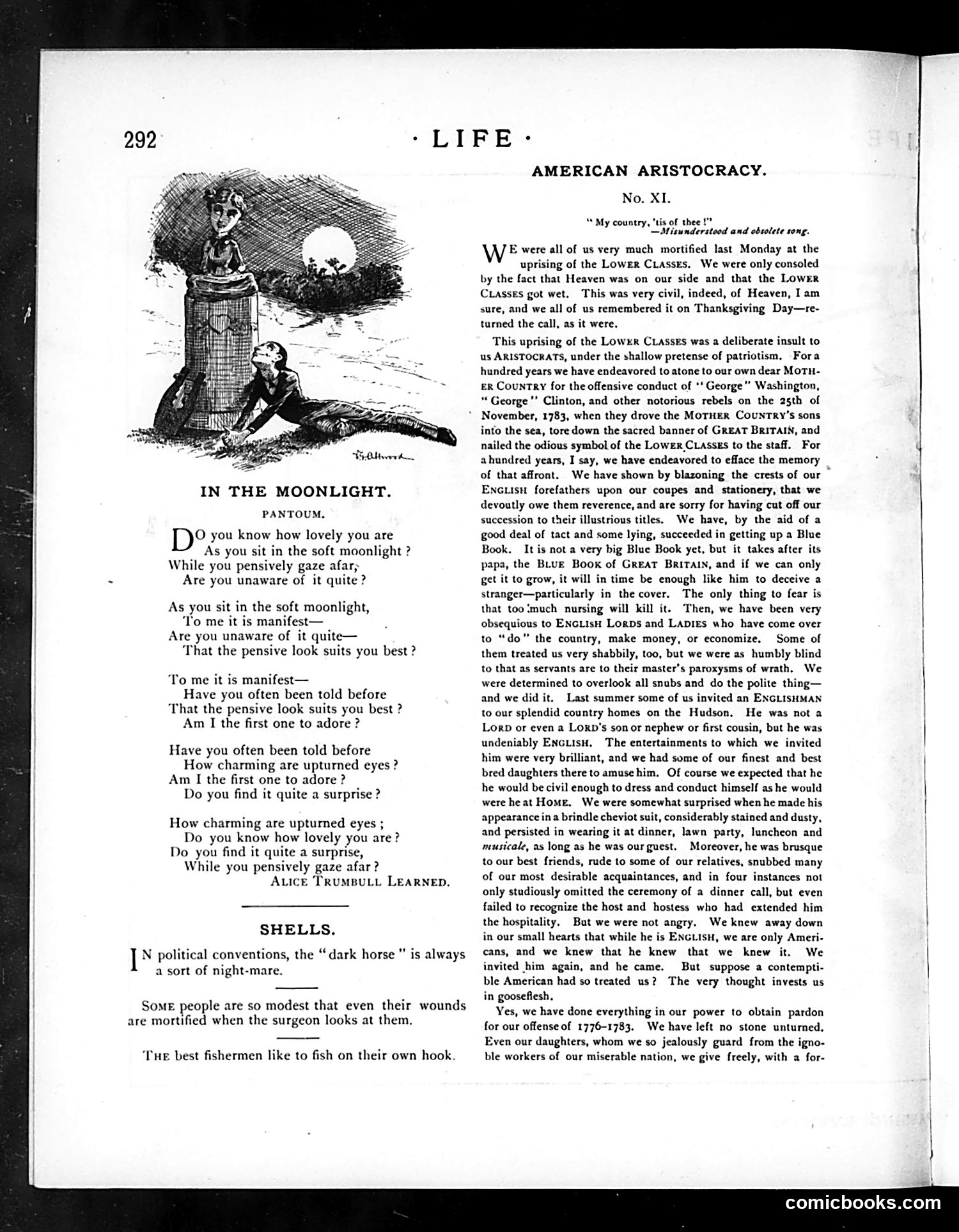
This page contains two separate pieces: **"In the Moonlight"** is a romantic poem using the "pantoum" form—a literary exercise, not political satire. **"American Aristocracy No. XI"** is the satirical content. It mocks wealthy American elites who spent a century apologizing for the American Revolution and trying to curry favor with Britain. The narrator (speaking for the aristocratic class) complains that "lower classes" recently staged an uprising, and boasts of their efforts to atone for ancestors like George Washington who rebelled in 1783. The satire targets American snobs who: - Manufacture fake genealogies ("Blue Books") mimicking British nobility - Fawn over visiting English aristocrats - Overlook rudeness from British guests to maintain social status - Remain obsessed with erasing their revolutionary heritage The joke: these self-proclaimed aristocrats are actually insecure social climbers desperate for British approval, embarrassed by American democracy itself.
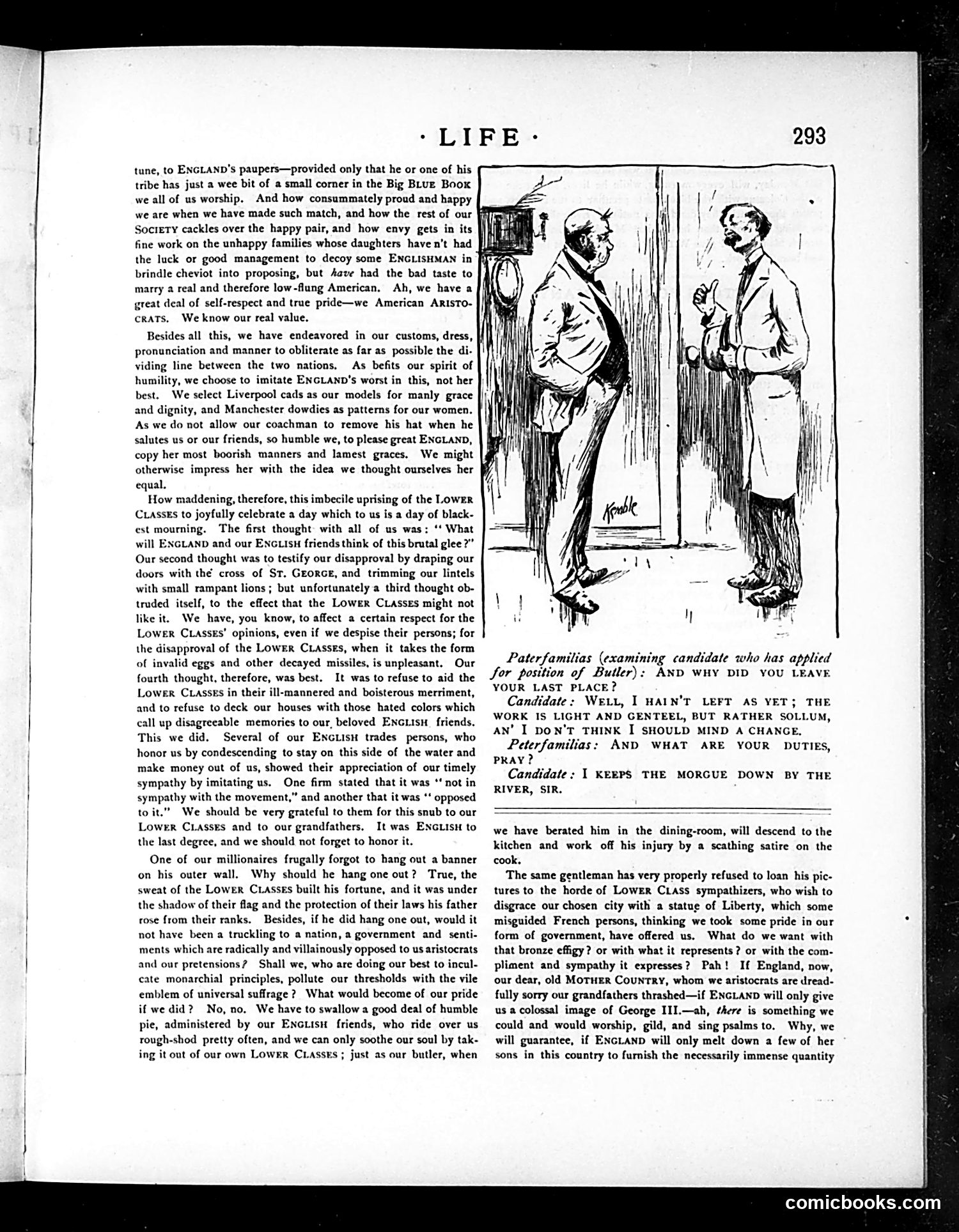
This 1876 Life magazine page satirizes wealthy American "aristocrats" who: 1. **Slavishly imitate English society** while adopting only England's worst traits (Liverpool "cads," Manchester "dowdies"), desperately seeking social validation through British connections and marriages. 2. **Betray their own country** during what appears to be Independence Day celebrations. The upper classes refuse to display American flags or participate in public festivities because they fear offending their English friends and because celebrating democratic ideals contradicts their monarchical pretensions. 3. **Despise the working classes** who built their fortunes. The text mocks their anxiety about lower-class approval while simultaneously scorning "universal suffrage." The cartoon (showing two well-dressed men in conversation) illustrates this tension between American prosperity and aristocratic self-loathing. The satire attacks how America's elite prioritize Old World snobbery over national pride and democratic values—a pointed critique of Gilded Age social climbing.
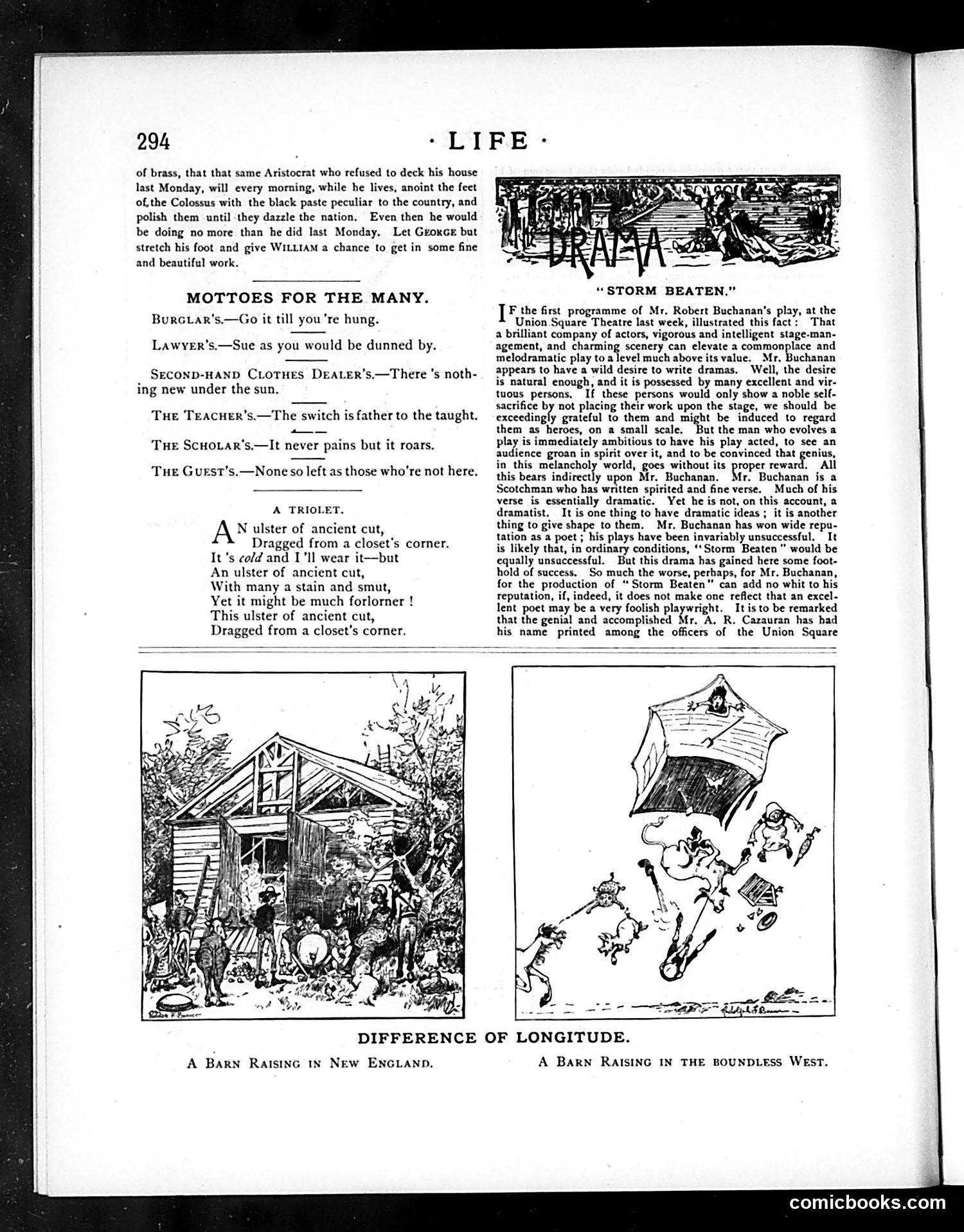
This page contains social satire typical of 19th-century Life magazine. **"Mottoes for the Many"** offers cynical one-liners mocking various professions—burglars, lawyers, clothes dealers, teachers—presenting their unspoken mottos as mercenary or hypocritical ("Nothing new under the sun," "The switch is father to the taught"). **"Storm Beaten"** is a theater review savagely critiquing poet Robert Buchanan's dramatic play at Union Square Theatre. The writer argues that while Buchanan excels as a poet, he lacks skill as a playwright. Despite strong acting and staging elevating the mediocre melodrama, the review suggests his theatrical ambitions are misguided—implying a good poet can be a "very foolish playwright." **"Difference of Longitude"** compares two barn-raising scenes: the left shows an orderly New England community effort; the right depicts chaotic frontier conditions in the West, with people flying through the air. This satirizes regional differences in American civilization and social organization. The tone throughout is witty, dismissive, and class-conscious.
This page is primarily **advertising and editorial content** rather than political cartoons. The main elements are: **The small cartoon** (top right) shows a biblical reference—"Render unto scissors those things which are scissors"—a play on "Render unto Caesar." The joke appears to mock excessive use of scissors in editing or criticism, though the specific context is unclear. **The text content** includes a theater review of "Storm Beaten" (criticizing its melodramatic plot devices like mortgages and seduction) and **"The Modern Style,"** a humorous poem satirizing romantic courtship conventions—candy, moonlight kisses, poetry, languishing looks, and inevitable weddings. **The advertisements** promote wallpaper, books, and champagne. Several brief editorial quips mock things like Newport's jail and the Pullman Company's blankets. The overall tone is light satirical commentary on contemporary social conventions and cultural products, typical of Life magazine's satirical humor. No specific political figures or events appear to be targeted on this particular page.
This is primarily an **advertising page** from Life magazine, with minimal editorial cartoon content. The page showcases typical late-19th-century advertisements for candy, lunch rooms, printing ink, office furniture, and hotels. The small editorial section contains **brief satirical quips** rather than cartoons: - A joke mocking Mormon polygamy (Salt Lake City sidewalks joke) - Humor about Pennsylvania legislators' wastefulness - A jab at Detroit residents as financially foolish - Wordplay about sculptors as husbands These are **light social commentary** typical of Life's satirical style—poking fun at regional quirks, political inefficiency, and everyday absurdities rather than addressing serious political issues. The **dominant content is commercial**: advertisements for Gunther's candy, Common Sense lunch rooms, printing supplies, and the Parker House hotel in Boston represent the magazine's revenue model from paid advertising.
This page is primarily advertising and notices for a historical American periodical. The main content consists of five brief satirical jokes typical of Life magazine's humor: 1. A schoolroom joke comparing a sloth to a "messenger boy" (suggesting laziness) 2. A dark joke about a druggist's error causing death 3. A Sunday School teacher's question about wealth "taking wings and flying away" 4. A youth's misunderstanding about Thanksgiving preceding Congress (a pun on nature/timing) 5. A reference to O'Donovan Rossa, an Irish nationalist, joking he'd somehow "planned" a planetary collision These are gentle, pun-based jokes without complex political commentary. The remainder of the page features period business advertisements for bankers, steel pens, billiard tables, and subscription services. No significant political cartoons appear on this page—it's primarily a text-based humor and advertising page typical of 19th-century magazine formats.
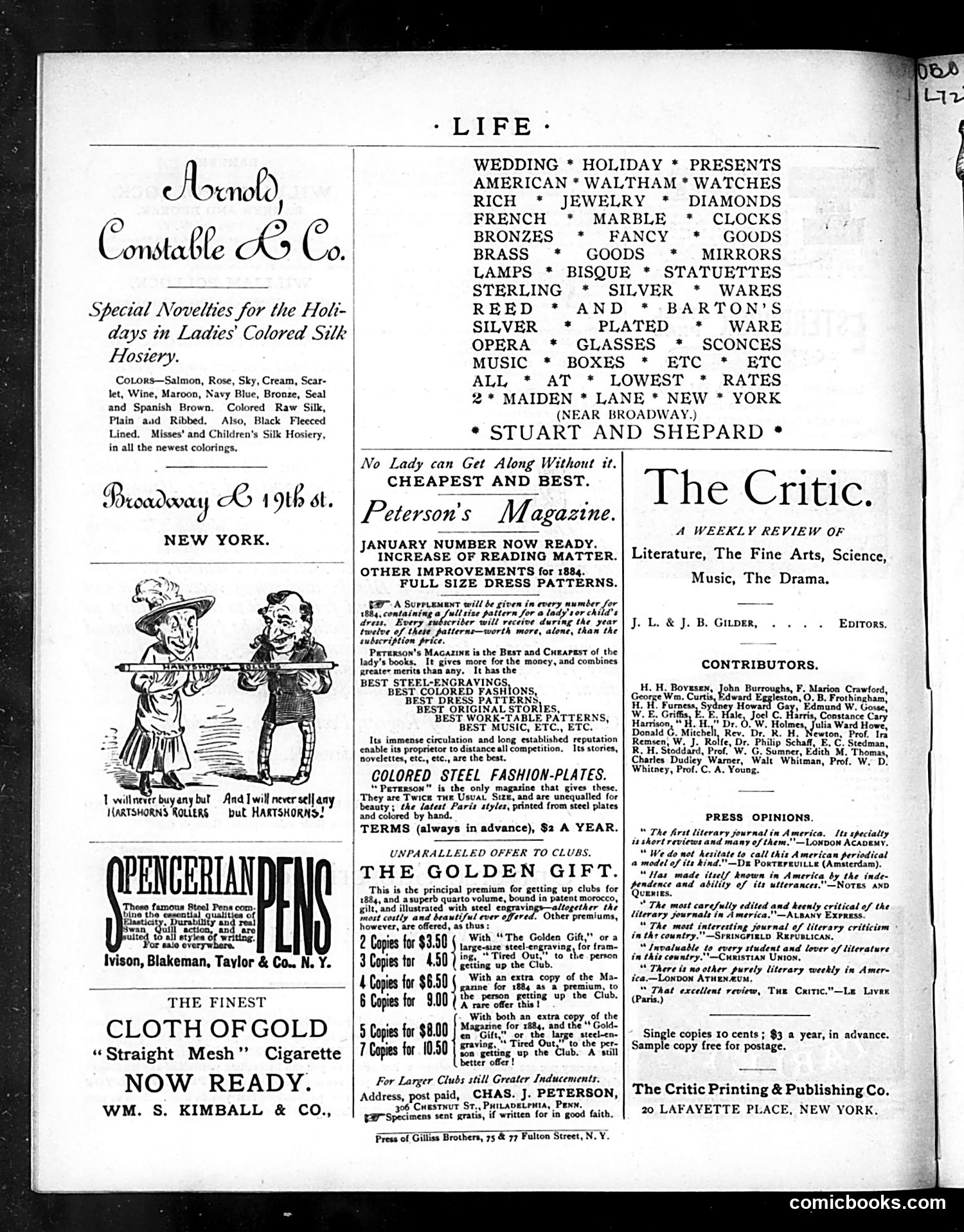
This page is primarily **advertising and masthead content** rather than satirical material. It showcases *Life* magazine's identity as a literary and cultural review alongside period advertisements. The one cartoon visible depicts **two working-class figures (likely laborers or craftsmen)** in a humorous exchange about "Hartshorn's Rollers"—a window-shade product. Their pledge of exclusive loyalty ("I will never buy any but...") is a period advertising convention mocking consumer brand loyalty, presented as comical exaggeration. The rest of the page advertises luxury goods (jewelry, watches, silver), women's magazines (*Peterson's*), cigarettes, and *The Critic* literary journal. This reflects the magazine's dual purpose: satirical commentary on American life mixed with advertisements targeting educated, affluent readers. The content targets the upper-middle class interested in literature, fashion, and consumer goods.