
Life, 1883-12-06 · page 5 of 16
Life — December 6, 1883 — page 5: what you’re looking at
What you’re looking at
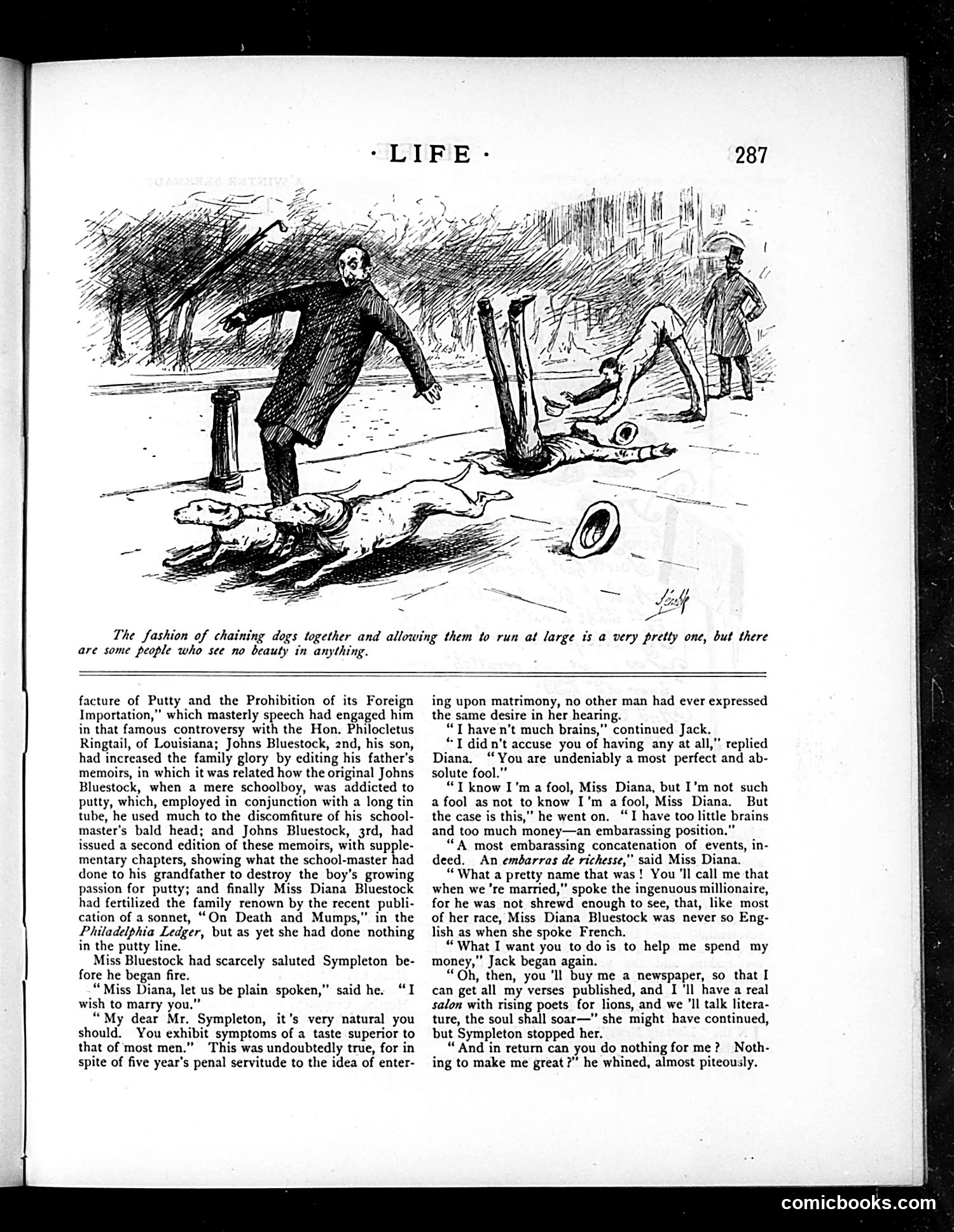
The illustration depicts a man stepping over a prostrate dog while others observe. The caption states: "The fashion of chaining dogs together and allowing them to run at large is a very pretty one, but there are some people who see no beauty in anything." This is **social satire about class attitudes**. The cartoon mocks wealthy people who adopt fashionable practices (here, allowing chained dogs to run loose in public spaces) without regard for practical consequences or public safety. The "people who see no beauty" represents working-class citizens annoyed by the nuisance. The accompanying text involves a dialogue between Jack Sympleton and Miss Diana Bluestock, satirizing courtship rituals among the upper classes—her pretensions, his social climbing, and their mutual absurdity. The satire targets **fashionable foolishness** among the wealthy elite.
📄 Transcribed text from this page (OCR, searchable)
Machine-transcribed from the original scan — historical spelling and the odd misread are preserved.
The fashion of chaining dogs together and allowing them to run at large is a very pretty one, but there are some people who see no beauty in anything. facture of Putty and the Prohibition of its Foreign Importation,” which masterly speech had engaged him in that famous controversy with the Hon. Philocletus Ringtail, of Louisiana; Johns Bluestock, 2nd, his son, had increased the family glory by editing his father's memoirs, in which it was related how the original Johns Bluestock, when a mere schoolboy, was addicted to putty, which, employed in conjunction with a long tin tube, he used much to the discomfiture of his school- master's bald head; and Johns Bluestock, 3rd, had issued a second edition of these memoirs, with supple- mentary chapters, showing what the school-master had done to his grandfather to destroy the boy’s growing passion for putty; and finally Miss Diana Bluestock had fertilized the family renown by the recent publi- cation of a sonnet, “On Death and Mumps,” in the Philadelphia Ledger, but as yet she had done nothing in the putty line. Miss Bluestock had scarcely saluted Sympleton be- fore he began fire. “Miss Diana, let us be plain spoken,” said he. “I wish to marry you.” “My dear Mr. Sympleton, it’s very natural you should. You exhibit symptoms of a taste superior to that of most men.” This was undoubtedly true, for in spite of five year’s penal servitude to the idea of enter- ing upon matrimony, no other man had ever expressed the same desire in her hearing. “T haven't much brains,” continued Jack. “T didn’t accuse you of having any at all,” replied Diana, “You are undeniably a most perfect and ab- solute fool.” “T know I’m a fool, Miss Diana, but I’m not such a fool as not to know I'm a fool, Miss Diana. But the case is this,” he went on. “I have too little brains and too much money—an embarassing position.” “A most embarassing concatenation of events, in- deed. An embarras de richesse,”" said Miss Diana. “What a pretty name that was! You ’ll call me that when we 're married,” spoke the ingenuous millionaire, for he was not shrewd enough to see, that, like most of her race, Miss Diana Bluestock was never so Eng- lish as when she spoke French, “What I want you to dois to help me spend my money,” Jack began again. “Oh, then, you ‘ll buy me a newspaper, so that I can get all my verses published, and I'll have a real salon with rising poets for lions, and we ’Il talk litera- ture, the soul shall soar—” she might have continued, but Sympleton stopped her. “ And in return can you do nothing for me? Noth- ing to make me great ?” he whined, almost piteously. comicbooks.com