
Life, 1883-12-06 · page 10 of 16
Life — December 6, 1883 — page 10: what you’re looking at
What you’re looking at
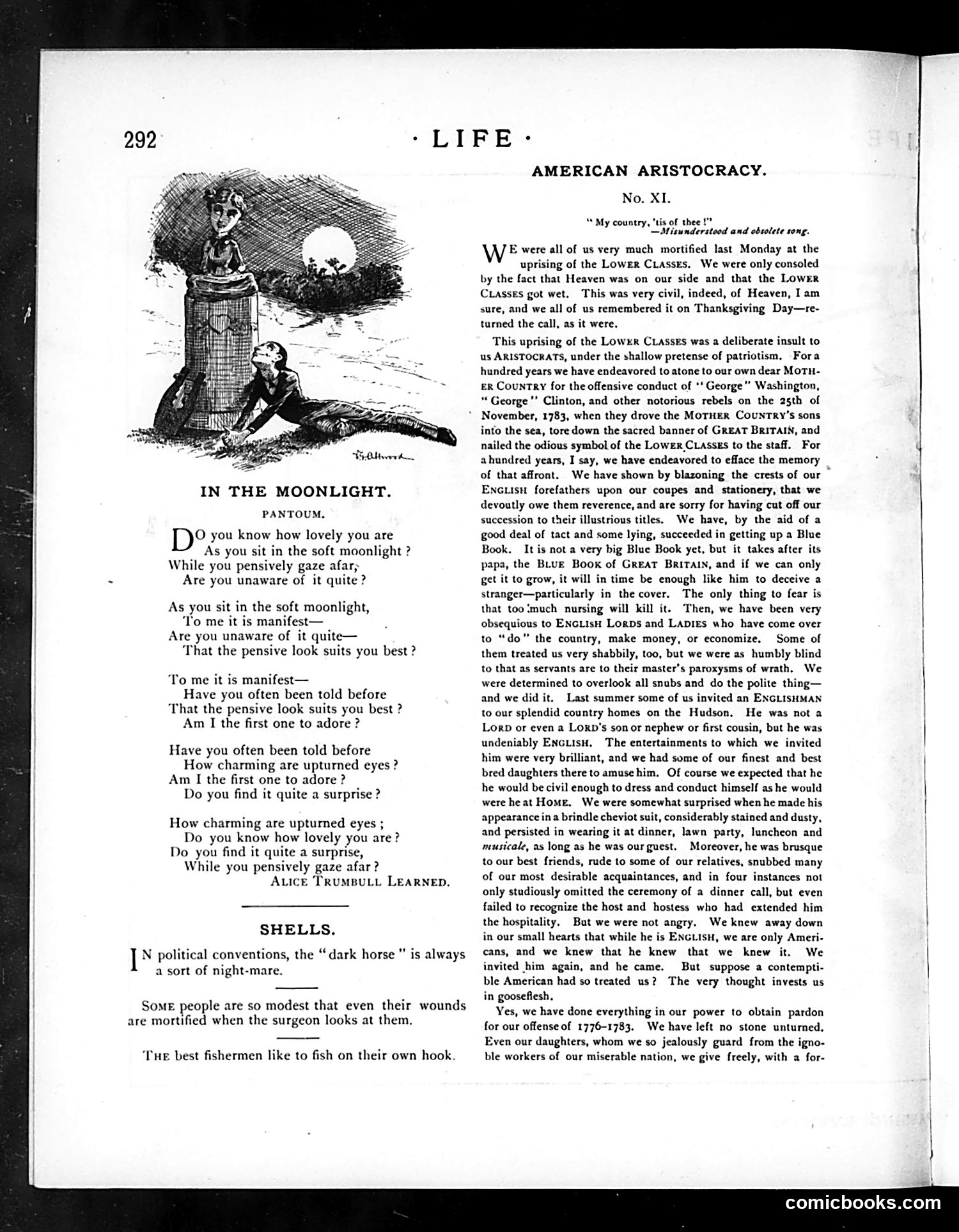
This page contains two separate pieces: **"In the Moonlight"** is a romantic poem using the "pantoum" form—a literary exercise, not political satire. **"American Aristocracy No. XI"** is the satirical content. It mocks wealthy American elites who spent a century apologizing for the American Revolution and trying to curry favor with Britain. The narrator (speaking for the aristocratic class) complains that "lower classes" recently staged an uprising, and boasts of their efforts to atone for ancestors like George Washington who rebelled in 1783. The satire targets American snobs who: - Manufacture fake genealogies ("Blue Books") mimicking British nobility - Fawn over visiting English aristocrats - Overlook rudeness from British guests to maintain social status - Remain obsessed with erasing their revolutionary heritage The joke: these self-proclaimed aristocrats are actually insecure social climbers desperate for British approval, embarrassed by American democracy itself.
📄 Transcribed text from this page (OCR, searchable)
Machine-transcribed from the original scan — historical spelling and the odd misread are preserved.
IN THE MOONLIGHT. PANTOUM. O you know how lovely you are As you sit in the soft moonlight ? While you pensively gaze afar, - Are you unaware of it quite ? As you sit in the soft moonlight, To me it is manifest— Are you unaware of it quite— ‘That the pensive look suits you best ? To me it is manifest— Have you often been told before That the pensive look suits you best ? Am I the first one to adore ? Have you often been told before How charming are upturned eyes ? Am I the first one to adore ? Do you find it quite a surprise ? How charming are upturned eyes ; | Do you know how lovely you are? Do you find it quite a surprise, While you pensively gaze afar? ALICE TRUMBULL LEARNED. SHELLS. [* political conventions, the “dark horse ” is always a sort of night-mare. Some people are so modest that even their wounds are mortified when the surgeon looks at them. ‘THe best fishermen like to fish on their own hook. * LIFE: AMERICAN ARISTOCRACY. No. XI. “ My country, 'tis of thee!” Misunderstood and obsolete song. E were all of us very much mortified last Monday at the uprising of the Lower CLasses. We were only consoled by the fact that Heaven was on our side and that the Lower CLasses got wet. This was very civil, indeed, of Heaven, Iam sure, and we all of us remembered it on Thanksgiving Day—re- turned the call, as it were. This uprising of the Lower CLasses was a deliberate insult to us ARISTOCRATS, under the shallow pretense of patriotism, Fora hundred years we have endeavored to atone to our own dear MOTH- ex Country for the offensive conduct of ** George” Washington, “ George’ Clinton, and other notorious rebels on the 25th of November, 1783, when they drove the MOTHER CouNTRY'S sons into the sea, tore down the sacred banner of GREAT BRITAIN, and nailed the odious symbol of the Lower CLassks to the staff. For ahundred years, I say, we have endeavored to efface the memory of that affront. We have shown by blazoning the crests of our EnG.isut forefathers upon our coupes and stationery, that we devoutly owe them reverence, and are sorry for having cut off our succession to their illustrious titles. We have, by the aid of a good deal of tact and some lying, succeeded in getting up a Blue Book. It is not a very big Blue Book yet, but it takes after its papa, the BLUE Book of GREAT Britain, and if we can only get it to grow, it will in time be enough like him to deceive a stranger—particularly in the cover. The only thing to fear is that too ‘much nursing will kill it. Then, we have been very obsequious to ENcLisH Loans and Lapies who have come over to “do” the country, make money, or economize. Some of them treated us very shabbily, too, but we were as humbly blind to that as servants are to their master’s paroxysms of wrath, We were determined to overlook all snubs and do the polite thing— and we did it. Last summer some of us invited an ENGLISHMAN to our splendid country homes on the Hudson, He was not a Lorp or even a Logp's son or nephew or first cousin, but he was undeniably ENGLisH. The entertainments to which we invited him were very brilliant, and we had some of our finest and best bred daughters there to amuse him. Of course we expected that he he would be civil enough to dress and conduct himself as he would were heat Home. We were somewhat surprised when he made his appearance ina brindle cheviot suit, considerably stained and dusty, and persisted in wearing it at dinner, lawn party, luncheon and musicale, as long as he was our guest. Moreover, he was brusque to our best friends, rude to some of our relatives, snubbed many of our most desirable acquaintances, and in four instances not only studiously omitted the ceremony of a dinner call, but even failed to recognize the host and hostess who had extended him the hospitality. But we were not angry. We knew away down in our small hearts that while he is ENGLISH, we are only Ameri- cans, and we knew that he knew that we knew it. We invited him again, and he came. But suppose a contempti- ble American had so treated us? The very thought invests us in gooseflesh, Yes, we have done everything in our power to obtain pardon for our offense of 1776-1783. We have left no stone unturned, Even our daughters, whom we so jealously guard from the igno- ble workers of our miserable nation, we give freely, with a for- comicbooks.com