
Life, 1883-12-06 · page 7 of 16
Life — December 6, 1883 — page 7: what you’re looking at
What you’re looking at
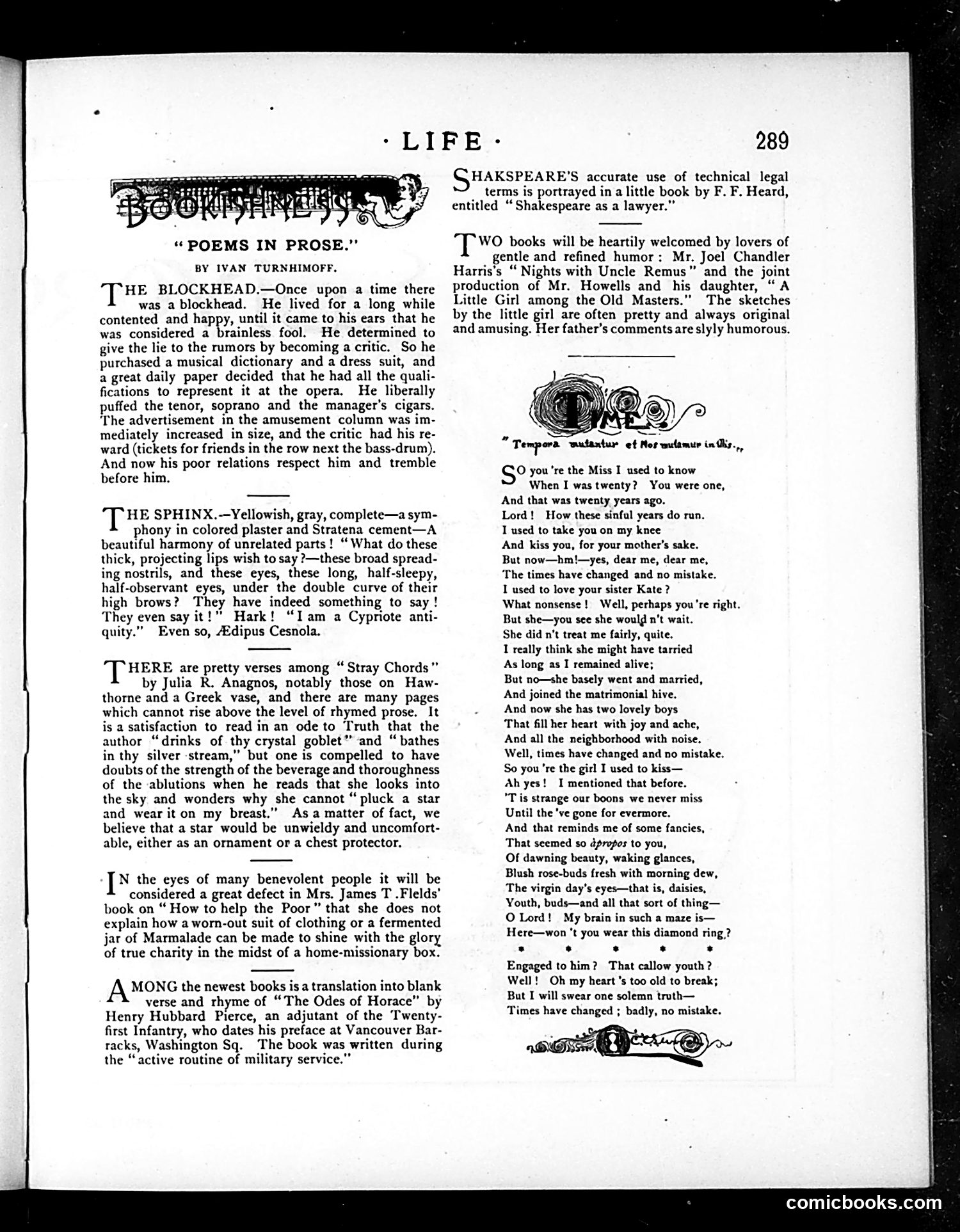
This page contains literary reviews rather than political cartoons. The content discusses several books: 1. **"Poems in Prose" by Ivan Turhnimoff** - Reviews of short literary pieces, including "The Blockhead" (about a man who becomes a music critic) and "The Sphinx" (describing a mysterious plaster sculpture). 2. **"Stray Chords" by Julia R. Anagnos** - Praised for verses on classical subjects like Hawthorne and Greek vases. 3. **Works by Mrs. James T. Fields and a translation of Horace's Odes** by Henry Hubbard Pierce. The page also includes a substantial poem about lost youth and love, seemingly melancholic in tone. The small decorative illustration near the poem is ornamental rather than satirical. This appears to be a genuine literary review section, not political satire.
📄 Transcribed text from this page (OCR, searchable)
Machine-transcribed from the original scan — historical spelling and the odd misread are preserved.
-LIFE- *“ POEMS IN PROSE.” BY IVAN TURNHIMOFF, HE BLOCKHEAD.—Once upon a time there was a blockhead. He lived for a long while contented and happy, until it came to his ears that he was considered a brainless fool. He determined to give the lie to the rumors by becoming a critic. So he purchased a musical dictionary and a dress suit, and a great daily paper decided that he had all the quali- fications to represent it at the opera. He liberally puffed the tenor, soprano and the manager's cigars. The advertisement in the amusement column was im- mediately increased in size, and the critic had his re- ward (tickets for friends in the row next the bass-drum). And now his poor relations respect him and tremble before him. HE SPHINX.-—Yellowish, gray, complete—a sym- phony in colored plaster and Stratena cement—A beautiful harmony of unrelated parts! “ What do these thick, projecting lips wish to say ?—these broad spread- ing nostrils, and these eyes, these long, half-sleepy, half-observant eyes, under the double curve of their high brows? They have indeed something to say! They even say it!" Hark! “Iam a Cypriote anti- quity.” Even so, A2dipus Cesnola. “THERE are pretty verses among “ Stray Chords” by Julia R. Anagnos, notably those on Haw- thorne and a Greek vase, and there are many pages which cannot rise above the level of rhymed prose. It is a satisfaction to read in an ode to Truth that the author “drinks of thy crystal goblet*’ and “ bathes in thy silver stream,” but one is compelled to have doubts of the strength of the beverage and thoroughness of the ablutions when he reads that she looks into the sky and wonders why she cannot “ pluck a star and wear it on my breast.” Asa matter of fact, we believe that a star would be unwieldy and uncomfort- able, either as an ornament or a chest protector. I N the eyes of many benevolent people it will be considered a great defect in Mrs. James T .Flelds’ book on “ How to help the Poor” that she does not explain how a worn-out suit of clothing or a fermented jar of Marmalade can be made to shine with the glory of true charity in the midst of a home-missionary box. MONG the newest books is a translation into blank verse and rhyme of “The Odes of Horace” by Henry Hubbard Pierce, an adjutant of the Twenty- first Infantry, who dates his preface at Vancouver Bar- racks, Washington Sq. The book was written during the “active routine of military service.” 289 GHAKSPEARE'S accurate use of technical legal terms is portrayed in a little book by F. F. Heard, entitled “Shakespeare as a lawyer.” Two books will be heartily welcomed by lovers of gentle and refined humor: Mr. Joel Chandler Harris's “ Nights with Uncle Remus” and the joint production of Mr. Howells and his daughter, “A Little Girl among the Old Masters.” The sketches by the little girl are often pretty and always original and amusing. Her father’s commentsare slyly humorous. * Teopen S° you 're the Miss I used to know When I was twenty? You were one, And that was twenty years ago. Lord! How these sinful years do ran. I used to take you on my knee And kiss you, for your mother’s sake. But now—hm!—yes, dear me, dear me, ‘The times have changed and no mistake. 1 used to love your sister Kate? What nonsense! Well, perhaps you're right. But she—you see she would n’t wait. She did n't treat me fairly, quite. I really think she might have tarried As long as I remained alive; But no—she basely went and married, And joined the matrimonial hive. And now she has two lovely boys That fill her heart with joy and ache, And all the neighborhood with noise. Well, times have changed and no mistake. So you're the girl I used to kiss— Ah yes! I mentioned that before. "T is strange our boons we never miss Until the 've gone for evermore. And that reminds me of some fancies, That seemed so dprofos to you, Of dawning beauty, waking glances, Blush rose-buds fresh with morning dew, The virgin day's eyes—that is, daisies, Youth, buds—and all that sort of thing— O Lord! My brain in such a maze is— Here—won 't you wear this diamond ring? . *. . * * Engaged to him? That callow youth? Well! Oh my heart 's too old to break; But I will swear one solemn truth— ‘Times have changed ; badly, no mistake. comicbooks.com