
A complete issue · 16 pages · 1883
Life — November 15, 1883
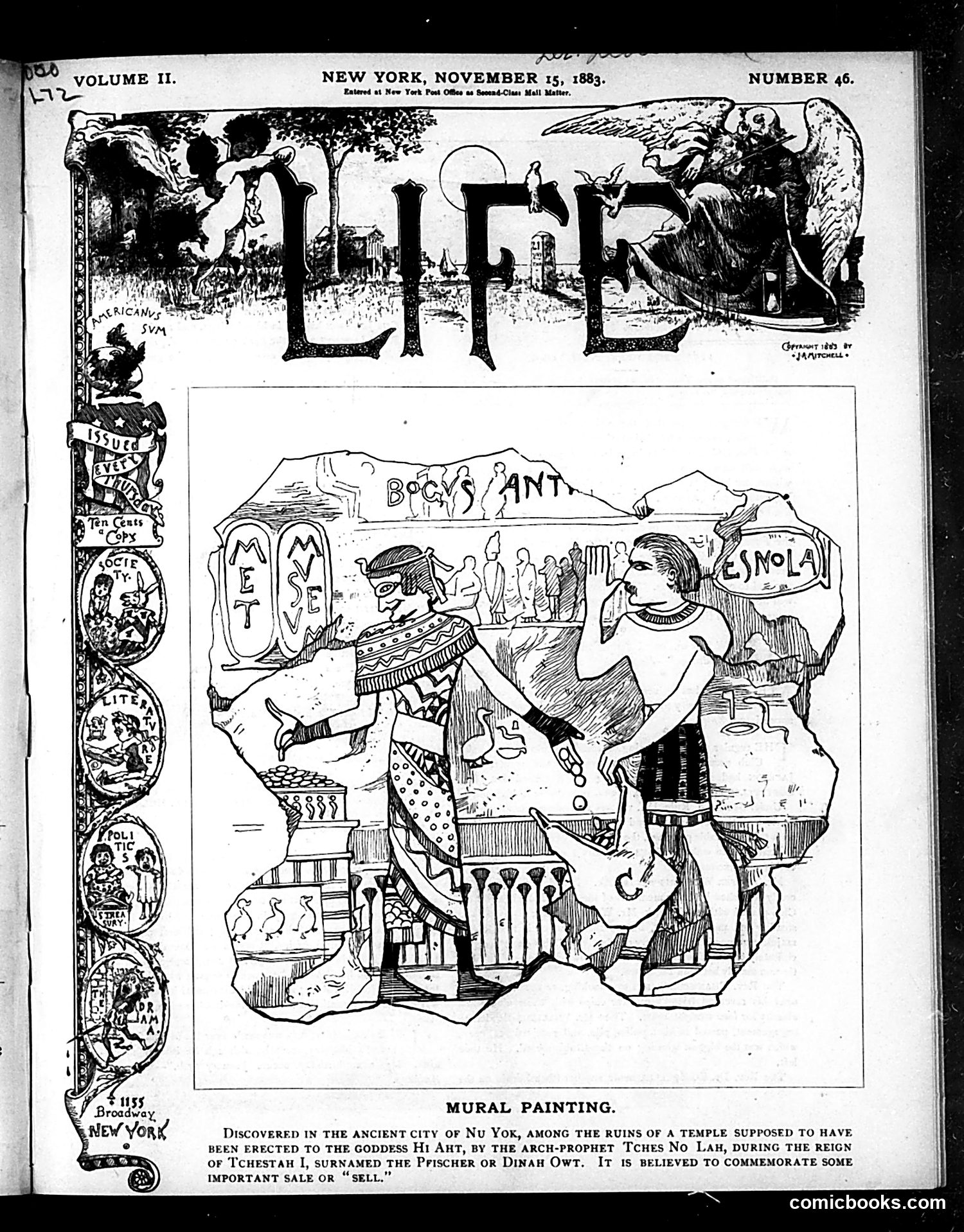
This satirical cartoon depicts a "mural painting" supposedly discovered in "Ancient Nu Yok" (New York). The artwork parodies archaeological discoveries by presenting a farcical "temple" scene with Egyptian-style imagery. The main figure appears to be a caricatured military or political leader wearing ornate dress, gesturing dramatically. Text labels include "Boys Pant," "Esmola," and references to a "Goddess Hi Aht" and "Arch-Prophet Tches No Lah." The caption mentions commemoration of an "important sale" or "sell." The satire likely mocks contemporary archaeological claims, pretentious art exhibitions, or political figures of the era through mock-ancient framing. Without clearer identification of the specific political references or individuals caricatured, the precise target remains unclear, though the absurdist "discovery" format suggests commentary on either fraudulent antiquities or inflated public spectacles.
The page contains satirical editorial commentary rather than illustrated cartoons. The main piece concerns a poker game incident involving prominent figures: Mr. Rube Jackson, Mr. Gus Johnson, and Reverend Dr. Cooppuller. The satire mocks a dispute over winnings from a Thompson Street Poker Club game. After Jackson accused Johnson of cheating, they settled accounts at a bank. The humor derives from the reverend's involvement in validating the settlement and the gentlemen's elaborate—yet ultimately absurd—efforts to maintain composure and propriety while engaged in gambling. The piece satirizes hypocrisy regarding gambling among respectable society members and clergy's tacit acceptance of such vices. Additional notes criticize Mr. Abbey (opera house), the N.Y. Sun, and reference Cincinnati opera disputes, reflecting typical 1880s New York social and cultural commentary.
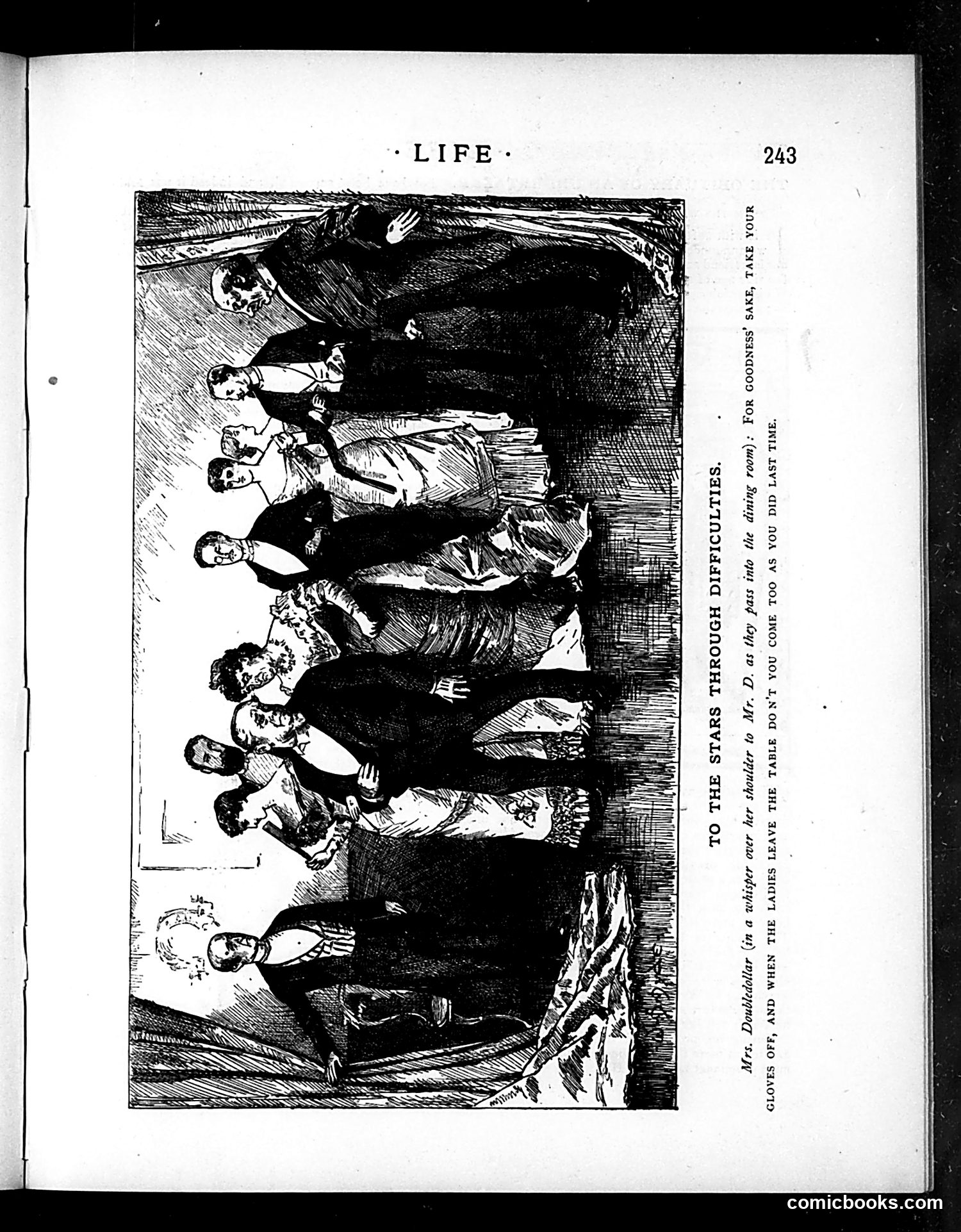
This appears to be a satirical illustration titled "To the Stars Through Difficulties," depicting a group of people climbing or struggling upward together. The caption references "Mr. D" as a "builder" who "aided in the dining room" and suggests leaving "the table as you did last time." The cartoon likely satirizes social climbing or ambition, with the figures straining to reach upward goals. The specific reference to "Mr. D" and dining room behavior suggests this targets a particular social or political figure engaging in self-promotion or social advancement, though the specific identity and historical context are unclear without additional publication date information. The humor relies on the contrast between aspirational effort and mundane domestic conduct.
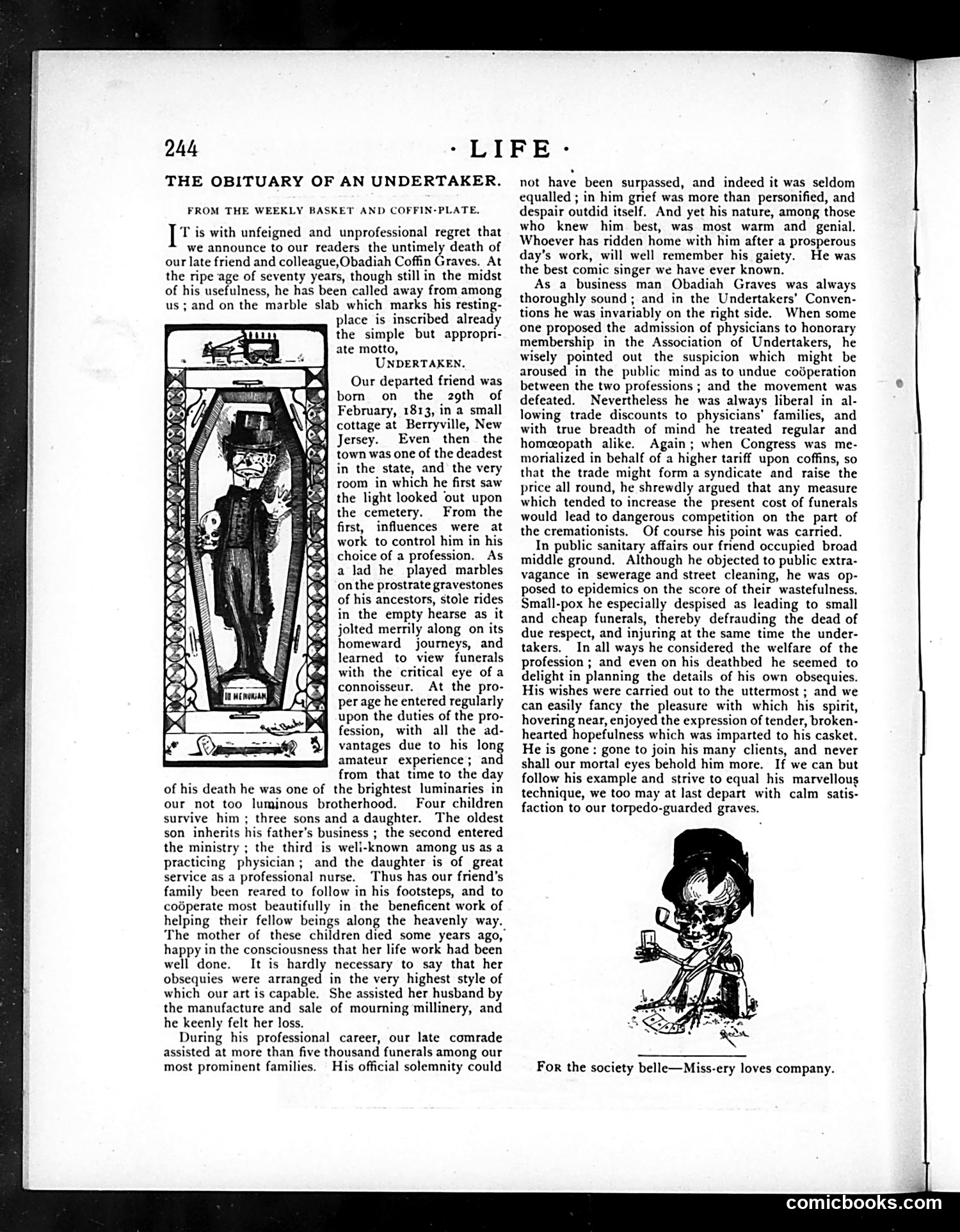
This page is primarily a **sincere obituary**, not satire. It commemorates Obadiah Coffin Graves, an undertaker who died at age 77. The left illustration shows a coffin with skeletal imagery—appropriate visual symbolism for the funeral profession. The text praises Graves as a skilled businessman and advocate for professional standards in undertaking. It notes his opposition to price-cutting and cremation, and his involvement in trade organization efforts. His family's professional contributions are highlighted (sons in business and ministry, daughter a nurse). The small cartoon at bottom right—captioned "For the society belle—Miss-ery loves company"—is the only satirical element, a pun-based joke unrelated to the obituary's main content.
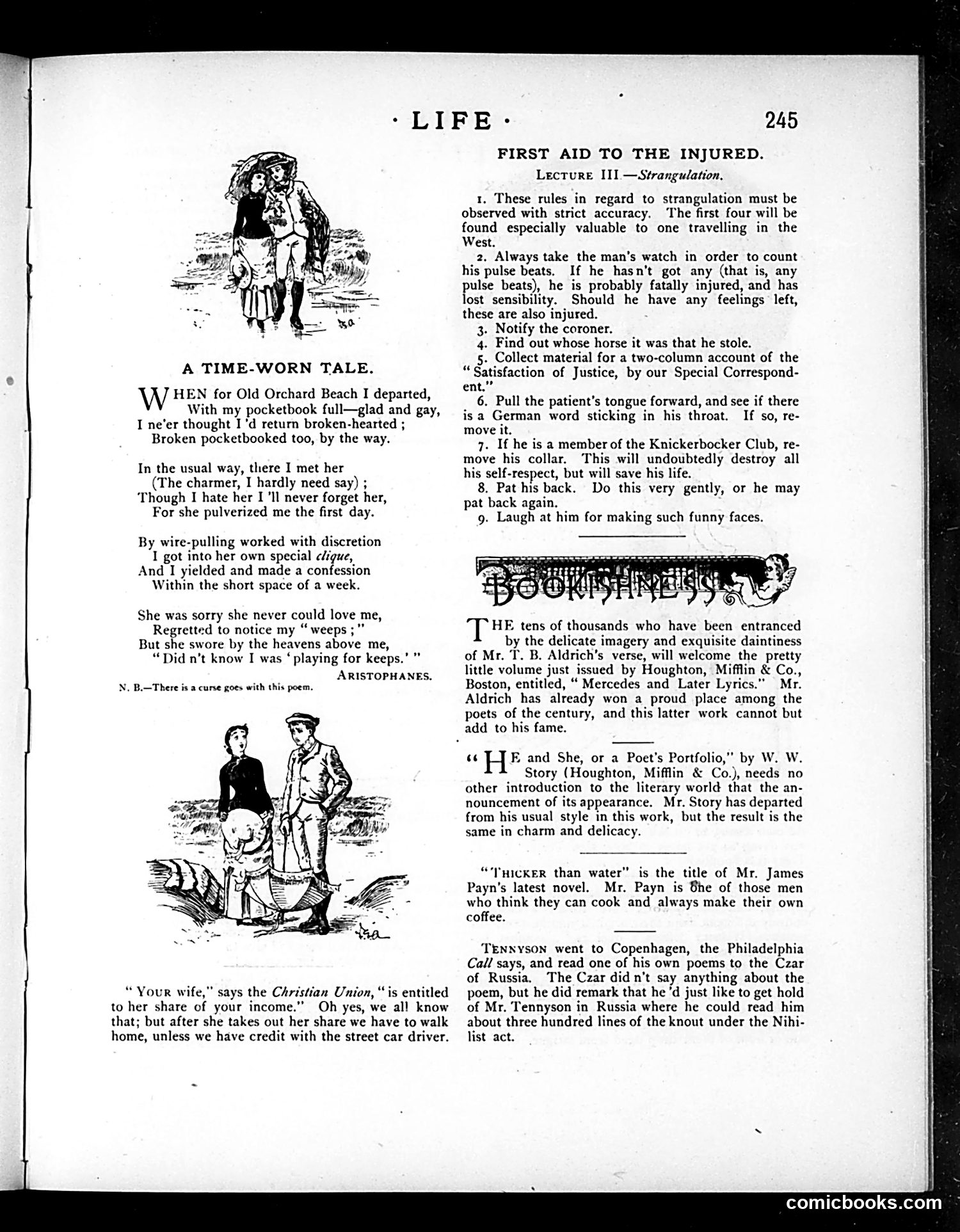
This page contains mixed content: a "First Aid to the Injured" lecture on strangulation (practical safety advice), a poem titled "A Time-Worn Tale" about romantic rejection at Old Orchard Beach, and two small illustrations accompanying the poem showing a couple. The right column features book reviews and literary gossip, including notices about new volumes by T.B. Aldrich and W.W. Story, and a James Payn novel. The final item reports that Tennyson visited Copenhagen and read poetry to the Russian Czar, with a humorous note that the Czar showed little enthusiasm. **No political satire or caricature appears on this page.** It's primarily literary content with practical safety information—typical of *Life* magazine's mixed editorial approach during this period.
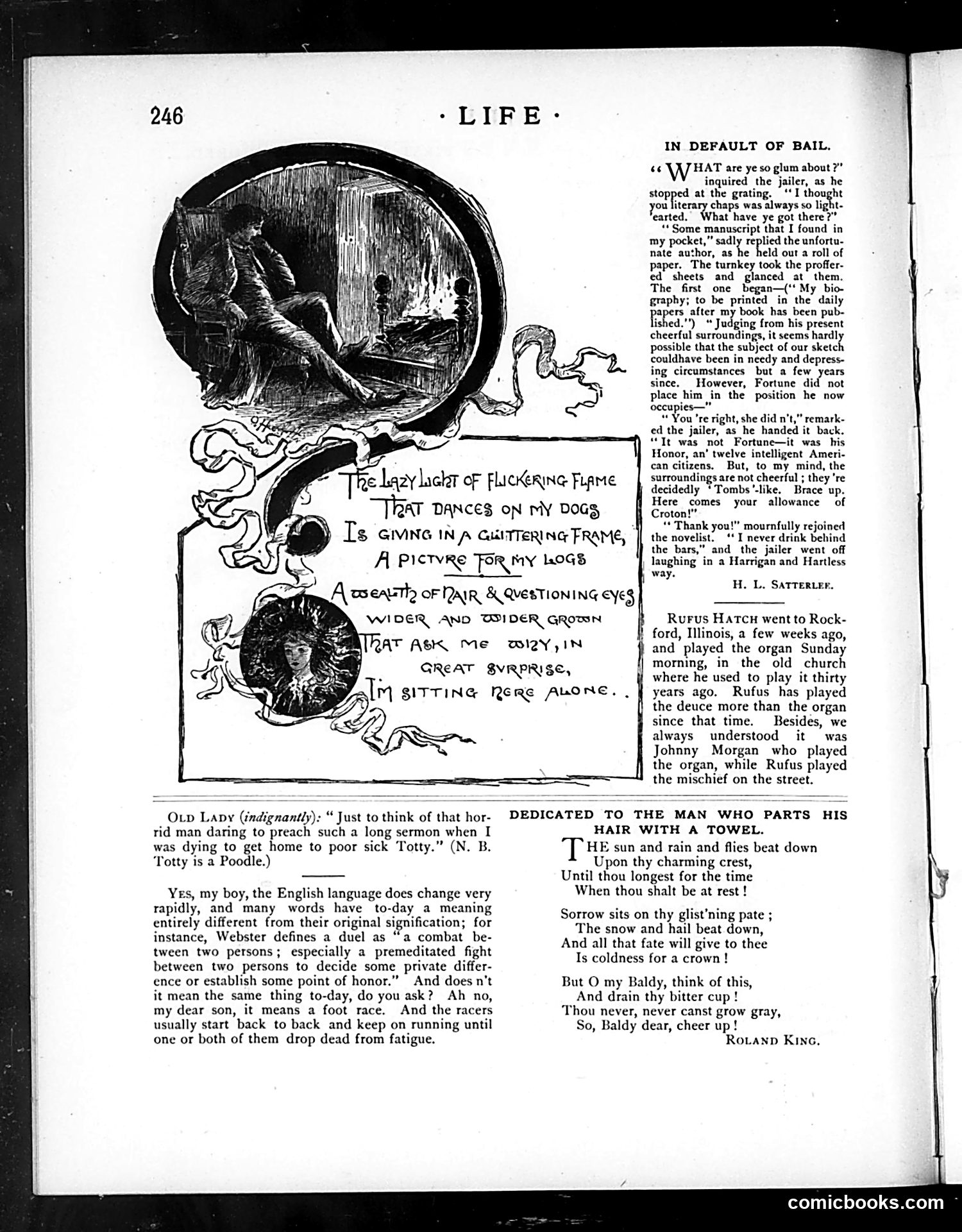
The page contains two distinct pieces: **Left side**: A whimsical illustration with decorative text about "the lazy luster of flickering flame / that dances on my dogs / is giving in a glittering frame, / a picture for my logs" — essentially romantic verse about firelight and a dog's eyes. This appears to be light, non-political verse. **Right side**: A prose piece titled "In Default of Bail" about a jailed author, followed by anecdotes (including one about organ player Rufus Hatch) and a dedicatory poem "To the Man Who Parts His Hair With a Towel" by Roland King. The poem humorously addresses someone's hair-parting habits. The content is primarily **humorous personal essays and verse** rather than political satire. No clear political figures or events are referenced.
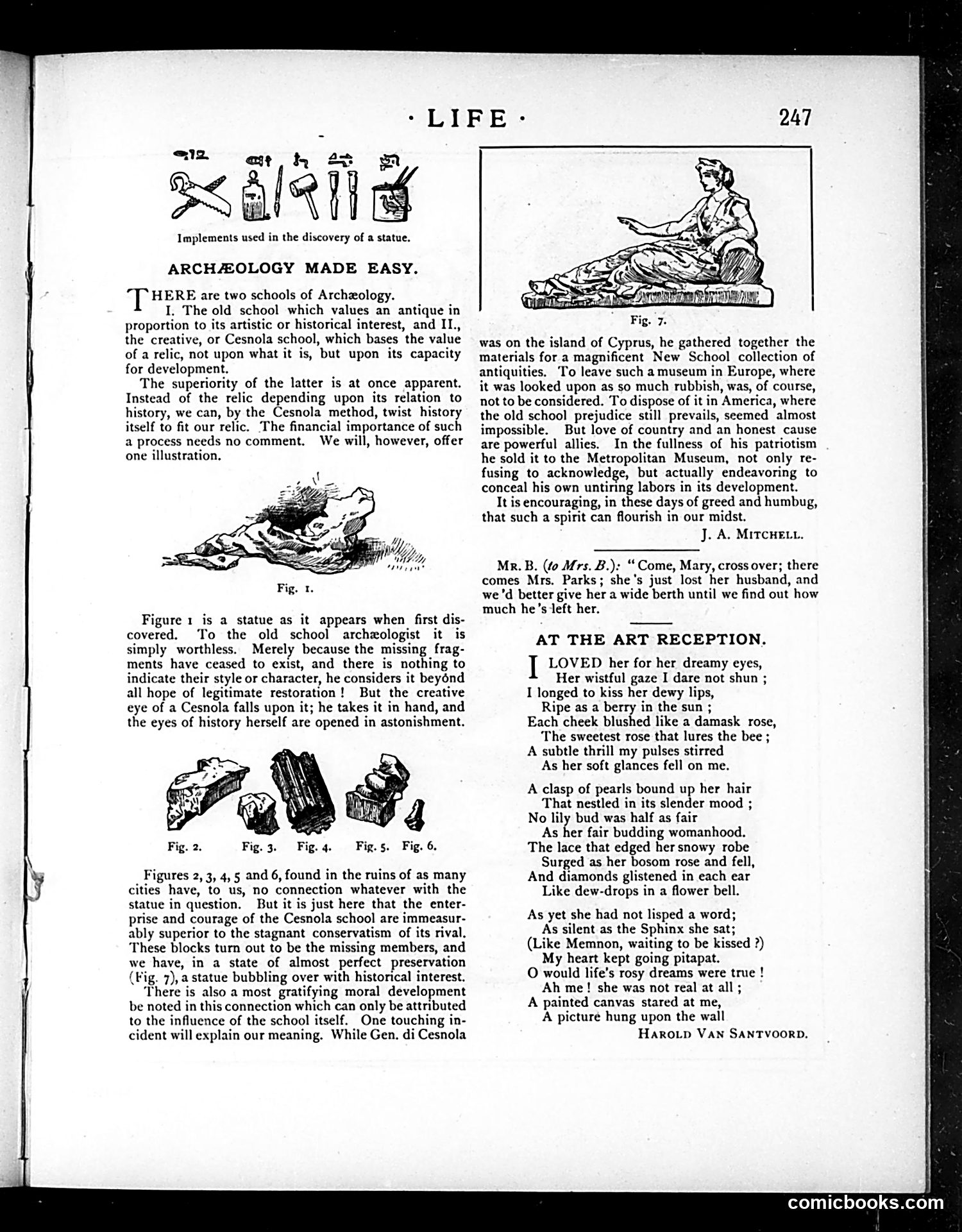
This page contains an educational article about archaeology paired with romantic poetry, rather than political satire. The left column explains two schools of archaeological thought: the "old school" that values artifacts for historical importance, versus the "Cesnola school" that values objects for their development potential. The article uses archaeological fragments (Figures 1-6) to illustrate how the creative Cesnola approach reconstructs incomplete artifacts into meaningful whole pieces, contrasting with those who dismiss fragmentary finds as worthless. The right side features "At the Art Reception," a romantic poem by Harold Van Santvoord about admiring a woman's portrait. The content is straightforward—neither satirical nor political—focusing on art appreciation and aesthetic beauty rather than social commentary.
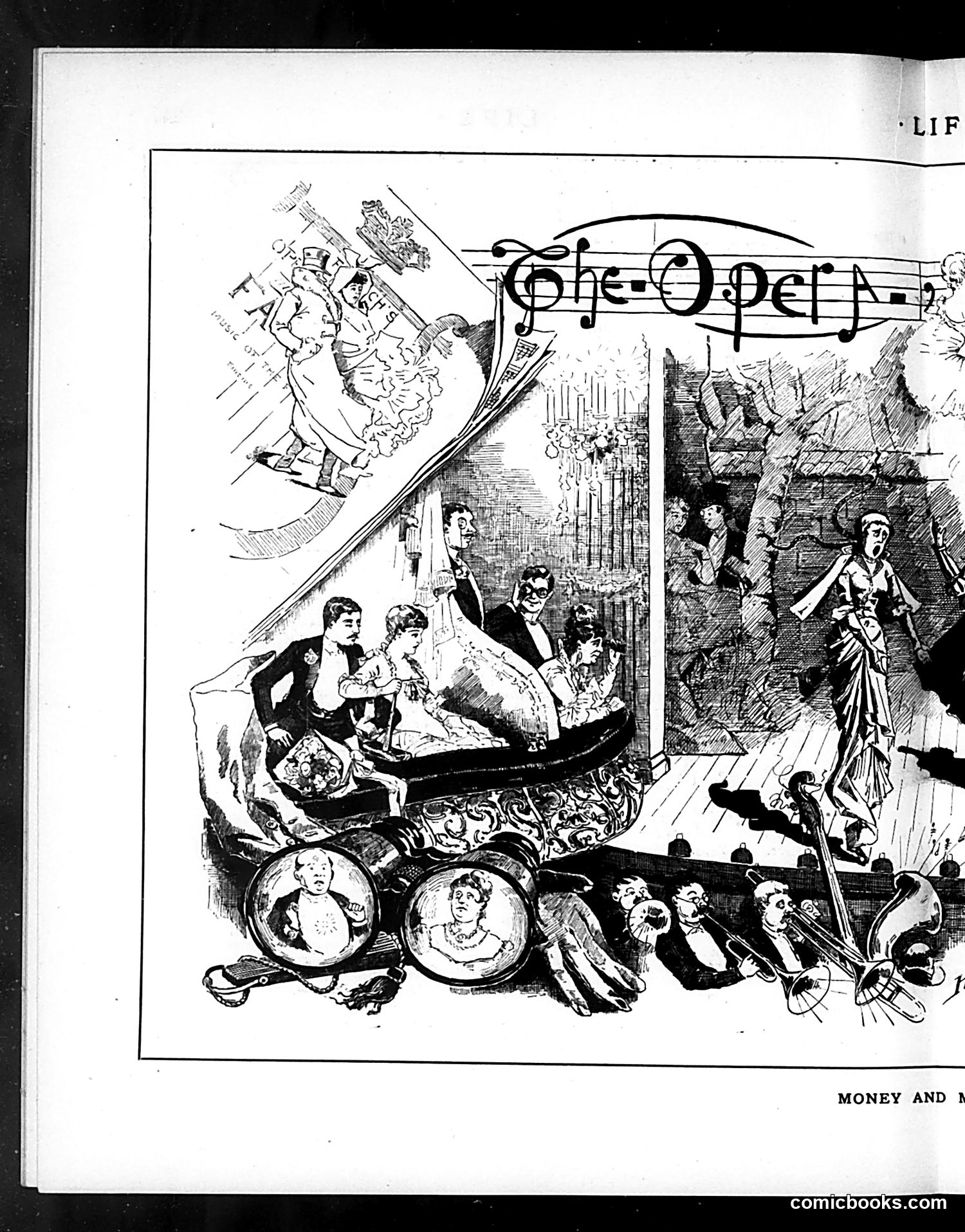
This page appears to be from Life magazine's section titled "MONEY AND M[ANNERS]" (text cut off at bottom). The main illustration is a satirical engraving depicting an elaborate operatic or theatrical scene with the title "The Opera" overlaid in musical notation across the top. The cartoon shows wealthy, well-dressed patrons in an ornate opera box, while below them are crude caricatures of common people, cherubs, and musical instruments. The satire likely mocks the pretensions and class divisions of opera-going society—contrasting the refined aesthetic aspirations of the wealthy elite with the chaotic, undignified masses below. This reflects a common 19th-century satirical theme criticizing the hypocrisy of high society and their claim to cultural superiority.
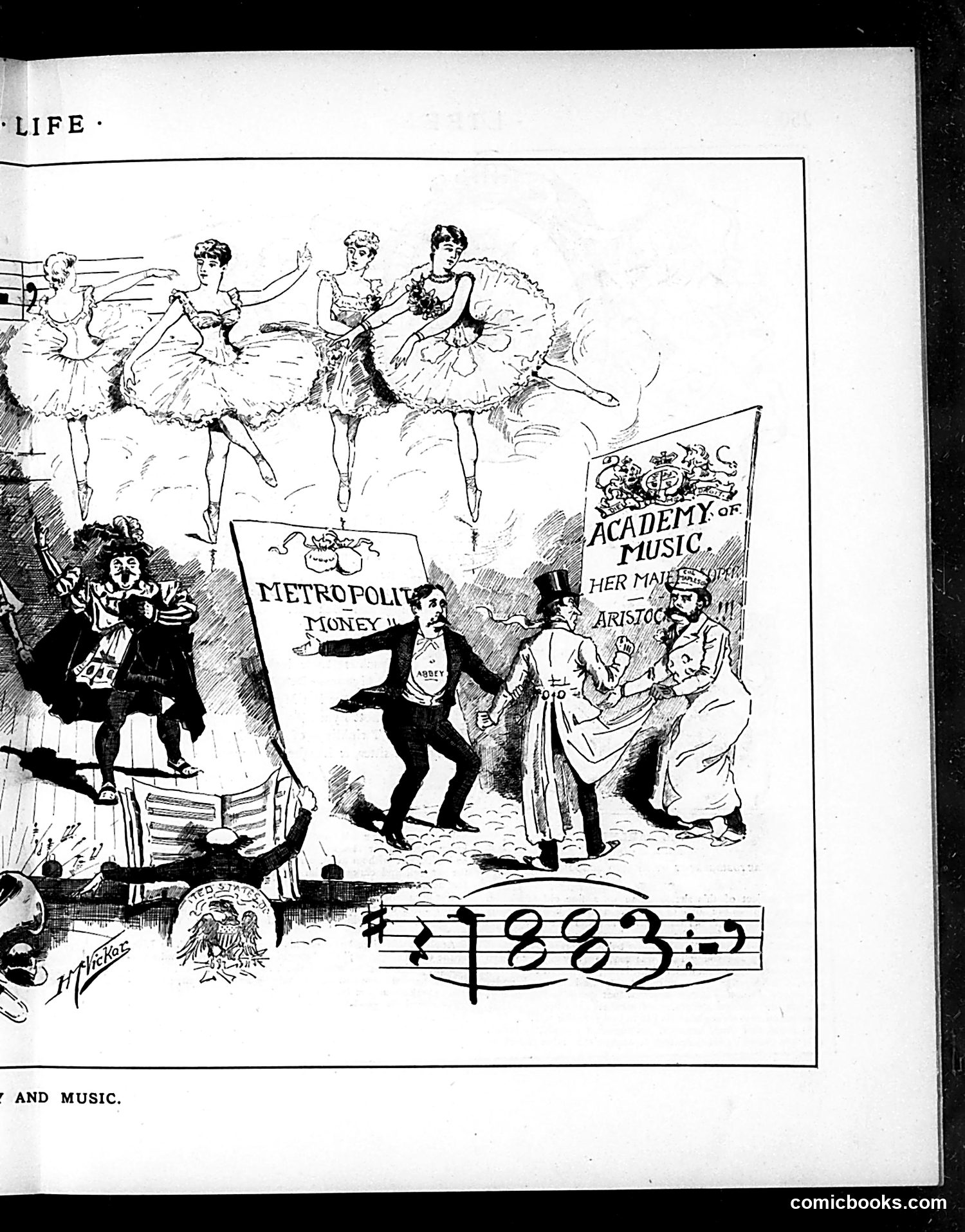
This satirical cartoon depicts the world of elite performing arts institutions in what appears to be the early 20th century. The image shows ballet dancers performing above, while below, well-dressed gentlemen represent the "Metropolitan" opera house and the "Academy of Music" (establishments visible on their banners). The cartoon satirizes the management or patronage of these prestigious cultural institutions, suggesting they are run by wealthy male figures who control the entertainment world. The musical notation at the bottom anchors this as commentary on the music and performance industry. The contrast between the ethereal dancers above and the earthly, materially-focused men below likely mocks how commercial interests and wealthy patrons controlled high culture, despite claims of artistic purity.
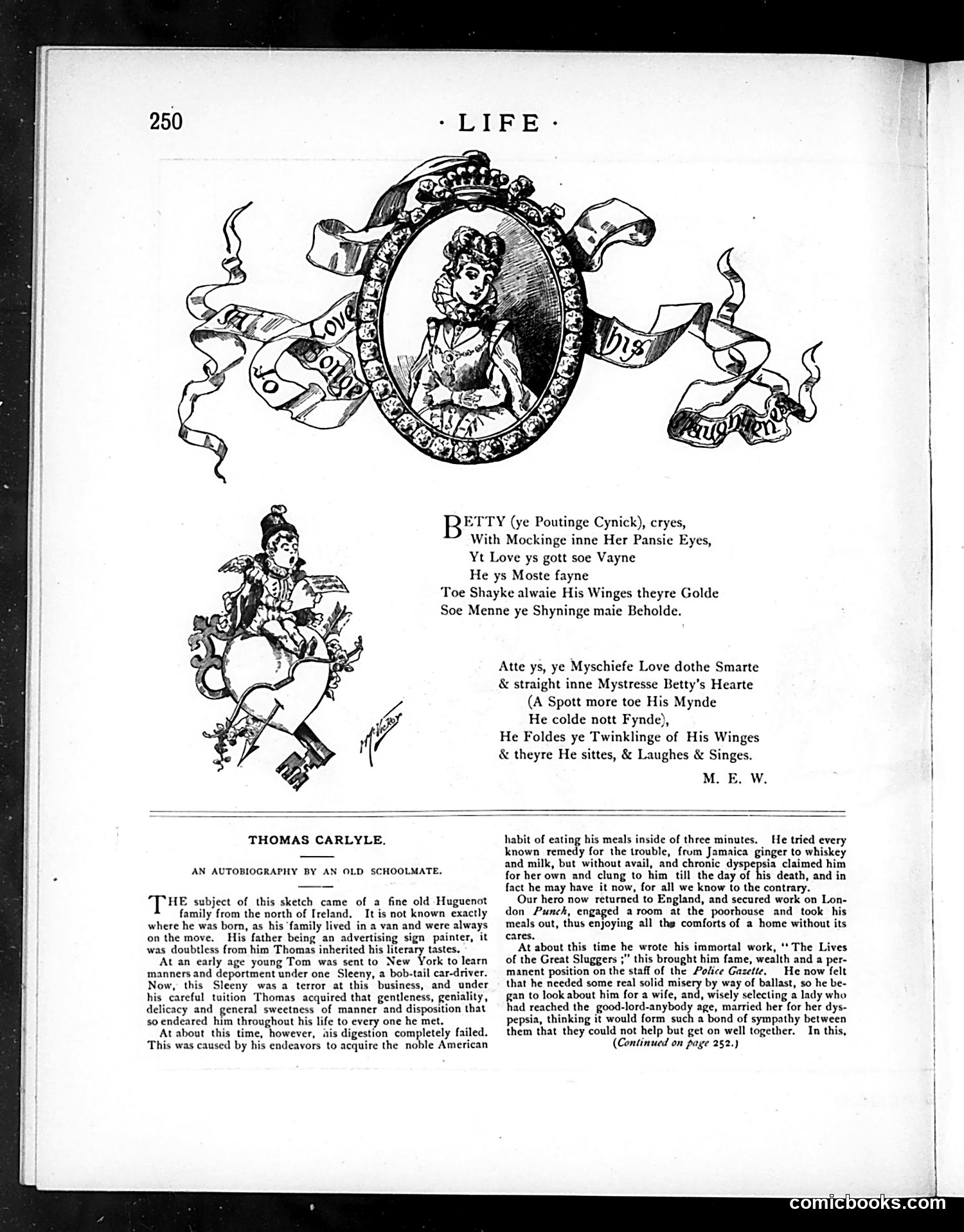
This page contains two distinct pieces of satire: **Top Section - "Betty" Poem:** A mock-romantic verse in pseudo-archaic language ("ye Poutinge Cynick") mocking sentimental love poetry. The ornate illustrations show Cupid figures with ribbons. It's satirizing overwrought romantic sentiment through deliberately awkward, affected language. **Main Article - "Thomas Carlyle":** A faux-biographical sketch brutally mocking the famous Scottish philosopher/historian. The satire works through absurd exaggeration: his father was an "advertising sign painter," he learned manners from a cab-driver named "Sleeny," he suffered chronic dyspepsia from rushing meals, and wrote a book called "The Lives of the Great Sluggers" (not his actual work). He married a woman solely for *her* dyspepsia, hoping shared misery would bond them. The joke is that Life presents outlandish fabrications as serious biography, inverting Carlyle's reputation as a serious intellectual. The continued notation suggests this is part one of the satire.
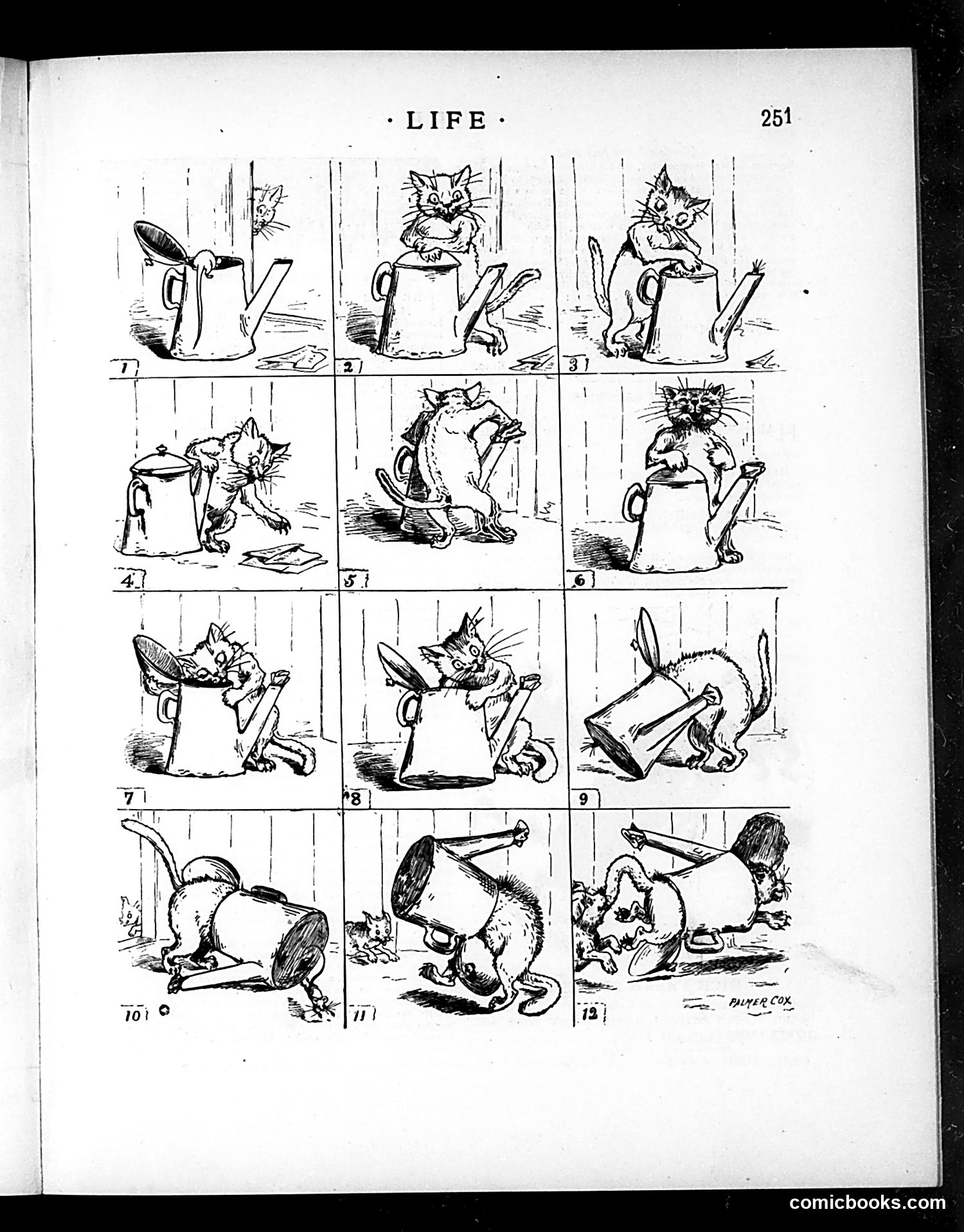
This is a wordless comic strip by Palmer Cox showing a cat's misadventure with a watering can. The sequence depicts: 1. A cat discovers a watering can 2-6. The cat investigates it, apparently getting wet or sprayed 7-9. The cat attempts to escape or shake off water 10-12. The cat continues struggling with the can, eventually appearing to overturn it completely The humor is purely visual slapstick—a common approach in early Life magazine comics. The joke relies on physical comedy: the cat's escalating frustration and the inevitable chaos resulting from its encounter with the watering can. There's no political or social satire here; it's simply entertainment through animal misadventure, typical of early 20th-century American humor.
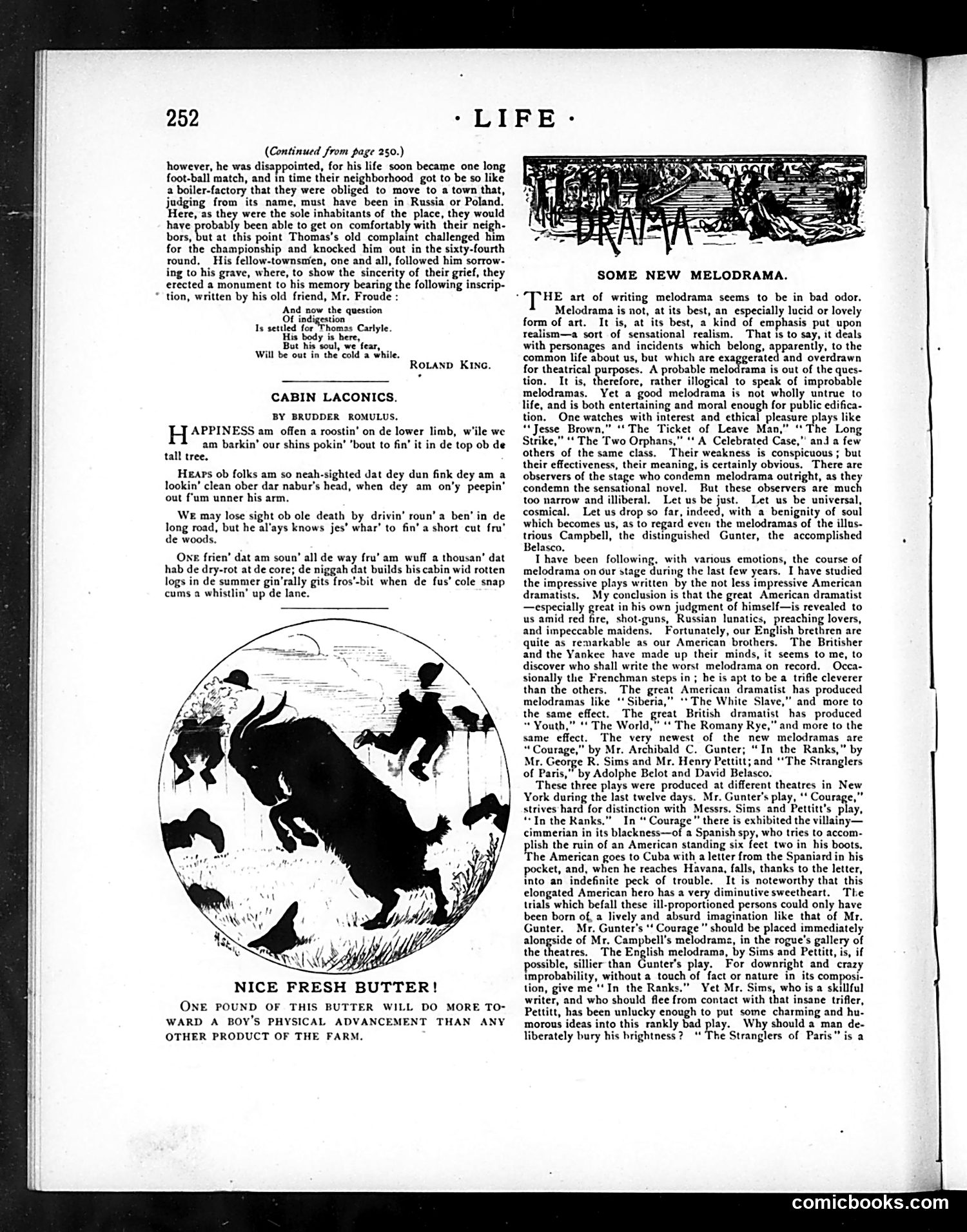
This Life magazine page contains two distinct sections: **"Cabin Laconics"** presents pseudo-dialect philosophy attributed to "Brudder Romulus"—a racist caricature using exaggerated Black dialect ("w'ile," "jes'," "fum unner"). These brief aphorisms about life and death employ offensive stereotyping common to 19th-century American humor that mocked Black speakers. **"Some New Melodrama"** is a serious theater critique discussing the artistic merit of melodramatic plays. The author defends melodrama against critics who dismiss it as lowbrow, citing examples like "Jesse Brown" and "The Two Orphans." He argues American dramatists excel at melodrama despite their own inflated self-regard. The **butter advertisement** uses a circular illustration showing children playing to promote dairy products as beneficial for children's physical development. The page reflects period attitudes: casual racism in entertainment alongside legitimate dramatic criticism—demonstrating how offensive content was normalized in mainstream publications of this era.
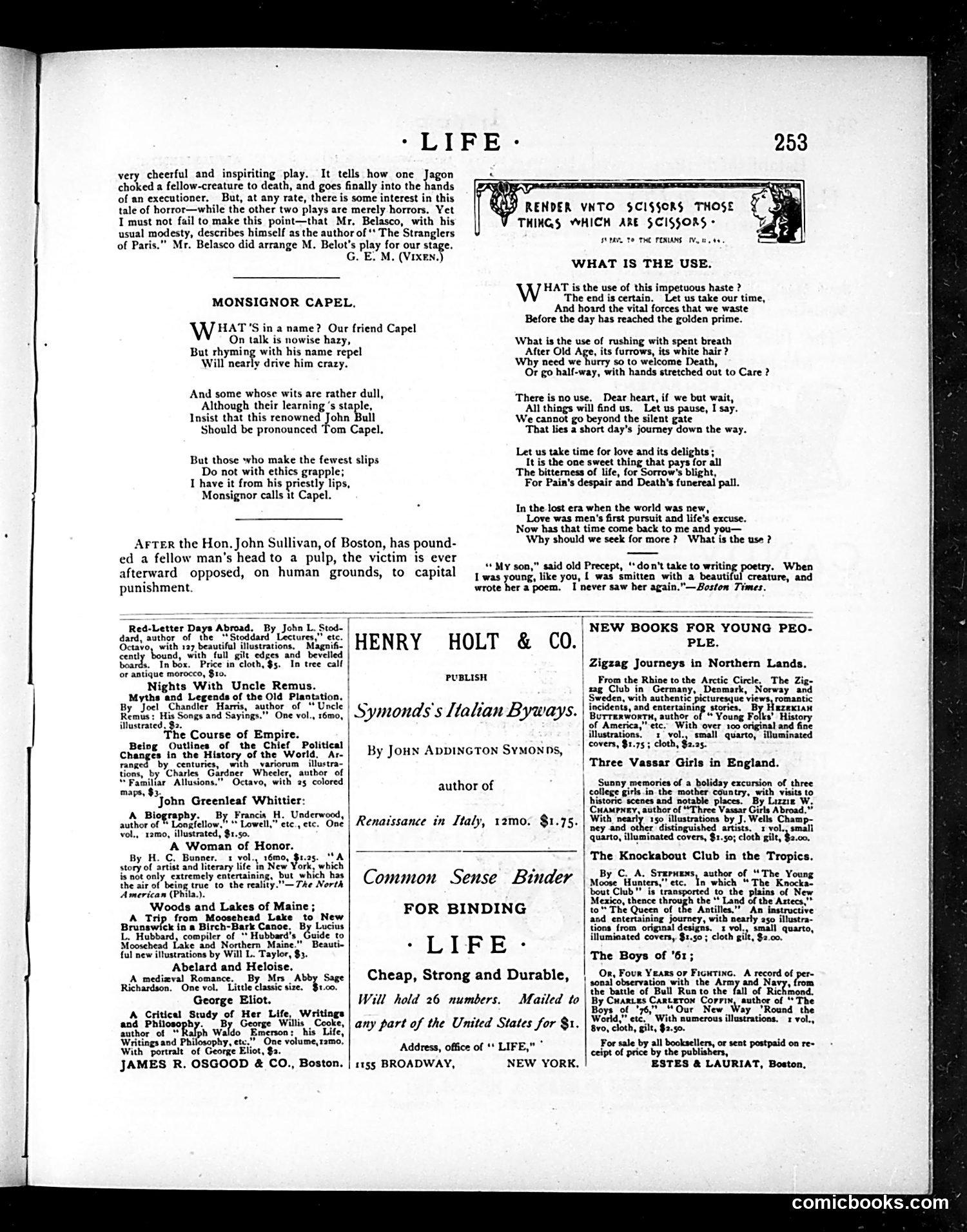
This page is primarily **advertising and literary notices** from Life magazine (page 253), with one notable satirical poem. ## The Satire **"Monsignor Capel"** is a brief verse mocking a clergyman named Capel, playing on the homophone between his surname and the word "repel." The joke concerns pronunciation: common people wrongly call him "Tom Capel," but he insists it's pronounced "Capel." It's gentle wordplay humor targeting name-related vanity. ## Other Content Below Capel's poem is a brief anecdote about Hon. John Sullivan of Boston, who apparently beat someone so severely that the victim became an opponent of capital punishment—a dark joke about violence leading to unexpected moral conclusions. **"What Is the Use"** is a philosophical poem about not rushing through life, advocating for leisure and love. The page is otherwise dominated by **book advertisements** from Henry Holt & Co. and other publishers, listing titles like "Renaissance in Italy" and children's books. This reflects Life's dual function as both satirical commentary and commercial publication venue.
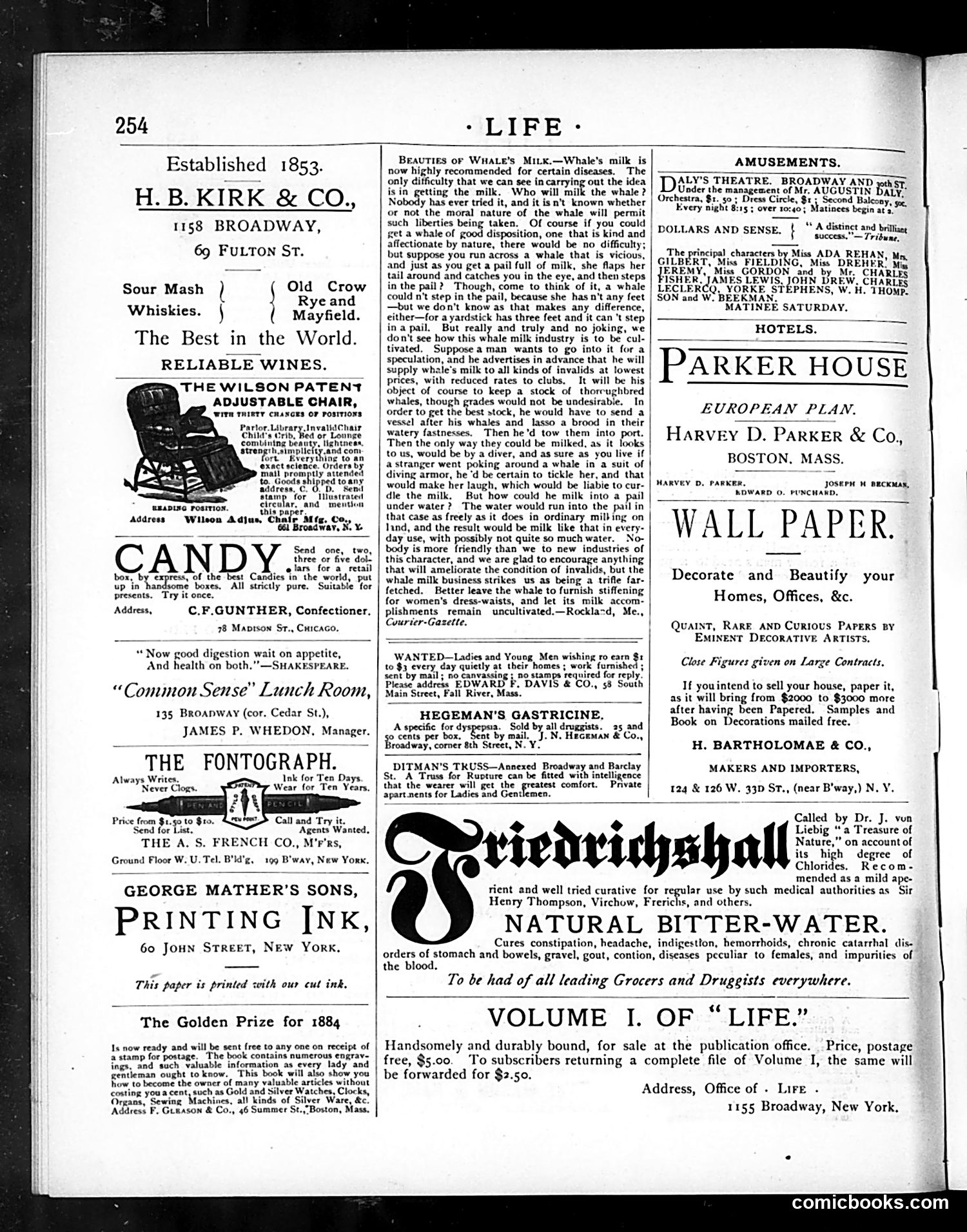
This page is primarily **advertisements and notices**, not a political cartoon. However, it contains one substantial satirical piece: "Beauties of Whale's Milk." ## The Satire The article mocks the contemporary fad of whale's milk as a medicinal cure-all. Through elaborate, absurdist reasoning, the anonymous writer ridicules the impracticality of the idea: Who would milk a whale? How would you control a dangerous marine mammal? How would you collect milk underwater? The humor escalates through increasingly ridiculous scenarios—a whale's tail causing injury, the impossibility of a whale stepping in a pail (because whales lack feet), concerns about tickling the whale and curdling the milk. ## Context This reflects 1880s medical quackery, when exotic animal products were marketed as panaceas for disease. The satire is **not politically charged**—it's social satire targeting pseudoscience and gullible consumers pursuing dubious health trends. The piece exemplifies *Life* magazine's tradition of using exaggeration and absurdist logic to deflate contemporary nonsense. The surrounding page consists entirely of period advertisements for patent medicines, furniture, candy, and printing supplies.
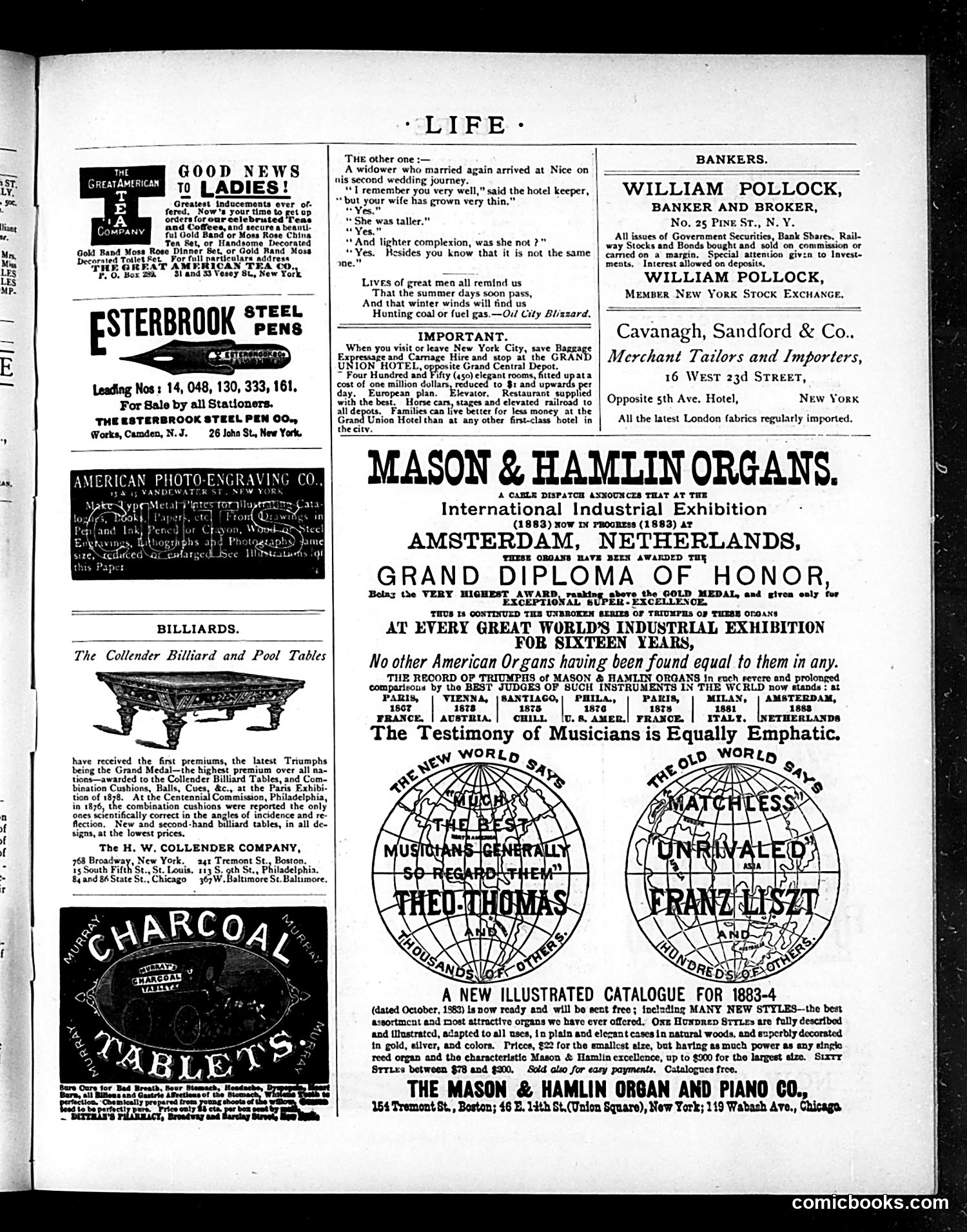
This is primarily an **advertising page**, not a satirical cartoon page. It contains commercial advertisements for various products and services popular in the 1880s. The notable content includes: **"Good News to Ladies"** - A pen company advertisement using a crude joke: a widower remarries, and the hotel keeper comments the new wife looks thinner and lighter-complexioned than the first—implying the new wife is the *same person* he's passed off as someone else, a joke about marital deception. **Mason & Hamlin Organs** - The dominant advertisement celebrates the company winning a "Grand Diploma of Honor" at the 1883 Amsterdam Industrial Exhibition, claiming superiority over competitors for sixteen years. **Collender Billiard Tables** - Similarly boasts international prizes and "scientific correctness." These ads reflect late-19th-century commercial culture: manufacturers competed for international exhibition awards as proof of quality, and companies prominently displayed these credentials to consumers. The page demonstrates how advertising legitimized products through institutional validation rather than modern advertising techniques.
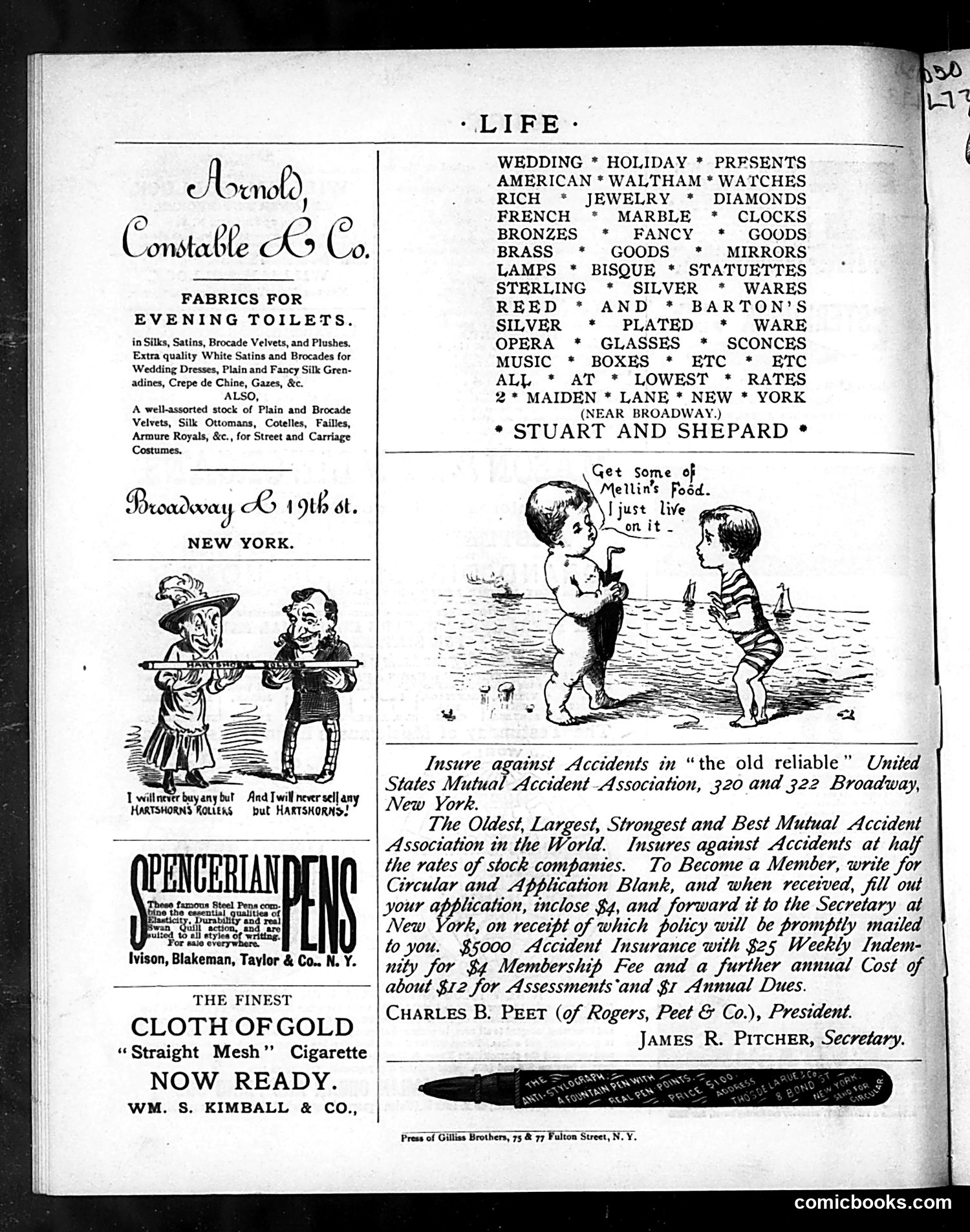
This is primarily an **advertising page** from Life magazine, not a political cartoon. The page features commercial advertisements for late 19th-century New York businesses: fabric suppliers, jewelry dealers, insurance companies, and pen manufacturers. The one cartoon present shows two figures arguing about **Hartshorn's Rollers** (window shade hardware). Each claims exclusive loyalty: "I will never buy any but Hartshorns" versus "I will never sell any but Hartshorns!" This is straightforward **product advertising disguised as humor**—a common marketing tactic of the era. The joke's appeal relies on exaggerated brand loyalty, suggesting Hartshorns rollers are so superior that both buyer and seller refuse alternatives. The surrounding content is dense classified advertising reflecting the prosperity and consumer goods available in Gilded Age New York, concentrated near Broadway.