
Life, 1883-11-15 · page 7 of 16
Life — November 15, 1883 — page 7: what you’re looking at
What you’re looking at
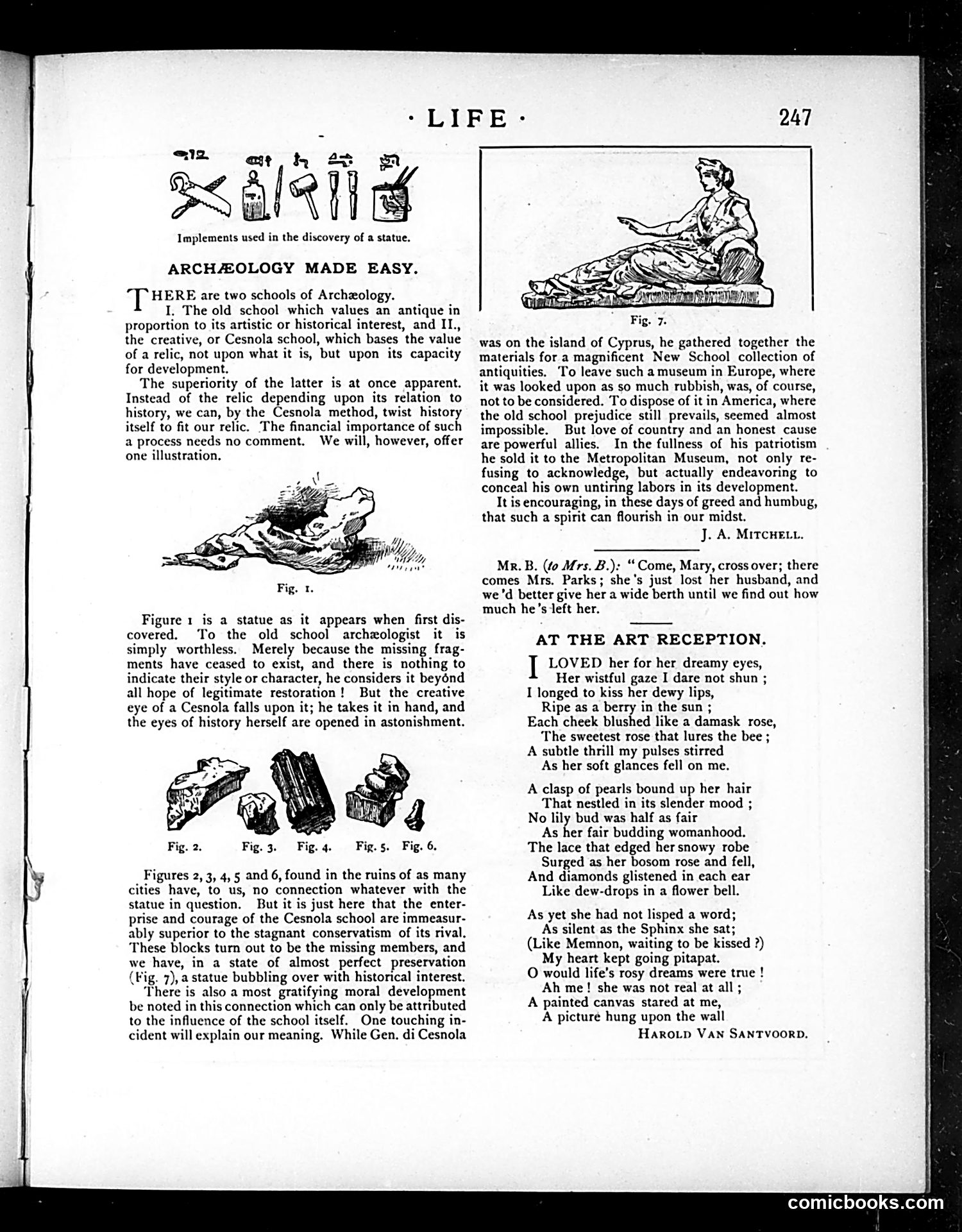
This page contains an educational article about archaeology paired with romantic poetry, rather than political satire. The left column explains two schools of archaeological thought: the "old school" that values artifacts for historical importance, versus the "Cesnola school" that values objects for their development potential. The article uses archaeological fragments (Figures 1-6) to illustrate how the creative Cesnola approach reconstructs incomplete artifacts into meaningful whole pieces, contrasting with those who dismiss fragmentary finds as worthless. The right side features "At the Art Reception," a romantic poem by Harold Van Santvoord about admiring a woman's portrait. The content is straightforward—neither satirical nor political—focusing on art appreciation and aesthetic beauty rather than social commentary.
📄 Transcribed text from this page (OCR, searchable)
Machine-transcribed from the original scan — historical spelling and the odd misread are preserved.
12 ait, 8 FS altli Implements used in the discovery of a statue. ARCHAEOLOGY MADE EASY. HERE are two schools of Archzology. I, The old school which values an antique in proportion to its artistic or historical interest, and II. the creative, or Cesnola school, which bases the value of a relic, not upon what it is, but upon its capacity for development. The superiority of the latter is at once apparent. Instead of the relic depending upon its relation to history, we can, by the Cesnola method, twist history itself to fit our relic. The financial importance of such a process needs no comment. We will, however, offer one illustration, Figure 1 is a statue as it appears when first dis- covered, To the old school archeologist it is simply worthless. Merely because the missing frag- ments have ceased to exist, and there is nothing to indicate their style or character, he considers it beyond all hope of legitimate restoration! But the creative eye of a Cesnola falls upon it; he takes it in hand, and the eyes of history herself are opened in astonishment. Fig. 2. Fig. 3. Fig. 4. Fig. 5. Fig. 6. Figures 2, 3, 4,5 and 6, found in the ruins of as many cities have, to us, no connection whatever with the statue in question. But it is just here that the enter- prise and courage of the Cesnola school are immeasur- ably superior to the stagnant conservatism of its rival, These blocks turn out to be the missing members, and we have, in a state of almost perfect preservation (ig. 7), a statue bubbling over with historical interest. There is also a most gratifying moral development be noted in this connection which can only be attributed to the influence of the school itself. One touching in- cident will explain our meaning. While Gen. di Cesnola CES Fig. 7. was on the island of Cyprus, he gathered together the materials for a magnificent New School collection of antiquities. To leave such a museum in Europe, where it was looked upon as so much rubbish, was, of course, not to be considered. To dispose of it in America, where the old school prejudice still prevails, seemed almost impossible. But love of country and an honest cause are powerful allies. In the fullness of his patriotism he sold it to the Metropolitan Museum, not only re- fusing to acknowledge, but actually endeavoring to conceal his own untiring labors in its development. It is encouraging, in these days of greed and humbug, that such a spirit can flourish in our midst. J. A. MitcHett. Mr. B. (fo Mrs. B.): “Come, Mary, cross over; there comes Mrs. Parks; she's just lost her husband, and we'd better give her a wide berth until we find out how much he’s left her. AT THE ART RECEPTION. LOVED her for her dreamy eyes, Her wistful gaze I dare not shun ; I longed to kiss her dewy lips, Ripe as a berry in the sun ; Each cheek blushed like a damask rose, The sweetest rose that lures the bee ; A subtle thrill my pulses stirred As her soft glances fell on me. A clasp of pearls bound up her hair That nestled in its slender mood ; No lily bud was half as fair As her fair budding womanhood. The lace that edged her snowy robe Surged as her bosom rose and fell, And diamonds glistened in each ear Like dew-drops in a flower bell. As yet she had not lisped a word; As silent as the Sphinx she sat; (Like Memnon, waiting to be kissed ?) My heart kept going pitapat. O would life’s rosy dreams were true ! Ah me! she was not real at all ; A painted canvas stared at me, A picture hung upon the wall Haroitp VAN SANTVOORD. comicbooks.com