
Life, 1883-11-15 · page 10 of 16
Life — November 15, 1883 — page 10: what you’re looking at
What you’re looking at
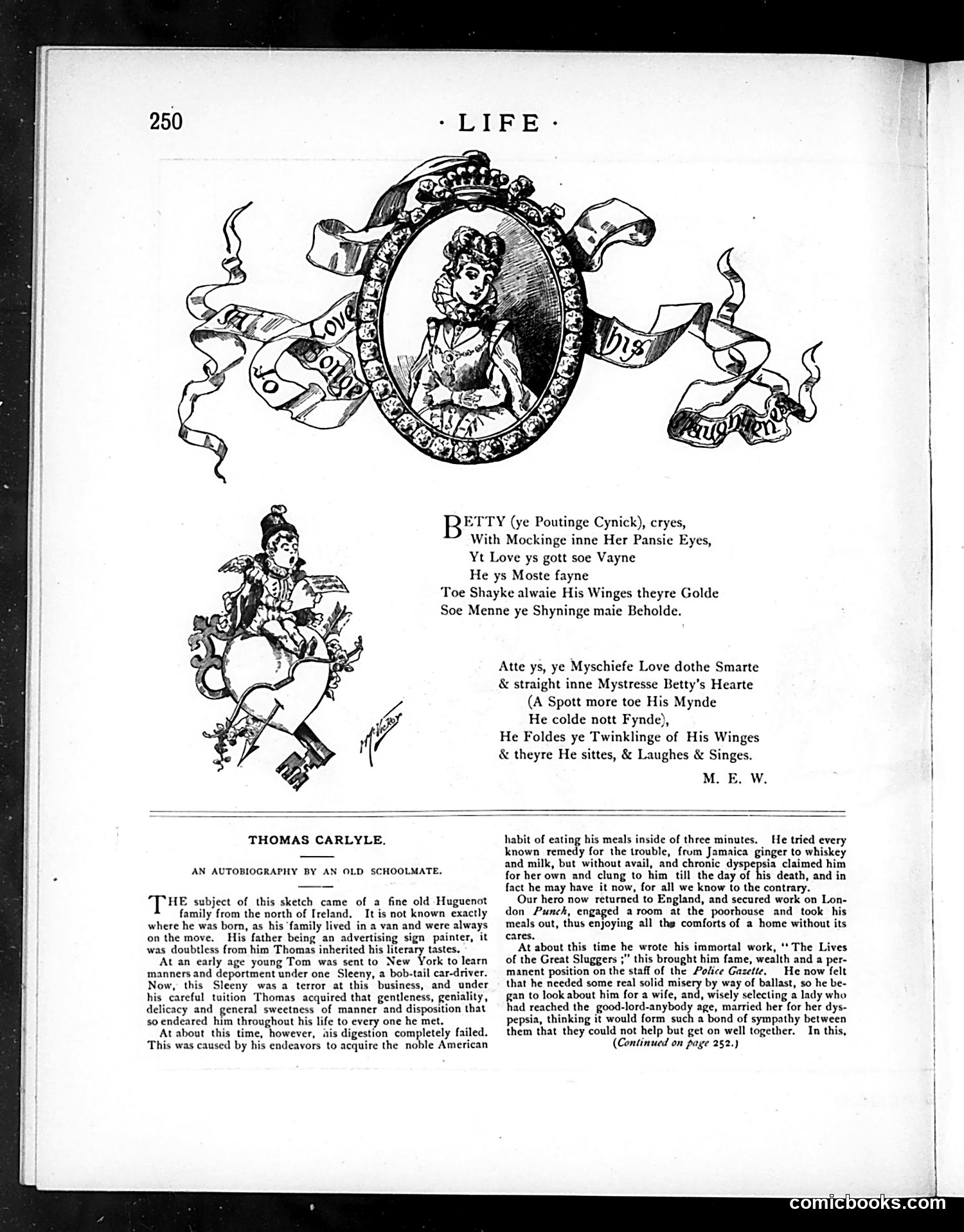
This page contains two distinct pieces of satire: **Top Section - "Betty" Poem:** A mock-romantic verse in pseudo-archaic language ("ye Poutinge Cynick") mocking sentimental love poetry. The ornate illustrations show Cupid figures with ribbons. It's satirizing overwrought romantic sentiment through deliberately awkward, affected language. **Main Article - "Thomas Carlyle":** A faux-biographical sketch brutally mocking the famous Scottish philosopher/historian. The satire works through absurd exaggeration: his father was an "advertising sign painter," he learned manners from a cab-driver named "Sleeny," he suffered chronic dyspepsia from rushing meals, and wrote a book called "The Lives of the Great Sluggers" (not his actual work). He married a woman solely for *her* dyspepsia, hoping shared misery would bond them. The joke is that Life presents outlandish fabrications as serious biography, inverting Carlyle's reputation as a serious intellectual. The continued notation suggests this is part one of the satire.
📄 Transcribed text from this page (OCR, searchable)
Machine-transcribed from the original scan — historical spelling and the odd misread are preserved.
BEzY (ye Poutinge Cynick), cryes, With Mockinge inne Her Pansie Eyes, Yt Love ys gott soe Vayne He ys Moste fayne Toe Shayke alwaie His Winges theyre Golde Soe Menne ye Shyninge maie Beholde. Atte ys, ye Myschiefe Love dothe Smarte & straight inne Mystresse Betty’s Hearte (A Spott more toe His Mynde He colde nott Fynde), He Foldes ye Twinklinge of His Winges & theyre He sittes, & Laughes & Singes. M. E. W. THOMAS CARLYLE, AN AUTOBIOGRAPHY BY AN OLD SCHOOLMATE. HE subject of this sketch came of a fine old Huguenot family from the north of Ireland, It is not known exactly where he was born, as his ‘family lived in a van and were always onthe move. His father being an advertising sign painter, it was doubtless from him Thomas inherited his literary tastes, At an early age young Tom was sent to New York to learn manners and deportment under one Sleeny, a bob-tail car-driver. Now, this Sleeny was a terror at this business, and under his careful tuition Thomas acquired that gentleness, geniality, delicacy and general sweetness of manner and disposition that so endeared him throughout his life to every one he met. At about this time, however, ais digestion completely failed. This was caused by his endeavors to acquire the noble American habit of eating his meals inside of three minutes. He tried every known remedy for the trouble, frum Jamaica ginger to whiskey and milk, but without avail, and chronic dyspepsia claimed him for her own and clung to him till the day of his death, and in fact he may have it now, for all we know to the contrary. Our hero now returned to England, and secured work on Lon- don Punch, engaged a room at the poorhouse and took his meals out, thus enjoying all the comforts of a home without its cares. At about this time he wrote his immortal work, ‘* The Lives of the Great Sluggers ;” this brought him fame, wealth and a per- manent position on the staff of the Police Gazette, He now felt that he needed some real solid misery by way of ballast, so he be- gan to look about him for a wife, and, wisely selecting a lady who had reached the good-lord-anybody age, married her for her dys- pepsia, thinking it would form such a bond of sympathy between them that they could not help but get on well together. In this, (Continued on page 252.)