
Life, 1883-11-15 · page 12 of 16
Life — November 15, 1883 — page 12: what you’re looking at
What you’re looking at
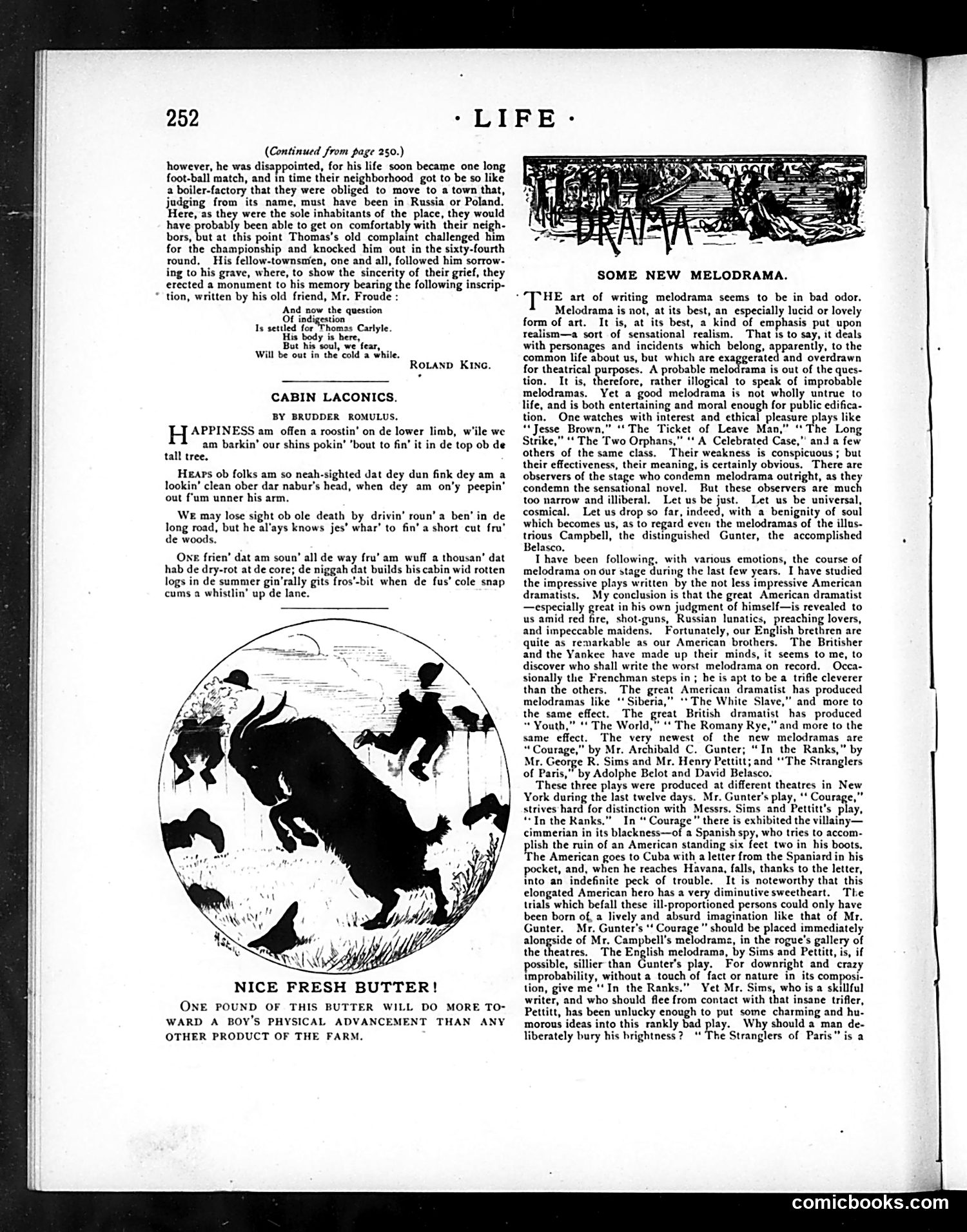
This Life magazine page contains two distinct sections: **"Cabin Laconics"** presents pseudo-dialect philosophy attributed to "Brudder Romulus"—a racist caricature using exaggerated Black dialect ("w'ile," "jes'," "fum unner"). These brief aphorisms about life and death employ offensive stereotyping common to 19th-century American humor that mocked Black speakers. **"Some New Melodrama"** is a serious theater critique discussing the artistic merit of melodramatic plays. The author defends melodrama against critics who dismiss it as lowbrow, citing examples like "Jesse Brown" and "The Two Orphans." He argues American dramatists excel at melodrama despite their own inflated self-regard. The **butter advertisement** uses a circular illustration showing children playing to promote dairy products as beneficial for children's physical development. The page reflects period attitudes: casual racism in entertainment alongside legitimate dramatic criticism—demonstrating how offensive content was normalized in mainstream publications of this era.
📄 Transcribed text from this page (OCR, searchable)
Machine-transcribed from the original scan — historical spelling and the odd misread are preserved.
252 (Continued from page 250.) however, he was disappointed, for his life soon became one long foot-ball match, and in time their neighborhood got to be so like a boiler-factory that they were obliged to move to a town that, judging from its name, must have been in Russia or Poland. Here, as they were the sole inhabitants of the place, they would have probably been able to get on comfortably with their neigh- bors, but at this point Thomas's old complaint challenged him for the championship and knocked him out in the sixty-fourth round, His fellow-townsmen, one and all, followed him sorrow- ing to his grave, where, to show the sincerity of their grief, they erected a monument to his memory bearing the following inscrip- * tion, written by his old friend, Mr. Froude : And now the question Of indigestion Is settled for ‘Thomas Carlyle His body is here, But his soul, we fear, Will be out in the’ cold a while, Rotanp Kino. CABIN LACONICS. BY BRUDDER ROMULUS. APPINESS am offen a roostin’ on de lower limb, w'ile we am barkin’ our shins pokin’ ‘bout to fin’ it in de top ob de tall tree. Hears ob folks am so neah-sighted dat dey dun fink dey am a lookin’ clean ober dar nabur's head, when dey am on’y peepin’ out f'um unner his arm. We may lose sight ob ole death by drivin’ roun’a ben’ in de long road, but he al'ays knows jes’ whar’ to fin’ a short cut fru’ de woods. Ons frien’ dat am soun’ all de way fru’ am wuff a thousan’ dat hab de dry-rot at de core; de niggah dat builds his cabin wid rotten logs in de summer gin'rally gits fros'-bit when de fus’ cole snap cums a whistlin’ up de lane. NICE FRESH BUTTER! ONE POUND OF THIS BUTTER WILL DO MORE TO- WARD A BOY'S PHYSICAL ADVANCEMENT THAN ANY OTHER PRODUCT OF THE FARM. SOME NEW MELODRAMA. . THE art of writing melodrama seems to be in bad odor. Melodrama is not, at its best, an especially lucid or lovely form of art. It is, at its best, a kind of emphasis put upon tealism—a sort of sensational realism. That is to say, it deals with personages and incidents which belong, apparently, to the common life about us, but which are exaggerated and overdrawn for theatrical purposes. A probable melodrama is out of the ques- tion, It is, therefore, rather illogical to speak of improbable melodramas. Yet a good melodrama is not wholly untrue to life, and is both entertaining and moral cough for public edifica- tion, One watches with interest and ethical pleasure plays like “Jesse Brown,” ‘* The Ticket of Leave Man,” ‘The Long Strike,” ‘‘ The Two Orphans,” ‘* A Celebrated Case," andj a few others of the same class. Their weakness is conspicuous ; but their effectiveness, their meaning, is certainly obvious. There are observers of the stage who condemn melodrama outright, as they condemn the sensational novel. But these observers are much too narrow and illiberal. Let us be just. Let us be universal, cosmical. Let us drop so far, indeed, with a benignity of soul which becomes us, as to regard even the melodramas of the illus- trious Campbell, the distinguished Gunter, the accomplished Belasco. Thave been following, with various emotions, the course of melodrama on our stage during the last few years. I have studied the impressive plays written by the not less impressive American dramatists. My conclusion is that the great American dramatist —especially great in his own judgment of himself—is revealed to us amid red fire, shot-guns, Russian lunatics, preaching lovers, and impeccable maidens, Fortunately, our English brethren are quite as remarkable as our American brothers. The Britisher and the Yankee have made up their minds, it seems to me, to discover who shall write the worst melodrama on record. Occa- sionally the Frenchman steps in ; he is apt to be a trifle cleverer than the others. The great American dramatist has produced melodramas like ‘‘ Siberia,” ** The White Slave,” and more to the same effect. The great British dramatist’ has produced “Youth,” “ The World,” ‘ The Romany Rye,” and more to the same effect. The very newest of the new melodramas are “Courage,” by Mr. Archibald C. Gunter; “In the Ranks,” by Mr. George R. Sims and Mr. Henry Pettitt; and ‘‘The Stranglers of Paris,” by Adolphe Belot and David Belasco. These three plays were produced at different theatres in New York during the last twelve days. Mr. Gunter’s play, ‘* Courage,” strives hard for distinction with Messrs, Sims and Pettitt’s play, “In the Ranks.” In “* Courage" there is exhibited the villainy— cimmerian in its blackness—of a Spanish spy, who tries to accom- lish the ruin of an American standing six feet two in his boots, The American goes to Cuba with a letter from the Spaniard in his cket, and, when he reaches Havana, falls, thanks to the letter, into an indefinite peck of trouble. It is noteworthy that this elongated American hero has a very diminutive sweetheart. The trials which befall these ill-proportioned persons could only have been born of, a lively and absurd imagination like that of Mr. Gunter. Mr. Gunter’s ““ Courage” should be placed immediately alongside of Mr. Campbell’s melodrame, in the rogue’s gallery of the theatres. The English melodrama, by Sims and Pettitt, is, if ible, sillier than Cunter's play. For downright and ‘crazy improbability, without a touch of fact or nature in its composi- tion, give me ‘In the Ranks.” Yet Mr. Sims, who is a skillful writer, and who should flee from contact with that insane trifler, Pettitt, has been unlucky enough to put some charming and hu- morous ideas into this rankly bad Play, Why should a man de- liberately bury his brightness?“ The Stranglers of Paris” is a comicbooks.com